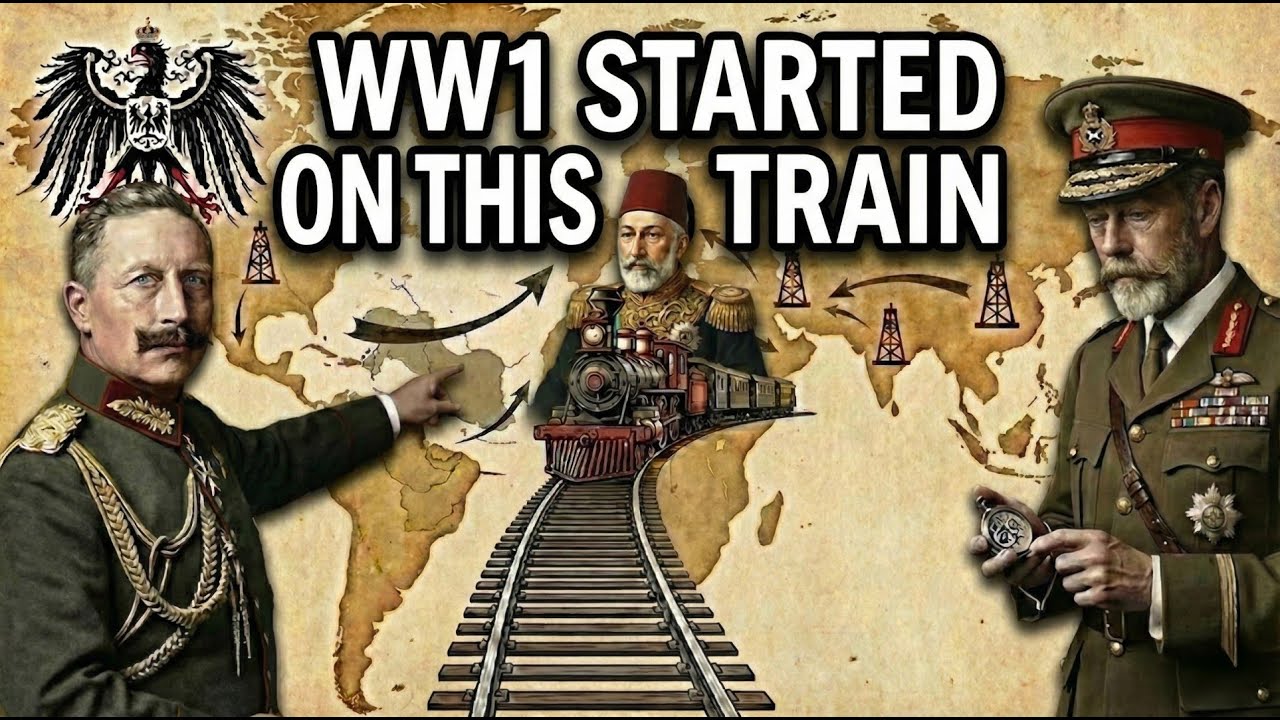
World War I is often taught as a tragedy triggered by two bullets in Sarajevo, but the deeper forces behind the conflict were rooted in economics, empire, and a single infrastructure project that terrified Britain more than any rival navy. That project was the Berlin–Baghdad railway, an iron road designed to connect the heart of Germany to the oil fields of the Middle East and bypass British control of global trade. At the turn of the 20th century, Britain’s power rested on the Royal Navy and the Suez Canal, which gave it control over the fastest route to India. Any merchant trading with the East had to pass through British checkpoints and play by British rules.
Germany, unified in 1871, had become an industrial titan but had no empire, no colonies, and no navy strong enough to challenge Britain. It was a major power trapped in the center of Europe, cut off from global markets by the British fleet. The Ottoman Empire, meanwhile, was drowning in debt. Known as the “sick man of Europe,” it had lost territory in the Balkans and was forced to surrender control of its economy to European creditors after declaring bankruptcy in 1881.
The Ottoman Public Debt Administration collected taxes from Ottoman citizens, with the revenue flowing to bank vaults in London and Paris. Sultan Abdul Hamid II was desperate to modernize and defend his borders without relying on the very powers that were draining his empire. What he needed was a railway that could move troops from Constantinople to the desert frontiers in days rather than months. That is where German and Ottoman interests collided.
Kaiser Wilhelm II saw a railway from Berlin to Constantinople and then to Baghdad as a way to bypass the British Empire entirely. A train loaded with German goods could travel overland to the Indian Ocean without ever seeing a British ship. For the Sultan, it was a lifeline. For Germany, it was a path to world power.
For Britain, it was a direct threat to its empire. Construction began with German financing and German engineers, led by Deutsche Bank. The engineering was a marvel of its time, requiring tunnels through mountains and tracks laid across scorching deserts. As the rails moved east, panic set in in London.
British planners saw a dagger pointed at the heart of their empire. A completed railway could allow German troops to threaten the Suez Canal and German merchants to flood the markets of India. Even more dangerous than trade was oil. Britain had started converting its navy from coal to oil, but had no domestic supply.
Geologists were beginning to realize that Mesopotamia, now Iraq, sat on an enormous ocean of oil. The Germans had secured mineral rights for 20 kilometers on either side of the track, meaning that if the railway was finished, Germany would control the fuel that powered the future of warfare. The British establishment moved to stop it. They pressured the Sheikh of Kuwait into a secret agreement not to lease land to foreign powers without British permission, blocking the railway from having a terminal on the Persian Gulf.
British newspapers launched propaganda campaigns against the Ottomans, and the City of London refused to allow British capital to invest in the project. Despite all of this, the Germans kept building. By 1914, the rails had reached the mountains of southern Turkey, and the project was nearly complete. This context is essential to understanding the outbreak of World War I.
The tensions between the great powers were not just about national pride or European border disputes. They were about who would control the economic future of the world. The Triple Entente, the alliance of Britain, France, and Russia, was formed to encircle Germany and stop its expansion. Russia feared the railway would strengthen the Ottomans, France feared German economic dominance, and Britain feared for India and Suez.
The Ottoman Empire joined the war on the side of Germany, hoping that a German victory would free it from its debts to Britain and France. But the British were not just fighting to defeat an army. They were fighting to secure an asset. As soon as the war began, a British expeditionary force was sent to Basra in southern Iraq.
The official mission was to protect the oil refinery at Abadan, but the real goal was to march north, following the path of the unfinished railway to secure the oil fields of Mosul and Kirkuk before the Germans could get there. The war in the Middle East was brutal and marked by disease and heat as much as combat. The British suffered a humiliating defeat at the Siege of Kut, where an entire army was forced to surrender to the Ottomans. Yet the Ottomans were running on empty.
The railway that was supposed to save them was not finished. Gaps in the tracks through the mountains meant supplies from Germany had to be unloaded and carried by truck or camel before being reloaded onto trains. This bottleneck strangled the Ottoman war effort. If the railway had been finished years earlier, the course of the war might have been very different.
As the war dragged on, the British and French met in secret to decide the fate of Ottoman lands. In 1916, diplomats Mark Sykes and François Georges-Picot drew lines across a map of the Middle East, ignoring tribal boundaries, religious sects, and geography. The Sykes-Picot Agreement’s borders corresponded almost perfectly to the proposed route of the Baghdad Railway and the known locations of oil deposits. Britain claimed the southern part of Iraq and the port of Haifa.
France claimed Syria and Lebanon. The railway that was meant to unite the region became the instrument by which it was divided. The Arabs, who had been promised independence for revolting against the Ottomans, were instead placed under British and French colonial rule. The Ottoman Empire was dissolved, the Sultan deposed, and the caliphate abolished.
The empire’s debt was not forgiven but restructured to be paid by the new nations carved out of its territory. The Berlin–Baghdad railway was split among Turkey, Syria, and Iraq, and it never functioned as the unified trade route it was designed to be. The consequences of that failure shaped the 20th century. After the war, Britain and France controlled the region but faced a problem: they had the land and the oil, but they still needed to get it to Europe.
They built pipelines instead of railways, which were easier to control and did not carry passengers or ideas, only oil. The Iraq Petroleum Company, a consortium of British, French, and American oil giants, built a pipeline from the Kirkuk oil fields to the Mediterranean coast, following the exact strategic logic of the old railway project but with profits flowing exclusively to the West. During World War II, the railway became a focal point again. Nazi Germany looked east, dreaming of the oil of Iraq and the Caucasus.
German agents were sent to Iraq to stir rebellion against the British, and the British once again had to invade to secure the oil fields and transport routes. History was repeating itself, with the prize the same: control the corridor, control the world. After World War II, the British Empire collapsed, and the United States stepped in, inheriting the British obsession with the Middle East. The Americans used coups and alliances instead of direct colonial rule, but they were just as terrified of a rival power dominating the Eurasian landmass.
Turkey became a key NATO ally not for its democracy but because it sits on the choke point between East and West. Today, many observers see parallels between the era of the Baghdad Railway and our current moment. China, a rising industrial power, faces the same geographic vulnerability Germany faced: it is vulnerable at sea, and the US Navy controls the shipping lanes of the Pacific and Indian Oceans. In response, China has built the Belt and Road Initiative, a network of high-speed rail lines, pipelines, and highways connecting China to Europe and the Middle East overland.
The map of that initiative looks strikingly similar to the map of the Baghdad Railway, but on a much larger scale, seeking to bypass the choke points controlled by the American Navy and unite the economies of Asia, Europe, and the Middle East in a trading block that excludes the United States. Critics in the West describe Chinese projects as debt traps and accuse China of supporting dictators, language that mirrors the British response to German expansion a century ago. The strategic anxiety is nearly identical. The story of the Baghdad railway offers a warning for developing nations today.
When you invite a superpower to build your critical infrastructure, you are not just buying steel and concrete. You are importing their geopolitical enemies and making your land a target. The Sultan invited Germany to build a railway that was supposed to bring prosperity. Instead, it brought armies that tore the empire apart.
The borders of the modern Middle East were not drawn to create nations. They were drawn to stop a train. The wars, the instability, and the tensions that have plagued the region for over a century all follow the same fault lines where the rails were laid a hundred years ago.