On the morning of February 3, 1945, Roland Freisler was conducting a session of the People’s Court in Berlin when American bombers attacked the city. A column collapsed inside the courthouse and crushed him. His body was found beneath the rubble, still clutching the files he had stayed behind to gather.
Freisler was the president of Nazi Germany’s People’s Court and the judge most responsible for sending thousands of Germans to their deaths. Between 1942 and 1945, more than 5,000 death sentences were decreed under his authority. Approximately 90 percent of the cases that came before him ended in guilty verdicts.
He was born on October 30, 1893, in Celle, then part of the German Empire. His father was an engineer and teacher, and his mother was a teacher as well. Freisler studied law at the University of Jena before the First World War interrupted his education.
When the war began in July 1914, he enlisted as an officer cadet in the German Army. By 1915, he had reached the rank of lieutenant and was awarded the Iron Cross 2nd Class for gallantry. In October of that year, he was captured by Russian forces on the Eastern Front and held in an officers’ camp near Moscow.
Although prisoners were released in 1918, Freisler remained in Soviet Russia until 1919. He learned to speak fluent Russian, and it is believed he supported Bolshevism during that period. He returned to Germany to complete his law studies and qualified as a Doctor of Law in 1922.
Freisler joined the Nazi Party in July 1925. He quickly gained influence by using his legal training to defend party members facing prosecution for political violence. From 1924 to 1935, he frequently appeared before the Leipzig Court of Honor, where he often insulted and threatened colleagues, victims, and judges. Despite this behavior, his license to practice law was never revoked.
In 1927, a fellow Nazi official described Freisler as rhetorically equal to the party’s best speakers but unsuitable for positions of authority due to his unreliability and moodiness. Freisler married Marion Russegger on March 24, 1928. The couple had two sons.
After the Nazis came to power in January 1933, Freisler became a member of the Reichstag and was appointed to senior positions in the Prussian and Reich Ministries of Justice. He also joined the Academy for German Law and chaired its Criminal Law Committee. The academy was tasked with reforming German law to align with National Socialist ideology.
Freisler used his legal skills to turn Nazi theories into practical law. He published a paper arguing that racially foreign or racially degenerate juveniles should be segregated from those considered German and racially valuable. He also advocated for laws punishing so-called race defilement, the Nazi term for sexual relations between Aryans and those deemed inferior races.
In 1935, the Nazi regime introduced the Reich Citizenship Law and the Law for the Protection of German Blood and German Honor. These laws stripped Jews of full citizenship and banned marriages and sexual relations between Jews and Germans. Freisler’s earlier writings reflected the ideology behind these measures.
When Germany invaded Poland in September 1939, Freisler introduced the concept of the precocious juvenile criminal in the Juvenile Felons Decree. This decree provided the legal basis for imposing the death penalty on juveniles for the first time in German legal history. At least 72 German juveniles were sentenced to death by Nazi courts.
In 1941, Propaganda Minister Joseph Goebbels suggested appointing Freisler as Reich Minister of Justice. Hitler refused, reportedly saying, “That old Bolshevik? No!” The comment referred to Freisler’s time in Soviet Russia.

On January 20, 1942, Freisler attended the Wannsee Conference, where senior Nazi officials coordinated the implementation of the Final Solution. The plan called for the systematic annihilation of European Jews. None of the officials present objected to the policy.
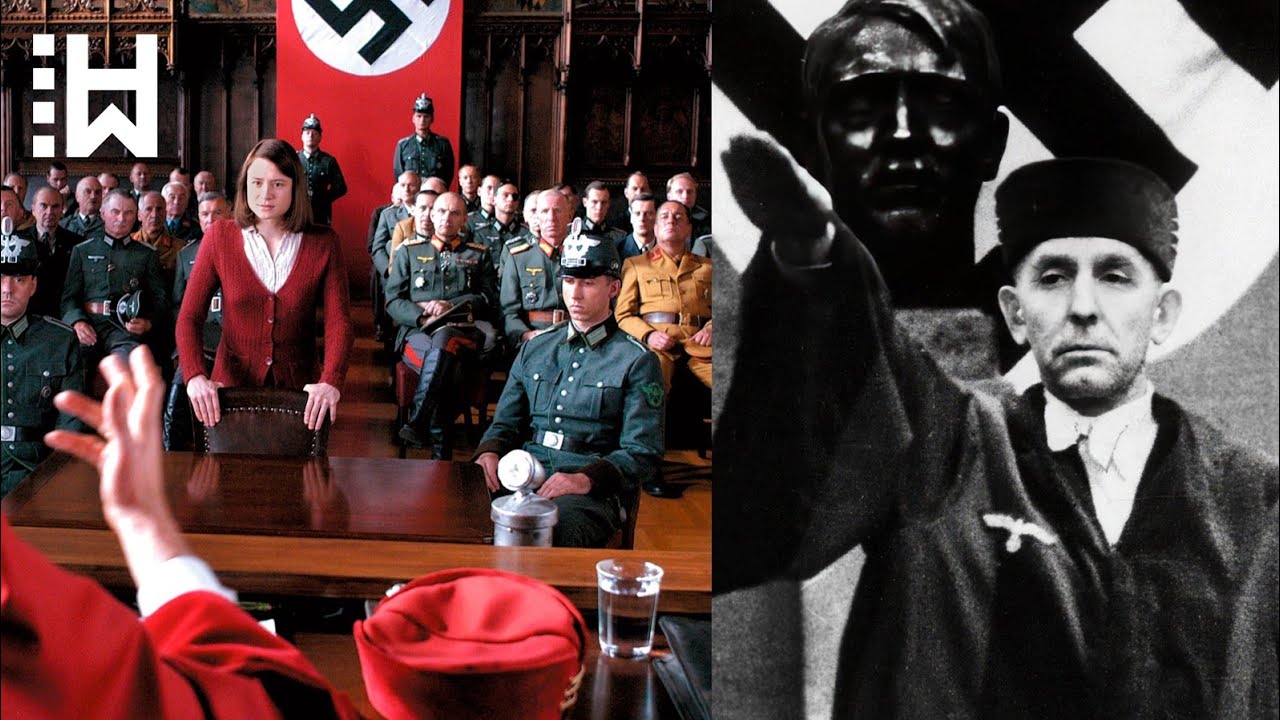
On August 20, 1942, Hitler named Freisler president of the People’s Court. Freisler chaired the First Senate wearing a blood-red judicial robe, with the courtroom decorated in scarlet banners and a bust of Hitler behind his chair. He opened each session with the Nazi salute and acted as prosecutor, judge, and jury combined.
Under his rule, the frequency of death sentences rose sharply. He soon became known as a blood judge. Freisler said he wanted to judge as the Führer himself would judge the case. His loud screaming during trials made it difficult for sound engineers to record the answers of the accused.
The People’s Court was expressly a political court. Freisler humiliated defendants, interrupted them, and shouted at them. Defendants were often given old, oversized clothing without belts, forcing them to hold up their trousers while standing before the court.
On February 22, 1943, Freisler presided over the trial of Hans and Sophie Scholl, members of the White Rose resistance group. The siblings had distributed leaflets at the University of Munich calling for resistance against the Nazi regime. During the trial, Sophie Scholl told Freisler that what the group wrote and said was believed by many others. She also told him the war was lost and asked why he did not have the courage to face it.
Freisler sentenced them to death. Fearing they would become martyrs if publicly hanged, the authorities executed them by guillotine.

In April 1943, Freisler presided over a second trial of White Rose members. At the opening, he shouted that National Socialism did not need a criminal code against such traitors. When an assessor handed him the penal code, Freisler threw it toward the dock, forcing the accused to duck. Three defendants were sentenced to death, nine received prison terms, and one was acquitted.
Another victim was Elfriede Scholz, the sister of novelist Erich Maria Remarque. Remarque’s books had been banned in Germany in 1933. Elfriede stayed in Germany and was arrested after her landlord overheard her say the war was lost. During her trial, Freisler told her that her brother was beyond reach but she would not escape. She was beheaded by guillotine on December 16, 1943.
On July 20, 1944, German military officers attempted to assassinate Hitler at his headquarters in East Prussia. The bomb exploded but Hitler survived. In the following months, more than 7,000 people were arrested in connection with the plot. Many were brought before Freisler’s court.
Hitler ordered that those found guilty should be hanged like cattle. The proceedings were filmed for cinema newsreels. Freisler alternated between cold questioning and furious tirades, shouting insults at the accused from the bench.
During one trial, Field Marshal Erwin von Witzleben tried to hold up his trousers after being given oversized clothing without a belt. Freisler yelled at him, calling him a dirty old man and asking why he kept fiddling with his trousers. Von Witzleben told Freisler that in three months, the outraged and tormented people would hold him accountable and drag him alive through the mud of the streets.
Caesar von Hofacker, a resistance figure in France, told Freisler that in a year, it would be about Freisler’s head. General Erich Fellgiebel told Freisler to hurry up with his sentencing, saying Freisler would hang before the defendants did. Count Ulrich-Wilhelm Schwerin von Schwanenfeld, who opposed Hitler because of the many murders in Germany and abroad, was shouted down by Freisler, who called him a lousy piece of trash.
Of the more than 7,000 people arrested, 4,980 were executed, often on the barest evidence. Some executions were carried out within two hours of the verdict.
Freisler’s death on February 3, 1945, came as American bombers attacked Berlin. One account says he was crushed by a falling column while gathering files. Another says he was killed by a bomb fragment while trying to reach an air raid shelter. His body was brought to a hospital, where a worker commented, “It is God’s verdict.” No one replied.
Freisler was buried in the grave of his wife’s family in Berlin. His name is not recorded on the tombstone. There were no tears shed for Roland Freisler.