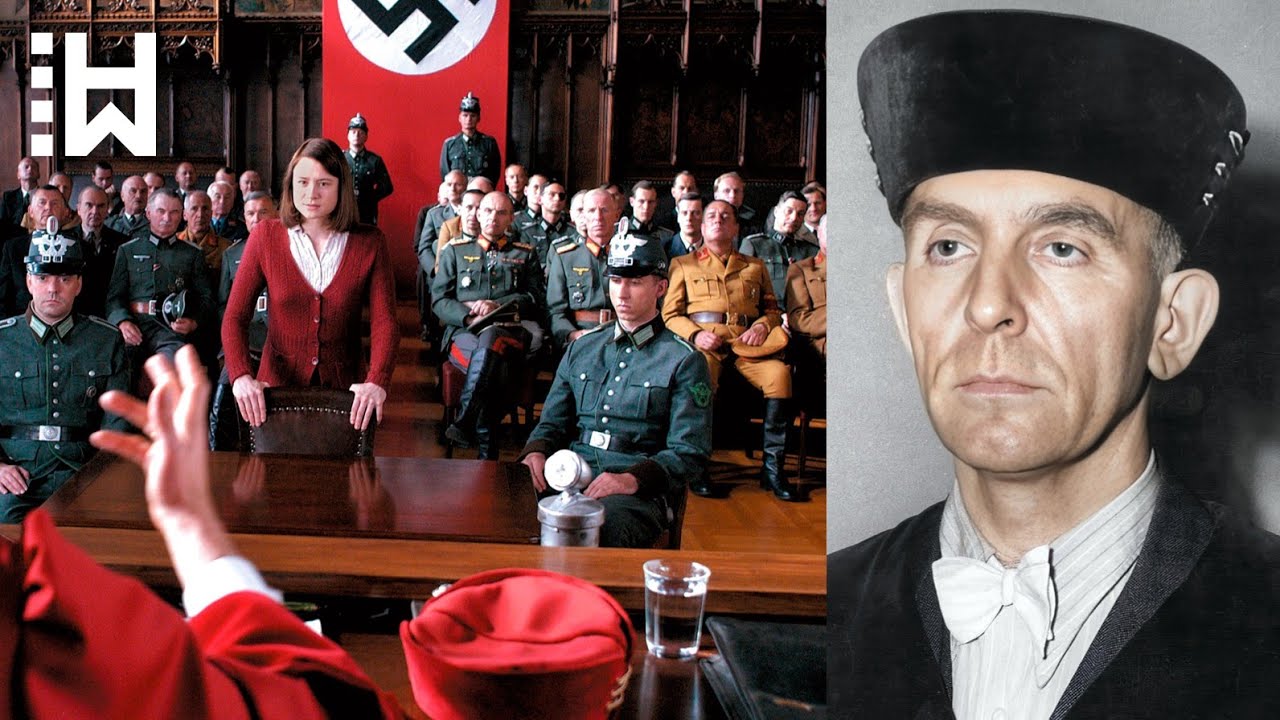
On a cold February morning in 1943, six members of the White Rose resistance group stood in a Munich courtroom, accused of treason. They had distributed leaflets urging Germans to recognize the cruelty of Hitler’s war. Instead of a fair trial, they faced a scripted show of power. The judge’s booming voice cut off any attempt to speak, and his rage filled the room.
The students remained calm, refusing to betray their beliefs even as insults and scorn closed in around them. The man presiding over their fate was Roland Freisler, a judge who served the Nazi regime with ruthless devotion and dishonored the very concept of justice.
Freisler was born on October 30, 1893, in the town of Telle, then part of the German Empire. His father was an engineer and government official, and his mother came from a modest background. As a young man, Freisler showed academic promise, excelling in school and displaying a particular skill for language and debate.
When World War I broke out in July 1914, Freisler was studying law. Like many of his contemporaries, he volunteered for military service and served on the Eastern Front. In 1915, he was captured by Russian forces. During his time as a prisoner of war, he studied Marxist literature and learned Russian.
After his release in 1918, Freisler resumed his legal studies. His fluency in Russian set him apart from his peers, and he completed his doctoral thesis in law at the University of Jena in 1922. Germany at the time was in turmoil, with postwar reparations, hyperinflation, and the humiliating terms of the Treaty of Versailles fueling political unrest.
Freisler initially had no direct connection to the Nazi Party. He practiced law and served as a defense counsel in several politically charged cases, gaining a reputation for fierce courtroom manners. By the late 1920s, his political leanings took a sharp turn to the right.
On July 9, 1925, he joined the Nazi Party, becoming member number 9,679. He also secured a position as a city counselor in Kassel, where his oratorical skill and knowledge of law earned him notice from party officials. Freisler quickly became known for his fierce devotion to the party’s message, advocating radical reforms that placed the collective will of the German people above individual rights.
In his speeches, he railed against enemies of the state, a category that in his mind could encompass Jews, socialists, and anyone critical of Adolf Hitler. On March 24, 1928, Freisler married Marion Russegger, and the marriage produced two sons.
When Hitler seized power in January 1933, Freisler’s career prospects rocketed. The new regime demanded legal minds capable of rationalizing the dismantling of democratic institutions, and Freisler proved more than willing. In 1933, he was appointed to the Prussian Ministry of Justice, where he used his authority to force out Jewish members of the staff.
From 1934, he served as state secretary in the Reich Ministry of Justice, solidifying his role as a key figure in linking the German legal system with Nazi ideology. Freisler was among those who oversaw the legislative transformation that eroded civil liberties, including laws allowing for indefinite detention without trial and special judicial practices targeting political offenses.
World War II began on September 1, 1939, when Germany invaded Poland. The following month, Freisler introduced the concept of "precocious juvenile criminal" in the Juvenile Felons Decree. This decree provided the legal basis for imposing the death penalty on juveniles for the first time in German legal history. At least 72 German juveniles were sentenced to death by Nazi courts.
In 1941, when Nazi propaganda minister Joseph Goebbels suggested appointing Freisler to replace the deceased Reich Minister of Justice Franz Gürtner, Hitler reportedly replied, referring to Freisler’s alleged red past, "That old Bolshevik? No."
In August 1942, Freisler achieved his most feared position yet: president of the People’s Court. Established by Hitler in 1934 to handle cases of treason and political dissent, the court functioned as a political weapon. It bypassed the established court system, ensuring that verdicts aligned with the regime’s demands for harsh punishment.
By the time Freisler took office, the People’s Court had already condemned thousands to prison or death. Under his leadership, the rate of executions boomed. He boasted of delivering guilty verdicts in nearly 90 percent of cases. Between 1942 and 1945, more than 5,000 death sentences were decreed by him.

One of Freisler’s earliest high-profile trials as president involved the White Rose, a clandestine group of Munich University students who opposed Hitler’s regime through nonviolent protest. Arrested in February 1943, the core members faced Freisler in open court. He called them traitors to the fatherland, unleashing a barrage of insults and rhetorical questions designed to humiliate and terrify them.
Despite his tirades, the Scholl siblings, Christoph Probst, and the others displayed remarkable composure. But the verdict was never in question. All were condemned to death.
Freisler’s style of conducting trials was both theatrical and terrifying. He used humiliation as a tool of domination, shouting and interrupting defendants, belittling their motives, and framing dissent as a betrayal of Germany’s war effort. Observers noted that he often wore a blood-red judicial robe, thumping his fists on the bench while calling defendants traitors, vermin, or worms.
The trials were typically rushed, sometimes lasting only hours, and defendants were given minimal opportunity to prepare their defense. Freisler’s approach to justice was steeped in the Nazi conviction that the only proper outcome was total acceptance of Hitler’s will or death.
As the war dragged on, support for the regime slowly eroded. An ever-widening group of intellectuals, military officers, and everyday citizens contemplated the possibility of toppling Hitler. On July 20, 1944, members of the German military attempted and failed to assassinate Hitler at the Wolf’s Lair in East Prussia.
In the subsequent days and weeks, Hitler’s security apparatus rounded up a large number of suspects. Many accused of taking part in the conspiracy were brought before Freisler in the People’s Court. In these trials, his reputation for cruelty reached its maximum.
He alternated between mocking the aristocratic backgrounds of some conspirators and condemning them as cowards who stabbed the fighting soldiers at the front in the back. The courtroom was set up with cameras to record these frenzied proceedings, a form of propaganda meant to demonstrate the merciless justice of the Nazi state.

Freisler not only dispensed death sentences liberally but devised humiliating procedures. In some cases, belts and suspenders were removed from the accused so they had to hold up their trousers. Others were tried in ill-fitting clothing, making them appear ridiculous as Freisler lectured them.
Following the July plot, a significant number of officers, civil servants, and intellectuals with ties, real or imagined, to the conspiracy found themselves before the People’s Court. Freisler presided over more than 50 trials connected to the plot.
In a final vindictive blow, Hitler instructed that many of the condemned conspirators were to be hanged like cattle. Some were strangled with piano wire or hung from meat hooks. Even friends and family members of the conspirators were dragged into the net of suspicion, and Freisler’s court systematically dismantled entire social circles that had once occupied senior positions in the Wehrmacht or the government.
Freisler’s activities were cut short on February 3, 1945, three months before the collapse of the Third Reich. Allied bombers targeted Berlin in a devastating air raid, and the People’s Court building was hit while the 51-year-old Freisler was presiding over a trial. A falling masonry column crushed him, killing him instantly.
Some witnesses claimed to have found him clutching a case file of one of the defendants. In a grim irony, the man who had orchestrated so many death sentences did not survive to see Germany’s unconditional surrender in May 1945.
In the wake of the Nazi defeat, Allied tribunals dismantled the Third Reich’s criminal justice apparatus. Only a fraction of legal officials who participated in the Nazi system were ever held to account, and many returned to legal practice after the war. The People’s Court was formally abolished, and its rulings were declared null and void by postwar German authorities.
Roland Freisler’s life illuminates a broader, darker truth about the Nazi era: a seemingly modern state was able to morph its legal system into a murderous tool of oppression, all under the mask of formal proceedings. There were no tears shed for Roland Freisler.