For decades, one of the most scrutinized marriages in American public life was that of Ronald and Nancy Reagan. But the full story of how it began, what it cost, and what it was built on is far more complicated than the polished image presented to the public. Nancy Reagan was born Anne Frances Robbins in New York City in 1921. Her parents separated when she was very young, and she spent years living with an aunt and uncle in Maryland while her mother, an actress, pursued her career.
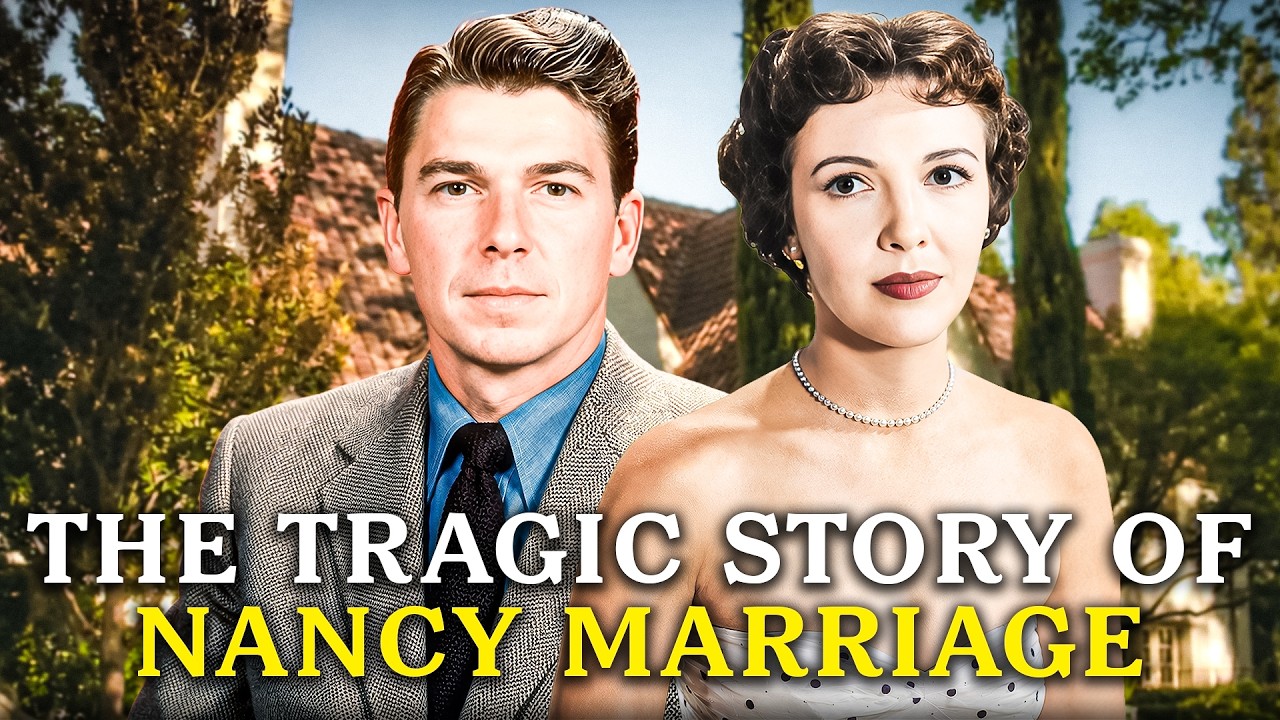
Close associates later described a deep need for emotional closeness that traced back to those years of waiting for her mother’s return. Her mother remarried in 1929, and her new husband, a prominent Chicago neurosurgeon named Loyal Davis, formally adopted Nancy when she turned 14. She took his last name and absorbed his deeply conservative values, which shaped her worldview for the rest of her life. After studying theater at Smith College, she moved to New York and then to Los Angeles, where she was signed to an MGM contract in 1949.
Everything that followed in her life began with a name on a list. In the late 1940s, Hollywood was in the grip of the House Un-American Activities Committee’s investigation into communist influence in the film industry. Nancy Davis discovered that her name had appeared on a list of suspected communist sympathizers. It was a case of mistaken identity, but in that climate, the distinction barely mattered.
Her director at MGM, Mervyn LeRoy, advised her that the best way to clear her name was to be seen publicly with someone of unimpeachable anti-communist credentials. He suggested Ronald Reagan, who was then president of the Screen Actors Guild, and arranged a dinner between them in November 1949. Whether the dinner was a genuine strategy or a convenient excuse engineered by Nancy, who was already interested in meeting Reagan, has been debated by people close to her for decades. Reagan was 38 and reeling from his divorce from actress Jane Wyman, whose career had eclipsed his before she filed for divorce in 1948.
Nancy was 28. The dinner was supposed to be a favor, but it became the beginning of something far larger. Reagan moved slowly, still working through the end of his first marriage. Nancy, by contrast, was direct and clear from early on that she was serious about him.
The engagement came in late 1951 through a quiet conversation, and they married on March 4th, 1952, at a small ceremony in the San Fernando Valley. Nancy was already pregnant, a detail that required careful management at the time. Their daughter Patti was born seven and a half months later. The 1950s were not easy for Reagan’s career.
His film stardom had stalled, and in 1954 he took a job hosting a weekly television program for General Electric. That job required him to travel constantly, delivering the same speech about free enterprise and limited government to workers and community groups. Over eight years, he refined his arguments and developed skills that would eventually transform him into one of the most polished political communicators in the country. At home, Nancy focused on Reagan above everything else.
Her relationship with his children from his first marriage was complicated from the beginning. Maureen Reagan later wrote about feeling shut out of the new household, and Michael Reagan described a distant relationship with Nancy during those years. Nancy’s defenders have argued that Reagan’s own reluctance to address the tensions contributed to the difficulty, but the accounts from his children remained consistent. On October 27th, 1964, Reagan gave a televised speech on behalf of Republican presidential candidate Barry Goldwater.
Called “A Time for Choosing,” it laid out his political philosophy in language so effective that it became the one lasting thing from the campaign. Goldwater lost badly, but party figures suddenly began asking whether Reagan could run for office himself. Nancy had watched him develop those arguments for a decade, and she understood before most did that his skills were now fundamentally political. Nancy’s role in his political career went far beyond that of a conventional wife.
She attended strategy meetings, followed polling, and had firm opinions about staff and messaging. Publicly, her role was presented as devoted and supportive. Privately, as documented by aides and biographers, she was deeply involved in personnel decisions and quietly exercised real power within the operation. Reagan won the California governorship in 1966, defeating the incumbent by nearly a million votes.
Nancy became first lady of California, redecorated the governor’s mansion, and when she found it inadequate, moved the family to a private home in a better part of Sacramento. She cultivated relationships with wealthy California Republicans who became essential to the Reagan political network, and she had a long memory for both loyalty and disloyalty. During the Sacramento years, Nancy also began a relationship with an astrologer named Joan Quigley. It was not unusual in her social circle, and nobody outside a very tight group knew at the time that it would become far more significant later.
Reagan challenged Gerald Ford for the Republican presidential nomination in 1976 and came very close, but lost narrowly. At 65, he went home to California, and many assumed his moment had passed. Nancy did not assume that. She spent the next four years quietly building relationships and infrastructure for another run.
On November 4th, 1980, Reagan was elected the 40th president of the United States in one of the most decisive electoral victories in modern history. The early months of the White House were difficult for Nancy. The country was in a recession, and her decision to commission a new set of White House China, 4,732 pieces costing $209,000, became the defining story of her public image. The press depicted her as extravagant and indifferent to ordinary Americans, and the coverage wounded her deeply.
The assassination attempt on March 30th, 1981 changed everything. Reagan was shot outside the Washington Hilton Hotel by John Hinckley Jr. , a young man obsessed with actress Jodie Foster. The bullet came within an inch of his heart.
Nancy arrived at the hospital and saw her husband on a gurney before he went into surgery. The experience of that afternoon altered her permanently. After that day, her involvement in his schedule and security arrangements went from significant to total. She interrogated schedules, pushed back on appearances she considered dangerous, and wanted to know exactly where he was at all times.
It was also after the shooting that her relationship with Joan Quigley began to influence White House scheduling. Quigley, who had called Nancy on the day of the shooting, began providing astrological guidance that Nancy used quietly, without telling most of the staff. Donald Regan, who served as chief of staff from 1985 to 1987, later described in detail how he received schedules from Nancy based on Quigley’s readings, including days when the president should not travel and days when meetings were favorable. His account was hostile, but the core of what he described has been corroborated by enough other sources that it is not seriously contested.
Nancy never denied the relationship, but she disputed its extent, describing it as a private coping mechanism rather than a governing tool. Nancy’s relationship with the White House staff was a source of tension for much of the presidency. She had opinions about personnel and was not shy about expressing them. Staff members who fell out of her favor found themselves losing access and influence, while those who maintained her trust were more secure.
She was widely reported to have contributed to the departure of several senior figures. The most public and damaging conflict was with Donald Regan, who collided with Nancy almost immediately after becoming chief of staff in 1985. The conflict came to a head during the Iran-Contra affair, which erupted in late 1986. The scandal involved the secret sale of weapons to Iran with proceeds funneled to Contra rebels in Nicaragua, and it was the most serious crisis of the presidency.
It landed at a moment when Reagan was also dealing with a diagnosis of prostate cancer. Nancy wanted Regan gone. She believed his management had contributed to the situation, and the battle between them played out over months before Regan resigned in February 1987. Reagan himself stayed largely above these conflicts, delegating extensively and avoiding direct confrontations with staff.
That style created an environment where Nancy’s influence was magnified. Amid the public conflicts, the private marriage remained consistent. They wrote letters to each other constantly, even when they were in the same building. Reagan called her Mommy in private, and she called him Ronnie.
People around them in unguarded moments described a bond that did not appear to be constructed for an audience. Nancy also launched the Just Say No anti-drug campaign in 1982, which became one of the most ambitious public outreach projects undertaken by a first lady. She visited rehabilitation centers, met with young people, and testified before the United Nations. The message that simply saying no was sufficient drew criticism from public health experts, but the effort itself was genuine.
She also advocated for the foster grandparents program, which connected elderly volunteers with children in difficult circumstances. Her public image remained difficult to manage, however. The China episode had set a narrative in concrete, and every subsequent extravagance, real or perceived, confirmed it. She tried to address it in 1982 by performing a self-deprecating musical number at the Gridiron Dinner, and her approval ratings improved afterward.
But the improvement never fully erased the original damage. Part of the problem was that the caricature was not entirely wrong. Nancy did care about clothes, decoration, and the aesthetics of the presidency. She accepted designer gowns as loans without fully understanding how that would look, and it was painful to learn publicly why these things were problems.
Ronald Reagan was diagnosed with Alzheimer’s disease in 1994, five years after leaving the White House. He announced it in a handwritten letter to the American people in November of that year. Nancy spent the next ten years as the organizing presence of his care, fighting for research funding and sitting with him through the long, gradual erasure the disease produced. She threw herself into advocacy for Alzheimer’s research with an intensity that surprised people who had categorized her as primarily a woman of social concerns.
Her support for stem cell research put her in direct conflict with the Bush administration and the political movement her husband had helped build. She did not back down, showing a willingness to break with her own political tribe when she believed the research could help those suffering from the disease. Reagan died on June 5th, 2004, at their home in Bel Air. He was 93.
Nancy was at his bedside, as she had been for 52 years. At the state funeral, she stood composed through the ceremony and pressed her lips to the flag-draped casket in a gesture so intimate it seemed to belong to a private moment. Afterward, she went home to a house that, for the first time in half a century, did not have Ronald Reagan in it. The years between his death and her own in 2016 remain the least examined part of her story.
She lived quietly in Bel Air, continued her advocacy, and watched with complicated feelings as the Republican party evolved in directions that bore less and less resemblance to the movement she and Ronald had helped build. She reconciled with her daughter Patti during the Alzheimer’s years, though the history between them did not disappear. Her younger son Ron, a liberal commentator, maintained a warmer relationship but had his own political differences with the family legacy. Nancy Reagan died on March 6th, 2016, at her home in Bel Air, at age 94, of congestive heart failure.
She was buried at the Reagan Presidential Library beside Ronald. Her grave marker was placed twelve years after his, beside him, as she had always been. The full arc of this marriage does not reduce easily to a single story. There was genuine, documented love between them, and there was also extraordinary ambition and careful management of image.
Nancy held no office and was elected to nothing, and yet her influence over personnel, scheduling, and access shaped the Reagan presidency in ways historians are still untangling. She was a complicated woman who organized her entire life around one man, and when the marriage ended, it ended with her pressing her lips to a casket in front of the world, then going home to wait the way she always had, even when there was no longer anyone coming through the door.