On December 6, 1969, the top two college football teams in America met in Fayetteville, Arkansas. President Richard Nixon sat in the stands, a massive television audience tuned in, and the game marked the centennial of college football. On the field that day, a 160-pound safety from Colorado played the biggest game of his life with a left leg that had no bone left above the knee. He told no one.
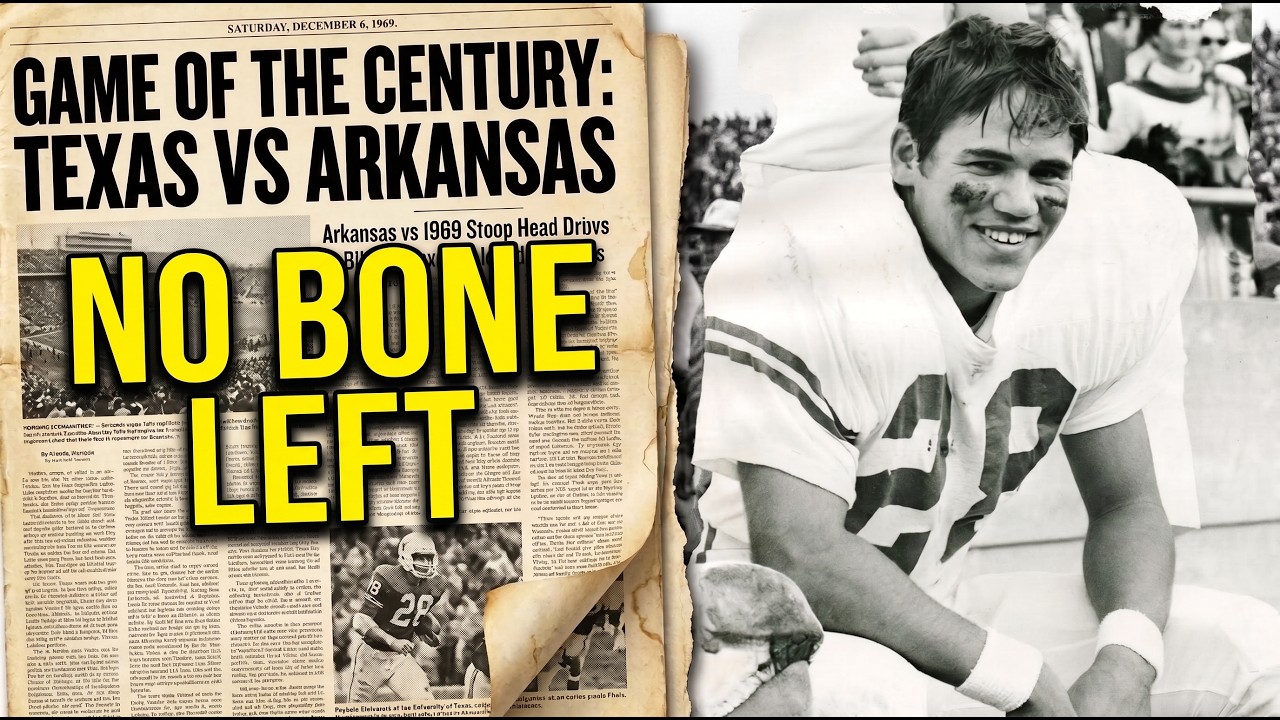
Six days later, his leg was amputated at the hip. The story of Freddie Steinmark has been told many times. But nearly everything surrounding that day unfolded differently than the country was led to believe — what happened in the stands, what happened on the hill overlooking the stadium, and what happened on a campus a few blocks away, where a young man was shot in the leg that same week for protesting a song. To understand what Steinmark did, it helps to understand the country watching him.
Five days before the game, the government held its first draft lottery in a generation. Young men across the nation sat by their radios and televisions waiting to hear if their birth dates would be called. Vietnam was not just a headline that fall; it was a deployment list. The South was still working through its own reckoning.
The Civil Rights Act had been in place for five years. In theory, the matter was settled. In reality, in a college town in the Ozarks, it was not settled at all. College football, the most public institution in that part of the country, was still keeping score in ways no one wanted to say out loud.
Texas had lifted its ban on Black players in 1963. But in 1969, the Longhorns still did not have a single Black player on the varsity team. They were among the last teams in the Southwest Conference to integrate. That fall, a freshman named Julius Whittier was enrolled in Austin.
Under NCAA rules at the time, freshmen were not allowed to play varsity football. So on the afternoon of the biggest game in the country, Whittier sat in his dormitory and watched on a television like everyone else. Whittier had arrived at a campus of about 35,000 students, only about 300 of whom were Black. His father had been scared for him.
Years later, Whittier recalled that his father knew men who had walked into white areas and paid for it with their lives. That 1969 Texas team would go on to win the national championship. It remains the last all-white team to be unanimously crowned national champion in college football. Freddie Steinmark came from Wheat Ridge, Colorado, a small town outside Denver.
By any reasonable measure, he should never have been on that field. He was five-foot-nine, weighed about 160 pounds, and had won the Denver Post’s award as the state’s top scholar-athlete. No major college football program offered him anything. Texas coach Darrell Royal watched his film and decided to take a chance.
He sent an assistant coach named Fred Akers to Wheat Ridge to knock on the door. When a small boy with a wide smile answered, Akers thought he was talking to Freddie’s younger brother. During his recruiting visit to Austin, Steinmark wore cowboy boots with high heels, hoping to look taller. He was not the only boy from Wheat Ridge who caught Royal’s eye.
His high school teammate Bobbie Mitchell, a fullback, came with him. The two had won a Colorado state championship together in 1966. In Austin, they roomed together for three years. Steinmark became a starting safety as a sophomore and intercepted five passes.
Mitchell moved to the offensive line and earned a starting job at guard. Two kids from a small Colorado town, 700 miles from home, at the heart of the best offense in college football. Then, in January of 1969, Mitchell received word that his older brother Mark had been killed while serving in Vietnam. Mark had been an army helicopter pilot.
The man who comforted him was his roommate, Freddie Steinmark. It was a moment that would take on new meaning later. In the late summer of 1969, Steinmark’s left leg began to hurt. It was not dramatic at first.
It was a deep pain above the knee that would not go away, the kind every football player in America gets and ignores. He thought it was a bruise. So did everyone else. The trainer showed him how to put a pain-relief balm between two pieces of gauze and wrap it around his leg.
He advised him to sleep with a pillow under his knee. The team doctor gave him Darvon for the pain. Steinmark took it and kept playing. The Longhorns kept winning.
As October turned into November, the pain grew bad enough to wake him in the middle of the night, make him miss classes, and leave him lying in bed in the afternoons because standing was not worth the effort. He was the one who directed the defense. He was the man in charge of lining everyone up. He said nothing.
Every week, he made a choice. Every week, he could have raised his hand, gone to the doctor, had an X-ray, and put an end to it. Every week, he chose not to, because the team was undefeated, because there were eleven games, and because he had told himself he would deal with the leg after the season. It was not a heroic decision.
It was a stubborn, small decision made by a twenty-year-old young man, again and again, in complete privacy, with no one watching. By the time Texas arrived in Fayetteville, the last section of bone above Freddie Steinmark’s left knee had disintegrated. The cancer had eaten it. As a writer who later retold this story put it, he was walking on a leg that, during that critical period, had no bone in it at all.
Here is what the rest of that week in Fayetteville looked like. Most of it never made it on television. The University of Arkansas band had a tradition of playing “Dixie” whenever the Razorbacks scored. Black students on that campus had spent the semester demanding that they stop.
That week, one of those students was shot in the leg on campus by a person who was never identified. Another group made a plan: if the band played the song during the game, they would run onto the field at halftime and lie down on it. The band director, a man named Doc Worthington, made the decision himself. “Dixie” was not played at the pep rally.
It was not played during the game. On a hill overlooking the stadium, Vietnam veterans and student protestors placed a huge peace sign made of crosses, put deliberately where the President of the United States would have to look at it. Nixon saw it. ABC never aired it.
When the writer who covered that game for Sports Illustrated sat down to tell America what happened in Fayetteville, first in his article and then in his book, he did not mention any of it. Not the shooting, not the song, not the crosses. The country got a football game. That football game, honestly, was one of the greatest ever played.
Texas came from behind to win 15-14. Late in the fourth quarter, for the first time all season, the smallest man on the field could no longer continue. The pain finally overwhelmed him, and Darrell Royal took him out. It was the last football game Freddie Steinmark ever played.
Afterward, President Nixon entered the Texas locker room carrying a plaque declaring them the number one team in the one hundredth year of college football. He shook hands with the players. He took pictures with Royal and the quarterback. Then he went to the Arkansas locker room and told a group of heartbroken young men that he understood how they felt because he had lost some things himself.
No one in either room knew what had just happened outside. No one knew that the boy calling the defensive signals had done it with a leg that was no longer fully intact. Two days later, they X-rayed his leg. The X-ray showed a tumor just above the left knee, an osteosarcoma — a cancer that originates in the bone itself, with no connection to football at all.
On December 12, 1969, six days after the Game of the Century, surgeons at MD Anderson in Houston amputated Freddie Steinmark’s left leg at the hip. Nixon called the hospital afterward. Twenty days later, on New Year’s Day, Texas played Notre Dame in the Cotton Bowl for the national championship. Freddie Steinmark stood on that sideline on crutches, only three weeks after losing his leg at the hip.
Texas won the game 21-17. His teammates gave him the game ball. Six weeks later, he walked across a stage with a prosthetic leg to receive his team letter jacket. Here is the part no one predicted.
The man who scored the winning touchdown in that Cotton Bowl game was a fullback named Billy Dale. Royal had demoted him to the second team two days before the season began, told him he was still valuable, and used him as a blocker. On New Year’s Day, Dale plunged in from one yard out to win the national championship. The following fall, Julius Whittier became eligible at last, becoming the first Black player to reach the varsity team in the history of Texas football.
He was the only Black player on the roster, and he needed a roommate. Darrell Royal called three seniors into his office and asked one of them to do it. Billy Dale volunteered. In his own words, decades later, he said he lost every friend he had because of it.
Dale said he made the choice because he thought it would add another dimension to his character. He was right. He would later say that Whittier made him more aware of racial issues than he had ever been. The two remained close for the next forty-eight years, until Whittier’s death in 2018.
Consider what that team actually produced. A national championship that no one quite knows how to talk about anymore, because of who was not allowed on the field. A defensive back who played an entire season on a leg that hurt terribly and told no one. And the man who scored the winning touchdown, who raised his hand a year later for the one job no one on the team wanted, and paid for it by losing his friends.
None of that was in the highlight film. Freddie Steinmark had only eighteen months left. He returned to school almost immediately in the spring of 1970. He changed his major and began planning for law school.
In April of that year, he went to the White House with Darrell Royal, where President Nixon presented him with a certificate of appreciation for what he called steadfast faith in God, his country, and himself. He traveled. He spoke at fundraising dinners for cancer research. He wrote a book about his life.
He was about to get married. Her name was Linda Wheeler. She had been his girlfriend since their high school days in Wheat Ridge, and she had followed him to Texas. They set a date.
Linda sewed her own wedding dress. Freddie went out and bought himself a white Italian suit. Then the cancer came back. On May 23, 1971, he began losing and regaining consciousness.
The wedding was called off. He died on June 6, 1971, at MD Anderson, the same hospital where his leg had been amputated. He was 22 years old. His funeral in Denver was one of the largest the state had ever seen.
A teammate, Tom Campbell, tried to explain the loss to a reporter. He reached for the only comparison available to him: a Notre Dame legend who died at 25 and became part of American folklore. “Freddie was the George Gipp, but without all the publicity,” Campbell said. That is true, and that is precisely the problem, because in the years that followed, Freddie Steinmark became a statue.
A photograph in a stadium tunnel that players touch as they run onto the field. A scoreboard bearing his name. A movie. A parable of faith and courage, polished until smooth and easy to accept.
Freddie was never a parable. He was a twenty-year-old young man, scared and in pain, who wanted to marry his high school sweetheart, and who made a small, stubborn, private decision every week of one autumn 57 years ago not to be the reason his team lost. He never got the wedding. He never wore the suit.
But here is the part people forget. He was present for the rest of it. In the fall of 1970, with one leg, Freddie Steinmark returned to work and coached the new defensive backs at the University of Texas. That meant he was inside that building all season.
Julius Whittier finally ran onto the field, and that season Billy Dale moved in with him and began losing his friends because of it. Freddie did not live long enough to see where that door led. He never saw Earl Campbell come to Texas three years later. But he stood there on a prosthetic leg in the fall that door opened.
He simply kept quiet, went down to the field, and directed the defensive line. And when he could no longer go down to the field, he stayed anyway. The screenwriter who eventually turned Freddie Steinmark’s life into a Hollywood movie is the same man who wrote Rudy.