On June 27, 1876, a column of soldiers crested a ridge in Montana Territory searching for George Armstrong Custer and the 7th Cavalry. What they found instead was a field of more than 200 swollen bodies that had been baking under the June sun for two days. At first, the shapes on the hillside looked like white boulders. They were men, stripped naked, their skin bleached by the sun.
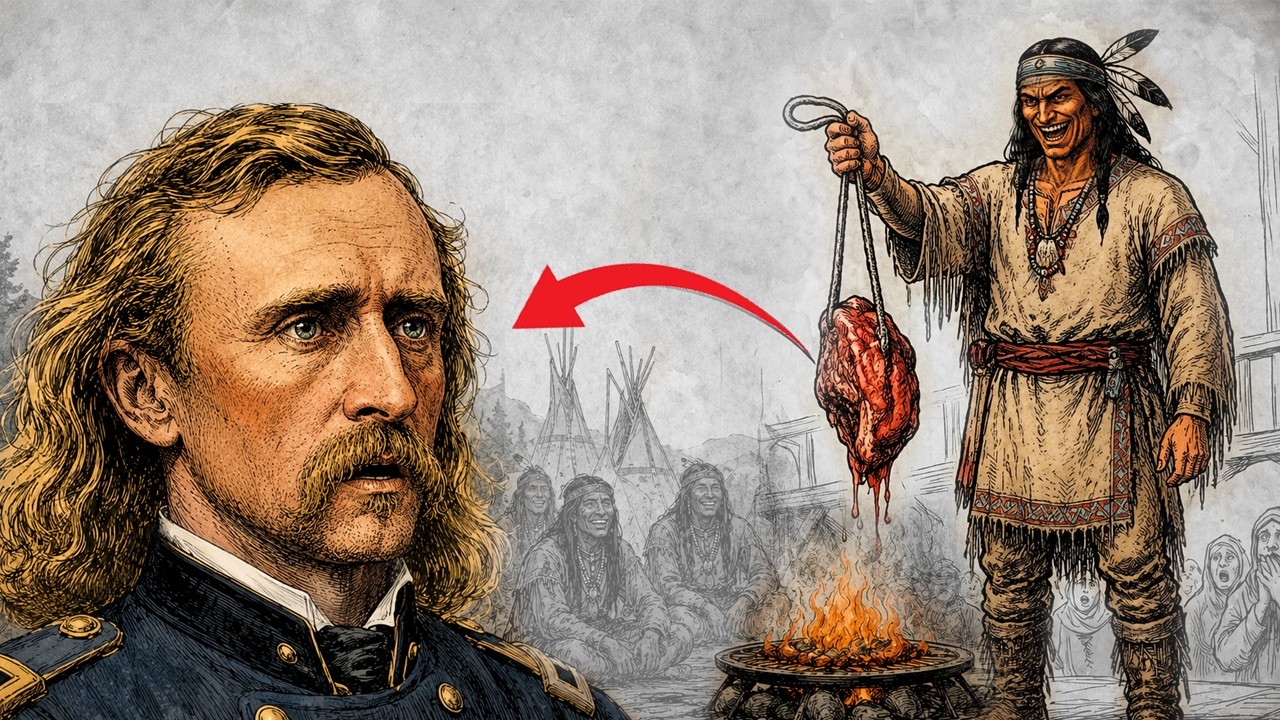
Many had no heads, no hands. Arrows protruded from empty eye sockets. Faces had been crushed by stone clubs until no features remained. Fingers lay scattered in the grass like dropped coins.
Of the more than 200 men who rode with Custer into that valley, only 56 could be identified. It had all happened in less than an hour—some accounts say less than 30 minutes. What was done to those bodies was not random savagery. It was deliberate and followed a specific spiritual logic that challenges the familiar heroic version of the battle.
There is also the question that has haunted historians for generations: who actually killed Custer? In 2005, a Cheyenne oral tradition surfaced claiming the person who struck Custer down was not a famous warrior, but a woman. George Armstrong Custer was 36 years old in the summer of 1876. A decade earlier, he had been the youngest general in the Union Army, a hero with golden hair and a talent for spectacle.
But his career had soured. He had been court-martialed in 1867 for abandoning his command and ordering deserters shot without trial, suspended for a full year. By 1876, he was riding toward the Little Bighorn with something to prove. The crisis Custer rode into was partly his own making.
In 1874, he had led an expedition into the Black Hills of South Dakota, land sacred to the Lakota Sioux and guaranteed to them by the Fort Laramie Treaty of 1868. His expedition confirmed gold, triggering a rush of miners onto Lakota land. The government, rather than enforce the treaty, ordered all Lakota onto reservations by January 31, 1876. Those who refused were declared hostile, and the army was sent to force compliance.
The Lakota and Cheyenne gathered along the Little Bighorn that summer did not see themselves as hostiles. They were defending their home. The camp was one of the largest concentrations of Plains Indian peoples ever assembled, between 6,000 and 8,000 people, including 1,500 to 2,000 warriors. It stretched nearly three miles along the river, a city of hide lodges arranged by tribal circle.
The most influential man in the encampment was not a war chief. Sitting Bull, a holy man of the Hunkpapa Lakota, held authority through spiritual power. Days before the battle, he performed the Sun Dance, slicing fifty pieces of flesh from each arm as an offering. In a vision, he saw soldiers falling into the camp upside down like grasshoppers dropping from the sky.
The people understood: the soldiers would come, and the soldiers would die. Crazy Horse was the blade. An Oglala Lakota war leader around 35 years old, he rode into combat with a lightning bolt painted on his face and hailstone marks on his body. He had never been seriously wounded.
He would lead the force that closed the trap on Custer. Major Marcus Reno, 41, would command the initial attack into the valley. Captain Frederick Benteen, 57, openly despised Custer and had once described him in writing as an insane commander who sacrificed men for personal glory. Benteen would receive the last message Custer ever sent.
Custer did not ride alone. His brother Tom Custer, a two-time Medal of Honor recipient, commanded Company C. His youngest brother Boston, a civilian, had tagged along as a forage master. His 18-year-old nephew Autie Reed was there too.
The battlefield was a series of rolling ridges and deep ravines on the east side of the Little Bighorn River. The ground concealed movement. A man could disappear behind a fold in the earth. On the morning of June 25, 1876, Custer’s scouts climbed to a high point called the Crow’s Nest.
Below them, the valley was hazed with smoke from thousands of cooking fires. Pony herds stretched across the floodplain. Scout Bloody Knife gestured that there were enough Sioux to keep them fighting for two or three days. Custer had been ordered by General Terry to continue south and wait for a coordinating force before attacking.
But he had learned his column was spotted by Lakota hunting parties. He believed the village would scatter if he waited. He decided to attack immediately, splitting his regiment into three battalions. He had been offered Gatling guns before the campaign and declined; they would slow him down.
He had been offered additional cavalry companies and declined those too. Scouts stood before him saying the village was enormous. He attacked anyway. Around noon, Custer split the regiment.
Reno took companies A, G, and M, about 140 men, with orders to cross the river and charge the village from the south. Benteen took companies D, H, and K, about 125 men, on a wide sweep to the left. Captain McDougall took Company B to guard the pack train with reserve ammunition. Custer kept five companies, roughly 210 men, to advance along the bluffs and strike from the north.
Benteen’s orders were vague. He found nothing on his sweep, just empty ravines and dry hills. Scouts continued to signal alarm. One reportedly told another officer, “If we go in there, we will never come out.
” Another scout pointed at the valley and said simply, “Too many. ” Custer pressed on. At approximately 3:00 in the afternoon, Reno crossed the river and formed a skirmish line on the valley floor. For a few minutes, it looked like a standard cavalry assault.
Then the village erupted. Hundreds of warriors poured out armed and organized. Gall, a Hunkpapa war leader, had lost two wives and three children in the first volleys of Reno’s attack. Rage drove him to rally the warriors and drive straight at Reno’s line.
Meanwhile, Custer sent a message back to Benteen: “Come on. Big village. Be quick. Bring packs.
P. S. Bring packs. ” The repeated word “packs”—ammunition packs—suggested near panic.
The messenger, trumpeter Giovanni Martini, was the last person to see Custer’s command alive. Reno’s line held for perhaps 20 minutes. He ordered a fallback into timber, then a retreat across the river. The Arikara scout Bloody Knife took a bullet through the skull, blood spraying across Reno’s face.
The retreat became a rout. Men fell into the chest-deep current as warriors lined the banks and fired into the mass. Reno lost about 40 men in the valley fight and crossing. The survivors clawed up the bluffs and dug in.
Benteen arrived with his three companies and looked at the chaos. He chose to stay with Reno rather than ride north to find Custer. His decision remains one of the great unanswerable questions of the battle. The 1879 court of inquiry cleared him; history has been less generous.
Custer’s five companies continued north. He attempted to find a ford to strike the village from the north, but Reno’s hammer had already shattered. Hundreds, then a thousand or more warriors, crossed the river and flowed up the ravines toward his position. The 7th Cavalry’s Springfield carbines were single-shot breech-loaders with copper casings that jammed when heated by rapid fire.
Archeologists have recovered dozens of casings with knife marks gouged into the rims, evidence that soldiers were prying stuck casings from their weapons. Many warriors carried Henry and Winchester repeating rifles, lever-action weapons capable of firing fifteen rounds without reloading. On this field, the assumed technological advantage was reversed. Crazy Horse led a force from the north that swung wide and came up behind Custer’s line.
The first position to fall was the right flank. The archaeological evidence tells a story of a line that broke rather than bent. When a skirmish line breaks, the result is not a fighting retreat; it is a stampede. Unit cohesion dissolved and could not be rebuilt.
Survivors fell back toward a rise now called Last Stand Hill, but the bodies found there were scattered, not arranged in a defensive perimeter. The fight’s final minutes were hand-to-hand. Captain Myles Keogh died on the slope. His horse Comanche was found standing among the dead with seven bullets and arrows in him, the only living thing found on the battlefield.
Comanche was nursed back to health, officially retired, and never ridden again. All 210 men in Custer’s immediate command were killed—there were no American survivors. Below Last Stand Hill lay a steep ravine where burial details found 28 bodies clustered together. These men had been running toward the river and escape, but warriors lined the rim and fired down.
Some historians believe these were the last of Custer’s command to die. By late afternoon the firing stopped. Then Lakota and Cheyenne women, children, and elderly moved onto the battlefield. What they did there to the bodies is the part of Little Bighorn that has been sanitized for nearly 150 years.
The dead had been stripped naked, standard spoils of Plains warfare. But the mutilation went far beyond that: scalps taken, limbs severed, fingers cut away, skulls crushed, faces destroyed, bodies opened and organs cast aside. Only 56 of more than 200 men could be identified. In Lakota and Cheyenne spiritual belief, the body a person carried in this life was carried into the next world.
A man left whole could fight again in the afterlife. Mutilation was spiritual warfare—disarmament of the enemy’s soul. Cut off a man’s hands and he cannot hold a weapon in the next world. Crush his face and he cannot see.
It was also revenge: Reno’s charge had killed Gall’s wives and children. Tom Custer, the two-time Medal of Honor recipient, was identified only by a tattoo of the goddess of liberty and initials on his arm, because his face no longer existed. Custer himself was found near the top of the hill, lying across two other soldiers, stripped naked. But he had not been mutilated or scalped.
He had two bullet wounds, one in the left temple and one in the left side of the chest, either fatal. Some historians see the lack of mutilation as a sign of respect; others argue the Lakota did not know who he was, as Custer had cut his famous long hair short before the campaign. A Northern Cheyenne oral tradition that surfaced publicly in 2005 holds that the person who struck Custer down was a woman named Buffalo Calf Road Woman. Eight days earlier, at the Battle of the Rosebud, she had ridden into gunfire to rescue her unhorsed brother, an act so remarkable the Cheyenne named that battle after her.
Whether the account is verifiable in the Western evidentiary sense, historians continue to debate. For the Northern Cheyenne, it has never been in doubt. The total death count was 268 United States soldiers, scouts, and attached personnel. Approximately 50 Lakota and Cheyenne died, almost certainly an undercount.
The burial parties worked through June 27 and 28 with no coffins and few shovels. The dead were buried in shallow graves, sometimes just inches deep, where they fell. Within months, wind and rain exposed many bodies. All three Custer brothers and their nephew were dead on the same ridge.
News of the disaster reached the East during the nation’s centennial celebration. On July 4th, 1876, Americans celebrating the 100th birthday of the United States received the telegraph report. The country turned Custer into a martyr and the Lakota into monsters. For a century, the dominant narrative was simple: brave soldiers, savage Indians, a noble last stand.
Paintings showed Custer standing with saber in hand, golden hair flowing, surrounded by his men. None of it was true. He did not carry a saber; his hair was cut short; the ring was a scattered field of dead. Reno was exonerated by a court of inquiry in 1879, but his reputation never recovered.
He descended into alcoholism, was court-martialed again, and died in obscurity, buried in an unmarked grave. In 1967, his body was exhumed and reburied with military honors at the cemetery overlooking the battlefield. The battlefield was originally designated the Custer Battlefield National Monument. For more than a hundred years, the only markers were white marble stones where soldiers fell.
There were no markers for the Lakota, Cheyenne, or Arapaho. Only in 1991 did Congress rename it the Little Bighorn Battlefield National Monument. An Indian memorial was not added until 2003, 127 years after the battle. The victory changed nothing for the Lakota and Cheyenne in the long term.
The Army flooded the Plains with troops. Band by band, the Lakota and Cheyenne were forced onto reservations. Sitting Bull fled to Canada, returned, was confined to Standing Rock Reservation, and was killed by reservation police in 1890. Crazy Horse surrendered in 1877 and was killed at Fort Robinson.
The Black Hills gold that Custer himself had found was never returned. CONTENT:
On June 27, 1876, a column of soldiers crested a ridge in Montana Territory looking for George Armstrong Custer and the 7th Cavalry. What they found instead was a field of more than 200 swollen bodies that had been decaying under the June sun for two days. At first, the shapes on the hillside looked like white boulders.
They were men, stripped completely naked, their skin bleached white by the sun. Many had no heads. Many had no hands. Arrows protruded from empty eye sockets.
Faces had been struck with such force by stone clubs that no features remained—just concave ruins where human faces used to be. Only 56 of the more than 200 men could be identified. The rest were too destroyed to name. All of it happened in less than an hour.
In the time it takes to eat lunch, an entire command of 210 men was wiped from the earth and then systematically taken apart. What was done to those bodies was not random savagery. It was deliberate, following a specific spiritual logic. And there remains the question no one has definitively answered: who actually killed Custer?
For a century, the answer was simply “we do not know. ” But in 2005, a Cheyenne oral tradition surfaced claiming the person who struck Custer down was not a famous warrior. It was a woman. George Armstrong Custer was 36 years old in the summer of 1876.
A decade earlier, he had been the most famous cavalry officer in America, the youngest general in the Union Army at age 25, leading charges with golden hair streaming behind him like a battle flag. Newspapers loved him. Artists painted him. But by 1876, the shine was gone.
Custer had been court-martialed in 1867 for abandoning his command and ordering deserters shot without trial, suspended from rank and pay for a full year. He had clawed his way back, but he needed something—a victory large enough to put his name back in the headlines. Here is the irony that should haunt you: it was Custer himself who had created the crisis he was riding into. In 1874, he had led an expedition into the Black Hills of South Dakota, land sacred to the Lakota Sioux and guaranteed to them by the Fort Laramie Treaty of 1868.
The expedition confirmed gold, and the announcement triggered a rush of miners onto Lakota land. The government, rather than enforce the treaty, demanded all Lakota move to reservations by January 31, 1876. Those who refused were declared hostile. The army was sent to force compliance.
Custer was the instrument of a betrayal he himself had set in motion. The gathering along the Little Bighorn River in late June 1876 was one of the largest concentrations of Plains Indian peoples ever assembled. Modern scholarship places the village at between 6,000 and 8,000 people, including somewhere between 1,500 and 2,000 warriors. The camp stretched nearly three miles along the river bottom, a city of hide lodges arranged by tribal circle.
This was not an army. It was a nation. The most influential man in the encampment was not a war chief. Sitting Bull was a holy man of the Hunkpapa Lakota, a man whose authority came not from military command but from spiritual power.
Days before the battle, he had performed the Sun Dance, slicing fifty pieces of flesh from each arm as an offering. In that vision, he saw soldiers falling into the camp upside down like grasshoppers dropping from the sky. Their hats fell off. They had no ears.
The people understood immediately: the soldiers would come, and the soldiers would die. If Sitting Bull was the spiritual center, Crazy Horse was the blade. An Oglala Lakota war leader around 35 years old, he rode into combat with a lightning bolt painted on his face and hailstone marks on his body. He had undergone spiritual preparation that rendered him untouchable in battle, and he had never been seriously wounded.
The other key officers are central to the story. Major Marcus Reno, 41, a Civil War veteran, would command the initial attack into the valley. Captain Frederick Benteen, 57, openly and vocally despised Custer, once describing him in writing as an insane commander who sacrificed men for personal glory. Benteen would receive the last message Custer ever sent.
Custer did not ride alone. His younger brother Tom Custer, a two-time Medal of Honor recipient, commanded Company C. His youngest brother Boston, a civilian with no military obligation, had tagged along. His 18-year-old nephew Autie Reed was there too.
This was a family outing riding into the largest hostile village on the Great Plains. On the morning of June 25, 1876, Custer’s Crow and Arikara scouts climbed to a high point called the Crow’s Nest. What they saw in the valley below stopped them cold. The Little Bighorn bottom was hazed with smoke from thousands of cooking fires.
The pony herds were so vast they looked like moving carpets. Scout Bloody Knife gestured that there were enough Sioux to keep them fighting for two or three days. Custer looked. He did not see what the scouts saw, or perhaps he chose to disbelieve it.
His orders from General Terry were to continue south and wait for a coordinating force before attacking. But Custer had learned his column had been spotted by Lakota hunting parties. He believed the village would scatter if he waited. He made the decision that killed him and every man who followed him that afternoon.
He would attack immediately, splitting the regiment into three battalions. He had been offered Gatling guns before the campaign and declined—they would slow him down. He had been offered additional cavalry companies and declined those too. Scouts warned him the village was enormous.
He attacked anyway. Around noon, Custer split the regiment at the divide above the Little Bighorn. Reno took companies A, G, and M, about 140 men, with orders to cross the river and charge the village from the south. Benteen took companies D, H, and K, about 125 men, on a wide sweep to the left.
Captain McDougall took Company B to guard the pack train and the reserve ammunition. The remaining five companies, roughly 210 men, stayed with Custer to advance along the bluffs and strike from the north. The regiment would never be whole again. At approximately 3:00 in the afternoon, Reno led his three companies across the river and formed a skirmish line on the valley floor.
For a few minutes, it looked like a standard cavalry assault. Then the village erupted. Hundreds of warriors poured out from the lodges, armed and organized, not in panic but with a speed that stunned the soldiers. Gall, a Hunkpapa war leader, had lost two wives and three children in the first volleys of Reno’s attack.
There was only rage. He rallied the warriors and drove straight at Reno’s line. Custer, meanwhile, sent a message back to Benteen: “Come on. Big village.
Be quick. Bring packs. P. S.
Bring packs. ” The repeated, misspelled “packs”—ammunition packs—suggests near panic. The messenger was the last person to see Custer’s command alive. Reno’s skirmish line held for perhaps 20 minutes.
Every fourth man held horses, so only three-quarters of the command was shooting. Reno ordered a fallback into the timber. In the timber, the Arikara scout Bloody Knife took a round through the skull, blood spraying across Reno’s face. Something broke in Reno.
He ordered a retreat to the bluffs across the river. But it was not a retreat; it was a rout. Men fell into the chest-deep current, horses went down, and warriors lined the banks firing into the mass. Reno lost about 40 men in the valley fight and river crossing.
The survivors clawed up the bluffs and dug in. Benteen arrived with his three companies, looked at the chaos, and made a decision: he stayed with Reno. He did not ride north to find Custer. Whether this was prudent or damning remains one of the great unanswerable questions of the battle.
The 1879 court of inquiry cleared him. History has been less generous. Custer’s five companies continued north along the bluffs. The 7th Cavalry’s Springfield carbine was a single-shot breech-loading weapon.
After each round, the trooper had to manually extract the spent casing and insert a new cartridge. The copper casings, when heated by rapid fire, expanded and jammed. Archaeologists have recovered dozens of casings with knife marks gouged into the rim—evidence that soldiers were desperately prying stuck casings from their weapons. Meanwhile, many warriors carried Henry and Winchester repeating rifles, lever-action weapons capable of firing 15 rounds without reloading.
On this field, the technological advantage the Army assumed it held was completely reversed. Crazy Horse led a force from the north that swung wide and came up behind Custer’s line. The trap was closing. The first position to fall was the right flank.
The archaeological evidence tells a story far removed from the heroic myth: the cartridge casings clustered tightly at first, then scattered abruptly. The line did not bend. It broke. There was no ring of brave soldiers standing shoulder to shoulder.
There was a line of men that held for a few minutes and then shattered like glass. When it shattered, what followed was not a battle. It was a hunt. The survivors fell back toward a rise now called Last Stand Hill, but the bodies found there were scattered, not arranged in a defensive perimeter.
The fight, which may have lasted less than 30 minutes, was in its final minutes hand-to-hand. Captain Myles Keogh died on the slope. His horse Comanche was found standing among the dead with seven bullets and arrows in him, the only living thing found on the battlefield. Comanche was nursed back to health, officially retired, and never ridden again.
All 210 men were gone. There were no American survivors from Custer’s immediate command. Below Last Stand Hill, a steep ravine known as Deep Ravine held 28 bodies clustered together. These men had been running toward the river, toward escape.
They never made it. Warriors lined the rim and fired downward. Some historians believe these men were the last of Custer’s command to die—that the last stand was not on the hill at all, but in this anonymous cut in the earth. By late afternoon on June 25, the firing stopped.
Then the Lakota and Cheyenne women, children, and elderly moved onto the battlefield. What they did there to the soldiers’ bodies is the part of Little Bighorn that has been sanitized for nearly 150 years. The dead had been stripped naked, standard practice in Plains warfare. But the mutilation went far beyond that.
Bodies had been scalped, limbs severed, fingers cut away, skulls crushed, faces destroyed. Some bodies had been opened, organs removed. Arrows had been driven into the dead. Of the more than 200 men, only 56 could be identified.
In Lakota and Cheyenne spiritual belief, the body a person carried in this life was the body they carried into the next world. A man killed in battle who was left whole could fight again in the afterlife. Mutilation was spiritual warfare—disarmament of the enemy’s soul. Cut off a man’s hands and he cannot hold a weapon in the next world.
Crush his face and he cannot see. It was theology, and the fury behind it was personal: these soldiers had attacked a village full of women and children. Tom Custer, the two-time Medal of Honor recipient, was identified only by a tattoo of the goddess of liberty and the initials TWC on his arm, because his face no longer existed. Custer himself was found near the top of Last Stand Hill, stripped naked, but not mutilated and not scalped.
He had two bullet wounds, one in the left temple and one in the left side of the chest, either one fatal. Some historians see the lack of mutilation as a sign of respect; others argue the Lakota did not know who he was, as Custer had cut his famous long hair short before the campaign. Still others suggest his body was untouched because someone, perhaps a Cheyenne woman, intervened claiming his spirit. A Northern Cheyenne oral tradition that surfaced publicly in 2005 holds that the person who struck Custer down was a woman named Buffalo Calf Road Woman.
Eight days earlier, at the Battle of the Rosebud, she had ridden into gunfire to rescue her unhorsed brother—an act so remarkable the Cheyenne named that battle after her. Whether the account is historically verifiable, historians continue to debate. For the Northern Cheyenne, it has never been in doubt. The final death count: 268 United States soldiers, scouts, and attached personnel dead, 55 severely wounded.
On the native side, approximately 50 dead, almost certainly an undercount. The burial parties worked through June 27 and 28. There were no coffins, few shovels. The dead were buried in shallow graves, sometimes just inches deep, exactly where they had fallen.
Within months, wind and rain exposed many bodies. All three Custer brothers—George, Tom, and Boston—were dead on the same ridge, along with their 18-year-old nephew. News of Little Bighorn reached the East during the nation’s centennial celebration. On July 4, 1876, Americans celebrating the 100th birthday of the United States received the telegraph report.
The shock was electric. The country turned Custer into a martyr and the Lakota into monsters. For a century, the dominant narrative was simple: brave soldiers, savage Indians, a noble last stand. Paintings showed Custer standing with saber in hand, golden hair flowing, surrounded by his men in a tight defensive ring.
None of it was true. He did not carry a saber that day. His hair was cut short. The ring was a scattered field of dead.
Reno was investigated by a court of inquiry in 1879 and officially exonerated, but his reputation never recovered. He descended into alcoholism, was court-martialed again for unrelated offenses, and died in obscurity, buried in an unmarked grave. Only in 1967 was his body exhumed and reburied with military honors at the cemetery overlooking the battlefield where his career was destroyed. The battlefield was originally designated the Custer Battlefield National Monument.
For more than 100 years, the only markers were white marble stones showing where soldiers fell. There were no markers for the Lakota, Cheyenne, or Arapaho—the people who won the battle were erased from the site of their greatest victory. It was not until 1991 that Congress renamed it the Little Bighorn Battlefield National Monument. An Indian memorial was not added until 2003, 127 years after the battle.
The victory changed nothing for the Lakota and Cheyenne in the long term. The Army flooded the Northern Plains with troops. Band by band, they were forced onto reservations. Sitting Bull fled to Canada, returned, and was killed by reservation police in 1890.
Crazy Horse surrendered in 1877 and was bayoneted by a guard at Fort Robinson. The Black Hills gold that Custer himself had found was never returned to the Lakota.