Eight kings murdered in 200 years. That is not the record of a stable dynasty, yet the Persian Empire presented itself as an eternal institution ruled by a living God. From Cyrus the Great to the final collapse, the most dangerous position in the realm was the throne itself. The King of Kings was more likely to die from poison or a blade than from old age.
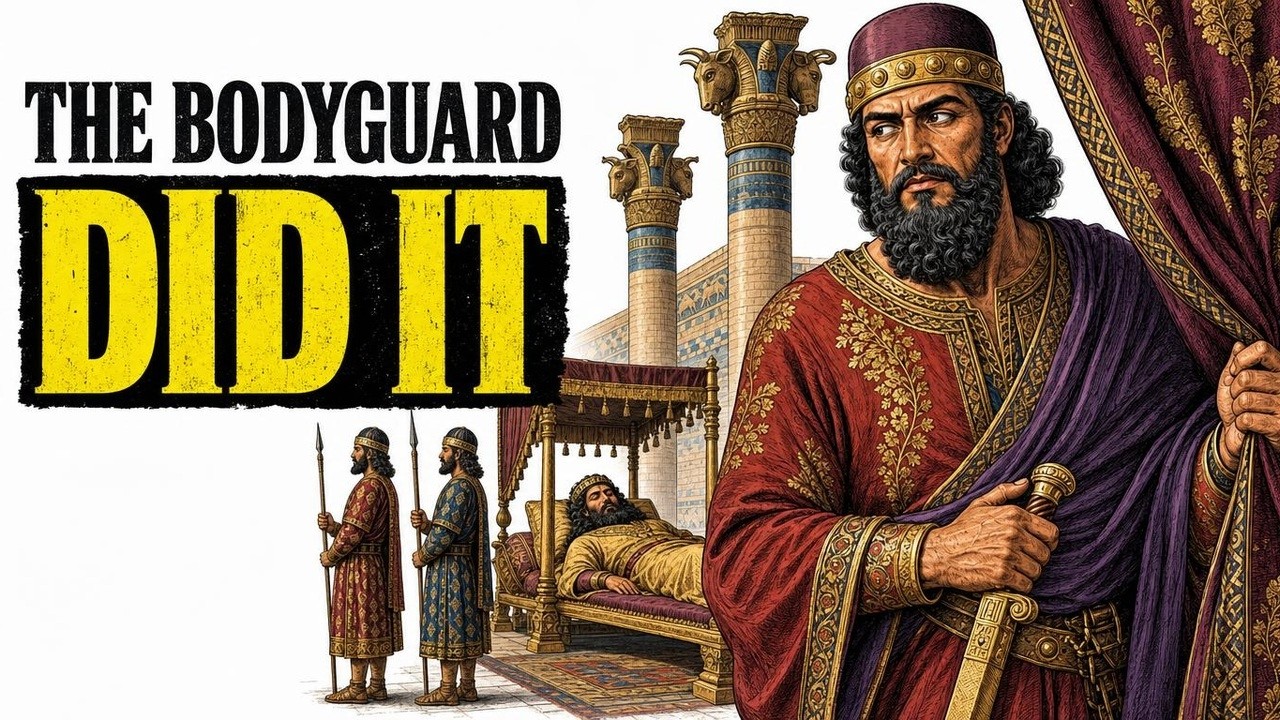
In 338 BC, the system finally consumed its strongest ruler, Artaxerxes III, an iron-handed king who had crushed rebellions and reconquered Egypt. He died in his own palace, poisoned by the one man a king should never have to fear: his grand vizier, Bagoas. On the surface, the empire broadcast stability. Kings carved their versions of history into cliff faces for eternity, presenting themselves as chosen agents of the great god Ahuramazda, holding the world in perfect balance.
Beneath that image, the court was a survival contest where sons turned on fathers, brothers hunted brothers, and the royal bed chamber became the empire’s most reliable crime scene. Succession was never a handover but a scramble in the dark, where the only rule was to strike before being struck. The official story and the hidden reality are preserved in two separate records. One was written by kings to justify their divine right.
The other survived through an unlikely witness, a Greek physician named Ctesias of Cnidus, who worked inside the court and treated the wounds that royal brothers left on one another. He learned firsthand that the Persian throne was less a seat of power than a sentence waiting to be carried out. The founding document of the empire’s public image is carved 100 meters up a cliff at Behistun in what is now western Iran. It shows King Darius I larger than every figure near him, his foot pressed on the chest of a fallen rival, with nine more rebels roped at the neck in a line.
The king had the ledges below the carving chiseled away so no one could climb up and alter a single line. It was made for the gods and for time. But Darius had no legitimate claim to the throne. He seized it in 522 BC in a killing carried out at a fortress in Media, where he and six other Persian nobles cut down the man who wore the crown.
According to Herodotus, one of the conspirators had uncovered that the ruling man was an impostor by sending his own daughter to feel for the king’s ears in the dark, because the real ruler had once had his ears cut off as punishment. She found no ears, and that was the signal to strike. Darius presented himself not as a man who grabbed power but as a man who restored it. He insisted the previous king, Bardia, was never a true king at all but an impostor, a Magus named Gaumata who had murdered the real prince years earlier and ruled in a dead man’s name.
Darius cast himself as the blade of Ahuramazda, sent to strike out what he repeatedly called the lie. He counted off provinces that revolted after he took power, recording 19 battles in a single year. He had the text copied and carried to every province, so the version on the cliff echoed where no eye could climb. The palace of order was built by an army of the conquered.
Persepolis, begun by Darius around 518 BC, was cut out of rock with blocks weighing several tons, joined without mortar by iron clamps sealed in lead. Clay tablets record wages paid to laborers in silver, grain, and wine, including extra rations for a woman who had given birth on the work site. The great eastern staircase showed 23 delegations filing upward in peaceful processions, carrying tribute with no soldiers and no chains present. The columns once rose more than 19 meters, crowned with twin heads of bulls, and traces of blue, red, and gold paint survive in the carvings.
Ctesias arrived in this world of granite certainty as a Greek physician taken in war. He claimed he served the royal house for 17 years and treated the king with his own hands. He came from the same island tradition that produced Hippocrates. His post gave him access to the king’s family as well as the king himself.
He was present when Artaxerxes II was wounded in battle at Cunaxa in 401 BC by his own brother, Cyrus the Younger. Ctesias says he cleaned and closed that royal wound with his own hands. The same battle left a Greek soldier named Xenophon stranded with 10,000 mercenaries and no leaders, and his account of their march back to the sea became one of the most famous survival stories of the ancient world. Ctesias also served as a go-between in the peace talks that followed, learning the court’s secrets not only from the sick room but from the negotiating table.
He recorded that the queen mother, Parysatis, poisoned her own daughter-in-law, Stateira, at a shared meal by cutting a small bird with a knife smeared on only one side. The dynasty’s founder, Cyrus the Great, fell in 530 BC fighting the Massagetae on the empire’s far northeastern frontier. Herodotus preserved a darker version in which the Massagetae queen, Tomyris, whose son Cyrus had captured and driven to death, dipped the dead king’s head in a skin filled with blood. Cyrus’s son Cambyses II, who added Egypt to the empire in 525 BC, was handed a death carefully free of blame.
According to Darius’s own account, Cambyses was mounting his horse when his dagger slid from its sheath and opened his thigh. The wound turned foul, and he died of it on the road home. Herodotus adds that before dying, Cambyses had already killed his own brother Bardia in secret, which would mean the impostor Darius later destroyed was no impostor at all but the true prince. If that is true, Darius did not defeat the lie.
He was the lie, carved 100 meters high and repeated in three languages. Darius then did what almost no Achaemenid after him managed. He held on. He ruled 36 years, divided the empire into some 20 satrapies, fixed weights and measures, built the royal road across roughly 2,500 kilometers with staging posts of fresh horses, struck a gold coin stamped with a crowned archer, and ordered a canal dug from the Nile to the Red Sea.
In 486 BC at around age 64, Darius died in his bed with Egypt in revolt but his dynasty intact. Age took him and nothing else. Xerxes, his chosen son, inherited the crown. But in 465 BC, the commander of the royal bodyguard, Artabanus, walked into the king’s bed chamber and killed the most powerful man alive while he slept.
Aristotle later named Artabanus as the model of a courtier who murdered his master out of contempt, not fear. The killing was only the opening move. Artabanus went to the king’s third son, Artaxerxes, and told him that the crown prince, Darius, had murdered their father. Artaxerxes believed him and helped put his own brother to death for a murder the brother did not commit.
Artabanus did not last long. He had placed his seven sons in key posts and moved to take the crown outright. But Artaxerxes learned the truth in time. He claimed his armor did not fit so he could exchange it for a longer blade, and in the struggle that followed, he ran the guardsman through.
Artabanus’s sons and the eunuch who had unlocked the bed chamber door were hunted down and killed in the days after. Artaxerxes I ruled 41 years. It was under his reign that the exiled Athenian general Themistocles, the man who had shattered Xerxes’s fleet at Salamis, fled to Persia and was welcomed by the son of the king he had beaten. Plutarch says the young Artaxerxes granted him three cities, one for his bread, one for his wine, one for his meat.
Themistocles died in Magnesia as a Persian pensioner. When Artaxerxes I died a natural death in 424 BC, everything he had held down came apart within days. His queen died the same day, and their two bodies were carried together to the royal cliff tombs. His only legitimate son took the throne as Xerxes II.
He wore the crown 45 days. Drunk at a festival feast, he was murdered in his bed by his half-brother Sogdianus, who bribed the eunuch Pharnacyas to open the way. Another half-brother, Ochus, the satrap of Hyrcania, was watching from the provinces. He commanded troops and saw the door standing open.
He gathered his forces, drew in supporters, and marched on the capital. He offered Sogdianus terms, swearing the man would not die by the blade, not by poison, not by hunger. Sogdianus took the oath as safety and surrendered. Ochus kept his word to the letter.
He had Sogdianus led to a hollow tower packed deep with ash, and a great wheel was turned to churn the ash into a choking cloud that filled the man’s lungs and eyes. He died in it, killed by no blade, no poison, no hunger. Ochus took the throne as Darius II. Ctesias notes that this king spent much of his reign steered by his own wife and half-sister, Parysatis, a woman who would prove the deadliest player at the table.
Ctesias served the next king, Artaxerxes II, the son of that same Parysatis. Plutarch, drawing on him, records that she loved her younger son more than the elder and never stopped scheming to lift that younger son above the king she herself had born first. When the elder came to the throne, she pressed him at every turn and later poisoned his wife with a knife smeared on a single edge. In 401 BC, the younger son decided the empire was his.
Cyrus the Younger hired a wall of Greek mercenaries, the 10,000, told them at first only that he marched against a minor hill tribe, and led them into the empire’s core to kill his brother and take the crown. The two brothers met near the Euphrates at Cunaxa. Cyrus saw his brother across the haze and drove his horse straight into the 600 riders of the royal guard. He got close enough to hurl a javelin and punch a wound through the king’s breastplate.
Then a common soldier’s spear caught Cyrus below the eye, and the pretender died on the field. Ctesias was there. He was called to the king’s side to close the wound the king’s brother had just made. He dressed it, he says, and stopped the bleeding.
Parysatis later hunted down every man who had touched her favorite son and had them killed one at a time over months. The disease eventually moved into the machinery of the throne itself. Its clearest voice was Bagoas, a eunuch who had climbed to Chiliarch and Grand Vizier, the second most powerful figure in the empire, commanding the thousand guards nearest the royal person. He served Artaxerxes III, the hardest ruler the dynasty had produced in generations.
This king had opened his reign, according to the historian Justin, by having his own brothers and sisters killed in a single sweep, with more than 80 of his nearest kin in one courtyard. Around 343 BC, he reconquered Egypt, and the Greek and Egyptian records say he had the sacred Apis bull slaughtered and served at a feast, mocking the priests who wept for it. But Bagoas served him for years and carried the king’s cup. In 338 BC, Bagoas had the court physician mix poison into the king’s drink.
The iron king who had butchered a sacred bull and crushed a dozen revolts did not fall in battle. He died from a drink handed to him by the minister he trusted most. Diodorus adds that Bagoas fed the dead king’s flesh to cats and had daggers forged from his bones. Bagoas was not finished.
He set the murdered king’s youngest son, Arses, on the throne, sure that a young and grateful boy would be clay in his hands. He read the boy wrong. Arses, who took the throne name Artaxerxes IV, began to stand on his own feet and quietly gathered men who might move against him. So Bagoas reached for the cup a second time and poisoned the very king he had just crowned in 336 BC, barely two years after lifting him up.
Then he had Arses’s young children killed as well. In roughly two years, a palace servant had erased two whole generations of the royal house. Bagoas then searched the thinned ranks of the nobility and settled on a man named Artashata, a distant cousin of the murdered line who had risen through the western provinces years earlier in a war against the Cadusians. This man had stepped out before both armies and killed a rebel champion in single combat.
Bagoas brought him to the capital, gave him a name heavy with the dynasty’s history, and set him on the throne as Darius III. He believed he had found the perfect instrument. He had chosen wrong. The new king was already watching the vizier the way the vizier had once watched everyone else.
When Bagoas came toward the king he had made, carrying a cup of wine to celebrate his rise, the same cup that had already carried off Artaxerxes III, the young Arses, and the children of Arses, the king did not take it. Darius III had spent his whole life at the edge of power. He had once stepped out before two armies and killed a rebel champion in single combat. Diodorus, who preserves the scene, says the king had already been warned of the plot against him.
He invited the vizier to drink first, framing it as a courtesy between king and servant. The master of the poisoned cup was being told to swallow his own trade under the cover of good manners, with the whole court watching, unable to refuse without confessing everything. Every version we have says he drank because there was no version of that room where he walked out alive. The kingmaker was unmade on his own recipe, and the last practitioner of the court’s dark arts died on the palace floor.
Darius III had won his room, but the kingdom under him was already dead in the places that mattered. The dynasty had spent two centuries perfecting the internal kill, and in mastering it, it had forgotten how to meet an enemy who came from outside the family. The satraps and generals knew how to buy a guard and slip something into a cup. They did not know how to trust the man standing next to them or how to hold a line together.
There was even a Greek in Darius’s own war council, the Rhodian mercenary Memnon, who begged the king to burn the fields and starve the invader rather than meet him in open battle. The satraps overruled him, unwilling to torch their own estates, and Memnon died of illness at the siege of Mytilene in 333 BC. The infection was already ashore. Alexander of Macedon had crossed the Hellespont in 334 BC, 22 years old, the son of the murdered Philip.
He beat a Persian satrapal army at the river Granicus that spring. A year later at Issus in 333 BC, on a narrow coastal strip where the vast Persian numbers could not spread out, Darius fled a battlefield for the first time. He left behind his mother, his wife, and his daughters, taken alive in the royal tents. The Greek accounts marvel that Alexander treated them as queens rather than spoils, and that his mother in time came to mourn Alexander as a son.
They met for the last great trial near a village called Gaugamela in 331 BC on a plain east of the Tigris that Darius had ordered leveled and cleared so his 200 scythed chariots could run without breaking a wheel. Curtius says the fires of the Persian camp burned across the plain that night like the lights of a city. When Alexander drove his companion cavalry in a single wedge into a gap on the Persian left, angling straight toward the king’s chariot, Darius did the thing his whole inheritance had taught him. He saved his own life.
He wheeled his chariot and fled the field. The moment the great nobles saw the king’s chariot running, the Persian line came apart into thousands of men, each making the same calculation. For 200 years, the rule had held firm: when the king is in danger, the only sane move is to preserve yourself. Loyalty to a dying king was a form of suicide.
Gaugamela was not a military collapse. It was the logical end point of a political culture built on assassination. Alexander rode into Babylon that autumn, then took Susa and its treasury. He forced the pass called the Persian Gates against a satrap named Ariobarzanes, who held it for a month with a handful of men, and stormed into Persepolis.
In the spring of 330 BC, the palace of Darius I went up in flame. The Greek writers argue over whether it was cold policy or a drunken night sparked by an Athenian courtesan named Thais. Either way, the cedar roofs caught, the painted reliefs blackened and cracked, and the house of stone Darius had built to outlast a thousand years came down in a single night. Darius III was not killed by Alexander.
After the flight from Gaugamela, he ran east into the highlands, still trailed by a shrinking band of nobles. Then his own cousin turned on him. Bessus, the satrap of Bactria, followed the established rules. The king was beaten, the throne was as good as empty, and it was time for a new man to reach for it.
Bessus and his fellow conspirators seized Darius, bound him in golden chains, threw him into a common ox cart, covered him with hides, and dragged him along behind their retreating column. When Alexander’s pursuit closed the distance, the conspirators ran the chained king through with their javelins, cut the oxen loose, and left him bleeding in the cart on the side of a dirt track. A Macedonian soldier named Polystratus, hunting for water in the heat, followed the low sound of a dying animal to the abandoned cart and found the king still breathing. The accounts say Darius asked the man for water, drank and thanked him, and sent word through him to Alexander that he was grateful his mother and children had been treated with honor in captivity.
Then he died there in the cart, alone with a soldier who did not even speak his language. When Alexander rode up, he unpinned his own cloak and laid it over the body of the last King of Kings. He sent the corpse back to be buried among the Achaemenid dead with full honors. Later he hunted Bessus across the eastern provinces, took him at last, and handed him to Darius’s own brother for a traitor’s death.
The Achaemenid empire was not conquered in the way the word suggests. Its fall was the slow account of a 200-year suicide. The poison Bagoas poured into that last cup was only a symptom of the older poison that had been moving through the dynasty’s veins since the sons of Xerxes turned on one another in 465 BC. Darius the Great, who built the house, and Artaxerxes I, who held it together for 41 years, were among the rare kings who died in their beds.
After that, the record narrows to a corridor of cups and daggers and ash. Alexander of Macedon did not kill the empire. He arrived in time to sign the certificate and cover the corpse with his cloak.