When Ulysses Grant rode into Chattanooga on October 23, 1863, he found an army that had been reduced to eating its own horses and mules. The Union Army of the Cumberland had been trapped in the Tennessee city for weeks, besieged by Confederate General Braxton Bragg’s forces after a devastating defeat at Chickamauga Creek that September. Thousands of men had arrived without shoes, many had abandoned their supplies during the retreat, and the survivors sat along the riverbanks in the mud, waiting without knowing what for. Bragg had followed the shattered Union army to the heights overlooking Chattanooga and laid siege.
His artillery on Missionary Ridge and Lookout Mountain could reach nearly any point in the city, and the single Union supply line ran 60 miles north over a road so poor that mules died pulling wagons across it. Rations dropped to a quarter of the standard issue. A private in the 21st Ohio later recalled watching a crowd gather around a dying horse with knives before the animal had fully stopped moving. Grant arrived on horseback, soaked through, his injured leg wrapped in a wet bandage, his horse nearly falling into a ravine twice along the way.
Thomas briefed him by candlelight. The situation was as bad as anything Grant had managed before, but within hours of his arrival he approved a plan already half-formed in the mind of Thomas’s chief engineer, William “Baldy” Smith. The Tennessee River made a long hook west of Chattanooga, and on the south bank sat a small community called Brown’s Ferry. If Union forces could seize that crossing and hold it, they could open a water route to a road that bypassed Confederate control entirely.
The supply distance would shrink from 60 miles to eight. Before dawn on October 27, 1,800 Union troops floated silently downstream in flatboats, drifted past Confederate pickets who heard nothing, and seized Brown’s Ferry before any alarm could be raised. Within a week, supply boats were moving up the river and wagons were rolling across a pontoon bridge. The starving men in Chattanooga called the new supply line the “cracker line,” after the hardtack crackers that began arriving in quantities that felt almost obscene in their abundance.
The army began to reconstitute itself. New regiments arrived from the north. William Tecumseh Sherman marched his Army of the Tennessee 400 miles from Mississippi and arrived in late November with four divisions, nearly doubling the effective Union force around Chattanooga. Joseph Hooker came down from the Army of the Potomac with two more divisions.
Grant now had roughly 70,000 men positioned around a Confederate army that had already been weakened by Bragg’s decision to detach Longstreet’s corps northward toward Knoxville. Bragg still held the high ground, and that was not a small thing. Missionary Ridge ran northeast to southwest for several miles east of the city, rising steeply from the valley floor to a crest that in places stood 500 feet above the plain. Confederate artillery sat along the top in numbers that should have made any assault from the valley suicidal.
On paper, Bragg’s position was formidable. In practice, it was riddled with errors. The Confederate artillery on the crest had been positioned for panoramic effect rather than tactical advantage. Many of the guns could not depress their barrels far enough to hit men climbing the slope directly beneath them.
The rifle pits at the base of the ridge sat forward of the natural military crest, meaning defenders inside them had to expose themselves to fire up the slope. The middle of the ridge, the open ground between the base pits and the summit, had been essentially ignored, as though no one imagined any army would be reckless enough to cross it under fire. Grant’s plan for the assault on November 25 had a certain logical elegance. Sherman would attack the north end of the ridge, drawing Bragg’s attention and reserves.
Hooker would sweep in from the southwest after descending from Lookout Mountain, which his men had seized the previous day in a fog-shrouded engagement that newspapers would call the Battle Above the Clouds. Once both flanks were engaged, Thomas’s Army of the Cumberland would advance to the base of the ridge, seize the rifle pits, and apply enough pressure to keep the center from reinforcing either flank. What happened bore only partial resemblance to the plan. Sherman’s attack ran into trouble almost immediately.
His maps were wrong, and the ground his men seized turned out to be a detached hill separated from the main ridge by a deep ravine. Throughout the morning and into the afternoon, he hammered at the actual Confederate position with Patrick Cleburne’s division waiting for him, repelling every assault with contemptuous efficiency. By early afternoon, Sherman had made no meaningful progress. Hooker’s approach was delayed by a burned bridge over Chattanooga Creek.
Grant was watching from Orchard Knob, a small rise in the valley Union forces had seized two days earlier. He could see that Sherman was stalled and Hooker had not yet appeared. He needed something to relieve the pressure on Sherman’s men before Cleburne began counterattacking. At half past three in the afternoon, he ordered Thomas to advance on the rifle pits at the base of Missionary Ridge.
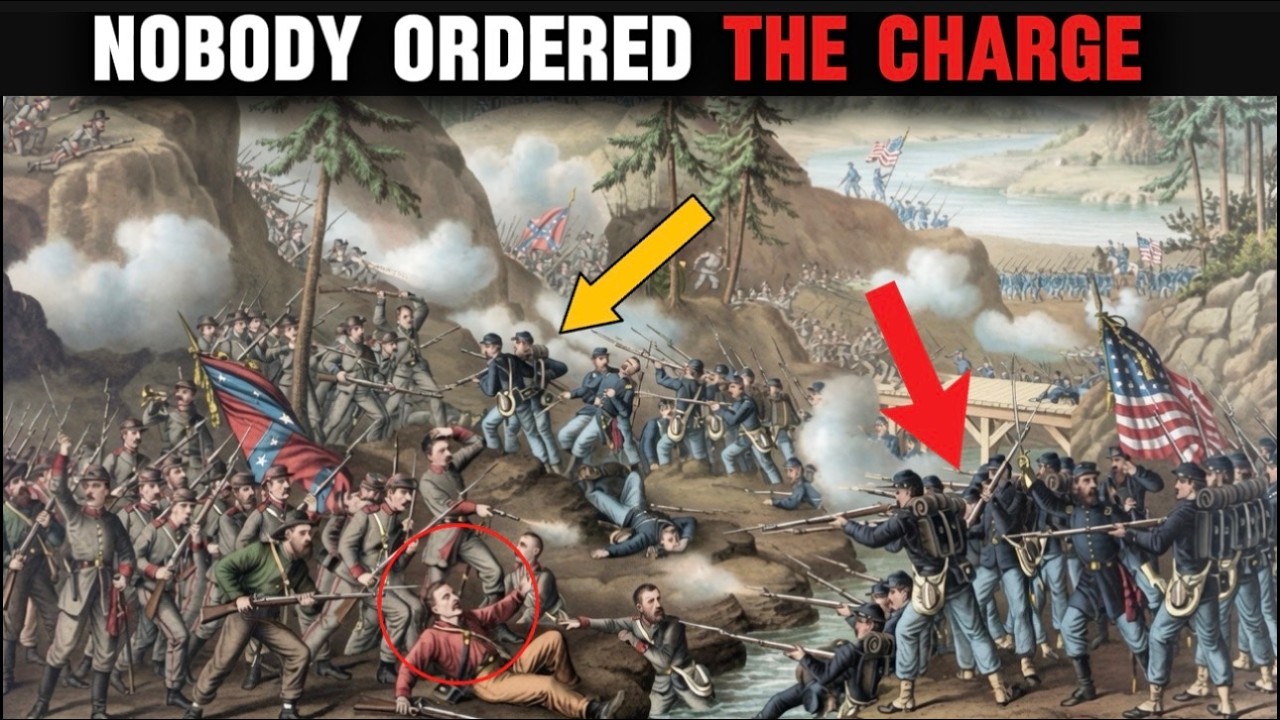
What happened next is one of the stranger moments in a war full of strange moments. Twenty-three thousand men of the Army of the Cumberland stepped off from Orchard Knob and began moving across the valley floor in parade-ground order, six divisions abreast, their flags snapping in the cold November air. Confederate artillery on the crest opened fire and men began falling, but the lines did not waver. They crossed the open ground and crashed into the rifle pits at the base of the ridge.
The Confederate defenders in those forward pits were caught between Union troops pouring over their works from the front and Confederate artillery above them that could not lower its fire enough to help. Hundreds surrendered immediately. Others scrambled up the slope. The rifle pits were taken in minutes.
And then the Army of the Cumberland did something nobody had ordered. They kept going. The men in the captured rifle pits looked up at the crest 500 feet above them and made, collectively and spontaneously, a decision that defied every rational calculation. They had been cooped up in Chattanooga for six weeks, half-starved and humiliated, carrying the memory of Chickamauga like a stone in the chest.
The men who had broken them there were up on that ridge. Men who would have called themselves sensible in any other setting found themselves climbing into direct fire because the men beside them were climbing, and that seemed, in the logic of that specific moment, like reason enough. The Confederate defenders watched with disbelief. They had built their position on the assumption that the slope itself was the defense.
But the men coming up were not moving in the slow, rigid formation that made volleys decisive. They were climbing in broken groups, using every fold in the ground and every stump and outcrop for cover, advancing in rushes, keeping below the horizon of fire from the guns above. The artillery on the crest, positioned for long-range work, was nearly useless against men 30 yards below the muzzles. The Confederate line on the crest was not continuous.
It had gaps between regiments, places where defenders had never been fully positioned because Bragg had assumed the slope made such density unnecessary. The first Union troops reached the crest through those gaps and poured over the top before the defenders on either side could respond. The moment the crest was breached in multiple places simultaneously, the entire Confederate position unraveled with a speed that shocked both armies. Bragg tried to rally his men, riding along the back of the crest and calling to regiments that were already running.
They did not stop for him. Some kept their discipline and retreated in reasonable order. Others threw down their rifles and ran without any order at all, streaming down the eastern slope in a mass no officer’s voice could reach. Bragg himself barely escaped capture.
The whole thing, the crossing of the valley floor, the seizure of the rifle pits, the unsanctioned climb, the breach of the crest, had taken roughly two hours. Two hours to destroy a position Bragg had been fortifying for six weeks. Grant, watching from Orchard Knob, was not pleased in the way a man who had planned something and seen it work might be pleased. He had not planned this.
He turned to Thomas and asked who had ordered those men up the ridge. Thomas said it wasn’t him. Gordon Granger said it wasn’t him either. Grant reportedly said somebody would have been in serious trouble if it had gone the other way.
Sheridan’s division, which reached the crest first, pursued the fleeing Confederates well past darkness, capturing guns and prisoners for miles into the night. The Army of the Cumberland lost around 5,800 men across the three-day operation. Bragg’s Army of Tennessee lost roughly 6,700 along with 40 artillery pieces and thousands of small arms abandoned in the rout. By the arithmetic of Civil War battles, which tended to punish attackers far more severely than defenders, the numbers were nearly inexplicable.
An attacking army had crossed an open valley and climbed an entrenched ridgeline and lost fewer men than the defenders. Bragg submitted his resignation the day after the battle. Jefferson Davis accepted it. The Army of Tennessee passed to William Hardee on an interim basis and eventually to Joseph Johnston.
Bragg spent the rest of the war as Davis’s personal military advisor in Richmond, a position that accomplished very little. The fall of Missionary Ridge opened the deep South to Union invasion in a way that had seemed impossible just two months earlier. Chattanooga was the railway hub of the Western Confederacy, connecting the Eastern and Western theaters. With the city secured and Bragg’s army shattered, Grant had a platform from which the next year’s campaigning could proceed.
He was promoted to Lieutenant General and given command of all Union armies in March 1864. Sherman inherited command in the West, and the campaign that destroyed Atlanta began from the base that the Army of the Cumberland had held through starvation and secured through an uphill charge nobody had ordered.