The same week the world learned of the atomic bomb over Hiroshima, America’s top fighter ace was killed during a routine test flight in California. Richard Bong, just 24 years old, had survived 40 aerial combat missions in the Pacific—a record of 40 confirmed kills that made him the most successful fighter pilot of World War II. He died not from enemy fire but while testing the very technology that would soon make his hard-won skills obsolete. Bong’s death on August 6, 1945, happened the same day the first atomic bomb was dropped on Hiroshima.
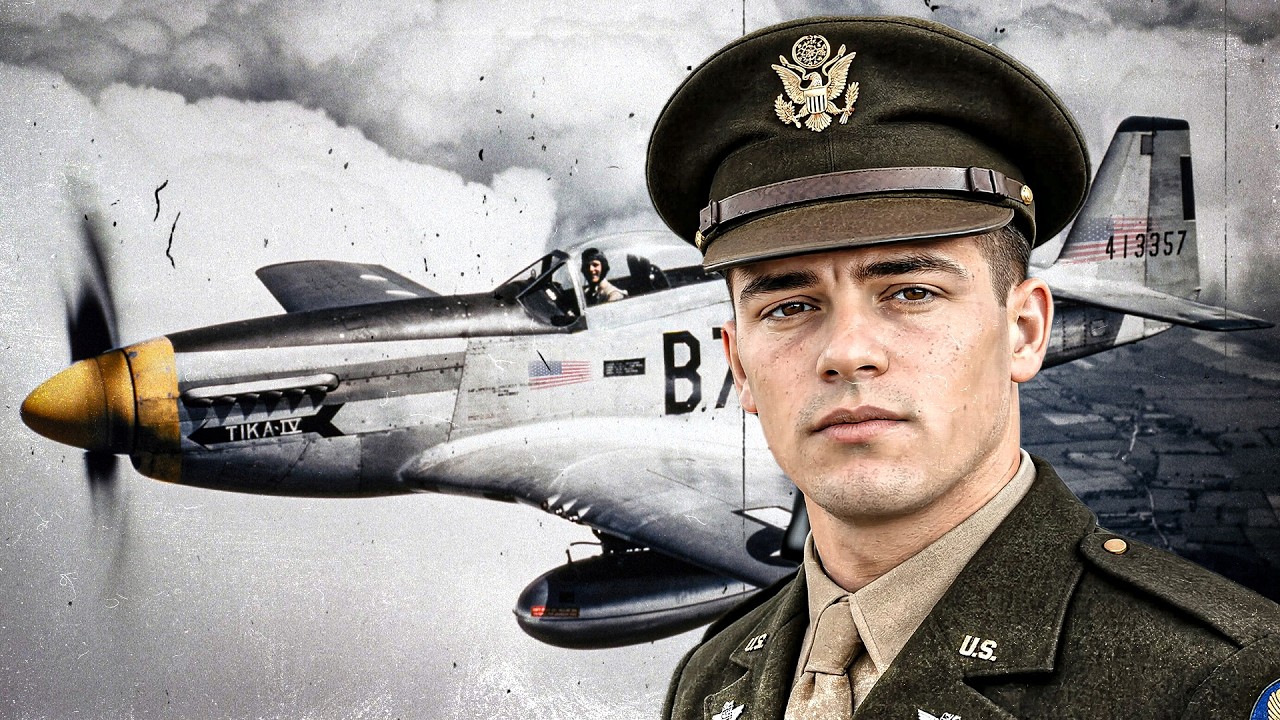
He was flying a Lockheed P-80 Shooting Star, one of the Army’s first jet fighters, when its engine failed at takeoff. The pilot who had become America’s most celebrated aviator was killed by the machine designed to replace his generation of combat flying. His legendary wartime record would soon become a historical footnote. For many of the other top aces, the transition to peacetime proved just as devastating.
Gregory Boyington, born in 1912, led the famous Black Sheep Squadron and spent the final months of the war as a Japanese prisoner after being shot down over the Pacific. He returned home to hero’s parades and front-page headlines, but his post-war years brought a private struggle with the transition to civilian life. Relieved from active duty in 1947, Boyington spent years working as a professional wrestling referee just to pay his bills—a sharp contrast to the Medal of Honor and the fame that had defined his homecoming just a few years earlier. He later summed up his experience bluntly: “Show him a hero, and he’ll show you a bum.
” He died in a hospital in 1988. David McCampbell, born in 1910, remained the Navy’s all-time leading ace with 34 kills, nine of them in a single mission—an achievement unrivaled in American naval aviation history and one that earned him the Medal of Honor. Despite being the most successful naval pilot in U. S.
history, his post-war career was increasingly marginalized as the Navy shifted toward nuclear carriers and a radically different vision of air power built on technology and doctrine that had no use for the dogfighting skills that made him famous. He retired as a colonel in 1964—a rank far below what his wartime record might suggest—and lived a quiet life in Florida, largely ignored by the national press. Gabby Gabreski took an opposite path and never fully left the military. Born in 1919, he became America’s top pilot in the European theater with 28 kills before being captured by German forces after crashing his P-47 while attacking an enemy airfield.
He spent the rest of the war as a prisoner, far from the aircraft that made his reputation. Unlike Bong, Boyington, and McCampbell, Gabreski remained in uniform after 1945. When the Korean War broke out, he became a hero once again—one of only a few American pilots to achieve that distinction in two separate wars fought with entirely different generations of aircraft. He eventually retired to corporate work, but colleagues and historians continued to view him as a man belonging to what the record calls a different era of aerial combat—a living link between propeller-driven warfare and the jet age that had already killed Bong during testing back in 1945.
He died in 2002. The public once labeled these men knights of the sky. The archives would quietly file them as excess in the years that followed—men whose unique wartime skills had no obvious use in a postwar nation building for itself a different type of conflict, increasingly fought by the very machines their service had helped bring into existence. What the public remembers rarely matches what military records actually show.
The most successful American fighter pilots did not glide smoothly from wartime stardom to peacetime achievement. Bong didn’t even survive to see peace. Boyington survived the war only to battle his own transition to peace, a Medal of Honor recipient working wrestling circuits for a paycheck—a fate the military parades and newspaper headlines at his homecoming never hinted at. McCampbell found no comparable role waiting in a Navy reorganizing itself around nuclear power and a new theory of naval warfare.
Only Gabreski found continuity, carrying his skill into a second war, yet even his career classified him forever as a relic of an older style of combat rather than a shaper of the new fight ahead.