In the final weeks of 2011, a soda quietly disappeared from store coolers across the American South. The green and silver cans had been on shelves for six years, but Coca-Cola simply stopped making them. There was no press release, no farewell campaign, and no explanation. The drink was called Vault.
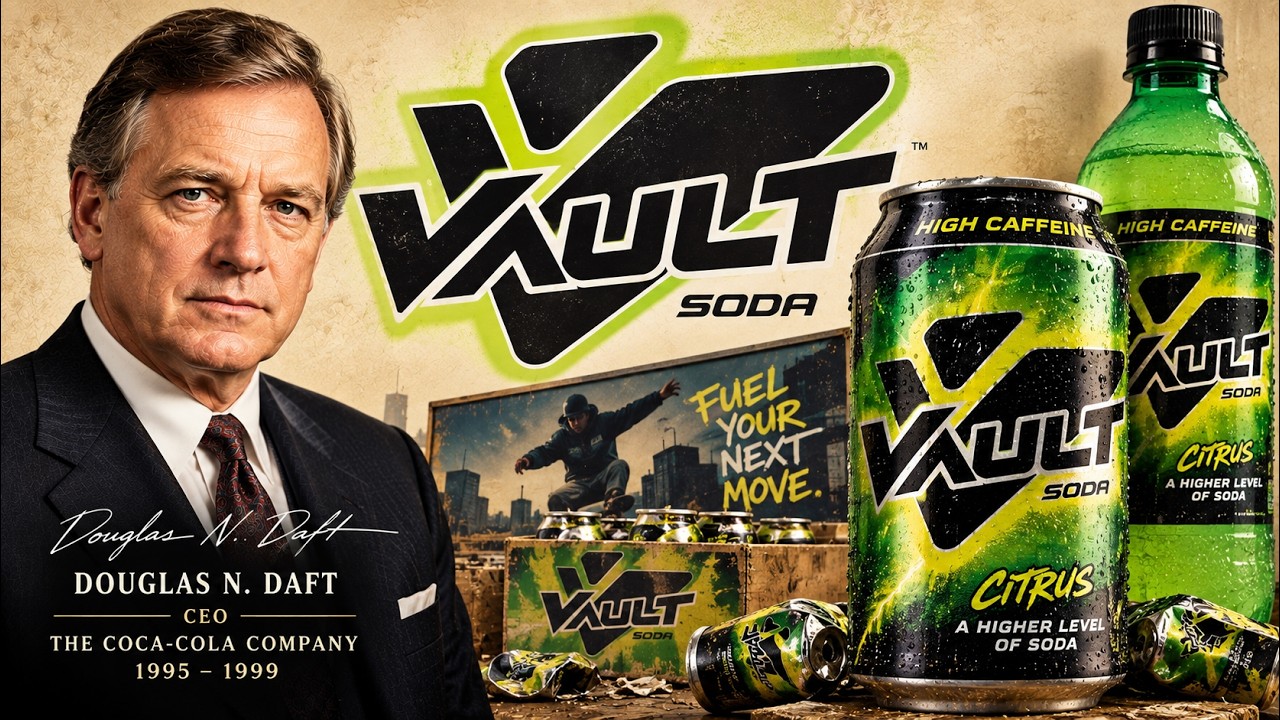
It carried more caffeine than Mountain Dew and promised the kick of an energy drink at the price of a regular soda, backed by the largest beverage company on Earth and a distribution network that reached nearly every gas station in the country. The drink that took its place was not new. It was Mellow Yellow, a citrus soda Coca-Cola had launched 32 years earlier to beat Mountain Dew. It had already failed at that job once.
Now the company was asking it to try again. The real story of Vault is not the story of one discontinued soda. It is the story of a 30-year war between the most powerful beverage company in the world and a lemon-lime soft drink born in the hills of Tennessee. Coca-Cola fought that war three times, and three times the mountain won.
The story begins in Knoxville, Tennessee, in 1940. Barney and Ally Hartman were bottlers, not chemists or inventors. They made their living filling glass bottles with soft drinks and moving them by truck to stores across the region. Knoxville in those years was a river city on the edge of the Appalachian Mountains.
The hills around the city had their own economy, and part of it was whiskey, much of it made without a license. The local slang for that whiskey was Mountain Dew. The Hartmans liked to drink their whiskey with lemon-lime mixer, but it was hard to find in Tennessee. So, by the most widely repeated account, they made their own.
It was a clear, sharp citrus soda meant to sit beside a bottle, not to replace it. They gave it the name of the thing it was built to accompany. For nearly two decades, Mountain Dew stayed small. It was a regional mixer sold in a handful of southern markets carrying a cartoon hillbilly on the label.
The Hartmans registered the trademark in the late 1940s, but they did not build an empire. They built a name. The drink that Americans came to know was shaped somewhere else. In Marion, Virginia, a small bottling operation called the Tip Corporation acquired the rights to Mountain Dew in the 1950s.
There, a bottler named Bill Jones reworked the formula. He added more citrus, more sugar, and more caffeine, and turned it from clear to a pale electric yellow-green. The new version reached stores around 1961, and it sold. In 1964, PepsiCo bought Mountain Dew.
What had been a Virginia and Tennessee curiosity now had a national distribution system behind it. Its slogan leaned into its roots: Yahoo Mountain Dew. To understand what came next, it helps to see the American soft drink shelf as it stood in the 1970s. There were colas led by Coke and Pepsi.
There were lemon-lime sodas led by 7Up and Sprite. And there was Mountain Dew. It was not quite lemon-lime and not quite anything else. It carried roughly as much caffeine as a cola and far more sugar and citrus bite than a Sprite.
It was the drink of long-haul truckers, third-shift mill workers, and farm hands in the middle of harvest. Coca-Cola, the company that owned the cola business worldwide, had nothing to put beside it on the shelf. Inside Coca-Cola’s headquarters in Atlanta, this was not a small matter. Mountain Dew was strongest in the South, in the company’s own backyard.
In 1979, Coca-Cola built its answer. It was yellow. It was citrus. It was sweet and loaded with caffeine.
The company called it Mellow Yellow. It was the first attempt. It would not be the last. Mellow Yellow arrived with a clear job: take the South back from Pepsi.
The formula followed Mountain Dew closely, a sweet citrus soda with roughly 50 mg of caffeine in every 12 oz can. It found drinkers. It did not find enough of them. Mountain Dew had a 15-year head start under Pepsi and a loyalty in rural America that no ad campaign could buy.
Mellow Yellow settled into a steady second place. That was a respectable result for most brands. For Coca-Cola in its own home region, it was a loss. In the summer of 1990, the brand got the biggest stage it would ever have.
Paramount released Days of Thunder, a stock car racing film starring Tom Cruise as a young driver named Cole Trickle. His car was number 51, painted bright yellow and green, and down its side in letters large enough to read from the grandstand was the name Mellow Yellow. For two hours in theaters across the country, the soda raced at Daytona. It was the most visible moment in the brand’s history.
Mountain Dew kept winning the war. Coca-Cola’s second attempt came as the decade turned. By the mid-1990s, Mountain Dew had reinvented itself around a younger drinker. Its ads showed skydivers, snowboarders, and mountain bikers under the slogan “Do the Dew.
” Sales climbed sharply. Coca-Cola answered with Surge. It first appeared in Norway in 1996 under the name Urge, and reached American stores in early 1997. Surge was louder than Mellow Yellow, greener, and aimed at teenagers.
Its slogan was “Feed the Rush. ”
For a few years, it sold well. Then the numbers slipped. By 2003, Surge was gone from most American shelves.
Two attempts, two retreats. And while Coca-Cola regrouped, a new kind of beverage was reshaping the market beneath both companies: the energy drink. Red Bull, an Austrian brand, had entered the United States in 1997. It came in a slim 8.
4-ounce can and sold for around $2, several times the price of a soda. Its promise was simple. It did not taste like a treat. It worked.
By the early 2000s, Monster and Rockstar had followed, and the energy drink category was growing at a pace the soft drink business had not seen in decades. The young drinkers Coca-Cola had tried to win with Surge were paying premium prices for small cans. In 2005, Coca-Cola tried a third time. The new drink was designed to sit between the two categories and take customers from both.
The company called it a hybrid energy soda. The formula was built around a number. A 12 oz serving of Vault carried roughly 70 mg of caffeine, compared with about 54 in Mountain Dew. A 20 oz bottle came in at more than 115.
The flavor stayed close to the citrus territory Mountain Dew owned, with a sharper finish and a small amount of fruit juice among the ingredients. It tasted like a soda. It hit closer to an energy drink. The packaging carried the same message.
The name suggested a bank vault, something locked and protected. The cans and bottles came in metallic silver and green with heavy lettering designed to look industrial, even armored. The price was the real weapon. Vault sold at ordinary soft drink prices, often around a dollar or a little more for a 20-ounce bottle.
That was more drink and more caffeine than a $2 can of Red Bull for roughly half the cost. For a young worker on a long shift or a college student on a long night, the math was obvious. The final advantage was one no energy drink startup could match. Vault did not need to fight its way into stores.
It rolled out first through test markets in the South and the Midwest, carried by the same bottlers and delivery trucks that stocked Coca-Cola in nearly every gas station, truck stop, and convenience store in those regions. Monster had to win each shelf. Vault already owned it. In the summer of 2005, the first cases of Vault reached stores in the American South.
The rollout moved market by market, following the routes of Coca-Cola’s regional bottlers. Georgia and the Carolinas came first, then Alabama and Tennessee, then parts of Texas and the lower Midwest. These were the states where Mountain Dew had been strongest for 40 years. The advertising made the promise in a single line: “Drinks like a soda, kicks like an energy drink.
” The slogan answered two questions at once. For the soda drinker, it said nothing would change except the effect. For the energy drink buyer, it said the effect would come without the medicinal taste and without the $2 price. The television spots that followed leaned on exaggeration and speed.
They showed ordinary young men finishing ordinary jobs at impossible pace after a single bottle. A lawn was cut in seconds. A room was painted before the camera could cut away. Vault did not promise extreme sports or mountain tops.
It promised to get the work done. The early numbers were strong enough to encourage expansion. Within about a year, Coca-Cola added to the line. Vault Zero arrived in 2006, sugar-free and aimed at drinkers who wanted the caffeine without the calories.
Vault Red Blitz followed, a red berry-flavored version with the same caffeine punch. Three products now carried the Vault name. The distribution map grew with it. What began as a southern test spread across a large part of the country, reaching dozens of states over the next few years.
It never became a truly national brand in the way Coke or Sprite were. In some cities, it was everywhere. In others, it never arrived at all. But in the places it reached, it found a place in daily routines.
It sat in the coolers of truck stops on Interstates 75 and 40, beside the jerky and the sunflower seeds. It was stocked in college town convenience stores in Georgia and Tennessee, where students bought it by the case before finals. It was carried in vending machines at warehouses and distribution centers where the night shift ran until dawn. These were the same drinkers Mountain Dew had built its empire on.
For the first time, Coca-Cola had a drink those drinkers were actually choosing. That first year proved the idea could work. What remained to be seen was whether it could last. The world Vault’s drinkers lived in was changing.
In November 2005, a few months after Vault reached its first stores, Microsoft released the Xbox 360. Online gaming moved from the edges of youth culture into the living room. Teenagers and young men played through the night against strangers across the country. The rituals of that world needed fuel, and the fuel was caffeine, sugar, and cold cans within arm’s reach.
Vault fit that world. It was cheaper than an energy drink, and a 20 oz bottle lasted longer than a small can. It could be bought in a 2-liter bottle for a whole night of play. The same years carried a heavier backdrop.
The United States was at war in Iraq and Afghanistan, and the country’s young service members had become some of the heaviest energy drink consumers in the nation. A study published by the Centers for Disease Control and Prevention in 2012, drawing on a 2010 Army survey, found that nearly half of the soldiers surveyed in Afghanistan drank at least one energy drink a day. Some drank three or more. The scale of what was happening in the beverage industry was hard to ignore.
Energy drinks, a category that barely existed in America a decade earlier, had grown by industry estimates into a business worth several billion dollars a year by the middle of the decade. Traditional soda sales had begun to slow, and the soft drink giants were losing young customers to something new. Coca-Cola’s answer was spread across more than one product. Alongside Vault, the company was also selling Full Throttle, a true energy drink in a tall can launched in 2004.
And Mellow Yellow, the brand from 1979, had never been discontinued. It still sat quietly in parts of the South doing the job it had always done. Coca-Cola was now running three different drinks at the same customer. Vault’s own peak is difficult to measure.
Coca-Cola never released separate sales figures for the brand, and industry trackers treated it as a small line within a very large portfolio. By most accounts, it did better than Surge had in its final years. By every account, it never came close to Mountain Dew, which by the late 2000s was selling several billion dollars worth of product a year. The single number that defined Vault was not a sales figure.
It was its caffeine, about 70 mg in every 12 ounces. That was more than Mountain Dew, more than Coke, and more than Pepsi. It was a soft drink built to be stronger than every other soft drink in the store. That same number placed it in a category it could not hold.
The first warning signs did not come from Vault itself. They came from the ground shifting beneath the entire soft drink business. In 2005, the year Vault launched, American soda consumption began a long decline. Total carbonated soft drink volume in the United States had peaked around 2004 and began falling almost every year after.
The decline was slow at first, but it did not reverse. Families were buying bottled water, sports drinks, and iced tea. Doctors, schools, and state legislators were beginning to talk openly about sugar and childhood obesity. Energy drinks were moving in the opposite direction.
Monster, sold by a California company then called Hansen Natural, was growing at a pace that astonished the industry. In some years, its sales rose by more than 50%. Red Bull kept expanding. Rockstar followed close behind.
This was the trap Vault had been built to escape. Instead, it walked straight into it. Vault’s promise was that it could be two things at once: a soda for soda drinkers and an energy drink for energy drink buyers. As the market split, that promise turned against it.
To the soda drinker, Vault offered more caffeine than they had asked for in a category they were starting to leave. To the energy drink buyer, it looked like a soft drink. It sat in the soda aisle. It was sold in 2-liter bottles and priced like a Sprite.
The drinkers who wanted the real thing wanted the tall black can with the claw marks. A hybrid is designed to win two markets. In practice, it often belongs to neither. The second pressure came from inside Coca-Cola’s own house.
In October 2008, Coca-Cola’s largest bottling partner reached a distribution agreement with Hansen Natural. Coca-Cola’s trucks, the same ones that had carried Vault into gas stations across the South, would now carry Monster into many of those same stores. The logic was simple. Monster was the fastest growing brand in the energy category, and Coca-Cola wanted a share of that growth rather than a fight against it.
For Vault, it meant a new rival on the same delivery routes. Where there had been one Coca-Cola caffeine drink in the cooler, there were now several: Vault, Full Throttle, and Monster. When the bottler loaded the truck, the brand with the fastest sales got the best shelf. The third pressure came from outside, in the form of scrutiny.
Between 2008 and 2010, researchers and public health officials began raising concerns about the caffeine content of energy drinks and highly caffeinated sodas, especially among teenagers. In late 2010, federal regulators acted against a separate category, alcoholic beverages mixed with caffeine. Vault was never part of that action. But the public conversation around caffeine was changing, and a soft drink marketed on its caffeine level was no longer an easy product to promote.
By the end of the decade, all three forces were pressing: a shrinking soda market, a sister brand taking the energy shelf, and a public growing wary of caffeine. Vault was still on the shelves. It was still selling, but it was selling into a narrowing space. Coca-Cola did not abandon Vault at the first sign of trouble.
For several years, the brand kept its place in the lineup and kept its flavors on the shelf. Vault Zero continued to sell to drinkers who wanted the caffeine without the sugar. Red Blitz stayed in coolers across the South. The brand held on in the markets where it had first found its footing.
Then the economy broke. The financial crisis of 2008 and the recession that followed hit the young working drinkers Vault was built for harder than almost anyone. Construction jobs vanished. Warehouse hours were cut.
College graduates moved back home. When people are counting every dollar, they buy the brands they know. For a caffeine soda in the South, that meant Mountain Dew. For an energy drink, it meant Monster or Red Bull.
A drink in the middle had little to fall back on. Through those years, Vault never received the kind of rescue Coca-Cola gives its flagship brands. There was no national relaunch, no major new campaign, and no celebrity deal. By most accounts, its distribution quietly narrowed.
Some bottlers dropped it. Some stores stopped reordering. In markets where it had once been easy to find, it became something drinkers had to look for. Inside the company’s portfolio, the question was no longer how to grow Vault.
It was whether Coca-Cola needed it at all. The company already owned a citrus soda in the South that bottlers knew how to sell. It was older and cheaper to support, and it had never gone away. That soda was Mellow Yellow.
In late 2011, the decision was made. Coca-Cola would stop producing Vault. In the markets where it had been sold, Mellow Yellow would take its place. The company made no public announcement that drew national attention.
The news reached drinkers the way news of a discontinued soda usually does: through empty shelf tags, store clerks, and online forums where people asked why they could no longer find it. There was no factory to close because Vault never had one. It had been made on the same lines as every other Coca-Cola drink. The bottlers simply changed the labels.
The syrup changed. The trucks kept running. The last bottles sold through. Stores did not reorder.
Shelf tags were quietly replaced. The green and silver cans were gone. Mellow Yellow stood in their place. Coca-Cola kept the name.
It never used it again. The third attempt was over. The mountain had won. Some discontinued brands come back.
In 2014, three years after Vault disappeared, Coca-Cola brought Surge back. The revival did not begin in a boardroom. It began with a group of fans on Facebook who called themselves the Surge Movement. For years, they wrote letters, collected signatures, and paid for a billboard near Coca-Cola’s headquarters in Atlanta.
In September 2014, the company released Surge again, sold online through Amazon. The first cases sold out within hours. Vault never got that second chance. There were petitions.
There were online threads, some of which ran for years, asking Coca-Cola to bring it back. But no movement grew large enough to move the company. The drinkers who had loved Vault had mostly moved on to Monster, to Mountain Dew, or to coffee. Coca-Cola held the name and left it on the shelf.
What remains of Vault lives in smaller places. Collectors trade unopened cans and bottles online, where sealed examples commonly sell for anywhere from $10 to more than $50 depending on the flavor and condition. The soda inside has long since lost whatever it once was. Buyers are not paying for the drink.
They are paying for the can. On forums and message boards, former drinkers compare store-brand citrus sodas looking for one that comes close. Most agree that none of them quite does. Vault’s balance of caffeine, sugar, and citrus bite was built for one purpose: keeping someone awake and working without the taste of coffee or the price of an energy drink.
For the trucker on the last 300 miles of a run, or the student facing a final exam at 8 in the morning, it filled a gap that nothing else in the cooler filled in quite the same way. When it disappeared, that gap did not close. It was split between two products that each did half the job. There is no brewery to visit and no factory ruin to photograph.
Vault was made on Coca-Cola bottling lines that are still running across the South. The machines that once filled its green and silver bottles are filling other drinks. And there is one last irony in the story. Mountain Dew, the drink that beat Coca-Cola three times, was never meant to be drunk on its own.
The Hartman brothers made it in Knoxville as a mixer, something to pour beside a glass of whiskey. It was a supporting player, a drink built to accompany something else. It went on to outlast Mellow Yellow’s first campaign, then Surge, and then Vault. And Mellow Yellow, the brand Coca-Cola had once let fade, outlived both of the drinks that were supposed to replace it.
The story of Vault says something about what even the largest companies cannot do. Coca-Cola had money, trucks, shelf space, and one of the most powerful marketing operations ever assembled. It could put a drink in nearly every cooler in the South. What it could not do was make people choose it over a drink they already trusted.
Loyalty in the soft drink business is not bought in a single season. It is built over decades, one shift and one long drive at a time. On a two-lane highway in eastern Tennessee, about an hour from where the Hartman brothers first bottled their mixer, there is a gas station open late into the night.
Inside, a truck driver slides open the cooler door, reaches past the energy drinks and the colas, and takes out a cold yellow-green bottle for the road ahead.