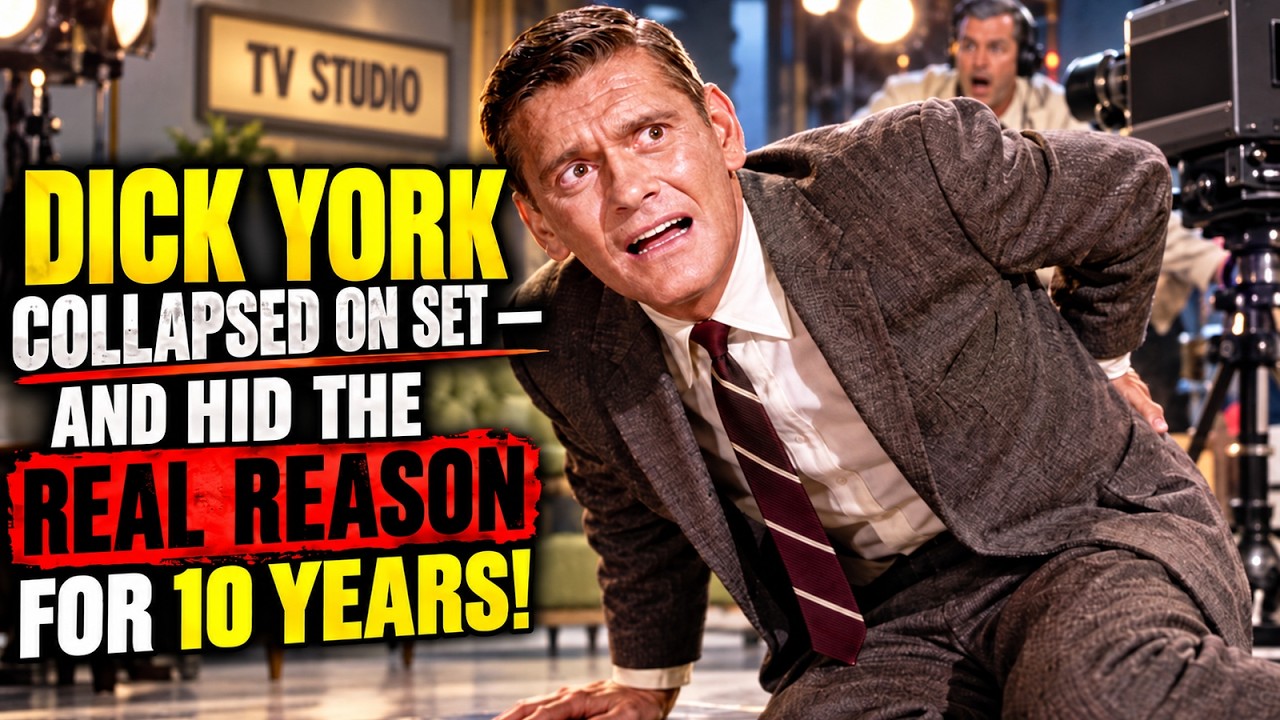
In January 1969, under the lights of a Los Angeles sound stage, one of America’s most familiar comic actors suddenly went into convulsions and collapsed. Dick York was 40 years old, a husband, father of five, and star of one of the most successful television comedies in the country. He had spent years making millions laugh while hiding a back injury that never stopped hurting. That day he woke up in a hospital, spoke with his longtime producer-director, and faced a sentence he had been refusing to say to himself.
He could not keep doing this. He would never return to “Bewitched. ”
When the new season arrived that autumn, Samantha Stevens still had a husband named Darren, but the face was different. No farewell episode explained it.
Dick York was simply no longer there. For years afterward, many viewers reduced the story to a piece of television trivia: the first Darren had been replaced by the second. What almost nobody watching at home knew was that York’s departure was only the beginning. He would spend the next years battling dependency, withdrawal, chronic pain, foreclosure, and welfare before a trip to Western Michigan nearly two decades later unexpectedly opened the final chapter of his life.
Born Richard Allen York on September 4, 1928, in Fort Wayne, Indiana, he grew up in a working-class Chicago family shaped by the Depression. Money was often so scarce that the family risked eviction, and York later recalled seeing his father compete for discarded food. By the time he was in his early teens, York was a professional radio actor, best known for “That Brewster Boy” and “Jack Armstrong, The All-American Boy. ” Even then, his instrument was his voice.
Around age 15, he met Joan Alt, a girl of about 12 also connected to the radio world. She would become the central relationship of his life, known to him as Joey, long before fame arrived. Richard and Joan married on November 17, 1951, in Pearl River, New York. He was 23; she was 20.
In New York, York worked steadily in live television and on stage, building exactly the foundation a serious young actor of his generation needed. In 1958, he joined the cast of “They Came to Cordura,” starring Gary Cooper and Rita Hayworth, directed by Robert Rossen. During a demanding sequence involving a railroad handcar, York was left bearing an enormous share of the weight when the other men released it at the cut. His spine was wrenched and the muscles around it badly torn.
He kept working. The injury became chronic, and over time the medications used to make work possible created another problem layered on top of the first. In 1960, York appeared opposite Spencer Tracy in “Inherit the Wind,” playing the young schoolteacher whose arrest sets the film’s drama in motion. He held his own, but the back pain followed him into the job, and treatment increasingly involved painkillers, muscle relaxants, sleeping pills, and cortisone.
York later spoke plainly about becoming dependent on the prescribed medication. The dependency built slowly, and by the peak years of “Bewitched,” he said, it had become a serious problem. “Bewitched” premiered in September 1964. York played Darren Stevens, the harried advertising executive at the center of the show, opposite Elizabeth Montgomery as Samantha.
Their chemistry was immediate, and the show was an instant hit, ranking second in its first season behind only “Bonanza. ”
Every morning before the studio, York had to figure out how to get his body to work. He was in serious back pain the entire time he shot the series and was on prescription painkillers the entire time as well. According to family accounts, Joan woke up earlier than she needed to so Richard would not face the first hour of the morning alone, laid out his medication, and managed the phone calls when he was too tired to speak.
Those who worked on the set have said Elizabeth Montgomery was aware early on that her co-star was in real physical trouble and was quietly protective of him. The friendship is documented; the exact daily choreography is part memory, part reconstruction. There is a persistent rumor that the professional chemistry concealed a romantic relationship. No reliable public evidence establishes such a relationship, and York’s departure was rooted in his physical condition.
By the fifth season, York was, in his own later description, dependent on painkillers to a degree that had begun to frighten him. In January 1969, seriously ill with a dangerously high fever and taking strong antibiotics, he went to work anyway. During preparation for a special-effects sequence, while positioned above the stage, his body finally gave out. He went into convulsions and lost consciousness.
When he came back to himself, he was in a hospital. The decision was made there. Producer-director William Asher asked whether he wanted to quit. York’s remembered answer was simple: “If it’s all right with you, Billy.
”
Dick Sergeant took over as Darren Stevens the following season. The show continued for three more years. For York, the real story was just beginning. He remained in California, describing the next 18 months as a drug-induced haze.
Then he decided to stop. He moved temporarily to his mother’s home in Buena Park so Joan and the children would not have to witness the withdrawal directly. The withdrawal was brutal. York later spoke of hallucinations, sleeplessness, seizures, and internal noise he compared to bagpipes playing day and night.
It took about six months before the hallucinations stopped. Sobriety did not restore the network salary or a deteriorating spine. The family invested their savings in an apartment building in West Covina, but tenants struggled to pay rent, and York, remembering his own childhood poverty, found it difficult to evict them. The mortgage went unpaid, and the building was foreclosed on.
By 1976, York received his first welfare check. For roughly a decade, the family survived on welfare, unemployment support, and occasional acting work, including guest appearances on “Simon and Simon” and “Fantasy Island. ”
York had also been a very heavy smoker, and emphysema began to close in on him. In the mid-1980s, Joan’s father died, and the couple traveled to Rockford, Michigan, for the funeral.
York’s emphysema worsened badly during the visit. He collapsed in the yard of his in-laws’ home and never returned to California. In Rockford, York lived on a modest Screen Actors Guild pension, broke, largely housebound, and tethered to oxygen. Yet it was there that he found his final purpose.
A friend asked him to record encouraging messages for a young girl in Chicago who had been in a coma. He began making tapes for her and for others who were sick or shut in. Then he read about the Federal McKinney Act and government surplus programs for homeless assistance. He began calling government agencies, relief workers, radio programs, and shelters, identifying surplus goods and moving them where they were needed.
He called the effort “Acting for Life. ” It was improvised: a few friends, a mailing address, a telephone, and an extremely stubborn sick man. In 1988 alone, York’s efforts helped release enough surplus clothing for roughly 15,000 changes of clothes. He pushed to move thousands of mattresses and blankets out of storage.
Thousands of pairs of pantyhose arrived at a Grand Rapids shelter after he spoke about warmth. Thousands of cans of orange juice concentrate found their way to the Salvation Army. A reporter who visited in 1989 found him in an old brown lounge chair in the corner of the living room, surrounded by mail and tapes, wearing a worn bathrobe and slippers, with oxygen close at hand. By then York knew the emphysema was killing him.
He joked about being an old actor with a hose in his nose and talked about helping people on the street. He said he felt wonderful; it was his body that was dying. Joan was still there. They had been married for nearly four decades.
Dick York died on February 20, 1992, at Blodgett Memorial Medical Center in Grand Rapids, Michigan. He was 63. He was buried at Plainfield Township Cemetery in the Rockford area. His memoir, “The Seesaw Girl and Me,” was published posthumously in 2004, with a forward by Joan.
She died in January 2012 at the age of 80. The story of Dick York is not a straight line from fame to tragedy. It is a life with damage, mistakes, poverty, work, love, and usefulness at the end.
The boy in the Chicago radio studio, the actor on the Hollywood set, the patient in the California hospital, the man accepting welfare, and the man on oxygen in Rockford were connected by one thread: persistence, and a voice used in service of others.