The gunshots outside an Italian restaurant in Studio City ended Bonnie Lee Bakley’s life and turned her husband, Robert Blake, into one of America’s most shocking murder suspects. The public watched in disbelief as the beloved child star from the 1930s was led away in handcuffs, his face hardened by decades of struggle. Before the scandal, Blake was remembered as Mickey, the lovable character from The Little Rascals who captured millions of hearts. That glittering fame masked a brutal childhood, one he later described in harrowing detail, involving abuse that scarred him for life.
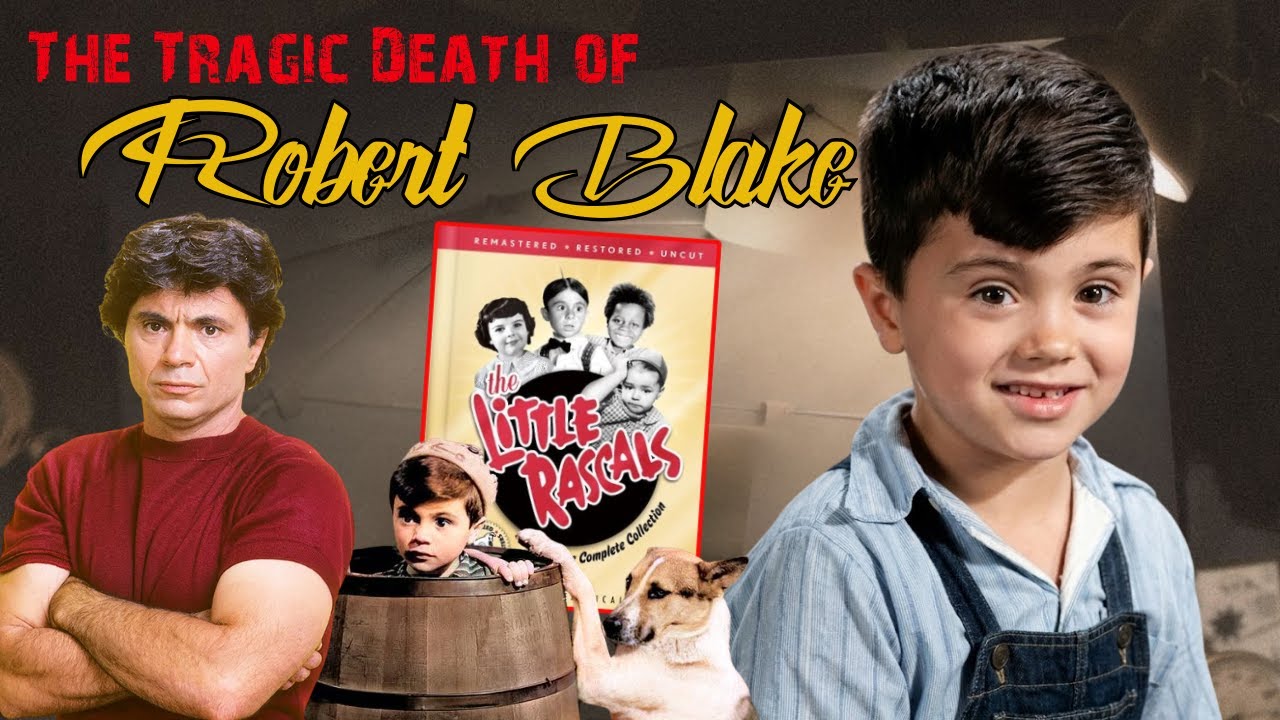
Born Michael James Gubitosi in Nutley, New Jersey in 1933, he never had the chance to be a toddler. His father, Giacomo Gubitosi, was an Italian immigrant with artistic pretensions and a severe drinking problem. By the time Michael was 2 years old, he was working. His father assembled him and his siblings into a vaudeville act called The Three Little Hillbillies.
The reality was brutal. If the children missed a cue or the audience didn’t clap loudly enough to satisfy Giacomo’s ego, there was hell to pay at home. The children learned early that their father’s love was nonexistent and his rage was inevitable. In 1938, Giacomo moved the family to Los Angeles, drawn by the money he saw in Hollywood.
Behind the closed doors of their cramped apartment, a nightmare was unfolding. Blake later spoke of a father who didn’t just beat him, but tortured him. Punishment for minor infractions meant being locked in a pitch-black closet for hours. He recalled being forced to eat his dinner off the floor like a dog.
School offered no escape. He was small, poor, and had the wrong ethnic background in a very Anglo-centric Los Angeles. He was bullied relentlessly and expelled from multiple schools for fighting. By age 6, he had learned two lessons that would define his adult life: people are dangerous, and you have to hit them before they hit you.
In 1939, at age 6, he landed at MGM. He replaced the character Porky in the popular Our Gang shorts, later known as The Little Rascals. He played Mickey, the cute, pitiable kid who always seemed to be the butt of the joke. On screen, he was adorable with big, expressive eyes.
Off screen, he was miserable, filming 40 episodes between 1939 and 1944 while suffering from malnutrition and abuse at home. The set was a high-pressure environment. Directors were demanding, and parents of the other children were competitive, often sabotaging other kids to get their own children more screen time. Blake watched other child actors undergo similar pressures and realized that as long as he was cute, he was safe.
But he knew cute doesn’t last forever. When Our Gang ended, he became Little Beaver, an indigenous sidekick in Red Ryder Westerns. For 23 films, he played a racial caricature speaking broken English. It was demeaning work, but it was work.
In the Gubitosi household, if you weren’t working, you were in danger. In 1948, he was cast in The Treasure of the Sierra Madre, holding his own against Humphrey Bogart at age 15. He had an intensity that a teenager shouldn’t possess, an intensity born of fear. He knew how to read adults because his survival depended on it.
Childhood fame has an expiration date. By 1950, at age 17, Robert Blake was washed up. The studios didn’t want a brooding adolescent. To escape his father, who still controlled his money, he joined the US Army.
The military didn’t tame him; it just suppressed the rage for a while. When he was discharged at 21, he spent two years in a haze of heroin and cocaine, dealing small amounts to keep the habit going. He was living on the fringes of society, drifting toward a prison cell or an early grave. With a survival instinct that bordered on supernatural, Blake cleaned up.
He walked into an acting class taught by Jeff Corey. This was the era of method acting, using your own pain to fuel the performance. Robert Blake had a lot of pain to mine. For a decade, he ground out a living in small TV roles, playing heavies, thugs, and Indians.
He built a reputation as a talent, but also as a difficult man. He carried a chip on his shoulder the size of the Hollywood sign. Then came 1967. Director Richard Brooks was casting for the film adaptation of Truman Capote’s In Cold Blood.
They needed someone to play Perry Smith, a real-life drifter and killer who had slaughtered a family in Kansas. Blake didn’t just understand Perry Smith; he felt him in his marrow. The similarities were unnerving. Both men were short, abused by alcoholic fathers, and haunted by tragic mothers.
During filming, Blake didn’t act, he channeled. In a pivotal scene where Smith recounts a dream about a giant yellow bird, the rain from the window pane cast shadows on his face that looked like tears. The director didn’t call cut. It became one of the most haunting images in cinema history.
The industry that had discarded him suddenly hailed him as a genius. He was compared to Marlon Brando and James Dean. He was 34 years old, and finally respected as an artist. But the role took a toll.
Blake later admitted that shedding the skin of Perry Smith was harder than putting it on. In 1975, ABC created Baretta for him. Tony Baretta was an undercover cop who didn’t play by the rules, living in a rundown hotel room with a cockatoo named Fred. It was a smash hit.
The catchphrase, “Don’t do the crime if you can’t do the time,” entered the national lexicon. Blake won an Emmy Award for Outstanding Lead Actor in a Drama Series. Suddenly, the boy who had been forced to eat off the floor was earning $100,000 an episode. But success didn’t mellow Robert Blake; it made him paranoid.
He became obsessed with control. On the set, he would rewrite scripts on the fly, scream at directors, and lock himself in his trailer for hours. He wasn’t just a diva, he was a man at war. The studio tolerated the abuse because Blake was making them money.
They smiled and cashed the checks, but they didn’t forget. When Baretta ended in 1978, Blake was wealthy and exhausted. He retreated to his compound, increasingly isolating himself. His choice of roles in the 1980s and ’90s revealed a disturbing pattern.
He seemed drawn to monsters. In 1993, he played John List, a real-life accountant who methodically murdered his family. Watching Blake methodically clean the dishes after slaughtering his family on screen was terrifying because it felt so clinical. His final film role was perhaps the most prophetic.
In 1997, David Lynch cast him in Lost Highway as the Mystery Man, a pale figure with unblinking eyes who delivers one of cinema’s most unsettling monologues. It was the last time Robert Blake would ever appear in a major motion picture. By 1999, Blake was 66, semi-retired and living alone in his fortress in Studio City. He had been married once before to actress Sondra Kerr, a marriage that lasted 22 years and produced two children before ending in a bitter divorce in 1983.
He described himself as a monk, but even monks get lonely. That loneliness walked into a jazz club in 1999. Her name was Bonnie Lee Bakley. Bonnie was, in many ways, the female equivalent of Blake’s darker side.
Born in New Jersey to a poor family, she learned early that her looks were her only currency. She was a career grifter with a rap sheet that included drug possession, fraud, and counterfeiting. Her main hustle was the lonely hearts scam, placing ads to solicit correspondence from lonely men, then spinning tales of woe to get them to send checks. But Bonnie’s true addiction was celebrity.
She kept detailed journals and scrapbooks of famous men she intended to seduce. She had been married nine times. Her goal was simple: have a baby with a celebrity. A baby was a paycheck, a baby was a ticket to the Hollywood Hills.
She met Blake at a jazz club. He was sitting alone. She was charming and attentive, projecting an air of vulnerability that Blake found irresistible. He didn’t know about the scams or the scrapbooks.
At the same time, Bonnie was also seeing Christian Brando. When she became pregnant in 2000, she told Christian it was his. The baby was named Christian Shannon Brando. But a paternity test showed Christian Brando was not the father.
Robert Blake was. When Blake found out he was the father, he was furious. He felt tricked and used. He hired private investigators who uncovered her past.
Most men would have written a check and walked away. But Robert Blake had a code, twisted and rigid, forged in the trauma of his own childhood. He swore that no child of his would grow up without a father. In November 2000, Robert Blake married Bonnie Lee Bakley.
It was not a wedding of love; it was a hostile merger. Blake moved Bonnie onto his property but relegated her to the guest house. He lived in the main house with their daughter, Rose. He openly despised his wife, calling her “that woman.
” He hired bodyguards to watch her. Bonnie was miserable. She had gotten what she wanted, the celebrity marriage, but it was a hollow victory. She was a prisoner in a guest house, living in fear of Blake’s explosive temper.
The atmosphere was toxic. By spring 2001, the situation had become unsustainable. On May 4th, 2001, Blake suggested dinner at Vitello’s, his favorite Italian spot on Tujunga Avenue. Bonnie agreed.
They got into Blake’s car and drove into the California night. Around 8:30 p. m. , Blake’s black Dodge Stealth pulled up near the restaurant.
Blake parked on Woodson Avenue, a residential side street around the corner, a darker spot shaded by trees and construction dumpsters. He would later claim he parked there to avoid the paparazzi. Inside, the dinner was swift and seemingly uneventful. They sat at table 41, a booth near the back.
Witnesses later recalled that Blake seemed distracted while Bonnie appeared nervous. At approximately 9:30 p. m. , Blake paid the bill and they walked out.
According to Blake, as they approached the car, he realized he had left his . 38 caliber revolver behind in the booth at Vitello’s. He claimed he carried it for protection. “Wait here,” he told Bonnie.
“I have to go back. ”
Witnesses inside Vitello’s confirmed seeing him return. He looked agitated but not frantic. He retrieved the gun, drank a glass of water, used the restroom, and lingered for a moment.
Then he walked back to the car. He found the passenger window shattered. Bonnie Lee Bakley was slumped over in the seat, struggling to breathe. She had been shot twice.
One bullet had passed through her shoulder. The second had entered her right cheek and lodged in her brain. Blake did not call 911 from a cell phone. He did not try to drive her to the hospital, which was only blocks away.
Instead, he ran to a nearby house and began pounding on the door. “Help! Help! My wife has been hurt!
” he screamed. The homeowner called 911. When paramedics arrived, Blake was sobbing and pacing in circles. But Detective Ron Iddo of the LAPD noted in his report that for all the noise Blake was making, his eyes were surprisingly dry.
It was a performance, they suspected. Bonnie Lee Bakley was pronounced dead at the scene. She was 44 years old. From hour one, Robert Blake was the prime suspect.
The police theorized Blake felt trapped, wanted sole custody of his daughter, and decided to eliminate the problem. They believed the forgotten gun story was a fabrication designed to create an alibi. However, the forensic evidence refused to cooperate. They tested Blake’s hands for gunshot residue.
While trace elements were found, the defense argued they were consistent with simply handling his own weapon. Blake’s . 38 revolver had not been fired. In a dumpster nearby, they found the actual murder weapon, a vintage World War II era German Walther P38 pistol.
It had been wiped clean, no fingerprints, no DNA. The serial number had been filed off, and tracing it led to a dead end. For a year, Blake remained a free man while the LAPD worked to build a case. Then they found the stuntmen.
Gary McLarty and Ronald Hambleton told police that Blake had attempted to hire them to kill Bonnie. McLarty claimed Blake showed him pictures of Bonnie and asked, “How would you do it? ” Hambleton claimed Blake drove him out to the desert and pointed out a spot where a body could be buried. On April 18th, 2002, Robert Blake was arrested at his sister’s home.
The images were flashed across the world: Baretta in handcuffs. He was charged with one count of murder with special circumstances and two counts of solicitation of murder, facing the death penalty. The trial began in late 2004. Blake fired his first lawyer and his second.
He finally hired M. Gerald Schwartzbach, a tenacious defense attorney from San Francisco. The prosecution, led by Deputy District Attorney Shelley Samuels, laid out a case built on circumstantial evidence. They argued Blake had a powerful motive, created the opportunity by luring her to a dark street, and attacked his alibi as far too convenient.
The two stuntmen swore under oath that Blake had tried to hire them to kill her. Schwartzbach went to work with a sledgehammer. His primary target was the credibility of the stuntmen. They were heavy, chronic users of methamphetamine and cocaine.
Schwartzbach painted a picture of two burned-out junkies desperate to please the police to avoid their own legal troubles. Then Schwartzbach attacked the forensic void. “Where is the blood? ” he asked.
“If Blake shot her at close range, where was the blowback? There was none on his clothes. Where is the gunshot residue? ” The particles found on Blake were consistent with the gun he carried, not the murder weapon.
Schwartzbach introduced an alternative theory: Bonnie’s dark past. She had scammed hundreds of men, sold nude photos to prisoners, and had enemies everywhere. “Who killed Bonnie Lee Bakley? ” he asked.
“Take a number. ”
The jury deliberated for 9 days. On March 16th, 2005, they returned a verdict: not guilty of the crime of murder. They also acquitted him on one count of solicitation and deadlocked on the second.
Blake collapsed into his lawyer’s shoulders, sobbing. Robert Blake walked out of the courthouse a free man. But freedom is not the same as exoneration. The court of public opinion does not require beyond a reasonable doubt.
The Bakley family filed a wrongful death civil lawsuit. In civil court, the rules are different. You only need to prove it is more likely than not that he did it. Bonnie Lee Bakley’s four children filed the suit, and the trial began in late 2005.
This time, Robert Blake took the stand. The jury saw his anger and his arrogance. The defense strategy that worked in criminal court failed to persuade the civil jury. On November 18th, 2005, the civil jury found that Robert Blake had intentionally caused the death of Bonnie Lee Bakley.
They ordered him to pay $30 million in damages to her children. Financially, it was a death sentence. Blake filed for bankruptcy. The Studio City compound was sold.
His fleet of cars was liquidated. He was legally innocent of murder, yet legally liable for the death. The years following were a slow, grinding decline. Hollywood pretended he didn’t exist.
The phone fell silent. Blake moved into a small apartment and lived largely on his Screen Actors Guild pension. He became a ghost in the city he used to rule. In his final years, Blake discovered YouTube.
He launched a channel with defiant slogans like “Robert Blake, I ain’t dead yet. ” The videos were raw, unedited transmissions of a man unraveling. He wore an eye patch and ranted about conspiracies and betrayals. He would break down weeping, invoking the memory of his childhood.
“I’m 85 years old,” he would shout. “I’m broke. I’m hungry, and I’m innocent. ”
Amidst the noise, there was a silent victim: Rose Lenore.
The baby found in the car that night grew up in the shadow of a tragedy. She was raised by Bonnie Lee Bakley’s eldest daughter, Holly, and eventually adopted by her. She grew up in a house that believed Robert Blake was a monster. In 2019, as a young adult, she made the decision to reach out to him.
They met and spoke. “I don’t know if he did it,” she told the press. “I just know he’s my father. ” She described their relationship as complicated.
Robert Blake died on March 9th, 2023 from heart disease. He was 89 years old. The obituaries were factual and heavily focused on the murder trial. Days later, during the 95th Academy Awards, Robert Blake was excluded from the In Memoriam segment.
Even in death, Hollywood refused to acknowledge him. The criminal court said no. The civil court said yes. The public remains divided.
Robert Blake spent 89 years trying to survive his own life, wearing the masks of Mickey, Little Beaver, Perry Smith, and Tony Baretta. In the end, perhaps he wore the mask for so long that it fused to his face.