Late one afternoon in a large Philadelphia household, a young girl was locked inside a closet by one of her sisters. She did not cry out. She simply sat down in the dark, took out her dolls, and quietly played by herself until someone finally let her out. That child would grow up to become Grace Kelly, one of the most photographed women in the world, a Hollywood legend who gave up her career to become a European princess.
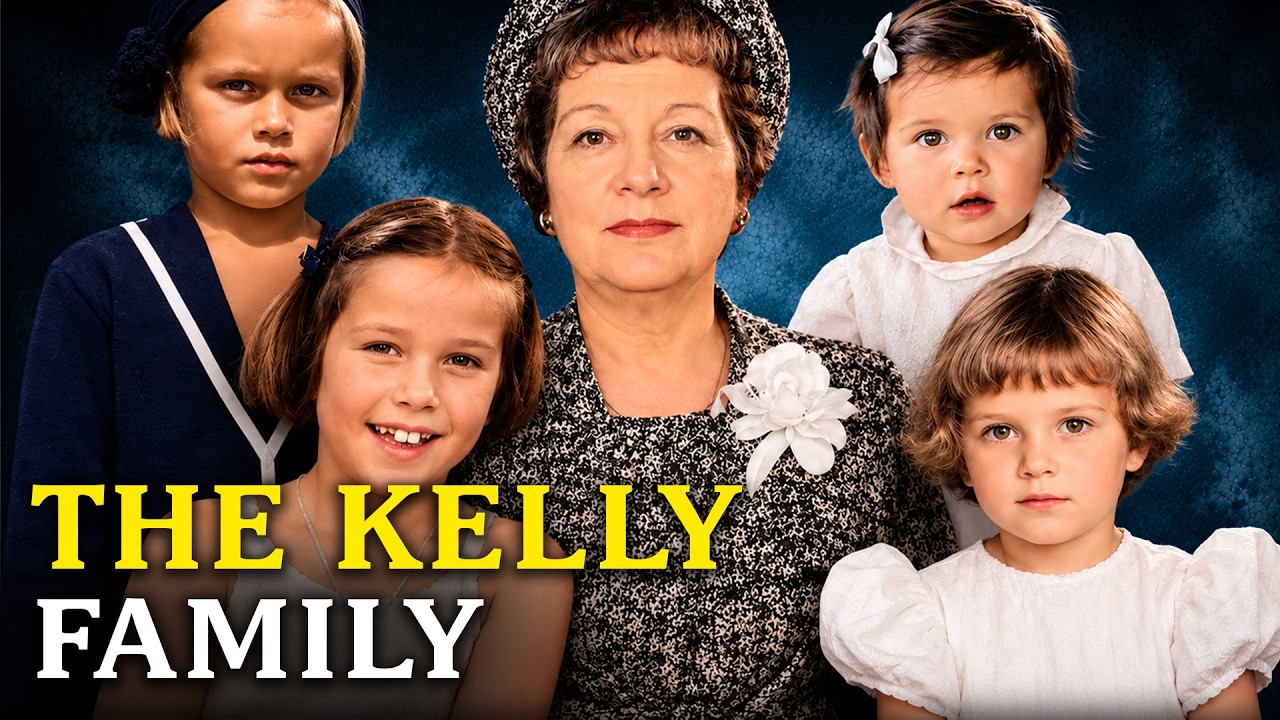
But the story of the family she came from, and especially of the mother who raised her, has rarely been told on its own terms. Margaret Katherine Major was born on December 13, 1898, in Philadelphia. Her parents, Carl and Margareta, were German immigrants who had settled in the working-class Strawberry Mansion neighborhood. She grew up Lutheran, a detail that would matter later when she fell in love with a young Irish Catholic athlete.
Even as a girl, Margaret was driven and fiercely competitive. She attended William Penn High School for Girls, where she was elected class president, and later studied at Temple University, where she became an outstanding intercollegiate swimmer. At a time when organized sports for women were widely viewed with skepticism, she pursued athletics seriously. She eventually became the first woman to coach women’s athletic teams at the University of Pennsylvania, a genuine milestone in American collegiate sports.
Margaret also worked as a model during her younger years, appearing on magazine covers. She was, by all accounts, a woman who refused to be defined by any single identity, equally at home coaching athletes or posing for a photographer’s camera. It was this combination of discipline, beauty, and quiet determination that caught the attention of John Brendan Kelly, known as Jack, a brash and ambitious young rower from a working-class Irish Catholic family. Their backgrounds could hardly have been more different, but his pursuit of her set the entire Kelly family story in motion.
Jack Kelly first met Margaret at a neighborhood swimming pool. According to several accounts of their relationship, it took roughly a decade of persistent courtship before Margaret finally agreed to marry him. One biographer described her as leading him on something of a merry chase before she consented. By the time they wed in January 1924, Jack had already established himself as one of the finest rowers in the world.
He had won an Olympic gold medal in single skulls at the 1920 Antwerp Games, a victory that carried personal satisfaction, since he had previously been barred from competing in the Diamond Sculls race at Henley in England, reportedly due to rules that discriminated against manual laborers like the bricklayers in his own family’s trade. He later built a multi-million-dollar construction business and entered local politics, serving briefly as Pennsylvania’s Secretary of Revenue and mounting an unsuccessful bid for mayor of Philadelphia in 1935. To make the marriage possible, Margaret made a significant personal decision. Raised Lutheran, she converted to Catholicism before the wedding, aligning herself with her husband’s faith and the Irish Catholic world he came from.
Friends later noted she rarely spoke of the conversion as a sacrifice, treating it as one more practical step toward the life she had chosen to build. Between 1925 and 1933, Margaret gave birth to four children. Their eldest, Margaret Catherine, known as Peggy, arrived in 1925. Their only son, John Brendan Kelly Jr.
, called Kell, followed in 1927. Grace Patricia was born in November 1929, and their youngest, Elizabeth Anne, known as Lisanne, arrived in 1933. The Kelly household in the East Falls section of Philadelphia was defined almost entirely by physical achievement and gregarious extroversion, qualities embodied fully by Jack Sr. He expected his children to match his athletic drive and outgoing personality, and three of his four children largely lived up to those expectations.
Peggy, the eldest, was witty, socially confident, and became her father’s clear favorite. Kell was steered from a young age toward a serious rowing career, groomed specifically to win at Henley and follow in his father’s athletic footsteps. Lisanne, the youngest, grew into what family members later described as the pampered baby of the household. The family split its time between their East Falls home and a beach house in Ocean City, New Jersey, where the children spent countless summers swimming, playing tennis, and competing in the good-natured but intense sibling rivalry that defined much of their shared childhood.
Grace, the third child, simply did not fit the mold. She was quieter, more introverted, and dealt with childhood health issues including asthma and sinus problems. In the competitive household, she increasingly found herself on the outside looking in. Her father’s blunt disappointment in her delicate temperament was, by multiple accounts, expressed openly.
He was reportedly heard to remark dismissively about Grace’s sensitivity, treating it as irritation rather than something requiring gentleness. He told a reporter at one point that whatever Grace could accomplish, her older sister Peggy could always do better. The closet incident captured something essential about Grace’s position in the family. Rather than fighting back or making a scene, she settled in and quietly entertained herself until someone came looking for her.
It was a pattern of quiet self-sufficiency that would follow her into adulthood. Margaret’s own approach to parenting differed from her husband’s openly expressive style, though it was not necessarily any gentler. Even though she was fully aware of her husband’s repeated infidelities, she rarely allowed her private pain to surface in front of her children. She loved them deeply but was not naturally inclined toward physical affection or overt displays of warmth.
Discipline became her primary language of love, with exacting standards of order, punctuality, and self-control. By the time Grace reached adulthood, she had decided to pursue acting, a path that immediately put her at odds with both parents’ expectations. Jack Sr. was reportedly blunt in his disapproval, at one point comparing the acting profession to something barely more respectable than street solicitation.
Grace enrolled at the American Academy of Dramatic Arts in New York City anyway, practicing relentlessly and reportedly recording her own voice to refine her delivery and shed her flat, nasal Philadelphia accent. During this period, she entered a relationship with one of her acting instructors, a man who was already married. When she brought him home, her father reportedly responded with outright laughter at the instructor’s prediction that Grace would become a star. Once Margaret discovered the man was married, the relationship was quickly ended, only to briefly resume later before her parents intervened once more to bring it to a definitive close.
Despite the family’s early resistance, Grace built a remarkable film career through the early and mid-1950s. She worked alongside Gary Cooper, Clark Gable, James Stewart, Cary Grant, and Bing Crosby, and collaborated memorably with Alfred Hitchcock across three suspense thrillers. In 1954, she won the Academy Award for Best Actress. Just as her career reached its peak, an entirely different opportunity arrived.
In the spring of 1955, Grace traveled to the French Riviera for a photo assignment tied to the Cannes Film Festival, where she was introduced to Prince Rainier III of Monaco. At the time, Grace was dating a French actor, but that relationship faded as her correspondence with the prince deepened. Their largely long-distance courtship culminated in a marriage proposal delivered over Christmas in 1955, inside the Kelly family home in East Falls, where Rainier had traveled to meet Grace’s parents and formally ask for her hand. Their engagement was announced in January 1956 at the Philadelphia Country Club, transforming Grace’s Hollywood career into one of the most significant royal romance stories of the 20th century.
For Margaret, the engagement represented an enormous shift. She found herself thrust into the role of mother of the bride for one of the most closely watched weddings of the era. The ceremony took place across two days in April 1956, beginning with a civil ceremony inside the Prince’s Palace on April 18, followed by a grand religious wedding at St. Nicholas Cathedral the next day.
Thousands of Monegasque citizens attended the reception, and the event was broadcast and photographed for audiences around the world. In the years that followed, Margaret and Grace’s relationship finally deepened. Distance seemed to soften whatever tension had once existed. Margaret made regular trips to Monaco, including traveling there in January 1957 to be close to Grace for the birth of her first child, Caroline.
She returned for the births of Albert and Stephanie, gradually becoming a steady presence in her daughter’s new life. But tragedy was quietly accumulating elsewhere in the Kelly family. Kell followed directly in his father’s rowing footsteps, competing in four Olympic Games and winning a bronze medal in single skulls at the 1956 Melbourne Olympics. In 1947, he received the James E.
Sullivan Award, given annually to the top amateur athlete in the United States. He won the Diamond Sculls race at Henley twice, in 1947 and 1949, finally accomplishing the feat his father had once been denied. Beyond rowing, Kell took over the family’s bricklaying business after his father’s death in 1960, building it into the largest masonry contracting firm in the northeastern United States. He served 12 years on the Philadelphia City Council, became president of the Amateur Athletic Union in 1970, and was elected president of the United States Olympic Committee in February 1985.
He held that position for barely three weeks. On March 2, 1985, following his usual morning row on the Schuylkill River, Kell suffered a fatal heart attack while jogging back toward his athletic club. He was 57 years old. In an eerie coincidence, Eugene Conlin, the former husband of his sister Peggy, collapsed and died of a heart attack that same day, just blocks away.
By then, the family had already endured another devastating loss. On September 13, 1982, Grace was driving from the family’s country home back toward the palace in Monaco with her younger daughter Stephanie beside her when she suffered a small stroke behind the wheel. The car went off the winding mountain road and tumbled down a steep hillside. Stephanie survived, though she suffered her own injuries.
Grace suffered trauma to her brain and chest, along with a broken leg. After doctors determined recovery was not possible, she was allowed to go. She died the following evening, September 14, 1982, at the age of 52. For Margaret, then 83, the loss of her third child was an almost unimaginable grief, made more painful by how close their relationship had become.
The years that followed brought an almost unbearable accumulation of loss. Margaret had lost her husband in 1960, her daughter Grace in 1982, and her only son in 1985. She herself began experiencing strokes and eventually moved into a convalescent care facility in New Jersey. On January 6, 1990, Margaret died of pneumonia at the age of 91, having outlived her husband by three decades and endured the loss of two of her own children.
Her obituaries noted her own genuine accomplishments in athletics and modeling, and the extraordinary family she had helped raise. Of her four children, only Lisanne survived Margaret by any significant length of time. Peggy passed away in November 1991 at age 65. Lisanne, the youngest, became the last surviving sibling, carrying the family’s memory forward alone until her own death in November 2009.
Looking back, Margaret Major Kelly’s story is considerably more layered than her usual mention as simply the mother of a famous princess. She was a trailblazer in women’s collegiate athletics, a woman who converted her religious identity for love, who raised four children in a demanding household, and who outlived her husband and two of her own children. All of it traced back to a determined young swimmer from a modest German immigrant household who spent a decade being courted by a stubborn Irish American Olympic champion before finally agreeing to become his wife.