In early November 1878, a cemetery groundskeeper making his morning rounds at St. Mark’s Church in the Bowery found a hole where a grave should have been. The burial vault of Alexander Turney Stewart, dead for barely a year, had been opened overnight. The coffin had been dragged out and the body removed.
Stewart was the wealthiest merchant in New York, the man whose Broadway store had reinvented American retail. His death in April 1876 had made front-page news across the country. The theft of his corpse was an even bigger story. For weeks, newspapers ran daily updates about ransom negotiations no one could confirm, investigators who found nothing, and a widow who eventually paid an undisclosed sum to men claiming to hold her husband’s remains.
They handed her a bag of bones she could never fully identify. The case was never solved. What the robbery did accomplish was to reshape the private fears of every American family with money to protect. If the richest man in New York could be dug up and held for ransom, no grave was safe, no amount of marble could change that.
The fear exposed by the Stewart case was not new. It was old, and it had a name nineteenth-century Americans used without hesitation: resurrection men. For most of the century, American medical colleges depended on a steady supply of corpses for anatomical teaching, and the law provided them almost none. Dissection of an executed criminal was occasionally permitted by court order, but demand for teaching material vastly exceeded that limited legal supply.
The gap was filled by men who dug up fresh graves at night and sold the bodies to medical schools for money. The trade was well known and rarely prosecuted seriously, because the colleges buying the bodies were often the same institutions training the physicians who would later certify deaths and treat the living. As late as 1888, the physician William Osler could still write candidly about how routine the practice was at the schools where he trained. Poor families and Black cemeteries were disproportionately targeted, because their dead were the least likely to be missed by anyone with the authority to demand an investigation.
The wealthy had assumed for most of the century that money bought them immunity from this particular indignity. The Stewart case proved otherwise. On the contrary, wealth made a corpse more valuable, because the rich family could be forced to pay for its return. New York had already passed a law in response to earlier scandals.
The Bone Bill of 1854, enacted after a series of grave robberies in the city’s potter’s field cemeteries, was designed to formalize the legal supply of unclaimed bodies to medical colleges, specifically to strip the illegal trade of its economic basis. It did not end the practice. What it did do was define clearly whose bodies it was acceptable to take, the poor, the unclaimed, leaving everyone else theoretically protected and practically exposed. The theft of Stewart’s body mattered because it proved that theoretical protection was worthless without a lock, a wall, and enough stone between the coffin and the surface to require a work crew rather than a shovel and two men working before dawn.
The years immediately following 1878 saw a documented shift in how wealthy American families handled burial, a shift cemetery historians directly attribute to the panic generated by the Stewart case. Woodlawn Cemetery in the Bronx, already the preferred address for New York’s commercial elite, entered its most intensive period of mausoleum construction during the 1880s and 1890s. Families that had once been satisfied with a headstone and an iron fence commissioned structures with vaulted roofs, bronze doors, and foundations sunk below the frost line. The language used by cemetery managers in business correspondence from that period is striking.
Clients were no longer asking for beauty first. They were asking for security, doors that could not be forced, construction meant to deter rather than merely commemorate. The grave, for the first time in American history on this scale, was being built the way bank vaults were built, to protect what was inside from people who wanted to take it out. Cornelius Vanderbilt, the Commodore, died in January 1877, leaving an estate estimated at $100 million.
His eldest son, William Henry, inherited the overwhelming majority of it. Almost overnight, William Henry Vanderbilt became the richest citizen in the country, a position he held with unease. He was not naturally ostentatious like his father. By most contemporary accounts, he was a cautious, somewhat anxious steward of a fortune he had not built and was not entirely sure how to handle.
He gave vast sums to charity, much of it quietly. He also developed, according to the newspapers of the period, an intense fear of public appearances, of crowds, of being watched, audited, and envied for what he owned. The Stewart case struck directly at that fear. It was proof that money did not buy peace after death.
It made death a bigger target. The Commodore’s original resting place was a modest family vault at Moravian Cemetery in New Dorp, on the South Shore of Staten Island, land the Vanderbilts had owned for generations before any of them became rich. By the standards of the 1870s it was an ordinary burial place, no fence, no watchman, accessible to anyone willing to make the trip from the city. Within two years of the Stewart robbery, William Henry Vanderbilt committed to replacing it with something entirely different, a mausoleum built not just to honor the family but to make the family dead physically unreachable.
He hired Richard Morris Hunt, then the most sought-after architect in the country, a man whose work would eventually include the pedestal of the Statue of Liberty and Biltmore’s main house. He also hired Frederick Law Olmsted, co-designer of Central Park, to shape the ground around the structure so that even locating the building from any public road would be difficult. What Hunt designed was not a mausoleum in the usual American sense. It was closely modeled on Romanesque churches in southern France, drawing specifically on the carved portal of Saint-Trophime in Arles.
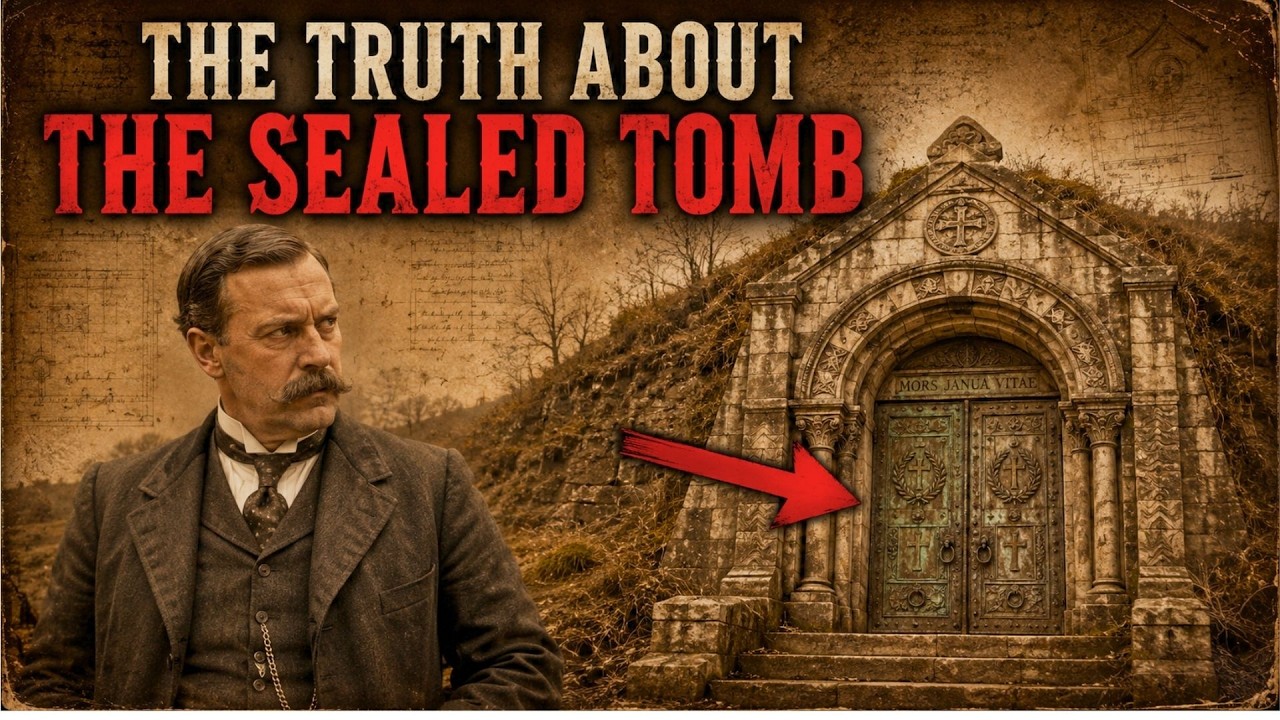
Rather than standing above ground as most family tombs did, it was set directly into the side of a hill, dug into solid rock, so that three of its four walls were effectively the earth itself. Granite was quarried in New England and shipped to the site by the ton. Construction crews spent years excavating into the hillside before the visible portal, with its carved arch and heavy bronze doors, was even installed. Any structure built above ground can be approached from any direction.
A structure built into a hill has only one entrance. The Vanderbilts made sure that single entrance was built as a fortress gate rather than a chapel door. The building itself was only half the project. Around the site, the family began acquiring land, piece by piece, of the New Dorp acreage surrounding Moravian Cemetery, far beyond what one family plot required.
Local residents who had lived near the cemetery for generations found themselves negotiating, sometimes reluctantly, with agents buying on the family’s behalf. At least one public road in the area was reportedly rerouted during this period to keep through-traffic away from the construction site. None of this was publicly framed as a security measure. It was presented as landscaping, a desire to give the cemetery a dignified, proper setting.
Olmsted’s design work gave that framing genuine substance, with curving paths and plant barriers that made the mausoleum genuinely hard to see until a visitor was almost upon it. But the practical effect of buying up the surrounding land was the same as the granite walls and the single bronze entrance. It made the site inaccessible to the public. A grave robbery like the Stewart case depended on the body being physically available and easy to dig up at night without drawing attention.
The Vanderbilts were building a place where neither condition could be met. William Henry Vanderbilt did not live to see the mausoleum completed. On December 8, 1885, he died suddenly at his Fifth Avenue home, of what physicians of the time called a stroke, while talking to a visitor in his reception room. He was 64 years old and had owned the largest private fortune in America for less than nine years.
His death accelerated the New Dorp project rather than halting it. The Commodore’s remains were moved from the old family vault into the new structure, and William Henry himself followed shortly after. The mausoleum built as a fortress against exposure for the living members of the family became, within months, the actual resting place of the two men whose wealth had made its construction necessary. What physical security measures the finished structure contained was never fully revealed, deliberately so.
Contemporary newspaper accounts from the 1880s describe iron bars behind the bronze doors, a stone vestibule between the entrance and the inner chamber, and a watchman on site who remained for years after the family finished construction. Cemetery records from the period are inconsistent about whether that watchman was an employee of Moravian Cemetery or someone paid directly by the Vanderbilt estate. A complete inventory of the mausoleum’s internal fortifications was never made public. What is not in dispute is the outcome those measures were designed to achieve.
Unlike most Gilded Age family tombs, which functioned as small tourist attractions from the moment they were completed, the Vanderbilt mausoleum at New Dorp was never opened to ordinary visitors. More than a century after its completion, it remains closed to the public, its interior effectively undocumented in any photograph or study available outside the family and the cemetery’s limited records. That silence is strange compared with the family’s history elsewhere. The Vanderbilts were not, as a rule, reclusive people.
William Henry Vanderbilt’s Fifth Avenue mansion, known as the Triple Palace, received extensive press coverage in its day, its interiors described room by room down to the wallpaper. His son Cornelius Vanderbilt II built The Breakers in Newport and opened its gardens, if not its rooms, to public curiosity with little effort made to prevent it. Biltmore, built by another son, George Washington Vanderbilt, remains a paid tourist attraction. Almost everything the family built to display its wealth in life was, sooner or later, put before the public in one form or another.
The only structure they built specifically to house their dead is the only one that has never been opened to the public at all. It was built that way from the laying of the foundation stone, not gradually closed off by later generations protecting their legacy. Privacy was the goal from the start. The Vanderbilt fortune was the largest to pursue this approach, but they were not alone.
The pattern they set during the 1890s and into the early twentieth century turned burial into a genuine competitive market among the wealthy. At Woodlawn, the Woolworth family mausoleum, built after Frank Woolworth’s death in 1919, was deliberately styled after an Egyptian temple. Its granite blocks were fitted so precisely that the joints are difficult to find without close inspection, a design choice contemporary reports described as intended to convey permanence and impregnability in equal measure. The Jay Gould family also built a mausoleum at Woodlawn, a white marble Greek temple.
Its bronze door was cast in a foundry that also produced bank vault doors for several major New York financial institutions, a detail newspapers noted at the time because readers immediately understood what kind of protection the family was buying. The financiers who built these structures were, in several documented cases, the same men who sat on the boards of credit and insurance companies that in the same decade were formalizing the modern American funeral industry, consolidating embalming practices, casket manufacturing, and cemetery management into an organized commercial sector for the first time. The families most fearful of grave robbery were often the families whose capital was simultaneously professionalizing and monetizing the American death trade more broadly. This is not a contradiction.
It is the same instinct working in two directions at once: protect what is yours while building the systems that will profit from everyone else’s dead. The granite and monument trade that served this boom left a paper trail, invoices, shipping records that survived as fragments through cemetery archives and quarry company records in Vermont, Massachusetts, and Maine. What these documents collectively show is a construction economy based almost entirely on fear rather than grief. Quarries that had spent decades supplying modest headstones to ordinary cemeteries were, by the 1890s, filling orders at weights beyond anything the industry had produced before, polished stones custom-cut for a small group of family burials never seen by anyone outside those families and the workers who built them.
The sheer volume of material and the precision of the security features specified in surviving correspondence, iron bars, reinforced hinges, stone thresholds cut to exact measurements, refute the idea that any of this was primarily decorative. These were people spending fortunes to solve a problem that, until 1878, had not been a consideration for anyone with money. What distinguishes the Vanderbilt mausoleum within that general pattern is not its size, though it remains among the largest private tombs built in the United States, but its continuity. Most fortified tombs of that era gradually became tourist landmarks, listed in cemetery guides, photographed by architecture students, opened for occasional charity tours, once the immediate fear that drove their construction faded from living memory.
The Vanderbilt site never softened. Access has remained restricted through five generations of family ownership and more than a century of changing cemetery administrations, a persistence of closure that outlived everyone who made the original decision to build it that way. That is the part of the story that is hard to explain simply. A structure built in response to a specific 1870s panic about grave robbery should, by any ordinary logic, have relaxed its defenses once grave robbery stopped being a realistic threat to wealthy families in the early twentieth century, with embalming laws, cemetery regulations, and the decline of the illegal body market making the original crime nearly extinct.
Instead, the closure continued. Whatever the mausoleum was originally built to prevent, the family continued to treat its privacy as something worth protecting for reasons unrelated to grave robbers and not fully explained by the historical record. By the time William Henry Vanderbilt’s grandchildren were managing family affairs, the New Dorp mausoleum had already outlived the specific fear that justified its construction. The era of body-snatching for medical purposes had ended decades earlier.
The Stewart case itself had faded from active memory except among cemetery historians and true-crime writers who revived it occasionally. Yet the doors remained closed, the watchman remained at his post, and the family’s control over who could approach the hillside remained as tight as it had been in the 1880s. Somewhere in that gap between a threat that no longer existed and a level of secrecy that never relaxed lies the real question at the heart of this story. It is not what the Vanderbilts were originally protecting themselves from, because that part of the record is clear and well documented.
It is what made that protection worth continuing after the original reason for it had vanished. Cemetery managers who worked at Moravian Cemetery across different decades described the arrangement in similar terms whenever they spoke to local historians. A family trust controls access separately from normal cemetery operations. Standing instructions predate any current employee there.
There is no indication those instructions were ever formally reviewed or reconsidered. An arrangement that old, maintained with that much smoothness, is not usually about a real threat. It is usually about habits that became policy until no one in the institution remembers why they exist, only that they have never been questioned and questioning them is not anyone’s job. Look at what happened to the rest of the Vanderbilt real estate empire over the twentieth century, and the contrast becomes stark.
Biltmore, the largest private home ever built in America, was opened to paying visitors by George Washington Vanderbilt’s descendants in 1930 and remains one of the most visited historic houses in the country. The Breakers in Newport, built by Cornelius Vanderbilt II, passed to the Preservation Society of Newport County in the 1970s and has been a ticketed public landmark ever since. Its dining room and great hall are photographed by more tourists in a single summer than people probably saw during decades of private family ownership. Marble House, built for William Kissam Vanderbilt, followed the same path.
Room by room, house by house, the family that guarded its privacy as fiercely as any dynasty in American history made a considered, well-documented decision to trade that privacy for revenue and cultural significance once maintaining the mansions as private homes became financially irrational. Every major Vanderbilt property eventually opened its doors. The New Dorp mausoleum is the only holding for which that calculation was never made, or was made and came out differently every time the question arose. It is not because the mausoleum lacks the qualities that make historic houses profitable museums.
Richard Morris Hunt’s design is at least as architecturally significant as many of the family properties that already receive the public. Frederick Law Olmsted’s site plan has been closely studied by historians precisely because so little of it has ever been altered, a rare case of an Olmsted design surviving almost untouched for more than a century. Ironically, the family’s insistence on restricting access also reduced the site’s exposure to the kind of modernization that reshaped Central Park and dozens of other Olmsted works. A structure that, by any normal commercial logic, should have been a natural candidate for the same museum treatment granted to Biltmore and The Breakers was instead kept entirely separate from that whole process.
It is not run by a historical foundation or preservation society but by a private family trust whose decision-making process has never been disclosed. The generations that inherited responsibility for the site rarely spoke about it publicly. When family members discussed Vanderbilt history in interviews or memoirs during the twentieth century, the mausoleum appeared as a throwaway reference, almost automatic, rather than a subject anyone dwelled on. A family cemetery on Staten Island, closed to visitors.
That was the sentence. Compare that with how freely those same relatives spoke about the family mansions, yachts, business failures, and society scandals, subjects that filled entire published memoirs with frank, sometimes embarrassing detail. Death itself was not taboo. But this particular resting place was.
Local historians on Staten Island who spent decades trying to arrange access inside for research or restoration documentation describe a consistent pattern. Polite correspondence, acknowledgment of the request, then either silence or a flat refusal, with no explanation beyond the family’s stated desire for privacy. No lawsuit ever settled the matter. No journalist ever published photographs of the interior that the family disputed, itself striking given how thoroughly the private spaces of other Gilded Age families have been documented, leaked, or even opened by descendants hungry for attention rather than averse to it.
Staten Island municipal records and Richmond County property files confirm the outlines of ownership and trust administration across generations. But the internal terms of that trust, who exactly holds decision-making power over access in any given decade, and whether conditions were attached when it was originally created, have never been part of the public record. What remains instead is the pattern itself, repeated without interruption from William Henry Vanderbilt’s generation to the current one. A family that opened everything it owned to history and kept only one door closed the entire time.
The structure itself still stands exactly where Hunt and Olmsted placed it, carved into the same hillside above the same cemetery. Granite unchanged by more than a century of Staten Island winters. Moravian Cemetery remains an active burial ground, open during normal hours to visitors coming for the ordinary reasons people visit cemeteries, to find family plots, to walk the grounds, to see the old stones. The mausoleum sits within that same public space, visible from a distance along the winding road Olmsted planned.
Close enough for visitors to see the carved portal and bronze doors from behind the surrounding fence that separates the mausoleum directly from the rest of the cemetery. What they cannot do, and what no member of the public is documented as ever having done throughout the site’s history, is approach those doors and enter. The site has held official historic designation for decades and has been recognized in state and federal historic property surveys for its architectural significance, recognition that in most cases comes with a requirement for public access or at least interpretive signage. Here, neither followed.
The protection status preserves the stone. It did nothing to open the door behind it. Staten Island historical societies, several of which have documented the mausoleum’s exterior extensively in photographs, architectural drawings, and preservation surveys conducted over multiple decades, consistently describe the interior as terra incognita even to them, relying on old newspaper descriptions written before the family tightened access in the 1880s and nothing more recent than handed-down family memories repeated across several generations. A building this well documented from the outside, covered exhaustively in the architectural literature on Hunt’s and Olmsted’s careers, and completely undocumented from the inside, is in itself an unusual combination.
Paired with a family that opened every similar property it built anywhere else in the country, it becomes the kind of gap researchers notice and then cannot explain, the original and true story about the grave robbers that started it all in 1878. Architectural historians surveying Gilded Age funerary structures for National Register listings have consistently ranked the New Dorp mausoleum among the most important private tombs built in the United States, citing Hunt’s design and the survival of Olmsted’s original planting plan almost entirely intact as reasons the site deserves far more research access than it has ever been granted. Their published assessments rely almost completely on exterior documentation, old photographs, and transferred architectural drawings, rather than any direct survey of the interior, a limitation each of them notes in passing and none has been able to resolve. The watchman mentioned in 1880s newspaper reports did not disappear once the original construction period ended.
Cemetery staff and local residents interviewed by Staten Island historians across different decades describe an unusual level of attention paid specifically to the mausoleum grounds compared with the rest of the cemetery. Gates are checked more frequently. The immediate perimeter is maintained to a standard the rest of the property does not receive. A level of upkeep that requires money and a decision from someone to keep spending it year after year on a building no one but the family is allowed to enter.
Staten Island local newspapers reported occasional incidents at the site over the decades. Break-in attempts by teenagers or thrill-seekers drawn by the mausoleum’s reputation as one of the borough’s most mysterious landmarks. None was ever successful according to any published account. Each was handled quietly by cemetery security or local police rather than becoming an ongoing story that forced the family to speak publicly about the site.
The pattern those incidents reveal is not about the incidents themselves, which read as fairly ordinary trespassing cases, but about how consistently they were contained and ended without ever turning into a public discussion of exactly what was being protected and why. Staten Island newspaper archives hold scattered articles written across the twentieth century. Local journalists visiting the mausoleum every decade or so as a kind of curiosity. Every article publishes the same limited set of exterior photographs.
Every article notes that requests for interior access went unanswered or were refused. And every article closes with a version of the same sentence, that the Vanderbilt family has never explained its position on this matter. The repetition across generations of local journalism is evidence in itself. A family does not need to issue an official statement clarifying its position when it has already made that position clear, unchanged, for 140 years.
Genealogists working on the broader Vanderbilt family tree have noticed a similar pattern regarding who is buried and who is not buried at New Dorp. Not every Vanderbilt descendant is buried there. The family’s decisions about who merits a place inside the mausoleum versus burial elsewhere are not explained in any document available to outside researchers. Some branches of the family, after divorces, disputes, or simply geographic distance from New York, are buried in entirely different cemeteries across the country, while others who spent their lives far from Staten Island were specifically brought back to New Dorp.
Whatever criteria the family trust applies, they have been applied consistently and privately across five generations, itself a kind of institutional sustainability that few American family arrangements manage to maintain for that long without formal codification or public disclosure. A private decision that outlives its makers and continues to be honored by people who were not alive when it was made is usually evidence that something is written down somewhere. In this case, if that document exists, it has never left the family’s hands. Alexander Turney Stewart’s grave tells the rest of this story in miniature.
After the 1878 ransom negotiations, his widow Cornelia eventually reburied what she was told were his remains, not at St. Mark’s Church where they had once been stolen, but at the Cathedral of the Incarnation in Garden City, Long Island, a cathedral Stewart himself had helped fund before his death and built specifically to be secure enough that the indignity of 1878 could not recur. To this day, no independent verification has ever confirmed that the remains returned to the family for money were actually his. The Stewart family, like the Vanderbilts after them, chose to live with permanent uncertainty rather than risk increased attention, closing the case instead of solving it.
That decision by the family whose loss began the era of fortified tomb building set the template every wealthy family after them would follow in one form or another. A secure and ambiguous ending is better than an open one that invites more attention. What connects the Stewart crypt at the cathedral and the Vanderbilt mausoleum is a shared response to the same historical moment. A single crime against a prominent family revealed, briefly and clearly, how little protection money bought for the dead in nineteenth-century America and how much money was required to fix that.
The families who could afford the fix built structures that lasted, in several documented cases, longer than any other form of privacy their descendants ever enjoyed. The mansions became museums. The business records became public archives. The personal letters ended up in special collections at universities, digitized and searchable by anyone with an internet connection.
The tombs, built as the first and most fortified structures of that era, remain in notable cases the only thing still holding at the same level of privacy for which they were designed. There is a cost to keeping a door closed for 140 years, even when there is nothing hidden inside in the usual sense of the word. Every year the trust pays for grounds maintenance, for the watchman who has continued in some form since the 1880s, for the legal and administrative work of managing a private structure that generates no income and answers to no public authority. Every year that spending is a choice renewed rather than merely inherited, made by people who could at any time decide that the original reason for closure no longer exists and open the doors as every other branch of the family did.
They have not made that choice. Across five generations, through the crises of the Gilded Age, two world wars, the Great Depression, and the family’s gradual transition from active industrialists to scattered trust-fund heirs in different professions and regions, the one constant Vanderbilt institutional decision has been to keep this door closed. Historians who study institutional secrecy usually look for a reason proportionate to the effort of maintaining it. Here, the effort stayed constant while the original justification, protection from grave robbers who have not posed a real threat to American cemeteries for over a century, quietly ended.
What replaced that justification in the family’s internal logic was never written down anywhere an outside researcher could find. Perhaps nothing replaced it at all, and the closure simply became the safest path, unquestioned because questioning was harder than explaining a decision no one alive today witnessed being made. Or perhaps the family has reasons they have chosen not to share, which is, after all, the same kind of thing a family with this much experience keeping doors barred is good at. Compare that quiet, unexplained persistence with how other elements of Gilded Age fortunes became public property almost automatically.
Antitrust lawsuits forced the disclosure of business records for the railroads the Vanderbilts controlled for decades. Tax filings, court testimony, and congressional hearings took apart the finances of almost every great fortune built in that era, Rockefeller, Carnegie, Morgan, Vanderbilt included. So little remained about how the money was made that was truly private. It turned out that wealth on this scale is almost impossible to hide completely from historians, regulators, and journalists with enough time and motivation.
Oddly, death proved easier to keep private than money. No one subpoenas a mausoleum. No regulatory body has jurisdiction over whom a family trust allows through a cemetery gate. The parts of the Vanderbilt story involving boardrooms and bank accounts have been under scrutiny for over a century.
The one part involving a hillside on Staten Island was never forced open, because there was no legal or financial mechanism with any reason to force it. Go back for a moment to that groundskeeper at St. Mark’s Church in November 1878, standing over an empty grave in the cold, trying to understand how a man as fortified as Alexander Turney Stewart could simply disappear. Standing there, he could not have known that the hole in front of him would end up reshaping how an entire generation of wealthy Americans chose to bury their dead.
That architects like Richard Morris Hunt would spend years of their careers building answers to the fear that morning created. That landscape designers like Frederick Law Olmsted would plant trees specifically to make certain structures hard to find. That a hillside on Staten Island would be hollowed out from within and sealed behind bronze doors thick enough to make a breach unthinkable. He was looking at a crime.
What grew out of it over the following decades was an entire architecture of American privacy, built initially to protect the dead from thieves, and maintained, in at least one case, long after the thieves themselves stopped being a real threat to anyone. The Vanderbilt mausoleum at New Dorp still stands on that hillside today. Granite unchanged, bronze doors closed, the family trust that administers it as silent about its internal decisions now as it was in 1886. Visitors to Moravian Cemetery can walk the same winding road Olmsted designed, stand at the same respectful distance the outer fences have always enforced, and look at a building whose exterior has been photographed, measured, and written about more than almost any other private tomb in the country, while its interior remains, in the literal sense available in the documented historical record, terra incognita.
Whatever is inside that hill, it is there because a family owning a fortune greater than almost anyone else in American history decided, in the aftermath of a specific crime against one of their peers, that the safest thing to do with their dead was to make them unreachable. After 140 years, the door built in response to that fear has never been opened. Not for historians, not for journalists, not for the preservation societies that administer almost every other Vanderbilt property in the country. The records explain why that door was built.
They do not explain why it is still closed.