Jim Brown lost his final football game in ankle-deep mud and heavy fog at Lambeau Field. He had every excuse available to him. The weather had stripped away the footing his entire style of play depended on. The opposing coach had built his entire defense around stopping him.
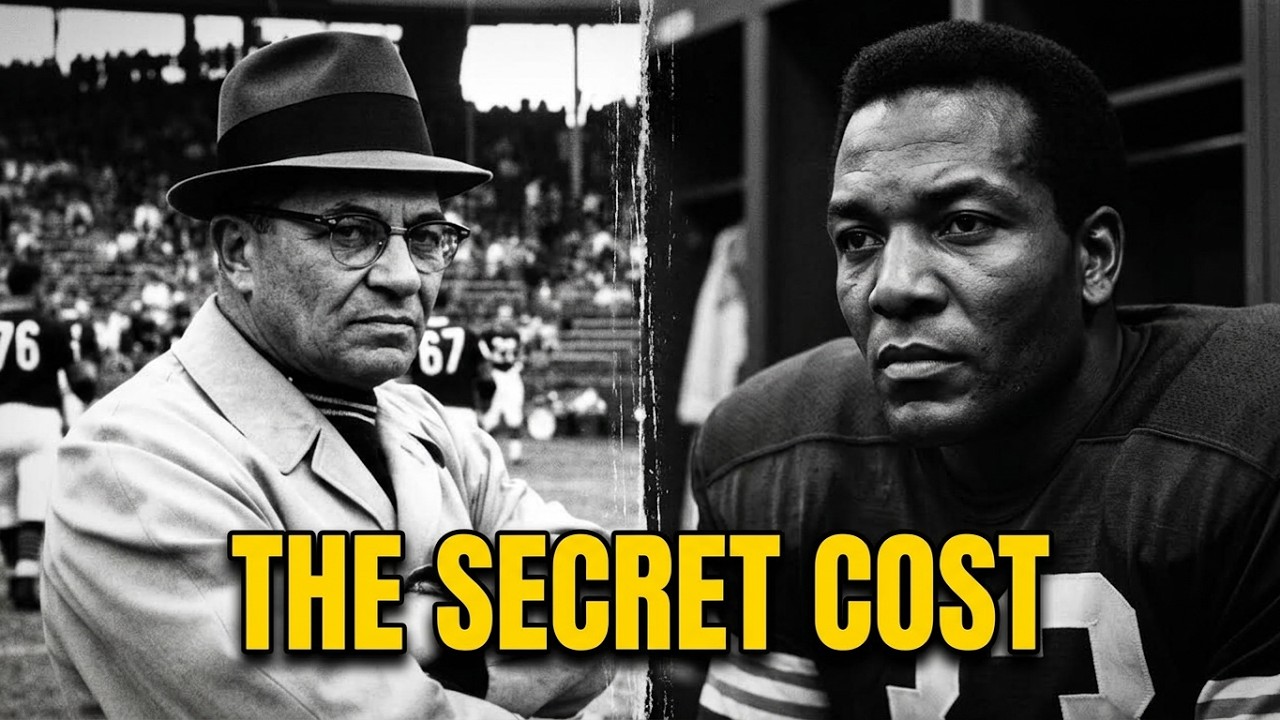
A future Hall of Fame middle linebacker shadowed him on every play. He could have blamed any of it. He did not. When asked decades later what he remembered about that afternoon, Brown did not mention the mud, the weather, or the man who hit him.
He said six words instead: “I take responsibility for it. No excuses. ”
The date was January 2, 1966. Green Bay beat Cleveland 23–12 to win the NFL Championship.
The game had everything needed for a legendary story, and the facts are all recorded. What the record books leave out is that more than 50,000 people sat in the freezing cold that day to watch the end of the greatest career in football history, and almost none of them knew it. There was no farewell. No one stood.
No one cheered. Jim Brown walked off the field expecting to return in September. There was one exhibition game left two weeks later in California sunshine. But this was the last time it truly mattered.
The story of why begins with what Green Bay coach Vince Lombardi did that week. Lombardi had not played in a championship game since 1960 when his Packers lost to Philadelphia. After that loss, Lombardi stood in the silent locker room and told his players he was responsible, and that they would never lose a championship game again. He was not predicting.
He was telling them something he believed to be true. He finished his career 9–1 in the playoffs. That week, Lombardi put a sign in the Green Bay locker room about chasing the ball carrier by the shortest possible route, and getting there with a bad attitude. No one in that room had to ask which ball carrier he meant.
Then he did something almost no coach does. He took Ray Nitschke, the defense’s best player, and assigned him to cover Jim Brown man-to-man on every snap. Lombardi abandoned his own defensive scheme to close the middle and force Brown to hesitate and cut on wet ground, daring the other ten Cleveland players to beat them. It was the greatest compliment one football man could pay another, and it was ruthless.
Nitschke spoke about that week years after retirement, saying he kept asking himself the same question over and over: whether he was big enough and strong enough to stop him, and ultimately, whether he was man enough. Green Bay safety Tom Brown summarized the plan in one sentence. Tie down Jim Brown and let anyone else try to beat us. Who was this man who made a Hall of Fame coach tear up his own defense?
Nine seasons, 118 consecutive games. He never missed one. He played in an era where defenses used physical violence, late hits, and cheap shots that would get players banned today. He led the league in rushing in eight of his nine seasons, made the Pro Bowl every year he played, and totaled 12,312 rushing yards at 5.
2 yards per carry. He also had a habit that wore down defenders psychologically. After every tackle, he would stay down. Then he would rise slowly, always the last man to get up.
Lineman Larry Zonka recalled watching this and thinking, “My God, he must be hurt. ” On the next play, Brown was through the line like nothing had happened. He never gave the opponent one piece of information about how he felt. Nineteen sixty-five was one of his best years: 1,544 yards and 17 touchdowns, beating Chicago rookie Gale Sayers by 677 yards.
He was the league MVP at age 29. That is the man who walked into Green Bay. Then the weather decided the game. Snow fell the day before.
The grounds crew kept a plastic cover on the field until just before kickoff, but the ground underneath was already soft. Rain fell all through the first half, then turned to light snow, then fog settled over the stadium by the second half. By the third quarter, Lambeau Field was no longer a football field. The one man in the stadium who needed firm ground more than anyone else found nothing under his feet.
He tried everything. Cleveland gave him the ball on the first play, and he slipped out of the backfield for a 30-yard reception. Late in the first half, he cut left for nine yards, right behind Gene Hickerson for 15, then took a lateral and added eight more along the sideline where grass was firmer. He spent the game searching for solid ground like a man in a dark room searching for a light switch.
Every time he tried to cut inside, the area was packed with green and gold. He had to take an extra step, and that extra step gave Green Bay time to reach him. Meanwhile, Lombardi did exactly what he said he would. Paul Hornung ran 18 times for 105 yards, and Jim Taylor ran 27 times for 96 yards.
Green Bay ran the ball 47 times for 204 yards, and kept Cleveland off the field so completely that the Browns ran only 38 offensive plays for the entire game. That brings the story to the play. Third quarter, Green Bay leading 20–12. Cleveland had the ball at the Packers’ 27-yard line.
Frank Ryan spotted Jim Brown in the end zone and threw the ball. It was the third time that day Ryan had thrown a fade to that end zone, and this one was catchable. Ray Nitschke reached up, got a hand on the wet ball, and knocked it out of Jim Brown’s hands. Cleveland never threatened the goal line again.
The final score was 23–12. Jim Brown carried 12 times for 50 yards. Decades later, he was asked what he remembered about that game. He said the pass was not perfectly thrown.
Then he said he should have come back to the ball. He should have jumped higher. He did not, and it was his fault. If he had caught it, Cleveland would have won the championship.
Then he said those six words: “I take responsibility for that. No blame. No excuses. ” He said nothing about the weather that had taken away the only thing his greatness depended on.
Jim Brown learned early how to carry things alone. He was born on St. Simons Island, Georgia, in February 1936. His father, a professional boxer named Swinton Brown, left when Jim was two weeks old.
His mother left when he was two, heading north to Long Island to work as a maid because no other work was available. Jim stayed behind, raised by his paternal grandmother, Nora Peterson. When he was eight, his mother finally sent for him. It was the first time they had seen each other in six years.
He arrived at Syracuse University in the fall of 1953, the only Black player on the freshman football team. They housed him apart from the other athletes. They put him fifth on the depth chart. So by the time he stood in a locker room in Green Bay with mud drying on his arms, he had been carrying his own burdens for 29 years.
He was not going to hand that weight to anyone else. That same trait was about to end his career six months later. Weeks after the championship, Brown traveled to England to film “The Dirty Dozen. ” It was part of a three-film deal with a major studio, not simply a hobby.
But production fell behind schedule, and by July, with training camp approaching, it was unclear whether he would return to Ohio in time. He had not yet signed his 1966 contract. Instead of calling him, Browns owner Art Modell went to the newspapers. He said no veteran player would be allowed to be late to training camp at Hiram College, and he singled out Jim Brown by name.
Camp attendance was set for Sunday, July 17. If Brown missed it, he would be suspended without pay, and Modell began a fine of $100 for each day he missed. Jim Brown read about it in a newspaper thousands of miles from home, before anyone from the organization called him. He did not hold a press conference in response.
He sat down and wrote a letter. He told Modell his decision was final. It was about the future he wanted for himself, his family, and his people. He said he was sorry Modell had made those public statements, because no one benefited from them but the reporters.
He said it seemed he had trusted Modell more than Modell trusted him. One line in the letter deserves to be remembered: that his manhood mattered to him as much as Modell’s manhood mattered to Modell. In January, he refused to let the weather take any of the blame. In July, he refused to let an owner tarnish his name.
Both answers came from the same source. He signed the letter, “Your friend, Jim. ”
Then he wrote a second letter, one that almost no one talks about. He wrote to his head coach, Blanton Collier, a man he genuinely respected and did not want to leave in the lurch.
He told Collier he had decided to retire. He asked that Ernie Green stay in the backfield, and he reassured the coach about the running game. Give the ball to Leroy Kelly. Leroy Kelly went into the Hall of Fame.
On the morning of July 14, 1966, Jim Brown sat on a raised stool in front of a tank, wearing a military uniform, and read a statement to a room full of reporters. He said his original intention was to play the 1966 season, but circumstances had made that impossible. He was 30 years old. He left holding nearly every significant rushing record.
He said afterward that he retired with regret, but without sadness. He was not escaping to Hollywood. Midway through his football career, while still carrying the ball every Sunday, he founded an organization in Cleveland to provide real capital to Black-owned businesses. His teammates joined him: John Wooten, Sid Williams, and Walter Beach.
The same Walter Beach who was there in the mud at Green Bay that evening. Two years later, Brown gathered the most famous Black athletes in America in that office to stand beside Muhammad Ali. Cleveland has not won a professional football championship since Jim Brown played for it. More than 50,000 people watched him play his last game with the Browns, and no one realized they should have stood up for him.
No victory lap. No warm applause. Just a man leaving a muddy, ruined field after a loss, rising slowly, the way he always did, so no one could read his face. Some of the most important final moments in life happen exactly like that.
Quietly. Unnoticed. Without applause. The last time you carried your child up the stairs.
The last real conversation with your father. The last morning at the job you gave everything to. You almost never realize it while it is happening. When that moment finally passed, Jim Brown did not point to the mud, the fog, or the fifty thousand people who never knew.
He put it on his shoulders and walked on.