For roughly a thousand years, Rome was organized around a quiet bargain—not a treaty with an enemy, but a contract with the gods. At the center of that arrangement stood six women known as the Vestal Virgins, priestesses whose purity was treated as a form of state security. Rome believed that if their sacred flame was ever polluted, the city itself would fall. The paradox of their lives was absolute: in a society where women were legally subordinated to fathers and husbands, the Vestals owned property, wrote their own wills, gave testimony in court without a male guardian, and could free a condemned man simply by crossing his path.
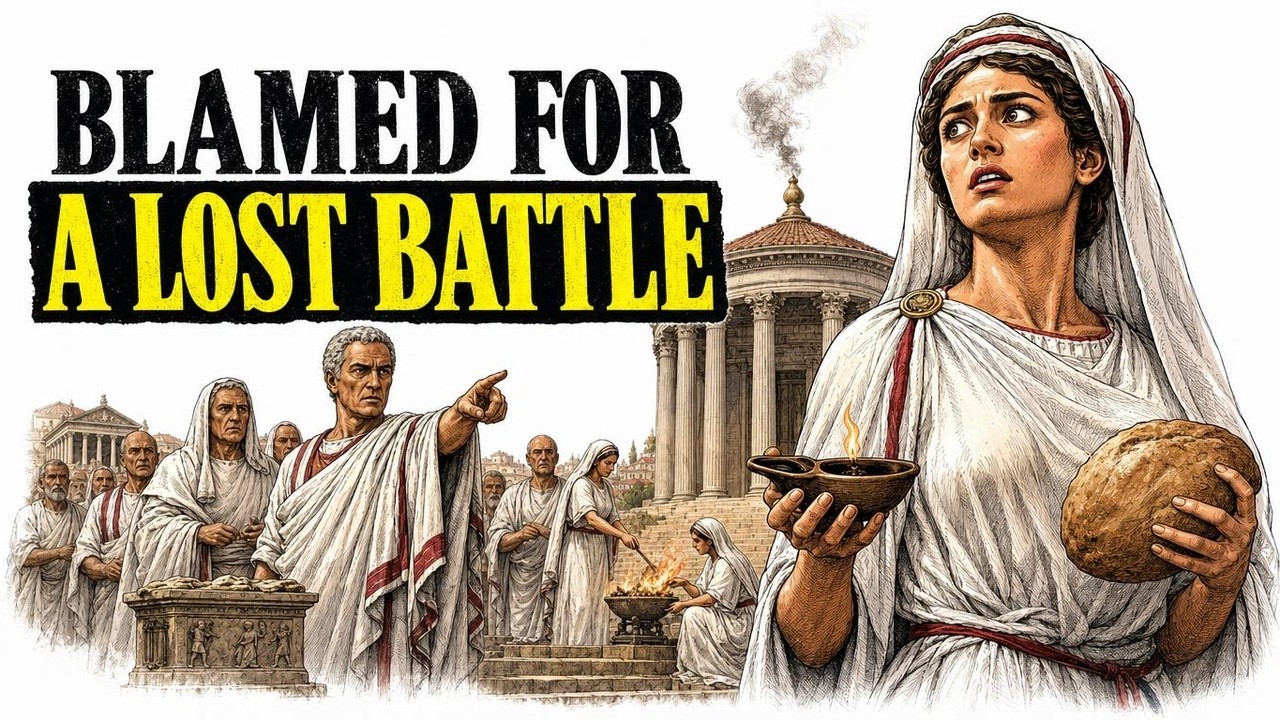
Yet every privilege came with a single, crushing condition. They were required to remain chaste for 30 years. A broken vow was not a private failing; it was treason against the gods, a tear in the invisible shield that held disaster at bay. Candidate selection was coldly practical.
According to the second-century antiquarian Aulus Gellius, a girl had to be between six and ten years old, the daughter of patrician parents married under Rome’s oldest rite, and physically flawless—no scar, limp, stammer, or missing tooth. A child who could not hear or speak clearly was disqualified, because a garbled prayer was considered a broken prayer that never reached the gods. Twenty candidates were gathered, and one was chosen, normally by lot. In practice, however, wealthy families often volunteered a daughter to avoid the draw.
By the reign of Tiberius, senators had become so reluctant to give up their girls that the emperor had to offer a dowry of two million sesterces to compensate the family whose daughter was taken. The ceremony itself was a legal transfer of ownership. The high priest took the girl by the hand and recited a brief formula: “I take you, beloved one. ” Under Roman law, she ceased to be her father’s daughter.
Her hair was cut and hung on a sacred tree, and when it grew back it was bound into six braids, a style otherwise worn only by brides. The contract ran 30 years, divided into three blocks of ten: a decade of learning, a decade of service, and a decade of teaching the next intake of girls. At around age 40, the Vestal was free to leave and marry. Almost none did.
Plutarch records that those who left were said to bring misfortune on their husbands, and that most stayed rather than face the world they no longer knew how to live in. The temple they served was deliberately unimpressive. While Rome rose into marble and gold, the Temple of Vesta remained a small round hut, its shape echoing the dwellings of the city’s first shepherds. A hole in the roof let the smoke escape, so a thin column of smoke rose above the forum day and night.
Inside there was no statue of the goddess, only the fire itself, believed to have been carried from burning Troy. Behind an inner curtain, hidden from the eyes of all men, the Vestals guarded the Palladium, an ancient wooden image of armed Minerva, one of the sacred pledges on which Rome’s survival was said to depend. When the temple burned in 241 BC, the chief priest ran into the flames to save it and lost his sight, a sacrifice Rome honored with a rare public privilege. If the sacred fire ever went out, it was read as a signal that the gods had abandoned the city.
The Vestal on watch was beaten in silence by the high priest. The flame could only be rekindled by drilling sacred wood or focusing the sun through a bronze mirror—no ordinary fire could serve. The Vestals’ duties extended far beyond tending the flame. They prepared the mola salsa, the sacred salted flour required for every official sacrifice in the Roman state.
Without it, no animal offering was valid, and no prayer was believed to reach the gods. Every bull, sheep, or pig killed on an altar had to be prepared with flour made by the Vestals’ hands. They sat at the narrowest point in the entire supply line of divine favor. Their privileges were considered equipment rather than honors.
A lictor, the armed attendant who cleared the road for consuls and praetors, went ahead of them in public. They were granted the legal rights of a mother of three children, a status that freed them from male guardianship. At the games, they sat among the magistrates in the front rows, and men rose when they entered. Julius Caesar entrusted his will to the senior Vestal; Mark Antony’s last testament was also said to have been deposited with them.
Their residence had become the most trusted vault in the city. If a condemned man on his way to execution happened to meet a Vestal by pure chance, he was set free. Her presence alone cancelled the sentence. But the central vow that underwrote all this power was chastity, and Rome treated it as insulation.
A Vestal’s body was believed to be a sealed channel between the human and divine worlds. Any sexual contact was thought to break the seal, voiding every prayer and sacrifice made by the city, and opening the gates to plague, famine, and defeat. The crime was called incestum, meaning pollution of the sacred. The man accused of sharing in it was scourged to death in public.
The woman could not be executed in the ordinary way, because her blood was considered sacred. Instead, Rome had designed a procedure that killed without shedding a drop of it. In 114 BC, the mechanism was tested under unbearable pressure. Far to the north, the Cimbri and Teutones, whole peoples on the move with their wagons and herds, were grinding south toward the edges of the Roman world.
In Macedon, the legions had been shattered by the Scordisci. The consul who led them, Gaius Porcius Cato, escaped with his life, but his army did not. When he returned home, he was convicted of taking bribes. Rome read these disasters not as military failures but as symptoms of a broken contract with the gods.
Somewhere the shield had developed a hole. The state began running a diagnostic, and its attention settled on the six women in the House of Vesta. The spark, according to the accounts preserved by later writers, was almost absurdly small. A slave came forward as an informer, claiming he had arranged meetings for the Vestals.
He had been promised his freedom for the service and then cheated of it. A grudge lit the fuse. His word alone would not convict anyone, but it opened the door, and the fear of the whole city came pouring through it. Three Vestals—Aemilia, Licinia, and Marcia—were charged with incestum.
The case went before the college of pontiffs, judged by the chief priest Lucius Caecilius Metellus Delmaticus. The evidence was laid out, and the verdict came fast. Aemilia was condemned. Licinia and Marcia were acquitted.
The panic did not subside. The frontier kept bleeding. Then a daughter of a Roman knight was struck by lightning and killed on the road home from a festival, and the priests read the sign as a coded message about the chastity of maidens. The Sibylline Books, ancient prophecies opened only in moments of extreme danger, were consulted.
They called for a rite Rome had performed only in its darkest hours: the burial alive of a pair of Greeks and a pair of Gauls in the cattle market. Now the acquittal of the two Vestals no longer looked like justice. It looked like a cover-up. A tribune named Sextus Peducaeus stood before the people and argued that the pontiffs could not be trusted to judge themselves.
He carried a law creating a special court, with a single handpicked investigator at its head: Lucius Cassius Longinus Ravilla, a former consul and censor already famous for severity. He was remembered for pressing one question on every case: who benefited? The Romans turned his name into a phrase—a “Cassian judge,” meaning a court from which no defendant walked free. The secular power had overridden the sacred.
The machine’s own controls had failed, so an outside force was called in to purge it. The second trial was a different animal. Ravilla treated it as an interrogation, pulling at every thread until it gave. The slaves of the accused were questioned under torture, the standard Roman method for extracting testimony from the unfree.
New names came out of that room. The men accused alongside the priestesses were condemned. This time, Licinia and Marcia, acquitted only months before, were found guilty as well. Later generations used the whole episode as a lesson in how a frightened people convicts by mood—first sparing, then, when the mood turned, condemning the same women on the same facts.
What followed was a piece of legal engineering as cold as anything Rome ever devised. The condemned women were stripped of their veils and insignia, their sacred status revoked by the state that had made them. Their litter—the covered couch in which a Vestal moved through the city as a sacred presence—was prepared for one last journey. This time it was sealed.
The condemned woman was placed inside, bound and gagged, so that no sound escaped the curtains. If the crowd heard her voice, a cry or a curse, it might be read as one more tear in the sacred order. The destination was the Campus Sceleratus, the Field of Wickedness, a patch of raised ground just inside the Colline Gate. Nothing was built there.
It was a blank field the city walked past every day and never named aloud. A small chamber had already been cut into the earth, its walls lined and its roof shored. Inside, the state had arranged the props of its own legal fiction with terrible care: a narrow couch made up as if for sleep, a single lighted lamp, and a little food—a loaf of bread, a small measure of milk, a jar of water, a portion of oil. The record could say truthfully, by its own logic, that when the state left her, she was alive and had bread.
The procession halted at the mouth of the pit. The chief priest stepped forward, his head veiled as a man veils it when performing a sacrifice, and spoke prayers meant to absolve himself and the city of what was about to be done. Plutarch says he turned his face away at the last, as did all the other priests, so that none of them would watch the moment itself. The bindings were loosed.
The condemned woman was brought to a ladder set into the opening and made to climb down into the ground. When she reached the bottom, the ladder was drawn up after her. Masons came forward with dressed stone and mortar and closed the mouth of the chamber course by course. Then the diggers shoveled the earth back over the sealed stone until the ground was flat, until nothing marked the spot.
The Romans avoided the plain word for it. They did not say she was killed. They said she was dug in, as if she were a seed rather than a woman. The burial was meant to cleanse the pollution and restore the peace of the gods.
It did not work. Three years later, in 105 BC, at a river called Arausio in southern Gaul, the Cimbri and Teutones met two Roman armies that refused to cooperate with each other. The proud aristocrat Quintus Servilius Caepio refused to share command with a man he considered beneath his birth. The Germans destroyed both armies in a single day.
Roman writers put the dead at 80,000, more men lost on that riverbank than in almost any battle the city ever fought. The road to Italy lay open. The burials at the Colline Gate had cleansed nothing. In the wound of Arausio, Rome turned away from its old nobility and handed its armies to a self-made general named Gaius Marius, who would remake the legions and, with them, the republic itself.
But the failure planted a second lesson, quieter and far more dangerous than any defeat. The procedure existed now. The ground was consecrated. The veiled priest who turned his face away was written into the ritual.
It had all been built to purify the state. Yet a man was coming, a century and a half later, who would look at that same chamber and see something the founders never intended: not a way to cleanse Rome, but a way to erase anyone who stood in his path, and to call the whole business piety while he did it. The cult of Vesta was designed to repair itself from within, to find its own broken part and bury it. By that logic, it was almost indestructible.
It outlasted the kings, the republic, the civil wars of Marius and Sulla, the murder of Caesar, the reign of Nero, the year of four emperors, and plagues that emptied whole provinces. The fire stayed lit. Augustus made himself chief priest in 12 BC and moved a shrine of Vesta into his own house, folding the goddess into the imperial residence. The Vestals crowned the great occasions of the dynasty.
They kept the wills of emperors as they had kept Caesar’s and Antony’s. Nero seated them among the priests at the games. Domitian, by contrast, revived the old terror in the 80s and 90s, condemning several Vestals for breaking their vows and burying the chief Vestal Cornelia alive in the ancient way, protesting her innocence as she went down into the ground. But the machine had no defense against a rival.
In the fourth century, that rival arrived in the heart of the empire: Christianity, with a single jealous god who had no interest in sharing the sky with Vesta. The cult was not going to be broken by an enemy. It was going to be switched off by an accountant. The last great defense of the old religion has survived word for word.
It came in the year 384, spoken through Quintus Aurelius Symmachus, prefect of the city and the most respected voice of the pagan aristocracy. His official report, addressed to the young emperor Valentinian II, is not the raving of a fanatic. It is the careful brief of a man arguing from results rather than from faith. This cult, he wrote, has bent the whole world under Roman law.
These rites drove Hannibal from the walls and the Gauls from the capital. He asked the emperor to restore state funding for the Vestals and the ancient priesthoods. He put words in the mouth of Rome herself, personifying the city as an aged mother pleading with her children: “Let me live by the custom of my age, for this worship subdued the world. ” He warned that a famine had followed the confiscation of the temple lands, as if the earth itself had noticed the insult.
“We all look up at the same stars,” he wrote. “What does it matter by which road each of us seeks so great a mystery? ”
The answer came from Ambrose, bishop of Milan, a former provincial governor who held the ear of the court completely. Ambrose did not debate Symmachus.
He dismantled him, picking up the appeal to the record and turning the blade around. Where were your gods when the Gauls took Rome and burned it? A flock of geese on the Capitol raised the alarm, not your priests or your sacred chickens. Where were your gods at Cannae, where Rome lost the better part of an army in a single afternoon?
His logic was cold and almost commercial. The old religion had collected its premiums for a thousand years and paid out nothing. Rome’s greatness came from the nerve of its soldiers and the sense of its magistrates, not from flour sprinkled on a bull’s head. Then he went at the Vestals directly.
You keep seven priestesses at ruinous public cost, wrapped in fillets and purple, carried in litters, and even so, you can barely find girls to fill the places. My churches overflow with virgins beyond counting, who chose that life freely, wear no purple, and cost the treasury nothing. It was a total rejection of the machine’s value. The empire did not need Vesta anymore, and the men around the boy emperor sided with Ambrose.
Symmachus, the most eloquent man of his age, had lost with the finest speech of his life. He would petition again under later emperors and lose again each time. The shutdown, when it came, was written in ledgers rather than in blood. In 382, the emperor Gratian, acting under Ambrose’s influence, ordered the confiscation of the lands and revenues that had funded the pagan temples for centuries.
The great estates that fed and clothed the Vestals passed into the imperial treasury. He abolished their tax exemptions and inheritance rights. He had the Altar of Victory, before which senators had sworn their oaths since Augustus, carried out of the Senate House. And he refused the office of Pontifex Maximus, the title every ruler from Augustus onward had worn, letting an 800-year-old priesthood lapse from the crown.
The machine kept running for a while on momentum alone. The priests still recited the archaic formulas. The women still fed the fire. But they did it now as private persons.
A human flicker survives from those final years. A great pagan official named Vettius Agorius Praetextatus died in 384, holding a fistful of priesthoods at once, on the very eve of taking the consulship. His widow set up an inscription cataloging every rite they had shared, a stone that reads like the inventory of a dying religion. Around that time, a chief Vestal named Coelia Concordia still served in the emptying house.
In gratitude for her devotion, the pagan senators voted her a statue. In return, the Vestals wished to honor Praetextatus with a statue of their own—a priestess of Vesta raising an image to a man, a thing without precedent in 1,100 years. It was the old world reaching out to hold its own hand as the ground opened under it. The final decree came less than ten years on.
Around 391, the emperor Theodosius issued the laws that shut the temples for good. Sacrifice was forbidden on pain of heavy fines. Entry to the shrines was denied. It became a crime to hang a garland on a household altar or burn a pinch of incense to the old gods in one’s own home.
In 394, the last open pagan stand, an army under the usurper Eugenius marching behind a restored Altar of Victory, was crushed by Theodosius at the river Frigidus in the Alps. With that battle, the last political hope of the old religion died in a mountain pass. At Rome, there was no last stand at all. The sources are strange on this point.
No pagan mob defending the forum. No final clash of priests and bishops. The record is silent because nothing happened. The remaining Vestals, their numbers thinned, their purpose erased by imperial signature, simply left.
Their 30-year contracts had been voided by a stroke of a pen in a palace far to the north. The House of Vesta, the most prestigious address in Rome for more than a thousand years, was left empty. The Christian poet Prudentius wrote of the change, picturing the old priestesses freed at last to marry, and the sacred fires going cold across the city one by one. Since the founding of the city, the flame had burned without a single break.
Roughly eleven centuries, something like 380 intakes of six-year-old girls, each surrendering 30 years, so that the fire in the round hut would still be burning when they handed it on. It had survived the Gauls, the Great Fire of Nero in AD 64, the blaze under Commodus that gutted the temple. Now there was no one left to feed it. Sometime in the last years of the fourth century, in the dark of the round temple at the foot of the Palatine, the fire on the hearth of Vesta burned down to embers, then to a bed of gray ash, and went out.
No one recorded the night. No priest ran in to call it a catastrophe. The heartbeat that Rome had listened for across a thousand years simply stopped. The Palladium, the sacred image hidden behind the inner curtain, vanishes from history in the same years.
A rumor drifted through later centuries that Constantine had carried it off to Constantinople, to bury it beneath his own bronze statue, so that the luck of old Rome would pass to the new one. Nobody knows. Walk through the ruins today and you can still trace the outline of the machine. The circular base of the Temple of Vesta survives, a low ring of stone with three reconstructed columns.
Beside it lies the Atrium Vestae, the long house whose courtyard is still lined with the pedestals where the statues of the chief Vestals once stood. Many of the statues are gone, and many of those that remain stand headless. One of the inscriptions has a name deliberately chiseled out; scholars believe that particular chief Vestal converted to Christianity, and her sisters struck her name from the honor roll, erasing her the way the state had once erased the condemned. The site served as a stone quarry for churches and palaces, and its marble burned in kilns for lime.
It is an accidental but exact final image for the institution. The individual woman was always the replaceable part. The system she served was the point. An empire of law and legions, of aqueducts and account books, chose to anchor its entire spiritual security on six women taken as children.
Their privileges were never gifts. They were the state marking the value of its own investment. They were the human guarantee behind Rome’s bargain with heaven, held in reserve against the anger of the gods. And the moment a better guarantee appeared, the moment the empire found a new god who promised more security for far less money, the collateral was written off.
The funding was cut. The house was abandoned. The fire was left to die in the dark.
And the names of the women were left to weather away in unbroken stone in a courtyard that visitors now cross without once looking down at what is under their feet.