On December 8, 1941, President Franklin Delano Roosevelt stood before Congress to ask the nation to enter World War II. Photographs from that historic moment show a black cloth armband on his sleeve. Most Americans assumed it honored the sailors lost at Pearl Harbor the day before. It did not.
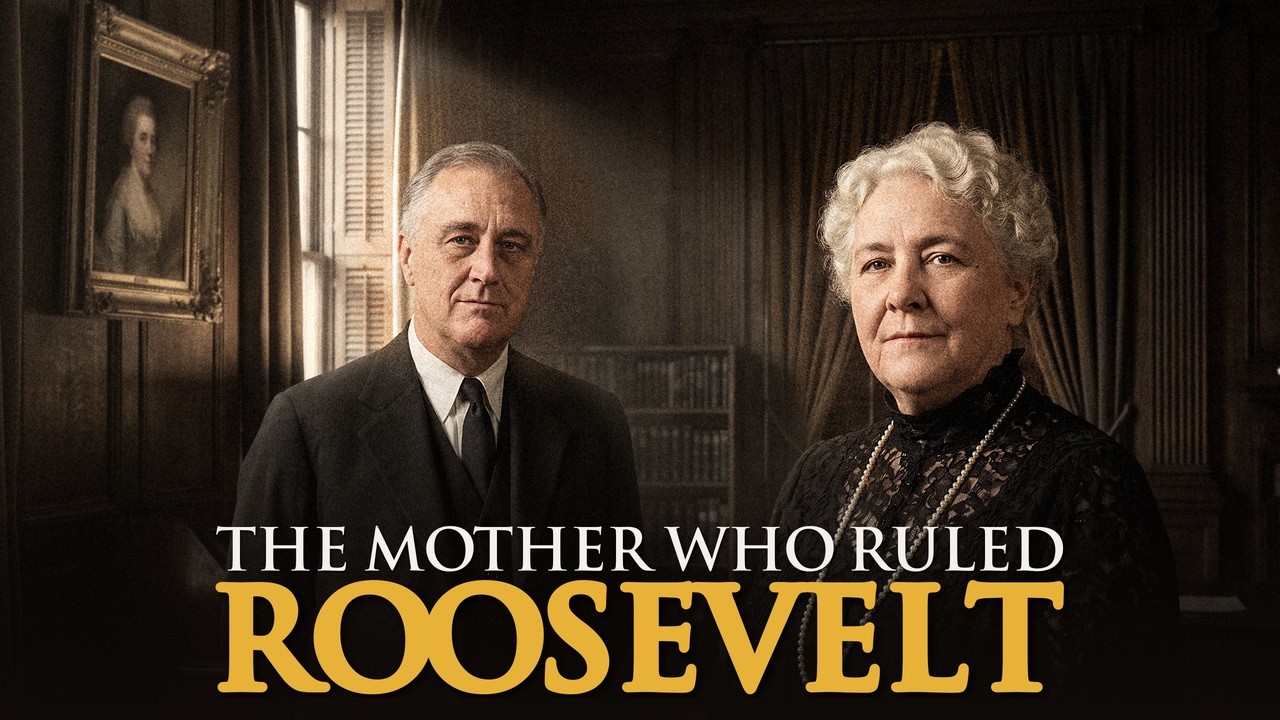
Roosevelt was mourning someone who had died three months earlier: his mother, Sara Delano Roosevelt. The story most people know is that of a domineering mother-in-law who tormented her son’s wife. The story beneath it is more complicated. It is a tale of a love so complete it became a cage, and of the three people who lived their lives inside it: a mother who never let go, a son who never fully left, and a wife who spent decades trying to find her own place.
Sara Delano was born into wealth built on ships and trade with China. Her family carried a quiet certainty that the world could be bent to the Delano will. In January 1882, she gave birth to a son after a long and difficult labor. The baby was born blue and silent, and for long minutes he did not breathe.
When he finally took his first breath, his father, James Roosevelt, recorded the moment in the family diary. The boy was their only child. When it came time to name him, Sara refused her husband’s choice and selected instead the name of a favorite uncle from her own side of the family: Franklin Delano Roosevelt. Before the child could walk or speak, he carried her family’s name in the middle of his own, as though marking her claim quietly on the ground.
Sara had been told by doctors that she should never have another child. She accepted that without argument. If there could be only one child, that one would have everything: every hour of her attention, every ambition she had set aside. She never considered this a sacrifice.
She considered it love, and until the end of her days, she never learned to tell the difference between the two. Franklin’s childhood was warm but entirely controlled. His mother chose his clothes, his tutors, his waking and sleeping hours. She taught him to read and to draw geography from maps of the oceans her family had sailed.
He did not attend school with other boys for years. Summers followed the same pattern, with the family sailing to their island retreat at Campobello, where Franklin learned to sail under his father’s eye and his mother’s supervision. He crossed to Europe six times as a boy, always beside his parents and always along his mother’s itinerary. The result, biographers note, was a boy who was bright, confident, and certain of his own charm.
He never doubted for a moment that he was loved. The price hidden inside that gift, however, was that he learned very early that the world was not a place from which one was expected to leave. At Hyde Park, there was no door Sara could not open: not the nursery, not the schoolroom, and, as it later turned out, not the private rooms of his heart. When James Roosevelt died in December 1900, Sara, then 46 and a wealthy widow, redirected all her attention to the only man left to her.
She went so far as to rent a house near Harvard so she could remain close to her son while he finished his studies. One biographer wrote plainly that she was determined to make Franklin the only man in her life. And he was. There was a financial dimension to this bond that mattered deeply.
When James died, the real wealth of the family remained under Sara’s control. Franklin received a generous income, enough to live as a gentleman expected, but he never held the purse strings. His mother did, year after year, decision after decision. For most of his adult life, the man who would one day lead the United States lived on an allowance from his mother.
In his final year at Harvard, Franklin did something he had never done before: he fell in love, and he kept it from his mother. The young woman was not one of the suitable society girls Sara had been steering toward him. She was tall, shy, and serious beyond her years, an orphan who had grown up believing herself plain and unwanted. She spent her days visiting the poor in New York’s tenements and teaching immigrant children to dance.
Her name was Eleanor, and she was already a Roosevelt by birth: a niece of President Theodore Roosevelt. When Franklin finally told his mother in the fall of 1903 that he intended to marry Eleanor, Sara did the only thing she knew how to do when the world moved without her permission. She set out to stop it. She asked the couple to keep the engagement secret for a full year, then took Franklin on a long Caribbean cruise, away from Eleanor and away from the entire uncomfortable situation.
She trusted the ocean to do the work for her. It did not. He returned home unchanged in his intentions. On March 17, 1905, Franklin and Eleanor were married in New York City.
Theodore Roosevelt, who happened to be in town for the St. Patrick’s Day parade, gave the bride away and drew half the crowd away from the wedding toward himself. The marriage should have been the beginning of a life belonging to the young couple alone. It was not.
Sara had already decided how they would live and where. As a wedding gift, she built them two six-story townhouses side by side on East 65th Street in Manhattan. She lived in one; Franklin and Eleanor lived in the other. The architect had been instructed to open connecting doors through the walls at several floors, linking Sara’s rooms to theirs and to the nursery.
She could move from her drawing room into her son’s rooms, and into her grandchildren’s rooms, whenever she wished. No knocking, no warning, only the quiet opening of a door that had, in the end, always been hers. For Eleanor, the arrangement was slow suffocation. In her own memoirs she recorded the moment she broke down, sitting at her dressing table in that beautiful borrowed house and weeping.
When Franklin asked what on earth was the matter, she could barely find words to explain that there was not one room in her home that felt like her own, because none of it was hers, and never had been. Franklin, who loved his mother and loved his wife and had never once been asked to choose between them, did not understand the tears at all. To him, the arrangement was simply generous. What was there to cry about?
So Eleanor learned the first hard lesson of her marriage: in any quiet conflict between herself and Sara, her husband would not take her side. He would smile, change the subject, and leave the connecting doors exactly where they were. Then came the children, six of them in ten years, though one died as an infant. Sara intervened there too, through the connecting doors and through every decision.
She hired the nurses and chose the schools. When the grandchildren wanted something their mother had forbidden, they quickly learned there was another door they could knock on. Grandmother had the money, and she rarely said no. Eleanor later wrote with painful clarity: Franklin’s children were more her mother-in-law’s children than they were hers.
In the fall of 1918, Eleanor discovered something that changed the shape of the marriage forever. While unpacking her husband’s suitcase after a long trip abroad, she found a bundle of love letters tied with a ribbon. They were not written to her. They were from Lucy Mercer, a young woman who had once served as Eleanor’s social secretary.
Eleanor, wounded beyond pretense, did something extraordinary: she offered her husband his freedom. She would give him a divorce and let him go to the woman he loved. For one moment, the most influential marriage of the coming century hung on a single decision. The marriage did not end.
Biographers disagree on every word spoken in those weeks, but they agree on the essence: it was not ambition alone that kept Franklin in place, but his mother. Sara made her position unmistakable. There would be no divorce. It would be a public scandal, a stain on the Roosevelt name, and an unthinkable disgrace to the grandchildren.
If Franklin defied her and left Eleanor and the children for Lucy Mercer, Sara would do the one thing that could truly stop a man who lived on her money: she would close her vaults, cut off his income, and strike his name from her will. For most men, a mother’s refusal is a storm that can be weathered. For Franklin, it was the end of the world. He had never earned a living in the conventional sense.
His entire public life rested on private income he did not control. Losing the allowance and the inheritance together was not a loss of luxury; it was a loss of the ground beneath his feet. His mother had patiently built that dependence over forty years, one generous check at a time. Now, for the first and last time, she made him see the binding woven into every gift.
Franklin submitted. He promised to end the affair, and the divorce was never mentioned again. The marriage continued, but in a colder new form, no longer warm husband and wife but partners and allies bound by six children, a shared career, and above all, the unyielding will of the woman who lived behind the connecting door. The relationship with Lucy Mercer would remain buried for twenty-seven more years, until the final moments of his life.
The hidden hand behind that secret, biographers argue, was Sara. In August 1921, the family was at Campobello, the rugged island off the coast of Maine and New Brunswick where the Roosevelts had summered for years. Franklin, then 39, was vigorous, ambitious, and already a rising figure in national politics. One afternoon he sailed with the children, helped put out a brush fire on a neighboring island, and then dove into the cold bay for a swim.
That evening he felt chills he could not shake. He went to bed early, in pain. He would never walk on his own again. Within days, both legs were paralyzed.
The doctors argued about what it was, and eventually gave it a name: polio. In the span of a week, a vigorous man at the height of his powers was unable to stand. For a man whose life had been built on ease and movement, it was a particular kind of horror. For weeks, no one could say whether he would recover the use of his legs at all.
When Sara returned from Europe and saw her son helpless in bed, she saw her chance. Her plan was simple and, to her, loving: Franklin would return to Hyde Park. He would give up the stress and ambition that, in her view, had worn his body down until disease could take hold. He would live out his days as a country gentleman on the estate where he was born, reading, collecting, tending the land, surrounded by care and comfort and safety, cared for by her.
It was the life she had secretly wanted for him all along. She had lost him to a wife and to politics. Now illness had made her necessary again. There was only one problem with her plan.
Two other people in that house wanted something completely different, and this time they refused to surrender. Eleanor, the shy and marginalized wife, discovered in the crisis a strength no one had known she had. She would not allow Franklin to fade into a quiet retirement as an invalid. Beside her stood Louis Howe, Franklin’s political adviser, a disheveled chain-smoker of absolute conviction who believed, without hesitation, that Franklin Roosevelt would one day be president of the United States.
The wife and the adviser made a pact and fought for it: Franklin would recover as much as he could, and then he would return to the world. For the first time in forty years, someone stood between Sara and her son and did not back down. The battle was fought quietly, in sickrooms and hallways, in long tense conversations over the still body of the man they were all struggling to claim. Sara had every traditional advantage: money, the estate, a lifetime of unchallenged authority.
Eleanor and Howe had almost nothing except conviction and the flat refusal to give up. It was not an even fight. Sara lost it. Franklin chose the harder road.
He chose grueling exercise, heavy steel braces locked around his paralyzed legs, and the agonizing, sweaty effort of learning to fake standing. He chose Warm Springs and the long climb back into public life. He chose, in the end, his wife’s vision of his future over his mother’s. It was the only time in his entire life that he did so completely.
It took years. Years of falling and rising, of parallel bars and warm mineral pools, of a carefully staged public performance of health that concealed a body that would never fully heal. He taught himself to swing his braced legs forward with the aid of a strong arm and a cane, giving the distant impression of a man who merely walked with difficulty. It was one of the greatest deceptions of that era.
The country elected him four times, and until the very end, most Americans never fully grasped that the president who asked them to stand tall could not stand at all without help. The ordeal also remade Eleanor. In the years Franklin fought to return, she went out into the world to keep his name alive, learning public speaking, organizing, and leadership, becoming a political force in her own right. The woman Sara had tried to erase inside a house of connecting doors became a figure no house could contain.
Sara accepted her defeat the way she accepted everything: gracious on the surface, unconvinced underneath. She never stopped believing that Hyde Park and her care would have been the gentler life for him. And perhaps a small buried part of Franklin never fully left that house either. Franklin rose anyway.
The man his mother had wanted to hide safely at Hyde Park was elected governor of New York in 1929 and then president of the United States in the depths of the Great Depression. He moved to the podium on legs that could not carry him and told a frightened nation that the only thing to fear was fear itself. Throughout every year of that ascent, Sara remained exactly what she had always been. She sat beside the president at his first inauguration, watching her only son take the oath of office.
When the King and Queen of England visited Hyde Park in 1939, it was Sara who played hostess, the lady of the house receiving royalty on her own land. She still held the purse strings. She still passed through the connecting doors. In 1933, the same year her son became president, she published a small, affectionate book about his upbringing called “My Boy Franklin,” presenting the nation with a picture of a devoted mother, a well-bred son, and the stately old order of Hyde Park.
Franklin, the most powerful man on earth, never entirely broke free of her. Even past fifty, even after four elections, he still lived under the weight of her opinions and, in ways that mattered to her, her money. The presidency of the United States was not enough to close the door she had opened over his cradle. A part of him remained that boy with the long chestnut curls, the center of one woman’s universe, the child who learned before he walked that the world was not a place one was expected to leave.
There were small rebellions over the years: a decision made without her knowledge, a relationship she disliked, a policy she considered beneath the family’s dignity. He would let her say her piece, and then, most often, he would do exactly what suited him with a warm smile that revealed nothing. He had mastered the one skill his mother could never overcome: the art of appearing to agree. But appearing to agree is not freedom, and part of him knew it.
In late summer 1941, as Europe burned and America edged slowly toward the fire, Sara Delano Roosevelt’s health began to fail. She was 86 years old. She asked to be taken to her home at Hyde Park, the house above the Hudson River where Franklin had been born on that cold January morning 59 years earlier. Her son came to her there, leaving the entire machinery of state behind to sit at her bedside.
On September 7, the president held his mother’s hand as she died. She passed away in the early afternoon in that great house that had held so much of their lives together. Her doctor said her heart had simply given out at last. There is a story that, moments after her death, the tallest oak on the Hyde Park estate tilted, creaked, and fell to the ground, as though the earth itself felt her passing.
No one ever proved it, but the story is still told at Hyde Park today, and Franklin himself is said to have been deeply moved by it. For the first time in his careful, guarded life, he could not contain his grief. Those close to him said the president wept like a child. Then he did something quieter and stranger, and far more telling.
He wore black, and he did not take it off. For a full year after his mother’s death, in the midst of the most dangerous crisis of his life, the president of the United States wore a black mourning band on his sleeve. He was still wearing it three months later on December 8, 1941, the day after Pearl Harbor, when he stood before a stunned Congress to ask the nation to declare war on the Empire of Japan. Look again at the photographs of that moment, perhaps the most important address an American president ever gave.
The country saw a wartime leader, stern and resolute, calling the nation to fight. What almost no one noticed was the band of black on his arm, and fewer still understood its meaning. It was not for the sailors lost at Pearl Harbor the day before. It was for her.
At the very moment he was leading a nation into the greatest war in human history, Franklin Delano Roosevelt was still, visibly to anyone who knew where to look, a son mourning his mother. And what of Eleanor? The wife who had lived 36 years inside that family, behind those connecting doors, in a home that was never hers. When Sara died, Eleanor found she could not summon the grief the world expected of her.
Days later she wrote to a friend with blunt, quiet honesty that it was terrible to live near someone for 36 years and feel no deep affection or sense of loss, but that it was harder on Franklin. Three lives bound together inside one woman’s love, laid side by side at last as the harvest of that love: a son who could not stop grieving, a wife who could not begin, and Sara herself, who poured every hour, every dollar, and every ambition she owned into her only son and who, if Eleanor is to be believed, died without ever receiving real love in return. Only obedience. Only admiration.
Only endurance. What she wanted more than anything on earth was to be the center of his world. She got exactly that. And in one of the crueler turns of this story, she never realized there was any difference.
Sara Delano Roosevelt spent her entire life certain of one thing: that love meant holding on, and that an open door was a form of kindness. She built an entire family around that certainty. She made a president. She broke a marriage.
And it never once occurred to her that those two things might be the very same act. The great house still stands above the Hudson River, and so does the empty place where the oak once grew. And in the most famous photograph of the century, if you know now where to look, there is still a strip of black cloth on the president’s sleeve, worn in mourning for the woman who gave him everything and never let him go.