In June 1944, days after the Normandy landings, a German artillery observer hidden in a hedgerow south of the invasion beaches watched an ordinary wheat field through his binoculars. He had been monitoring it intermittently since the invasion began. Then the machines arrived. Yellow bulldozers, gray with dust, pushed the hedgerows flat at both ends.
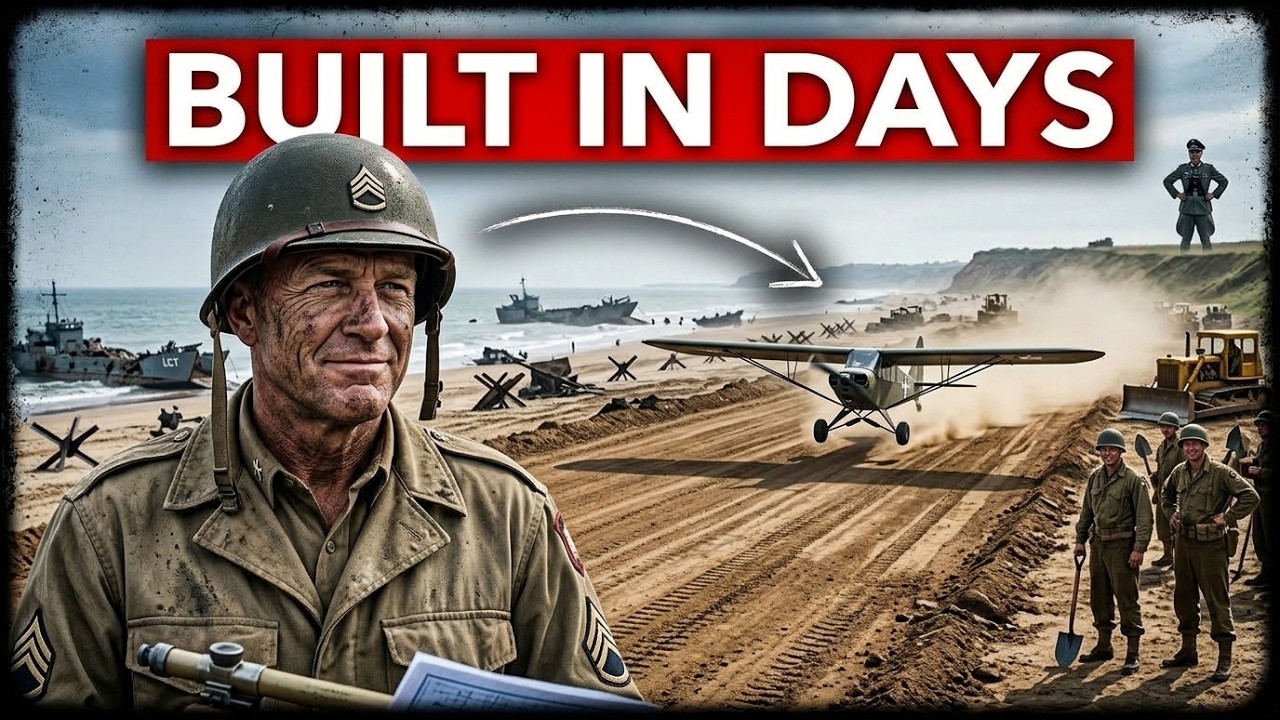
Scrapers cut down high ground and filled the low spots. Graders smoothed the surface. Rollers with rows of steel projections packed the soil. Water trucks sprayed down the dust.
Then men unrolled long strips of material across the prepared ground. From a distance, it looked like carpet. An American fighter plane came in low over the hedgerow, lined up with the field, and landed. It stopped at the far end, turned, and taxied to where tents, fuel drums, and men were waiting.
A few minutes later, it took off again. The observer knew what an airfield was supposed to be. He had spent four years watching Luftwaffe bases in France: concrete runways, hangars, fuel installations, and barracks, built over months by armies of laborers. Airfields were infrastructure.
They took a season to build and were planned a year in advance. What he was watching was a wheat field on D-Day turning into something else. This is the story of the men who broke that assumption, the machines they brought, and the wheat field that became a weapon. Part one: the cost of an airfield
The German understanding of an airfield was not wrong.
It was simply the only kind of airfield anyone had ever built on a large scale. A permanent military airfield in 1944 meant concrete or asphalt runways that could handle heavy aircraft in any weather—taxiways, dispersal areas, hangars, usually underground fuel storage, ammunition depots, workshops, quarters, drainage, lighting, and communications. The Luftwaffe had built and operated excellent airfields throughout France. Many were constructed by Organisation Todt, the massive German construction organization that relied heavily on forced labor and conscripted workers from across occupied Europe.
It was a huge, slow, labor-intensive process that produced solid, permanent facilities. Those facilities had one weakness that became catastrophic in 1944: being permanent meant being known, and known targets could be bombed. In the months before the invasion, Allied air forces bombed German airfields across northern France repeatedly and systematically. By June, many Luftwaffe bases in the invasion zone were cratered, their facilities destroyed, and their aircraft pulled back toward Paris and farther east.
The Germans ended up with the right kind of airfields in the wrong place, with no quick way to build new ones. The Allied problem was the exact opposite. Their air power was enormous but based on the other side of the English Channel. A fighter taking off from southern England had to burn a large portion of its fuel just to reach Normandy and return.
Every sortie was mostly a crossing flight. Pilots could stay over the landing zone only briefly before heading home. Planners had expected this, and their answer was to build no permanent airfields at all. Part two: the equipment and the men
The organization that did this work was part of the Army Air Forces, barely mentioned by anyone: aviation engineer battalions.
These were Army engineers whose specialty was building airfields fast, crudely, and practically. Many were assigned to the tactical air forces supporting the invasion, arriving on the Normandy beaches within hours and days of the assault troops, bringing their machines with them. The machines were the key, and they were products of the American civilian construction industry: bulldozers—heavy tracked tractors with blades for clearing hedgerows, trees, and obstacles and moving earth; tractor-drawn scrapers, which Americans called “carryalls”—huge open-bottomed bowls that lowered a cutting edge, scooped a load of soil while being pulled forward, hauled it where needed, and dumped it; motor graders to level the surface; sheep’s-foot rollers—drums covered with rows of steel projections to compact the soil so it could bear the weight of aircraft; plus water trucks and dump trucks. These were the same machines that had built America’s highways and dams in the 1930s, and in many cases they were operated by the same men who had done this work as civilians.
Then there was the runway surface, which came in three main forms. Square-mesh track was heavy wire netting, delivered in rolls, laid across the prepared surface and staked down to hold the soil together and keep wheels from rutting it. Prefabricated hessian surfaces were rolls of bitumen-impregnated burlap, laid in overlapping strips and tied together—essentially a waterproof cover over the earth that reduced dust in dry weather and kept the soil from turning to mud in rain. Pierced steel plank was interlocking steel sheeting, each piece about ten feet long, perforated with rows of holes to save weight, linked edge to edge to form a continuous steel surface.
It was heavy; a full runway of it was a huge amount of steel, all of which had to be shipped across the Channel and trucked inland from the beaches. But it formed a surface that could take the constant punishment of heavy fighter-bombers, and the engineers had a system of airfield types graded by how long they would be used. The first stage was an emergency strip: a short, rough, graded strip where a damaged aircraft could land instead of falling into the Channel. Next was a rearming and refueling strip, where a fighter could land, take fuel and ammunition, and take off again without returning to England.
Beyond that came an advanced landing ground: a proper forward airfield with a longer runway, a graded strip, taxiways, dispersal areas, and room for a full fighter group to live and work. The sequence had been drilled until it was routine, and it went roughly like this. A survey party went in first, often while the area was still dangerous, looking for a field long enough, flat enough, and firm enough, with an approach not blocked by high ground or woods. They marked the centerline and ends with stakes and flags.
Then came the bulldozers. The Normandy hedgerows were not simple fences. They were earthen banks, some more than head-high, matted with roots and topped with trees. Every hedgerow that crossed the runway line had to be pushed down and leveled.
Trees were cut, ditches filled. Then the scrapers came, cutting down the high spots and filling the low ones, working back and forth across the field until it was level enough for an aircraft to roll at speed without being bounced into the air. Then the graders and rollers worked repeatedly to compact the soil. Then came the surface, laid by hand in strips by crews working in lines, staked, linked, and tied.
Then fuel dumps dug into the hedgerows, ammunition stacked under camouflage netting, tents for pilots and ground crews, a control point with a radio, and a windsock on a pole. Then the call went back to England: the field was ready. The German observer hiding in the hedgerow had no way to know any of this. All he saw was a wheat field that stopped being a wheat field.
Part three: the first strips
Work began almost as soon as the engineers reached the beach. Above Omaha Beach, on the plateau behind the cliffs where some of the fiercest fighting on D-Day had taken place, aviation engineer troops began grading an emergency landing strip while the area was still under scattered fire. Within a day or two it was usable. It was short, rough, and dusty.
But a damaged aircraft that could not make it back across the Channel now had a place to land. That strip soon acquired a second mission no one forgets once they learn of it. Within days of the landings, transport planes began landing on the strips behind the beaches to evacuate the wounded. Stretchers were loaded into the fuselages, flight nurses stepped aboard, and men wounded in the hedgerows that morning could be in a hospital in England by evening.
The same field that received crippled fighters carried the wounded home. Then came the advanced landing grounds. Within about a week of the invasion, the first in the American sector was ready for operations, followed by another, and another. Fighter groups that had been flying from England began moving across the Channel to live beside those strips in tents, their ground crews working in the open, their aircraft lined up in dispersal areas surrounded by hedgerows.
The British were doing the same in their sector with their own airfield construction units, and the pace across the landing zone was relentless. By the end of June, there were numerous Allied airfields in Normandy. By the end of the summer, as the armies broke out and swept across France, the engineers were leapfrogging ahead of them, building a field, handing it over, packing their machines, and moving on to the next. It was not glamorous work.
Normandy in high summer was dusty, so dusty that the clouds raised by aircraft taking off and landing could be seen for miles, revealing the fields to German artillery and clogging engines and guns. The engineers sprayed water, then oil, then laid hessian layers to bind the dust. When the rain came, the problem reversed, and they fought mud instead. Aircraft crashed on runways that were too short, too rough, or too crowded.
Engineers were bombed while they worked. The men lived in the same tents and ate the same rations as everyone else in the bridgehead, working around the clock. They never appear in the famous D-Day photographs. If you believe the aviation engineers and machinery operators who built these runways under fire deserve to be remembered, then like this video.
It keeps their part of the story in front of the people who care. Part four: what the runways changed
Think about what those runways did to the mathematics of battle. A fighter-bomber taking off from southern England spent a large part of every mission just crossing the Channel and coming back. Its time over the battlefield was short.
When a ground unit called for air support, the answer had to come from aircraft already overhead or from a mission launched from England with a long transit ahead of it. A fighter-bomber taking off from a strip in Normandy was minutes from the front lines. That changed three things at once. It changed the sortie rate.
An aircraft that spent less time transiting could fly more missions per day. Pilots in Normandy flew multiple sorties a day—takeoff, attack, land, refuel, rearm, then take off again—with ground crews working at a pace impossible when every mission was a round trip across the sea. It changed time over the battlefield. An aircraft that did not need to conserve fuel for the crossing could stay over the front far longer, orbiting the columns waiting for orders.
And it changed response time. When a tank column ran into an antitank gun at a treeline, or an infantry company was pinned down by a machine gun in a farmhouse, responding aircraft could arrive in minutes instead of most of an hour later. On the German side of the line, this was felt immediately and bitterly. German units in Normandy learned that daylight movement was nearly impossible.
Roads were watched from the air from dawn to dusk. Columns were attacked within minutes of being spotted. Reinforcements had to move at night, arriving late, exhausted, and short of the equipment destroyed on the way. The Luftwaffe, trying to compete with the Allied air forces over Normandy, found itself fighting from the wrong positions.
Its remaining airfields were far to the rear, frequently bombed, and known. German fighter units that rushed to France after the invasion took off from fields near Paris and beyond. Every sortie they flew involved a long transit into skies filled with Allied fighters operating from strips only a few miles away. The German command had planned against a real threat—Allied air power based in England.
What happened was that the threat had moved to within very close range of the front. There is another effect rarely mentioned, and it concerns ground crews more than pilots. An aircraft damaged over Normandy that had to fly all the way back across the Channel to England might not make it. Fighters with holed fuel tanks, damaged engines, or wounded pilots, fell into the sea on the way home throughout the air war.
The emergency strips behind the beaches meant a damaged aircraft had a place to land within minutes, and a pilot who landed safely was a pilot who would fly again. A damaged aircraft that landed at a forward strip could often be repaired right there by mechanics working in the open beside the runway, flying again within a day or two. The same forward bases that doubled the sortie rate also doubled the survival rate of the machines—and the men who flew them. On the German side, a fighter pilot hit over Normandy faced a long flight back to a field near Paris, over territory swarming with Allied fighters, with no emergency strip along the way.
Many did not make it. Part five: the final verdict
The verdict is that the Germans were right about airfields, and it did not matter. A real airfield takes months to build. It requires concrete, drainage, hangars, and all the rest.
The German understanding of what an airfield was reflected a real engineering reality. The Luftwaffe’s fields in France were real and good airfields. But the Americans did not build real airfields in Normandy. They built something else: an airfield reduced to its absolute essentials.
A graded, compacted strip, a surface to bind dust and mud, fuel in drums, ammunition in boxes, tents, and a group of fighters parked among the hedgerows, minutes’ flying time from the front. It was rough, dusty, dangerous, temporary, and ugly—and it did not need to be anything more, because it was not designed to last. It was meant to be used for a few weeks, then abandoned and replaced by another one farther forward. This is the full vision, and it is a very American one.
The Germans asked: “What must an airfield be? ” The Americans asked: “What is the minimum an airfield can be and still work? ” Then they brought the machines to build that minimum in days, and the industrial capacity to supply the steel, the hessian, the fuel, and the trucks. The result was that the most powerful tactical air force in the world moved to within a few miles of the battlefield within days of the landings, and stayed there, advancing with the armies all the way into Germany.
The German observer in the hedgerow was watching a wheat field. What he was actually watching was the end of any chance his side had to move in daylight, and he could not have explained that to his superiors because his experience did not include the possibility that a wheat field could become an airfield from one week to the next. That observer is a composite figure. The aviation engineer battalions, the machines, and runway surfaces they used, the emergency strip above Omaha Beach, the airborne evacuation of wounded from Normandy’s strips, the rapid construction of advanced landing grounds in the American and British sectors, the dust problem, and the impact of advanced fighter-bombers on German movement—all of this is documented.
If this story gave you something to think about, then like this video. It helps the channel reach viewers who want history as it actually happened, including the parts decided by men on bulldozers. Subscribe if you want the next part. There are more stories like this, more fields, more machines, and more engineers who turned impossible timelines into routine work.
And if your father or grandfather served in an aviation engineer battalion, a fighter group ground crew, or any of the units that built and operated the airfields in France, leave his name and unit in the comments. They built the ground from which the air war was fought.