Paul Brown packed up his office alone. No cameras. No assistants helping him carry anything. He wrapped a framed photo in newspaper before placing it in a box, handling it with the care of a man who did not expect to unpack it anytime soon.
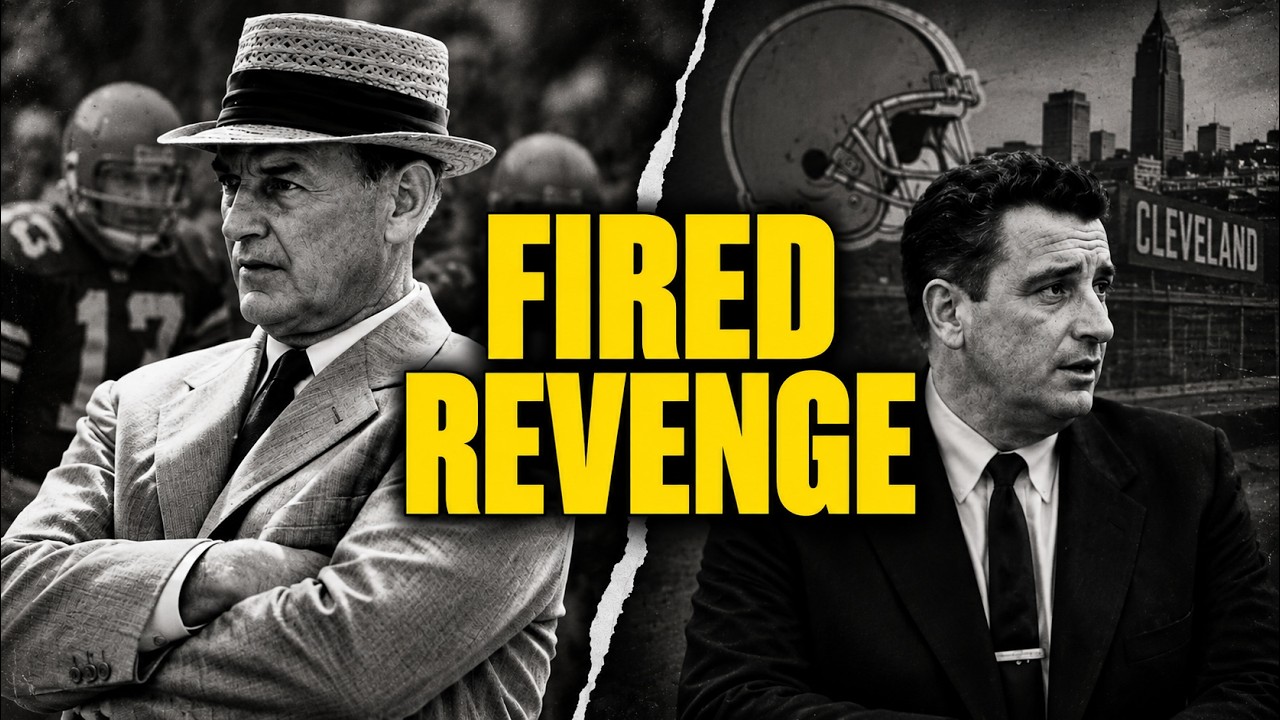
Then he took down a play diagram from a chalkboard, erased it slowly, gave one last look at the nameplate on the door that still bore his name, and left. Sixty years earlier, Cleveland had needed a football team. The Rams had just moved to Los Angeles, and taxi magnate Mickey McBride funded a new franchise in a brand-new league. He hired a young, obsessive coach from Ohio who had been coaching high school and college teams.
Brown was so respected that sportswriters began calling the team “Paul Brown’s Team” before it even had an official name. When the club held a fan contest to pick a name in the spring of 1945, more than 20,000 entries poured in. The most popular choice was the Cleveland Panthers. Brown rejected it outright, telling the club, “That old Panthers team failed.
I want nothing to do with that name. ” He also objected to the second-most popular suggestion: naming the team after himself. He called it immodest for a coach to put his name on a team while he was still alive to coach it. For years afterward, whenever reporters asked, Brown insisted the name had come from the “Brown Bomber,” the nickname of heavyweight champion Joe Louis, not from him.
The club ignored his objections anyway. Decades later, in his autobiography, Brown finally admitted the Joe Louis story was a version of the truth he had found easier to live with. The team became the Browns, almost against Brown’s will, and the name never went away. Even decades later, when the man himself had long since left the building that bore his name.
Brown repaid the franchise with a level of dominance the sport had never seen. He invented the modern playbook, turning what had been a loose collection of plays into an actual written system that players had to study and pass written tests on. He ran his locker room like a classroom, where a wrong answer on a Tuesday test could cost a player his spot in Sunday’s game. He was the first coach to hire a full-time, year-round staff of assistant coaches at a time when most teams had one or two men doing everything themselves.
He was the first to evaluate players scientifically based on game film rather than instinct. He was the first to make play calls from the sideline instead of leaving it entirely to the quarterback, a change some traditionalists at the time considered a betrayal of the game’s spirit. Over the next 17 years, his Browns won seven championships. Four straight titles in the old All-America Football Conference from 1946 to 1949, a run so dominant that the team lost only four games in those four seasons combined, including a perfect 14–0 season in 1948.
Then three more titles after the team joined the NFL in 1950, 1954, and 1955. Only one losing season in nearly two decades of football. In practical terms, from structuring modern coaching staffs to the existence of the general manager position as we know it today, he invented the blueprint the entire league still operates on. Decades later, most fans had forgotten the man behind it all.
That is exactly why what happened next was so cruel. In 1961, a 36-year-old New York advertising executive named Art Modell bought the franchise for $4 million, paying only $250,000 of his own money and borrowing the rest. He took over one of football’s most famous franchises almost entirely on credit. Modell wanted what he called an “active role” in football decisions that, under Brown’s contract, belonged to Brown alone.
Brown was not interested in sharing power. He had run the Browns as his own kingdom for 15 years and had no intention of changing that for a new owner half his age with no football background. Tension escalated over two full seasons through dozens of small decisions, each made Brown’s way without even a phone call to the man who technically owned the building. A slow accumulation of slights that Modell absorbed quietly, waiting for a moment to do something about it.
At one point, Brown traded All-Pro receiver Bobby Mitchell and a first-round pick for the rights to Heisman winner Ernie Davis without telling Modell in advance. A move that changed the franchise’s course, which the owner only learned about when another owner mentioned it casually, assuming Modell already knew. It was a recurring pattern: roster moves made entirely behind closed doors, a coach treating his new boss not as an owner but as an intruder in his own building. Then Ernie Davis, the same rookie Brown had traded for, was diagnosed with leukemia before playing a single professional game.
When the disease went into temporary remission that fall, Modell wanted to let him suit up once before the illness took that chance away forever. Brown refused completely, afraid that a visibly sick player would hurt team morale during a playoff push. Modell never forgave him, later saying he simply could not understand how a man could deny a dying 22-year-old his only chance to stand on a field he had already earned the right to be on. By the end of the 1962 season, Cleveland had missed the playoffs entirely, and Art Modell had seen enough.
He waited for his moment. It came during a newspaper strike that shut down both of Cleveland’s major papers for weeks, leaving the city’s two biggest sources of sports coverage silent. On January 9, 1963, Modell summoned Brown to a meeting at the team’s offices and told him bluntly he had to step down as coach and general manager. Brown was silent for a moment, then noted he still had six years left on his contract at $82,500 a year.
Modell had his answer prepared. He said the team could never fully be his as long as Brown was in the building, because everyone who thought of the Browns thought of Brown first, and because every time Modell walked into the stadium he felt like he was intruding on someone else’s territory. There could only be one dominant figure. Brown was told he would remain as club vice president, reassigned to a role with no real authority, a title he later described simply as vice president of, in his own words, “I don’t know what.
” Under his old contract, Brown stayed on the payroll for the next five years, earning the same full salary, sitting in an office inside a building that still bore his name outside, with no actual power to use, while an ex-boss barely acknowledged him in the hallways. He rarely spoke to Modell again for the rest of his life. What almost no one knew at the time was that Brown was not the only one who tried to stop it. According to Brown himself, NFL Commissioner Pete Rozelle personally tried to dissuade Modell from the firing before it happened.
He quietly asked Modell in a hotel room during a league meeting whether he was sure about such a consequential decision only two years into owning the team. Modell was sure. The commissioner of the entire league had tried to save Paul Brown’s job and failed. Things got worse before they got better.
In 1964, Blanton Collier, Brown’s quiet former assistant from Kentucky, led the team Brown built to an NFL championship in only his second year as head coach, beating the Giants twice by a total score that left no doubt about which team deserved the credit. The city that had loved Paul Brown for 17 years watched his replacement win everything without him, using his players, in the building that still carried his name on the front. For a proud, private man who had never lost control of anything in football, it was the most brutal public insult the sport could offer. A wound that never fully healed, even decades later.
By 1967, four years after that exile, Brown made a quiet decision. It was not loud. It was not a press conference. It was a systematic determination formed over years of drawing a salary for a job that no longer existed.
He resolved to return to professional football and make sure what happened in Cleveland could never happen again. That year, a group led by Paul Brown was awarded a brand-new expansion franchise in the American Football League, just two hours down the road in Cincinnati. Close enough that everyone in Cleveland knew exactly where to look. He served as head coach, general manager, and part owner all at once.
Total control this time, written into the contract in ink, so no future owner could reduce him to a meaningless title. The exact opposite of the arrangement that had cost him everything in Cleveland. He named the team the Bengals and built it from an empty roster using the same coaching manual he had created in Cleveland two decades earlier. The same evaluation system, the same practice schedules, and even, according to players who were there, the same outfit he wore to nearly every meeting: a cap with his initials, a simple white shirt, and dark pants.
It was not nostalgia. It was a man rebuilding the very structure that had once been taken from him, brick by brick. In 1970, the two competing football leagues merged, and by coincidence of scheduling, the Cincinnati Bengals and Cleveland Browns ended up in the same division. Paul Brown now faced Art Modell’s team twice a year, every year, for as long as he wanted.
That same year, after a game against Cleveland, Brown left the field without shaking hands with the opposing coach, Blanton Collier, the same assistant who had inherited his old job. Fans booed him for it. Reporters asked him about it later. Brown told them, “I haven’t shaken hands with other coaches after games for years,” adding that he and Collier had already exchanged words before kickoff.
An excuse no one believed given who he was refusing to shake hands with. Later that same season, when Cincinnati finally beat Cleveland, Brown described it in his own words as his greatest victory. Not a championship. Not a record.
Not one of the seven titles already on his resume. Just a regular-season game against the man who had once shelved him. In 1979, 16 years after that meeting in Modell’s office, Brown published his autobiography and used it to settle the score publicly, writing that Modell was not a football man, that he resented Modell’s complete lack of knowledge of the game, and that Modell had simply become, in Brown’s words, an “instant expert” at a job he knew nothing about. A line written clearly to hurt as much as it reads.
Modell filed a formal complaint with the league office, accusing his old coach of violating NFL rules against publicly attacking another club’s management. The man who had to rule on that complaint, Commissioner Pete Rozelle, only held the position because Paul Brown had personally recommended him for it in 1960. Rozelle sided with Modell anyway and fined the man who had helped appoint him commissioner $10,000. Brown coached the Bengals for eight seasons before stepping back from the sideline in 1976, almost to the month, 13 years after the meeting that started it all.
He remained owner and general manager until his death in 1991 at age 82, still running the only team he ever fully controlled. The story did not stop at his death. In 1995, Art Modell announced he would move the Cleveland Browns to Baltimore, taking the only team Paul Brown built out of the city that loved him. A betrayal Browns fans would spend years comparing directly to what Modell had once done to the man whose name still adorned the building.
Cleveland has not won a championship since 1964, the year Brown watched his old team win everything without him. Modell could not even keep what he took. By 2004, financial difficulties forced his family to sell their majority stake in the Baltimore team entirely. The kingdom he built on the foundation of another man’s removal eventually slipped from his family’s hands too.
Meanwhile, in Cincinnati, the team Paul Brown built from nothing is still run today by his son. The same boy who was there during the years his father waited for his chance. The same family still sits where Brown put them more than half a century ago. The man who emptied that office alone in January 1963 spent the next 13 years building an entire second kingdom using the same blueprint that had made him famous in the first one.
In a city close enough that he would never forget the place he lost. He was still there, watching, keeping score twice a year according to the same schedule he once tried to erase. He got his first team back. He never asked for that either.
He just made sure he would never need to.