By 1970, a soda company born in a Columbus, Georgia, grocery store basement had captured roughly 10% of the entire American soft drink market, making it the fourth-largest cola company in the United States. In blind taste tests conducted across the country, consumers repeatedly picked Royal Crown Cola over both Coca-Cola and Pepsi. Then, within a few decades, the brand was pushed off shelves, stripped of its national presence, and reduced to a regional legacy product buried in a corporate portfolio. This is not a story about a cola that lost a war of flavor.
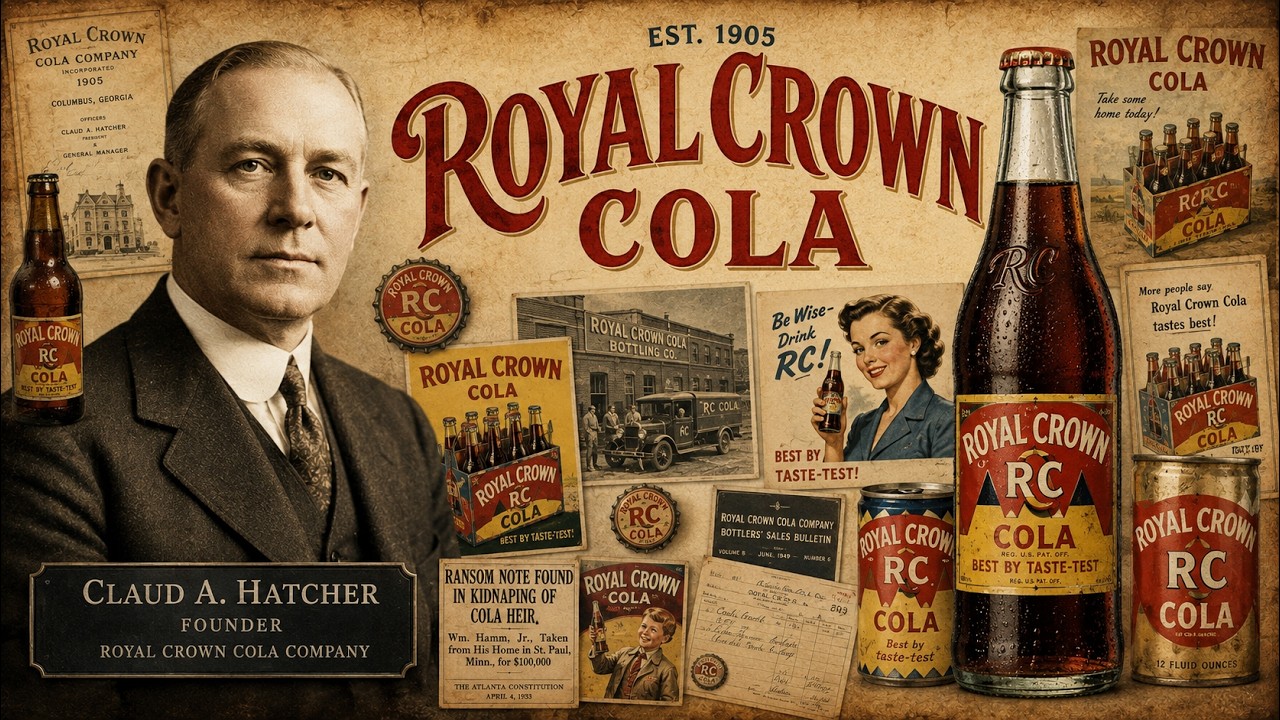
Royal Crown won plenty of those. It is the story of who controlled the trucks, the shelf space, and, ultimately, the debt that decided the company’s fate. Capital, not taste, determined the outcome. The story begins in 1901, when Claude Adkins Hatcher, a trained pharmacist from a Georgia merchant family, moved to Columbus, Georgia, with his father to run the Hatcher Grocery Company.
One of their reliable suppliers was Coca-Cola, which came with a wholesale price the company’s local representative refused to negotiate. Hatcher pushed back. When the representative would not budge, Hatcher pulled Coca-Cola off his own shelves and began formulating his own replacement in a basement beneath his family’s store. In 1905, Hatcher produced Royal Crown Ginger Ale, a sharper, more assertive drink he bottled himself and sold first through his own store, then to neighboring grocers.
That same year, he and his father formed the Union Bottling Works. By 1907, Hatcher had developed a cherry-inflected cola called Chero-Cola, which quickly outsold the ginger ale. In 1912, Hatcher reorganized the operation as the Chero-Cola Company, selling syrup concentrate and franchise rights to independent bottlers across the region. Rather than building factories in every city himself, he let local businessmen buy the formula, bottle the drink, and sell it through their own delivery networks.
By 1920, the syrup was flowing to 700 franchise bottling plants nationwide. The strategy worked until the early 1920s, when the price of raw sugar spiked dramatically. Hatcher responded by buying industrial sugar-refining equipment outright and bringing the process in-house. The gamble held the company together.
By the mid-1920s, as demand for Chero-Cola itself softened, Hatcher made another bold call: he let the cola fade and pushed a new line of fruit-flavored sodas called Nehi into the same 700 plants. Nehi sold well enough that by 1928, the company renamed itself the Nehi Corporation. Claude Hatcher died on December 31, 1933, at age 57. He never saw the name Royal Crown become a cola.
Leadership passed to vice president H. R. Mott, who inherited a company carrying real debt and a cola formula that had been losing ground for years. Mott ordered a full reformulation of the old Chero-Cola recipe and assigned the work to company chemist Rufus Cam.
After six months, Mott named the new cola Royal Crown, reaching back to the very first product line Hatcher had put his name on. The relaunch in 1934 was an immediate sensation, proving that the 700-plant distribution network Hatcher had spent three decades building could carry an entirely new product to national relevance almost overnight. Royal Crown’s working-class identity was reinforced by a pairing that formed organically during the Great Depression. In Chattanooga, Tennessee, the Chattanooga Bakery had been selling a graham cracker and marshmallow snack called the Moon Pie.
A nickel bought a Moon Pie, and a nickel bought a bottle of RC. For 10 cents, a working man had lunch. By the 1950s, the pairing had produced its own country song, “Give Me an RC Cola and a Moon Pie,” recorded by Big Bill Lister. Royal Crown’s leadership also reached for something bolder to prove the brand’s case nationally: a public challenge to Coca-Cola and Pepsi on the ground of taste itself.
The “Best by Taste Test” campaign staged blind comparisons with rival colas, unlabeled, and invited ordinary Americans to pick a winner. Company records and repeated public tests backed the claim; blind, RC won often enough that the company built its entire advertising identity around the slogan, “You Bet RC Tastes Best. ”
The company’s position was also shaped by external events. In 1907, Georgia became the first Southern state to ban alcohol outright, more than a decade before national Prohibition.
With legal alcohol gone, soft drinks stepped into the space it left behind, and Chero-Cola was already sitting in the coolers. When national Prohibition arrived in 1920, the same pattern repeated across the country. Breweries were forced to close or pivot, while soft drink companies like Chero-Cola simply had to outdistribute a flood of new competitors. The company emerged from the 1920s larger than it went in.
The next national test came with sugar rationing during the Second World War, beginning in 1942. Every bottler was allocated sugar based on prior usage, creating a hard ceiling on production. Royal Crown leaned on the sugar-refining capacity Hatcher had built two decades earlier. The company came through both crises because it was already positioned in advance to weather them.
By the mid-1950s, Royal Crown was setting the pace for the industry. In 1954, it became the first company in the country to sell a cola in a can. It also introduced a 16-ounce bottle at a price that made the arithmetic impossible for shoppers to ignore. Then, in 1958, it launched Diet Rite, the first diet cola sold nationally in the United States, years ahead of Coca-Cola or Pepsi.
Diet Rite was sweetened with cyclamate, a compound 30 times sweeter than sugar and, critically, much closer in taste to real sugar than available alternatives. The timing seemed perfect. America was becoming newly obsessed with calorie counts, and Royal Crown had a diet cola on shelves before either giant rival had one in development. For the first time in its history, the company was years ahead of an entire product category it had essentially invented.
But cyclamate had never been settled science. Through the 1960s, studies linking the sweetener to tumors and birth defects in laboratory animals began generating headlines, even though the doses were far beyond anything a human would consume from a can of soda. In 1969, the FDA banned cyclamate outright. Diet Rite’s entire formula, the exact innovation that had made Royal Crown first in the diet cola category, suddenly became illegal to sell.
Royal Crown scrambled to reformulate, but the damage was deeper than one product. The ban landed at the exact moment Coca-Cola and Pepsi were finally preparing to enter the diet cola category themselves, well-funded and no longer facing a Royal Crown product with a multi-year head start. The advantage that had taken the company to the top of the industry vanished in a single federal decision. The 1970s did not treat the company kindly.
With the cyclamate advantage gone and rivals launching their own diet colas with advertising budgets Royal Crown could not match, the company’s 10% peak began sliding backward. During the 1980s, at the exact height of the industry’s “Cola Wars,” Royal Crown largely stopped advertising at national scale. Bottlers began declining to renew contracts, and franchise by franchise, the company began losing the 700-plant distribution network that had built it. Into this weakened company stepped Victor Posner, a corporate financier known for acquiring businesses using heavily leveraged debt, extracting value from their assets, and letting the underlying operations absorb the risk.
Posner acquired Royal Crown in the 1980s and relocated the company’s headquarters from Atlanta to Miami Beach, hundreds of miles from the town that had built the brand’s identity. For nearly a decade, the Miami-run Royal Crown limped forward carrying the debt structure Posner’s acquisition had loaded onto it. Meanwhile, its market share continued eroding. Posner’s business empire soon came under federal investigation, and in December 1993, a federal judge in New York barred Posner and his son from ever running a public company again, citing Posner’s “open contempt” for the interests of shareholders who trusted him.
The company’s Miami plant, whose operational life ran from 1984 to 1993, shut down not long after. That same year, ownership passed to Triarc Companies Inc. , a conglomerate consolidating a portfolio of beverage brands. For Royal Crown, it was the fourth ownership structure in under two decades, and each new owner was a little further from Columbus, a little less invested in the brand as anything more than a line item in a larger portfolio.
In October 2000, Cadbury Schweppes, the British confectionery and beverage giant and parent company of Dr. Pepper, acquired Triarc’s beverage division, and Royal Crown came with it. A cola founded to spite a Coca-Cola representative in a Georgia grocery store now sat under the same corporate structure as one of its long-time domestic rivals. The following year, the brand was divided along a border it had never recognized before.
Royal Crown’s US operations stayed under Cadbury’s American beverage arm, while its international rights were sold to Cott Beverages of Canada. In 2008, Cadbury Schweppes spun off its American beverage division into the stand-alone Dr. Pepper Snapple Group, which took Royal Crown’s US business with it. Ten years later, Dr.
Pepper Snapple Group merged with Keurig Green Mountain, forming Keurig Dr. Pepper, which holds the US rights to Royal Crown Cola today. On the international side, Cott sold Royal Crown Cola International to Refresco in 2021, which then passed the rights into a newly formed entity called RC Global Beverages Inc. Two years later, in 2023, RC Global Beverages was acquired by Makkai Holdings, a company based in the Philippines, on the opposite side of the planet from the Georgia storefront where Claude Hatcher first bottled a ginger ale.
Nine ownership changes, four different countries, and a headquarters that moved from Columbus to Atlanta to Miami and finally dissolved into a corporate portfolio too large to have a headquarters for RC at all. No single owner in this chain set out to destroy Royal Crown Cola. Each one in turn was simply managing a smaller and smaller piece of a much larger balance sheet. Today, Royal Crown Cola is owned by Keurig Dr.
Pepper, the same company that owns Dr. Pepper, 7 Up, Snapple, and dozens of other beverage brands. RC Cola is one line among many inside a portfolio built through a century of mergers. It is still available on shelves, but it is no longer the fourth-largest cola in America fighting the giants head-on.
It is a regional legacy brand, present in some stores, absent in others, kept alive more by loyalty and nostalgia than by any marketing budget fighting for new customers. One place where the corporate history means nothing at all is in Bell Buckle, Tennessee. Every June, on the third Saturday of the month, the town of roughly 500 people fills with visitors for the RC Cola Moon Pie Festival. It began in 1994, the year Moon Pie turned 75, when the town decided the anniversary deserved a celebration built around the pairing that had defined the working man’s lunch since the Great Depression.
Three decades later, the festival still runs, featuring a 10-mile race, a 5K, a parade, the crowning of an RC Cola King and a Moon Pie Queen, and the ceremonial cutting of the world’s largest Moon Pie. In Columbus, Georgia, the Hatcher Family Cola Museum keeps the earlier chapter alive: the basement laboratory, the dispute with the Coca-Cola salesman, the artifacts of a company that once believed it could out-taste and out-distribute anyone. Royal Crown Cola won public taste tests against Coca-Cola. It was first to the can, first to the diet cola category, and first with a genuine national blind taste test campaign.
By almost any measure of pure product quality, it held its own against giants for the better part of a century. What Royal Crown never had was Coca-Cola’s capital. It never had the advertising budget to match Pepsi dollar for dollar during the Cola Wars. It never had a distribution network immune to a single regulatory ruling wiping out its best innovation overnight, or a corporate parent immune to a debt structure built by a man who never bottled a soda in his life.
Royal Crown lost the way most American regional brands lose: not to a better product, but to a bigger balance sheet, a wider distribution net, and an ownership structure that, sale after sale, cared less about Columbus, Georgia, than the town that built the brand ever did.