In the late autumn of 1969, a Soviet submarine captain sailed back toward the Kola Peninsula believing he had just completed a flawless deterrent patrol. He was wrong. For 47 days, an American attack submarine had been trailing him just a few hundred yards off his stern, listening to every pump, every turbine, and every classified word spoken in his command center. He never heard a thing.
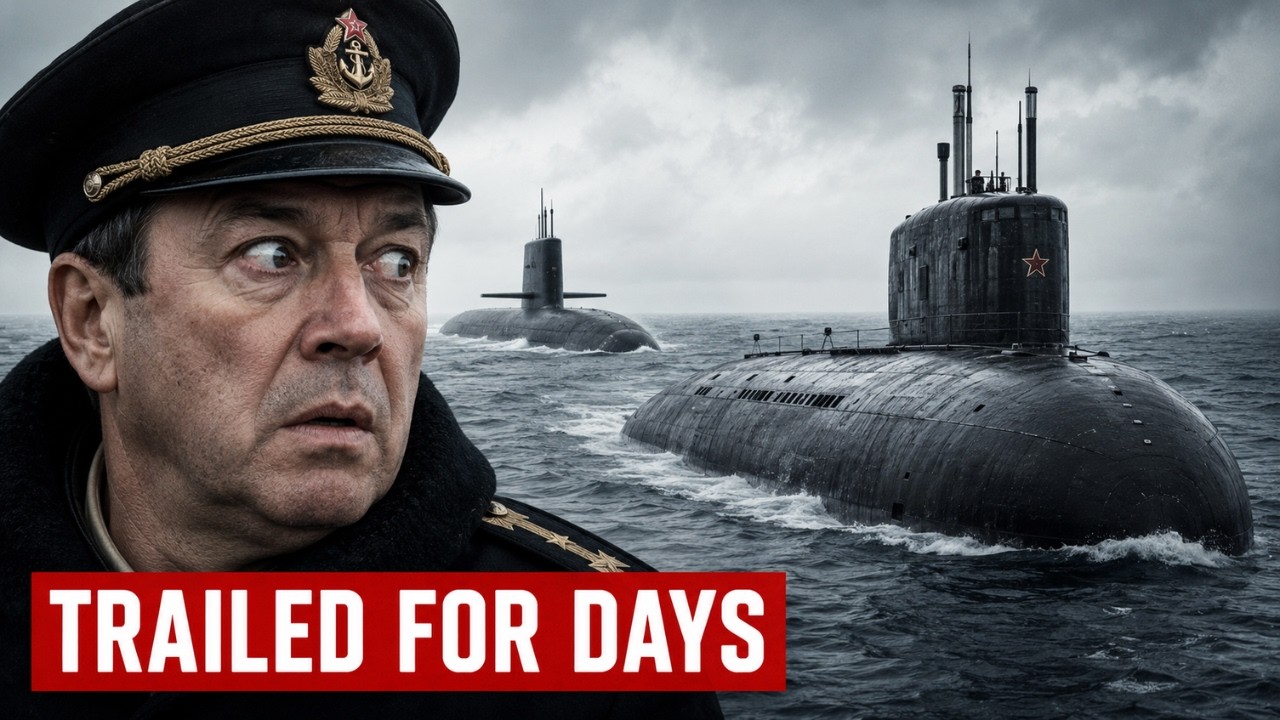
He would not learn the truth for nearly three decades. The pursuit began in September 1969, at a depth of 400 feet beneath the North Atlantic. A Soviet Yankee-class ballistic missile submarine, known to its builders as Project 667A Navaga, was carrying out something new: a strategic deterrent patrol within missile range of the American coast. Its R-27 missiles had a range of roughly 1,400 nautical miles.
Launched from the mid-Atlantic, they could reach Washington in under 15 minutes—not enough time to wake a president or authorize a response. That threat shaped the fear inside the Pentagon that summer. The Soviet Union had spent the years since the Cuban Missile Crisis building up its forces in silence. By 1969, Moscow had achieved strategic parity in land-based missiles, matched the U.
S. in bombers, and was finally closing the gap at sea. The Yankee was the proof. Earlier Soviet ballistic missile submarines, such as the Hotel and Golf classes, had to surface to launch their short-range missiles.
The Yankee could fire while submerged and stay at depth indefinitely thanks to its nuclear reactor. No one in the U. S. Navy could confidently tell the president where these submarines were.
One man could hunt them: Commander Chester Mack, a 38-year-old from Cape Hays, Florida, with prematurely white hair and a reputation for ignoring orders he considered stupid. His men called him “Whitie. ” His superiors called him other things. He took command of the USS Lapon, SSN 661, on December 14, 1967, at an unusually young age.
Admiral Hyman Rickover, who personally selected every nuclear submarine captain in the Navy, had approved him—despite Mack not being the quiet engineer type Rickover usually favored. Mack was a cowboy submariner, loud when needed, silent when required, and gifted at reading people. The Lapon was a Sturgeon-class attack submarine, 292 feet long, built for one mission above all others: finding Soviet submarines, tracking them, and killing them if necessary. It was among the most advanced hunter-killer submarines of its era, designed to remain at sea for months and capable of tracking Soviet missile submarines into their most remote operating areas.
In early 1969, Mack received orders to prove something the Navy had never before confirmed was possible: track another American submarine without being detected, in front of an audience of admirals. The Chief of Naval Operations was watching. The Commander-in-Chief of the Atlantic Fleet was watching. The Submarine Force Atlantic commander was watching.
According to the Lapon’s official history, Mack succeeded. He maintained his track and the admirals watched their own submarine try and fail to shake him. After the demonstration, Mack was quietly given what he had long wanted: a real target. The mission was classified as a special operation.
Crew families were not told where they were going. Letters home were pre-written before departure to make arrival times look normal. If the submarine did not return, the Navy would tell wives their husbands had been lost in a training accident. There would be no flag-draped funeral and no newspaper story.
Every man who volunteered for a special operation understood this—and most volunteered again anyway. The target was a Soviet Yankee-class submarine, though the Navy did not yet know which one. Intelligence indicated the Soviets were preparing to send one of their new missile submarines on a full deterrent patrol into the Atlantic for the first time. Previously, all Soviet ballistic missile patrols had stayed close to home.
This time, if intelligence was accurate, the submarine would head west to prove Moscow could threaten Washington. The Lapon’s job was to find it and follow it for as long as possible. Mack read his orders carefully. They told him to find and identify a Yankee-class submarine.
They did not explicitly tell him to stop there. He decided he would not. America had a secret system called SOSUS—the Sound Surveillance System—a network of underwater microphones stretched across the Atlantic floor in long chains between Greenland, Iceland, and Scotland. When a submarine crossed one of those chains, its engines whispered into the microphones, and analysts at coastal listening stations could determine its position within a few miles.
By September 1969, the network stretched for thousands of miles, and Soviet submarines left identifiable acoustic fingerprints when they crossed it. In early September 1969, SOSUS picked up a contact: a Yankee-class submarine leaving the Kola Peninsula, heading southwest. Mack was ordered to intercept it at the Denmark Strait, a 200-mile frozen waterway between Greenland and Iceland. September in the Denmark Strait is harsh—ice drifts down from the Arctic, seas run heavy, and sharp temperature layers bend sound unpredictably.
Listening accurately there is like trying to hear a whisper in a room full of shouting. The Lapon entered the strait and slowed down. In the early hours, the sonar men heard nothing. A storm swept over the surface, and the roar of breaking waves filled the crew’s ears.
Mack pushed closer and closer. The Yankee was not where intelligence had predicted; it had changed course. At one point, Mack had to bring the Lapon within 1,400 yards of the Yankee before he could confirm its classification—less than a mile apart in submarine warfare terms. If the Yankee had turned suddenly or the Lapon had made a single errant ping, the mission would have been over before it started.
The acoustic signature matched. It was a Soviet Yankee-class submarine heading south, at depth, slightly slower than expected. Mack now had a choice: fall back to a safer distance and report the position, or do what the orders technically required and what any sane commander would do. Mack did not do that.
He ordered his men to maintain continuous surveillance and directed the Lapon directly behind the Yankee’s stern, into the disturbed noise of its twin bronze propellers—the blind spot. The Lapon settled into the Yankee’s blind spot a few thousand yards back, matching its speed and depth. In the darkness of the Denmark Strait, in the middle of an Atlantic storm, Whitie Mack began doing something no American commander had ever done before. He began a sustained tracking operation for as long as the Yankee remained at sea.
The problem with tracking a submarine is that you must breathe the same water it breathes. Every current it passes through, you pass through. Every thermal layer it descends into, you descend into. Every mile it travels, you must match precisely, or you lose it.
And you must do all this without letting a single sound of your presence reach its ears. The crew of the Lapon understood this from the first hour. They wore soft sneakers instead of military boots because boots made noise on the steel deck. They spoke in whispers, even in the mess hall.
When a coffee cup slipped and hit the table, heads turned. Every dropped fork, every closed hatch, every sudden cough carried weight, because a single wrong sound at the wrong moment could reveal a submarine that was supposed to be a ghost. Life aboard a submarine on a special operation was grueling. The air was recycled, smelling of diesel, cooking oil, sweat, and something the men called “submarine smell” that lingered on clothes for days after leaving the boat.
Lighting was dim, bunks were stacked three high, sometimes shared by two men on different shifts. Privacy was nearly nonexistent. Meals were served around the clock because shifts ran around the clock. Sleep was rationed.
For 47 days, none of it stopped. The men who lived through it later described it as a kind of disciplined sleeplessness. They worked six-hour shifts, then rested for twelve, with variations depending on their specialty. They wrote letters they knew would not be sent for weeks.
They read the same paperback novels three or four times because they ran out of new ones by week three. Under all of it, there was always the awareness that a Soviet submarine was directly ahead in the darkness, doing exactly what they were doing, with no idea they existed. The Yankee ahead of them had no idea it was being followed. It cruised at a steady speed, heading south toward the open Atlantic at a depth of 400 feet.
Its captain was a senior Soviet Navy officer, a captain first rank whose name has never been publicly disclosed. He was likely in his forties, a veteran of older diesel submarines promoted to the new nuclear fleet because Moscow trusted him with the crown jewel of its naval forces. He believed his submarine was invisible—and he had reason to believe it. The Yankee was quieter than anything the Soviets had built before.
When it checked its blind spot, which it did on a rigid schedule, it never found anything behind it. When it pinged its sonar, which was rare, the ocean answered with silence. He did not know that silence was a lie. Behind him, between 2,000 and 5,000 yards away, Whitie Mack was making choices that would change how the American submarine force operated for the next thirty years.
The first choice concerned the blind spot. To check its blind spot, a submarine must turn sharply and sweep the water behind it with sonar. The Soviets performed this maneuver on a strict, predictable schedule. Mack knew the pattern from intelligence reports.
If the Lapon cleared its own blind spot on any schedule, both submarines could turn at the same moment—or worse, the Yankee could turn while the Lapon was mid-maneuver, and the two nuclear submarines could drift toward a collision neither expected. So Mack did something that existed in no manual. He ordered his officers to roll dice. On a warship worth hundreds of millions of dollars, the officer in charge made the most important tactical decision by rolling a pair of dice on the chart table.
The dice were random, unpredictable—a Soviet analyst in Severomorsk could model an American schedule, but he could not model a rolling cube. The dice came up, and the Lapon cleared its blind spot at odd, irregular times. The Soviet, who might have been looking for a follower, was never there. The second choice was harder to justify, but Mack made it anyway.
Somewhere in the middle of the patrol, in the mess hall where the crew ate and read letters written before the mission began, Mack hung a map. He marked the Lapon’s position on it, and also the Yankee’s position, updating it whenever the sonar room refined its estimates. He wanted his men to see what they were doing, to know they were not just passengers in a steel tube. He wanted them to feel the shape of the hunt.
The problem was that this violated regulations. The real-time position of a targeted submarine was among the most secret information aboard; it belonged in the control room, not on a wall where a cook could look at it while pouring coffee. A disciplinary board could have removed Mack from command. He did it anyway.
The map meant the 18-year-old from Ohio scrubbing pots was part of the mission. It meant the reactor technician who rarely came forward could see that they had moved 300 nautical miles closer to the Yankee’s turning point today. It meant everyone, from the youngest sailor to the executive officer, carried a piece of the mission in their heads at all times. It broke every rule of compartmentalized intelligence.
And it worked exactly as Mack knew it would. The crew came alive. Men who had stood watch out of duty now stood watch out of passion. One young sonar man, Tommy Cox, later wrote a song about what everyone on that submarine felt during those weeks.
He called it “The Ballad of Whitie Mack. ”
The weeks began to pass. Two weeks, three. The American submarine kept moving, patrolling a vast area of the Atlantic, changing depth and course, running the drills a Soviet ballistic missile submarine was ordered to run.
Nothing in its behavior during the first week suggested it suspected a companion. Its sonar reports to Moscow, as the Americans later deduced, showed no trace of a shadow behind it. Behind it, the Lapon was sucking up the Yankee’s acoustic identity. Every submarine has an acoustic signature—a unique print of noise from the way its pumps vibrate, its turbines whine, and its propellers strike the water at certain speeds.
If you capture that signature, you can identify that specific submarine anywhere in the ocean for years afterward. Mack’s crew recorded reel after reel of tape, frequency after frequency. Every mechanical breath the Soviet submarine took, from the deep hum of its reactor coolant to the beat of its steam engine, went into American archives. Those tapes were the heart of the mission, not the tracking itself, not the number of days, not the drama.
Each reel that reached Navy intelligence would be listened to by analysts who isolated individual frequencies, identified individual pieces of machinery, and gradually built a library. The next time a Yankee-class submarine crossed a SOSUS chain, analysts would compare its acoustic signature to the database and know not just the class, but whether it was the same hull Mack had followed. Over the years, the U. S.
Navy would build a catalog of every Soviet ballistic missile submarine based on sound alone. That is what 47 days of recordings actually accomplished. About a month into the tracking, something happened on the surface that no one aboard the Lapon knew about. In early October 1969, an article appeared in the American press discussing how slow, noisy, or quiet the new Soviet ballistic missile submarines actually were.
Someone in Washington, likely a senior officer or civilian official who knew about the special operation, had spoken to a reporter about the Yankee class’s acoustic performance. It may have been bravado, a leak designed to influence a budget debate, or simply a case of a secret traded for something in Washington’s currency. The leak was not treason to a person, because the reporter certainly did not know that a specific submarine was at that moment in the North Atlantic in the middle of the mission. But once published, it told the Soviets something they had not been able to confirm: that the Americans knew in specific technical detail how loud or quiet the Yankee actually was.
There was only one way the Americans could know that. They had been listening. The Soviets read American newspapers closely. Within days, whether by direct order from Moscow or by the Yankee captain’s own instinct, the target’s behavior began to change.
The Soviet captain received new orders in the middle of the Atlantic at 400 feet deep and began altering his conduct. His searches for followers became more aggressive. His course changes became sharper. He began executing maneuvers that were not in the standard patrol schedule.
The Lapon knew nothing about the leak; it learned only through sonar that the Yankee ahead had suddenly begun acting differently. The signature was still the same, but the behavior was not. Tension rose in the Lapon’s command center. When your target acts as if it knows you exist, you must assume the worst.
Every turn the Yankee made had to be treated as a potential attempt to expose your position. Mack held his position, did not slow, did not fall back. He followed the Yankee through its new maneuvers while his men hunched over sonar consoles, straining to track its motion. There were close calls.
One incident, according to the men who later spoke about it, occurred at a distance of less than 300 yards—three football fields in an ocean stretching thousands of miles, two nuclear submarines that close in total darkness, moving in opposite directions during a Soviet turn. No one on either submarine saw the other. The Lapon crossed the gap and resumed tracking at a safe distance. If they had collided, they would have taken 16 hydrogen weapons and two nuclear reactors to the bottom of the Atlantic, and neither government would have known why.
The Soviet Union would have lost a ballistic missile submarine on patrol; the United States would have lost a Sturgeon-class attack submarine on a mission the public was never allowed to know existed. Neither side would have known whether the other had just committed an act of war. It did not happen. The Lapon crossed successfully, fell back to a safe tracking distance, reacquired the signature, and resumed the chase.
When the two submarines came within less than 300 yards, the Lapon’s men knew it. They could hear the Yankee’s propellers close enough that the sound in the sonar room was not just data on a screen but something tangible in the water around them. The men on the Yankee, 400 feet deep on the other side of those 300 yards, knew nothing. Their sonar system, listening forward and to the sides, heard only the ocean.
The captain gave his orders based on the assumption that his stern was safe. Behind him, close enough that a rifle shot from the Lapon could have struck his hull, an American submarine was matching his every move. That is what technological asymmetry looks like up close: not a battle, but a one-way moment of contact in the dark, where one side knew everything and the other side knew nothing. The days wore on—20, 30, 40 days.
The Yankee’s patrol counter was running down. Every deterrent patrol has an endpoint. At some point, it would have to turn its bow toward the Kola Peninsula and begin the long journey home. If it did, the Lapon would face its final decision: break contact or continue the chase to the very end.
The 47th day began like the first. In the darkness and silence, under the dim red light of the night watch, men were at their stations with headphones on, eyes fixed on green screens showing the same faint trace of noise they had watched for nearly seven weeks. Ahead of the Lapon, the Yankee was turning—not a check turn, not a barrier sweep, but something larger. Its bow was slowly shifting to a new course: northeast, toward home, toward the Kola Peninsula, toward the bases at Gadjievo, toward wives and children and the shore leave every submariner in every navy dreams of after weeks in a steel tube.
The deterrent patrol was over. In the Lapon’s command center, Whitie Mack watched. He had not had a full night’s sleep in a month and a half. He had tracked the most valuable ship in the Soviet Navy through storms and thermal layers, nearly collided with it more than once.
Now he had to make a final decision. His orders had said nothing about how far to follow the Yankee. They said nothing about following it to the gates of the Soviet Union. There was a line in the North Atlantic, unnamed and unmarked, that every American attack submarine commander knew should not be crossed in a tracking operation—not because it was illegal, but because it was dangerous.
That was where Soviet anti-submarine aircraft flew, where Soviet surface ships listened, where a mistake stopped being just a mistake and became an incident. The Lapon turned and followed the Yankee northeast for a little longer, deeper into the North Atlantic, watching its signature stay steady on the recording tapes. Then, in a moment recorded in his logs that the public would not learn about for three decades, Mack decided to break off. He let the Yankee disappear into the darkness, turned his bow west, and pointed the Lapon toward home.
The chase was over. They had done it. 47 days on the tail of a Soviet ballistic missile submarine on its first full deterrent patrol, 47 days without being detected, 47 days of recording signatures, mechanical noise, propulsion data, patrol behavior, and tactical habits. Washington’s archives were about to become much richer than they had been in September.
The Yankee’s captain, whoever he was, sailed home believing his patrol had been a quiet success. He would file his reports, receive his medals, and move on to his next command or a desk in Severomorsk or the long sunset of Soviet military retirement. No one was ever allowed to tell him what had actually happened. The Lapon returned to Norfolk in late autumn 1969.
There was no parade, no reporters. The men who had lived inside that submarine for 47 days walked back to the pier in their work clothes, went to their families, and did not speak about what they had done. Their wives were told it had been a training mission. That was the story.
Some men, according to later interviews, could not sleep on a real bed for the first few nights. The mattresses were too soft. The rooms were too quiet. They had spent 47 days inside a machine that hummed and vibrated gently and never fell completely silent.
Their bodies had learned to sleep to that specific rhythm. In their own homes, the absence of the submarine’s noise was itself a sound that kept them awake. Within the Navy, the reaction was different. The Lapon received a Presidential Unit Citation, the highest award a U.
S. Navy ship can earn, reserved for combat and combat-support operations of extraordinary value to the United States. The citation itself was classified, and the men who wore the ribbon could not tell anyone—including other Navy officers—what they had done to earn it. Chester Mack received the Distinguished Service Medal, the highest peacetime award a naval officer can receive for personal service.
Rickover, who had been uneasy about pushing nuclear submarines close to the Soviets, approved the honor. Admiral Thomas Moorer, the Chief of Naval Operations, made sure the paperwork was done. Any doubts anyone had in early 1969 about whether a 47-day tracking operation was possible, wise, or worth the risk had ended. Mack had just proven a combat doctrine.
The doctrine was simple: American attack submarines, quiet enough, listening carefully enough, commanded by officers willing to break the rules, could track Soviet ballistic missile submarines for their entire deterrent patrols. In the event of war, those Soviet submarines could be sunk before they launched their missiles. That meant the Soviet nuclear deterrent, the great insurance policy of Moscow’s Cold War strategy, was in practical terms under American control every day. Consider what that meant in the strategic language of the era.
The entire foundation of mutual nuclear deterrence rested on the idea that a first strike could never completely destroy the other side’s ability to respond. Both sides kept a portion of their nuclear force at sea on submarines precisely because submarines were supposed to be undetectable. If your submarines could not be found, they could not be sunk. If they could not be sunk, your ability to retaliate remained intact.
If your ability to retaliate remained intact, the other side could not rationally attack you. That was the entire logic of mutually assured destruction. It was the entire reason the Cold War never became hot. The 47 days did not break that logic, but they cracked one of its walls.
They proved that half of the Soviet ballistic missile deterrent—that half at sea—might not be as invulnerable as Moscow believed. If American attack submarines could reliably track Soviet missile submarines during their patrols, most of those Soviet submarines could be destroyed in the first minutes of a war before they launched. The Soviets’ ability to retaliate was not what it appeared on paper. In the coldest possible reading, the balance of nuclear terror was tilting more toward the Americans than either side officially acknowledged.
The Soviet Navy spent the next twenty years trying to fix that situation. The doctrine shaped the next twenty years of the underwater Cold War, influencing the design of the Los Angeles-class attack submarines that followed the Sturgeon class, the number of hulls the Navy built, and how the Soviets responded once they realized the scale of what was happening to them. It began with attempts to make their submarines quieter, then with pulling their missile submarines back into protected bastions closer to home, then with pouring vast sums into their struggling shipyards. The bastion strategy, when the Soviets finally adopted it in the 1970s and 1980s, was itself an admission of defeat.
Instead of sending their ballistic missile submarines into the open Atlantic and Pacific where they could threaten American coasts, the Soviets pulled them into protected areas near home—the Barents Sea and the Sea of Okhotsk—where they could be defended by Soviet surface ships, aircraft, and attack submarines working together. That was safer for the missile submarines, but it also meant those submarines were effectively hiding. A ballistic missile submarine hiding in territorial waters is a submarine whose deterrent value depends entirely on whether its missiles can reach the enemy from its hiding place. That required longer-range missiles, which meant bigger submarines to carry them, which meant more expensive shipyards to build them.
The Typhoon-class submarines of the 1980s, the largest submarines ever put to sea, were the physical monument to that logic: enormous, expensive, and always deployed closer to home. Meanwhile, the U. S. Navy did the opposite—went farther, moved quieter, listened more carefully, and built the doctrine of forward pressure that continued, in one form or another, until the Soviet Union itself faded away.
None of this was public. For nearly 30 years, the story of the Lapon and the Yankee remained locked in classified files. There were hints. There was the song Tommy Cox wrote in the early 1970s.
Rumors circulated in the fleet about a captain in Norfolk who had done something extraordinary in 1969. The details—the 47 days, the dice on the chart table, the map in the mess hall, the 300 yards of ocean between two nuclear submarines at midnight—were nowhere in the official record. Think about what that silence cost and what it protected. The cost was recognition.
Chester Mack could not tell his neighbors what he had done. His crew could not tell their fathers, most of them World War II veterans, what they had accomplished. Wives were told almost nothing. Children grew up unable to boast about their fathers’ achievements.
Some of those sons and daughters did not learn the truth until later in life, when the book was published. What the silence protected was sources and methods. If the Soviets had known in 1969 or 1970 that the Lapon specifically had tracked a specific Yankee for 47 days, they could have narrowed down the technical questions—what kind of sonar the Americans used, at what range, from what angle—and begun designing countermeasures. Every year the story remained secret was another year the American technical advantage stayed intact.
That was the deal the men accepted: sacrificing public recognition in exchange for their country’s continued edge. Then, in 1998, reporters Sherry Sontag and Christopher Drew published a book called “Blind Man’s Bluff,” based on years of interviews with retired submariners, retired admirals, and retired intelligence officers. In one of its chapters, the American public read for the first time what the Lapon had done. Somewhere, presumably, the man who had commanded that Yankee in 1969 read the book, or heard about it, or was told by an old comrade.
Somewhere, an elderly Soviet officer, long retired, absorbed the news that the patrol he had brought safely home nearly 30 years earlier had never been safe at all. The ocean behind him had not been empty. Every move he made, every turn, every course change, every noise check, every private thought he had spoken in his submarine’s command center, had been heard by another submarine he never heard. No interview with him exists in the records, no memoir, no television confession.
The Soviet Navy—and the Russian Navy after it—never officially acknowledged what happened to that patrol. The horror in this story’s title is not fictional. It is what any submariner on any side of any ocean might feel when he learns he was followed for 47 days by an enemy he never detected. It is the horror that strikes when you realize, years later, that you were never the hunter you thought you were.
You were the prey. Chester Mack retired from the Navy as a captain and lived quietly for the rest of his life. He gave interviews after “Blind Man’s Bluff” was published because the story had become public and he was finally allowed to speak. He died on September 25, 2008.
His crew held a reunion the following year and stood for a moment of silence in his memory. In interviews, he told the story of the tracking the way old submariners always tell their stories: modest, practical, focused on the mechanics of the boat and the temperament of the men. He did not brag. He did not need to.
The Lapon herself was decommissioned in 1992 and eventually recycled in Puget Sound. The steel of her hull became other things. The Yankee-class submarines met the same fate. The Soviet Union collapsed in 1991.
The ballistic missile submarines that had once terrified Washington sat at their piers in the Kola Peninsula, their missiles removed, their reactor cores extracted with U. S. funding and expertise under the Nunn-Lugar program. That great fleet was cut apart in the snow.
The Cold War’s underwater war ended not with a battle but with a quiet dismantling, American and Russian technicians working side by side on the docks, pulling reactor hearts from hulls that had once been aimed at American cities. And in the process, the specific Yankee that Mack had tracked for 47 days in the autumn of 1969 went to the same scrapyard as the others. No one recorded a special note about it. It was just another hull.
The men who served on that patrol are now almost all in their seventies and eighties. Some have passed. Those still alive tell the story slightly differently each time, as old men do, but the core remains the same: a young captain, a pair of dice on the chart table, a map in the mess hall, 47 days in the dark, and the future of the Cold War beneath the waves sailing silently behind a Soviet submarine whose captain never knew anyone was there.