For nearly two decades, the Holloway Hotel in Newton County, Arkansas, was a respected landmark for travelers in the Ozark mining region. Built in 1882 by Thomas Holloway, a former railroad man from Pennsylvania, the Victorian-style hotel sat three stories tall at the edge of Blackwater Creek, roughly three miles outside the county seat of Jasper. It offered guests indoor plumbing, gas lighting, and a reputation for comfort and respectability. The property had been purchased at a steep discount.
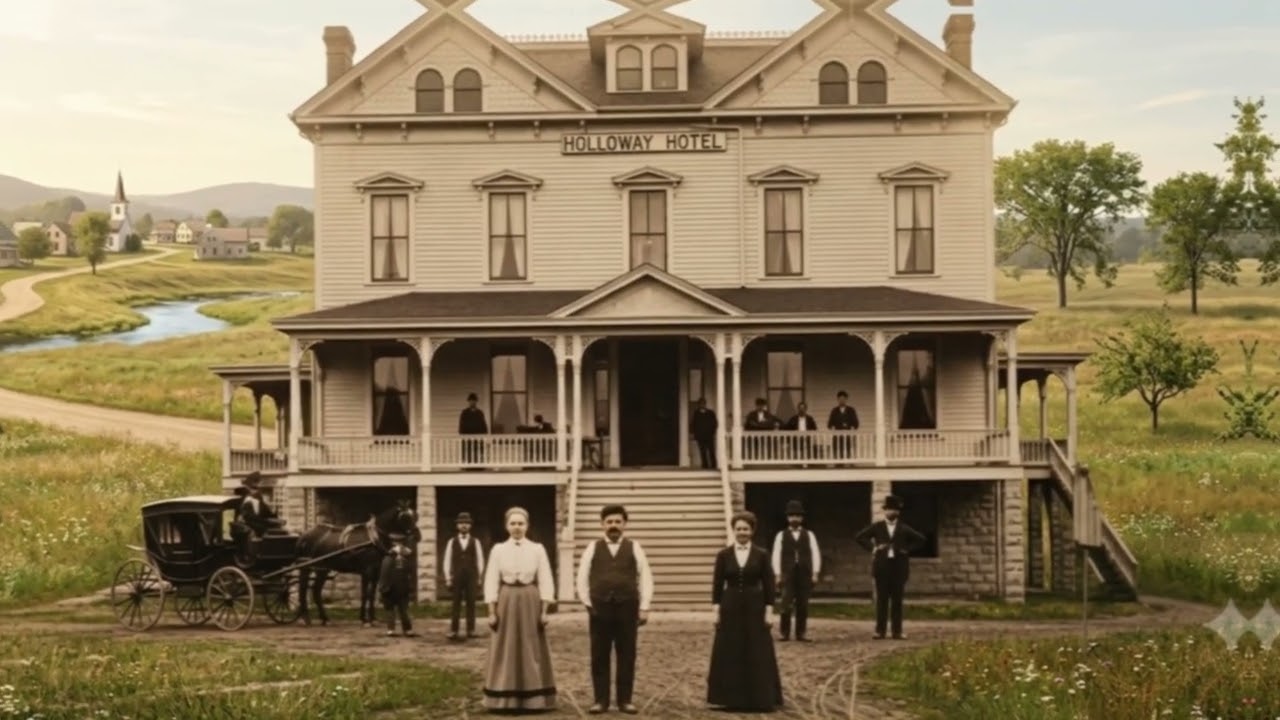
County records show the Holloway family acquired the six-acre parcel from the Harrington estate in 1881, after three unexplained deaths on the land between 1876 and 1879. The seller, Elizabeth Harrington, stipulated that certain underground features remain undisturbed, but that clause was struck from the deed and initialed by both parties. Construction began in April 1881. Local newspapers praised the project, but one worker, Samuel Davies, later recalled that Holloway brought in outside contractors for what he called “specialized underground work.
” Davies said the men worked at night, that the basement was kept locked during the day, and that he once saw unusual metal pipes being unloaded and quickly covered with canvas. The hotel opened in January 1882 and operated successfully for years. Holloway became a respected figure, serving on the town council and contributing to community projects. But behind that public image, bank records later revealed, he was in serious financial trouble.
By late 1898, he had overextended himself in speculative mining ventures. A letter from the president of First National Bank of Jasper noted that Holloway had been refused further financing and that he “did not take the news well. ”
A separate ledger discovered much later showed the hotel was losing money by January 1899, with mortgage payments months in arrears and suppliers threatening to cut off credit. The first documented disappearance came in April 1900.
Mary Carver, a 29-year-old seamstress from Springfield, vanished while staying at the hotel. A small notice in the Newton County Register said she had departed the area without notice. In fact, she left behind a partially finished dress, her sewing kit, and personal effects. Three months later, James Whitfield, a traveling Bible salesman, vanished after checking in.
His horse and sample case were left unclaimed. Authorities made a cursory inquiry, accepted Holloway’s explanation that the man had departed before dawn, and closed the matter. Deputy Sheriff Lionel Hayes, however, began keeping private notes. He noticed that each missing guest had stayed in rooms 27, 29, or 31, all on the eastern wing of the second floor.
When Hayes requested to inspect the rooms, Holloway claimed they were occupied by a hunting party. Hayes then observed that the hotel register showed no such guests and that no one from the evening stage had arrived for the hotel. By September 1900, a young couple from Kansas City—Edward and Lillian Barrow—and a Chicago mining investor named Samuel Crenshaw had also vanished after staying in those same rooms. Holloway insisted each had simply departed early, but the stage office had no record of any of them as passengers.
The chambermaid, Mary Ellis, sent a letter to her sister in October 1900 describing constant noises from below the hotel. She wrote that Holloway claimed they were just pipes, but, in her words, “pipes don’t sound like scratching. ” She described following Holloway to the old cellar, where he carried a tray of food, locked the door behind him, and stayed nearly an hour. When he returned, the tray was empty and his sleeves were wet to the elbows.
Ellis also recalled seeing levers or switches built into the underside of Holloway’s desk the night before Mary Carver disappeared. She said the next morning, room 31 had “that strange smell, like wet metal and something sour. ” She gave notice the next day and left for Joplin. Her replacement, Sarah Jenkins, lasted only 17 days before leaving without collecting her final wages.
Decades later, her grandson recalled that she would only say of her time at the hotel, “some places aren’t meant for decent folk to linger. ”
The situation turned from troubling to horrific in December 1900, when a severe ice storm struck the Ozarks, trapping travelers for days. County records show 17 people checked into the hotel during the storm. When the roads cleared, Holloway claimed all the guests had left.
But no one in town reported seeing anyone depart, and the stage and train services recorded no unusual passengers. Deputy Hayes noted that no family with small children could have departed into weather still near zero degrees with roads impassable. When he asked about the Thornton family—parents and two children aged seven and nine—Holloway produced a register entry claiming they had stayed only three nights, not the 11 days of the storm. Hayes sought a search warrant, but it was denied by Judge William Prescott.
Records later showed Prescott had received a $750 loan from Holloway that September to cover gambling debts, with the notation “private arrangement terms as discussed. ”
Meanwhile, Holloway’s wife, Margaret, was deteriorating. A doctor treated her for nervous exhaustion and auditory disturbances, noting her complaints of persistent noises from below the floorboards. An unsent letter she wrote to her sister described “scratching, whispering, sometimes what sounds like children crying,” and accused her husband of feeding whatever was beneath the hotel.
On April 3, 1901, a fire broke out in the eastern wing. Holloway had increased his insurance coverage by 300 percent just six weeks earlier. The fire chief’s report noted the blaze began simultaneously in three separate locations—the same rooms associated with the disappearances—and suggested accelerant may have been used. The insurance claim was initially denied but later settled for 60 percent of the requested amount after Judge Prescott intervened on Holloway’s behalf.
Rather than rebuild, the Holloways sold the property to a cousin and moved to Denver, where they bought a larger hotel using the insurance settlement. No charges were ever filed. The case might have been forgotten, but in 1937, Elias Holloway’s son Frederick began renovating the damaged property to create housing for Civilian Conservation Corps workers. Clearing debris, workers discovered a secondary well shaft roughly four feet in diameter adjacent to the original well.
They reported an offensive odor and unusual corrosion on metal surfaces. A letter to the editor from Oliver Hayes, son of the deputy, urged a proper examination before the shaft was sealed. County officials declined, calling it an abandoned well, and the shaft was filled with concrete. In 1962, the Ozark Historical Society purchased the property for restoration.
Architectural historian Raymond Chandler found inconsistencies in the original blueprints. The building contained three separate shafts, not the single well shown in the plans, arranged in a triangular pattern. Narrow channels cut into the foundation stones radiated from the shafts toward specific points in the building—aligning precisely with rooms 27, 29, and 31. In April 1964, workers found a copper box beneath the flooring of the private dining room.
Inside was a leather-bound journal belonging to Thomas Holloway. Entries from 1899 described his financial desperation and his discovery of something beneath the property. Holloway wrote that he had explored the original foundation chambers and found “a chamber unlike anything I have encountered. ” He described a substance that flowed like liquid and consumed organic matter completely, leaving no trace within hours.
The journal documented his installation of a system to deliver victims into this substance. He wrote that the eastern shaft connected directly to rooms 27, 29, and 31, and that when the floor mechanisms were activated, “everything above simply disappears below. ”
Entries from 1900 recorded each disappearance by initials, with the room number, the victim’s weight, and how long the processing required. The first entry, from April 12, 1900, matched the seamstress Mary Carver.
The entry noted the “financial benefit” of recovered personal effects. A June entry matched the Bible salesman and noted that his horse and sample case had been sold in Harrison. An August entry described the Barrow couple as the “largest contribution to date,” with processing requiring 14 hours. A December 11, 1900 entry, during the ice storm, is the most disturbing.
Holloway wrote that six rooms had been activated, with a total approximate weight of over a thousand pounds. He described the Thornton family as “unexpected additions, but necessary given circumstances,” and noted jewelry, a pocket watch, and travel funds totaling nearly $200. By December 18, he wrote that something had changed. The substance level had risen in all shafts, luminescence had become constant, and sounds had shifted from simple scratching to what Margaret insisted were voices calling her name.
The final legible entry, dated March 18, 1901, reads: “M can no longer bear it. The sounds from below have changed. ” Holloway wrote that Margaret insisted the well be burned, and he had indulged her request because the insurance policy would establish them elsewhere. “3 days hence we shall be free of this place and its hungry darkness.
”
The Historical Society notified state authorities. A preliminary investigation led by detective Warren Mitchell confirmed the journal appeared authentic based on paper and ink analysis. Structural examination found hinged sections in the floors of the rooms mentioned in the journal, with mechanical trigger mechanisms accessible from a hidden passage. When activated, the floors tilted at a 45-degree angle, sliding whatever was on them into the shaft below.
Excavation at the tertiary shaft beneath the former kitchen uncovered a metal-lined chamber roughly 15 feet in diameter. It contained no human remains, but the walls showed stains and erosion unlike typical mineral deposits. Forensic analysis identified trace elements of human hemoglobin and an unidentified organic compound with properties similar to powerful digestive enzymes. A biochemist wrote that the compound demonstrated the ability to break down organic material, including bone and hair, completely within hours.
She noted an anomaly: rather than simply dissolving test material, the substance appeared to temporarily incorporate structural elements before breaking them down. A hidden room near the kitchen contained personal effects—jewelry, watches, wallets—matching descriptions of items belonging to those who had disappeared. A ledger recorded the sale of recovered items, with entries corresponding to the dates of known disappearances. Mitchell’s final report, submitted in August 1964, concluded that Holloway had modified the hotel to murder selected guests, primarily those unlikely to be immediately missed.
He estimated as many as 27 individuals may have been victims. Both Thomas and Margaret Holloway had died in Denver by then—Thomas in 1917 of liver failure, Margaret in 1910 of what was recorded as nervous exhaustion. Sanitarium records from Denver describe Margaret’s persistent claims of hearing voices through the floorboards and her conviction that something had followed the family from their previous residence. The investigation stalled, funding was redirected, and the site was once again sealed.
In February 1968, a developer purchased the property and planned to demolish the structure to build a motel. During demolition, a worker named Joseph Keane was lowered into the sealed primary well shaft. Radio contact was interrupted. When he was pulled back to the surface seven minutes later, he was in extreme distress.
His attending physician noted that Keane was treated for shock and hallucinations, insisting that “it’s still alive down there. ” The worker told staff that something in the shaft had communicated with him directly, not through speech but through thoughts that pushed into his head, revealing personal details he had shared with no one. Keane left the hospital against medical advice and moved to Oregon. A brief letter he sent to the county sheriff read: “Whatever is down there should remain buried.
Fill it with concrete. Fill it with stone. Then pray it’s enough. ”
The developer abandoned the project, and in March 1968, approximately 30 cubic yards of concrete were poured into the well shafts.
The work order notes that the concrete was mixed with rock salt, quick lime, and water provided by the pastor of the local Baptist church. The site remains undeveloped today. Local ordinances prohibit excavation deeper than six feet in the area. While the journal proved that Holloway killed his guests to dispose of their bodies, the nature of what he claimed to have discovered beneath the hotel remains unresolved.
He wrote that the substance consumed everything it accepted—flesh, bone, wood, leather, fabric—leaving only metal, which even then showed corrosion. Geological explanations have been proposed, but none account for the sounds reported by multiple witnesses over decades: scratching from below, then something resembling words, and the extreme reaction of the worker lowered into the shaft decades after the last victim. Detective Mitchell’s personal diary, donated to the state archives after his death, contains a reference to audio recorded in the shaft in July 1964. He wrote that technicians had amplified vocal elements from the recording and identified multiple voices speaking in unison.
He described phrases that repeat: “Feed us, join us, find us. ” He wrote that he had ordered all copies destroyed, concluding, “Some things shouldn’t be preserved, even as evidence. ”
A geological survey from 1969 noted unusual subsidence patterns around the old foundation and the presence of an unidentified organic compound that appeared to respond to proximity with living tissue. The last documented incident came in June 1968, when a hiker found a perfect circle of dead vegetation centered on an old foundation stone, with a small pool of something dark in the middle.
The hiker reported hearing voices in his head that knew his name, and he was reaching toward the pool when his dog’s barking broke the spell. Today, three barren circles remain in otherwise lush vegetation where the well shafts were sealed. Blackwater Creek still flows past the overgrown lot, and those who stand at the edge of the property on a quiet night sometimes report a sound from deep below—not quite scratching, not quite whispering, something in between.