At 18, Madeleine Talmage Force stood in a Newport ballroom that much of the country had condemned her for entering, having just married a man old enough to be her father and richer than almost anyone alive. Months later, she sat in a wooden lifeboat on a freezing black sea, five months pregnant, watching the lights of the Titanic tilt toward the water with her husband still aboard. He had told her he would meet her in the morning. He did not.
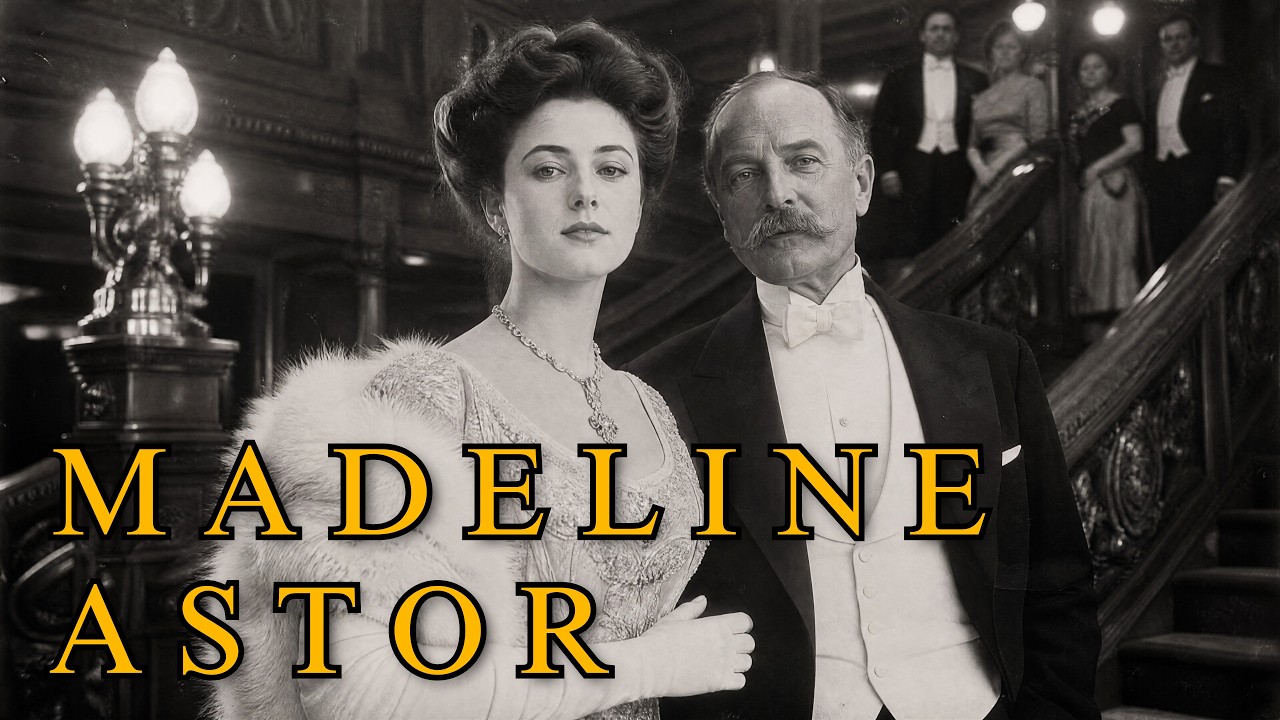
And what the young widow did after being handed a fortune worth more than $100 million in today’s money, under a single condition, became the most remarkable decision of her life. At 23, she gave it all back. Born in Brooklyn on June 19, 1893, Madeleine was the younger of two daughters of William Hurlbut Force, a prosperous shipping merchant. She was beautiful, fluent in French, well educated at elite schools in Manhattan, and remembered for a warmth that could, in the words of one observer, “twine itself around the heart of anybody.
” Yet the Force family was not on the exclusive social list known as the Four Hundred, the inner circle of acceptable society famously defined by Caroline Schermerhorn Astor. The doors of the highest rooms in New York remained closed to them. On December 22, 1910, Madeleine was formally presented as a debutante. She was admired, praised, and photographed, but she knew the essential fact of her position: she could see the party inside, but she was not part of it.
The only strategy available to a family in her position was to marry a daughter into an older name. Within a year, she had done exactly that. John Jacob Astor IV was the head of the American branch of the Astor family, a Harvard-educated man whose fortune, estimated at around $87 million, was built on generations of Manhattan real estate. By the standards of the age, that wealth would be equivalent to more than $2 billion today.
He had inherited the land and built famous hotels, including the St. Regis and the Knickerbocker. He was also widely regarded as cold, awkward, and deeply unhappy. At Bar Harbor, Maine, in the summer of 1910, the 46-year-old Astor met the 17-year-old Madeleine Force.
He had recently been divorced from his first wife, which made him a rare and dangerous thing in Gilded Age society: a divorced man of unlimited means. The courtship moved quickly. Astor gave dinners in her honor at the St. Regis and installed her in his opera box.
By August 1911, the engagement was announced from her father’s office. The reaction was national disgust. Astor was 47; Madeleine was 18. His son, Vincent, was older than the girl about to become his stepmother.
Newspapers described the romance as “wicked lust. ” Ministers refused to bless the union. Madeleine received anonymous letters filled with hatred, and the strain took a toll on her health. The very society she had married to enter gave her the cold shoulder.
To make matters worse, clergyman after clergyman refused to perform the ceremony because of Astor’s divorce. Rumors circulated, unproven, that ministers were offered money to overcome their scruples. The man who finally agreed was a Congregationalist pastor from Providence, Reverend Joseph Lambert. Within months, he resigned his church under national criticism and reportedly left the ministry.
The wedding took place at Beechwood, the Astor cottage in Newport, on September 9, 1911. Standing as best man was Vincent Astor, the 18-year-old son who was a year older than his new stepmother. Afterward, Madeleine had the name she had wanted, but belonging did not come with it. The Four Hundred received her where they could not refuse her, but froze her out everywhere else.
The couple left for an extended honeymoon abroad to escape the scandal. They traveled to Egypt and up the Nile, where they moved in the same circles as Margaret Brown, later known as Molly Brown. During these months, Madeleine became pregnant. For a short time, away from the judgment of New York, the marriage seemed to work.
He was gentle with her, and she was carrying his child. They decided to return home so the heir to the Astor fortune would be born on American soil. Their choice of passage was the new ocean liner that was the talk of the world: the Titanic. In early spring 1912, they boarded at Cherbourg with Astor’s valet, Madeleine’s maid, a trained nurse for the pregnancy, and their Airedale terrier, Kitty.
On the night of April 14, 1912, a grinding shudder ran through the ship. Astor reassured his wife that there was no danger; the Titanic could not sink. Later, the couple sat together in the ship’s gymnasium wearing their lifebelts. On the crowded deck, Madeleine gave her fur scarf to a steerage passenger named Leah Aks so the woman could wrap her infant child against the cold.
Madeleine was helped into lifeboat number four. Her husband asked if he could accompany her, but was told no man was allowed until the ladies were off. He asked the number of the boat so he could find her afterward. He told her the sea was calm, that she was in good hands, and that he would meet her in the morning.
Then he stepped back to the rail. The ship went down around 2:20 a. m. Madeleine, five months pregnant, took an oar and rowed and bailed in the freezing dark.
Her boat pulled several men from the water; at least one was already dead. The survivors waited for hours until the Carpathia arrived. Her husband’s body was recovered on April 22, identified by the initials sewn into his clothing. He had been found with about $2,500 in cash, a gold watch, and his diamond ring and cufflinks.
Madeleine gave birth to a son on August 14, 1912, in the Fifth Avenue mansion. He was named John Jacob Astor VI, and the press called him the “Titanic baby. ” Astor’s will left the bulk of the estate, about $69 million, to his son Vincent. It set aside a $3 million trust for the new infant.
For Madeleine, it provided $100,000 outright and the income from a $5 million trust, along with use of the Fifth Avenue mansion. The condition was absolute: she would keep that income and the house only for as long as she never remarried. For four years, Madeleine lived under that arrangement. In 1915, she remodeled the mansion, a sign she intended to stay.
But at 23, she made the choice no one expected. She decided to marry her childhood friend, a Brooklyn banker named William Karl Dick. In June 1916, she married him at Bar Harbor, the same Maine coast where she had met Astor. By saying the vows, she forfeited the trust income, the Fifth Avenue mansion, and the Astor name.
She became plain Mrs. Dick. The second marriage gave her years of plain, private happiness. She had two more sons.
The younger, John Henry Dick, became an ornithologist and a painter of birds, earning his standing through his own work. The marriage wore thin over time, and the Dicks separated after about 17 years. Their divorce was granted in Reno, Nevada, in 1933. Within months, Madeleine married again.
The man was Enzo Fiermonti, an Italian prize fighter and sometime actor, about 26 years old to her 40. The marriage, settled in Palm Beach, Florida, was loud and unhappy and became violent. Reports said he broke her bones. In 1938, she divorced him on the ground of extreme cruelty and took back the name Dick.
Fiermonti then sold the story of their marriage to a tabloid, which serialized it for the public. Her son, John Jacob Astor VI, had opposed the marriage, and the two had been briefly estranged, but they reconciled within months. Madeleine Force died on March 27, 1940, at her home in Palm Beach. She was 46.
Her household announced that her heart had failed. Rumors have long surrounded the death, unproven, involving prescription medicines, but the stated cause remains a heart ailment. She was buried in the family mausoleum at Trinity Church Cemetery in Manhattan. History remembers Madeleine Astor as a minor figure in the Titanic disaster, the pregnant young widow of lifeboat number four.
But the two defining choices of her life were not made on the ship. At 18, she chose to marry against a nation’s fury. At 23, she chose to give back a fortune worth more than $100 million in modern terms rather than accept a life that was not her own.
The world called her a gold digger, and she was the one who handed back the gold.