In the spring of 1901, Florida lawmakers spent 16 days drafting a law that has been used only once in the state’s entire history. It was written for a single man, Henry Flagler, the co-founder of Standard Oil who built modern Florida, and it was written to erase his wife. During that single legislative session, Florida passed a statute that had never existed before that year and was never used again. The newspapers of the time didn’t call it by its official name.
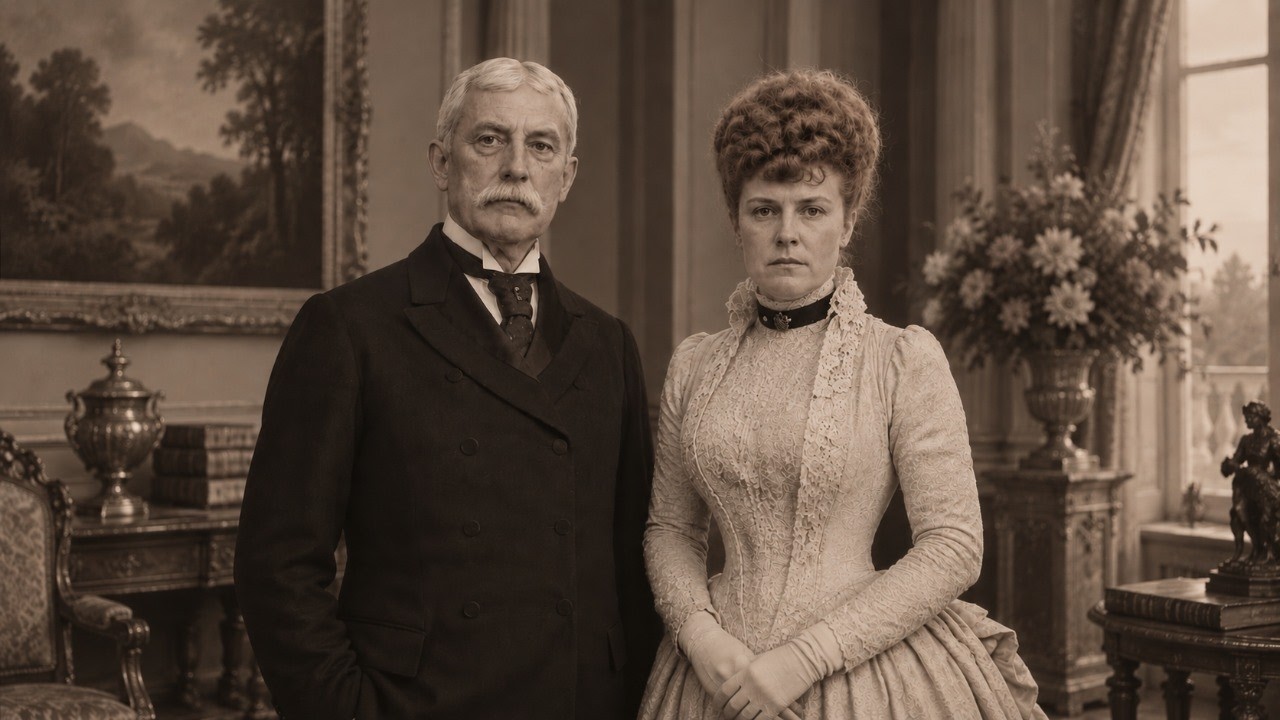
They called it the Flagler Divorce Bill. By the time he died inside his Palm Beach mansion in 1913, Flagler had helped build Standard Oil alongside John D. Rockefeller, extended railroads along the entire coast, and transformed a swamp into one of the most elegant addresses in the United States. The house still welcomes hundreds of visitors each year who come for the marble staircases, the gold-leaf ceilings, and the story of the man whose name is carved across half of Florida: a county, a university, a museum, a stretch of beach.
But in the second-floor tour of that mansion, behind the ballroom, visitors see two preserved bedrooms. One belonged to Flagler. The other belonged to his third wife, the woman the mansion was truly built for. There is no third suite.
There is no room bearing the name of the woman who came before her, the wife Flagler was married to for more than a decade and whom he later erased from history so completely that his own museum no longer has a place for her. Her name was Ida Alice. Before she became Mrs. Flagler, she spent her days at the bedside of another woman.
Mary Harkness Flagler, Henry’s first wife, was slowly dying of a wasting lung disease in 1881. Ida Alice Shourds, then in her early thirties, was the hired nurse. She was single, the daughter of an Episcopal minister who had died young, and she had briefly tried her hand at acting before turning to nursing. By most accounts, she was a patient and capable presence during those long months.
Mary died that year at age 47. Henry Flagler, already a wealthy man from his years building Standard Oil with Rockefeller, was 50 and, according to most accounts, genuinely devastated. What happened between the widower and the nurse over the following two years was not recorded. What was recorded is the date: June 5, 1883, when a small group of relatives and friends gathered at a Methodist church on Madison Street in New York to witness the marriage of 53-year-old Henry Flagler to 35-year-old Ida Alice Shourds.
That year, the couple traveled south for their honeymoon to Jacksonville and then St. Augustine, a quiet semi-tropical town with Spanish architecture and orange groves. A doctor had recommended a warmer climate for Ida Alice’s health. That trip changed almost everything that followed.
Flagler had spent his entire career moving oil, not people, but something about that honeymoon, the light on the Matanzas River, the sense of standing at a frontier no one in the North thought worth developing, reordered his ambitions entirely. His first idea had nothing to do with hotels. He tried to buy a poured-concrete villa built by an eccentric local, intending to turn it into a winter home for his new wife’s health. The owner refused to sell, so Flagler, a man rarely told no, decided to build something bigger himself.
Within two years, he had begun construction on the Ponce de León Hotel. Within two decades, he had extended railroads across a state that had not existed as a tourist destination until then. The Ponce de León opened in January 1888, a massive Spanish Renaissance fantasy of towers and courtyards. It was the first building in Florida built specifically to be photographed.
Its dining room alone could seat hundreds beneath a vaulted ceiling and stained-glass windows made in the workshop of Louis Comfort Tiffany. Its 540 rooms filled that first winter with guests who had never relied on an electric light switch instead of a candle. Ida Alice occupied a central place in that opening season. For a decade after the wedding, the marriage looked successful from the outside.
The Flaglers kept a winter residence in St. Augustine called Kirkside and a home on a spit of land in Mamaroneck, New York, that carried the old local name “Devil’s Rock. ” Henry ordered a steam yacht built and named it Alice, in her honor. A man who spent his life naming things related to profit took the time to name the one thing he built purely for pleasure after his wife.
Ida Alice threw herself into the role of Gilded Age hostess with real talent. She filled Kirkside with orchestras and imported flowers, organized dinners and dances that drew the Astors and Vanderbilts south to a city that barely had paved streets. By all surviving accounts from that period, she was warm, intelligent, and generous with her guest lists, the kind of hostess people wanted invitations from. In the summer of 1891, the Flaglers were in Newport, Rhode Island, following the social calendar that accompanied such wealth.
There, at a gathering arranged by a mutual acquaintance, Henry Flagler was introduced to a 23-year-old visitor from North Carolina, a young woman with a talent for piano and a way of drawing the attention of an entire room without seeming to try. Her name was Mary Lily Kenan. Over the following seasons, according to more than one account, she became close not just to Henry Flagler but to Mr. and Mrs.
Henry Flagler together. Ida Alice did not simply lose her husband to a stranger. She lost him to a young woman she had for a time considered a friend. By 1894, Ida Alice had become deeply interested in Spiritualism, a fashionable hobby half of her social circle was experimenting with that decade: tables knocking, automatic writing, and the new parlor game called the Ouija board.
In her rooms on Fifth Avenue, she held her own candlelit séances, guests’ fingers resting lightly on a small wooden planchette, waiting for it to slide toward letters forming messages she believed came from departed historical figures. She told her husband on more than one occasion that she had discovered through those sessions that her fate was to one day marry the Czar of Russia. What distinguished Ida Alice’s séances from those of her neighbors was not the table. It was what she said afterward, in those same rooms, to those same guests, in her ordinary daily voice: that her husband was having an affair with another woman.
She was not wrong. By that time, Mary Lily Kenan was a regular presence in Flagler family circles, invited to the same dinner parties, a familiar face in the corridors of St. Augustine hotels and in Newport parlors. Close enough to the family that some in their circle had already begun to notice what Ida Alice was simply saying out loud.
That autumn, Henry Flagler began sharing his concerns about his wife’s behavior with friends and household staff. At their Mamaroneck residence alone, they had a staff of ten: doormen, footmen, upstairs maids, parlor maids, cooks, kitchen helpers. Almost all were long-serving, loyal Flagler employees, ultimately answerable to him. Ida Alice ran a household full of people who were not, in the end, answerable to her.
Flagler hired a doctor, George Shelton, an ear, nose, and throat specialist with no special training in matters of the mind, to observe her. According to biographer Sidney Walter Martin, Shelton did more than observe. Because of her fluency of speech, Dr. Shelton made it his business to be in her presence and secretly record everything she said for a file that did not yet have a name.
A throat doctor, not a psychiatrist, was the man chosen to build the case against her in silence. Not because he understood her condition, but because he was already inside the house, trusted, and positioned to listen without appearing to be anything other than a family physician making a routine visit. The language used to describe her shifted gradually, from admired to eccentric, and from eccentric to the word high society reserved for women who said uncomfortable things too loudly: “unbalanced. ” She did not know that being right about her own circumstances was about to be diagnosed as a disease in itself.
One day that autumn, in her Fifth Avenue apartment, a maid opened the door to find two men standing on the threshold, politely asking whether the lady of the house was in. They presented themselves as doctors. One was George Shelton, the family’s throat specialist, who had spent much of the year silently recording everything she said. He had brought colleagues with him: alienists, to use the term of the era, men whose entire profession was built around a single question asked of a stranger during an afternoon.
Is this person of sound mind? Their presence disturbed her. According to the preserved record, she became frantic, perhaps understandably for a woman who had spent the past year rightly sensing she was being watched and now saw two strangers entering her home to decide her fate. That response was also added to the file.
The alienists of that era worked from a short, unforgiving checklist: unconventional manners, claims of communication with the dead, domestic accusations a husband might find scandalous, any behavior that disturbed the patient’s family. By that standard, Ida Alice had spent the past two years quietly building her own case. Within days, the official recommendation was delivered in writing: Mrs. Flagler should be removed from her home and taken immediately to a sanitarium in Pleasantville, New York, run by Dr.
George Choate. It was November 1895. Choate’s sanitarium was not a harsh place on paper. Choate built it as a ten-room addition to his own home, an exclusive retreat for wealthy families who preferred their nervous disorders treated in secrecy.
Its most famous former resident was Horace Greeley, the journalist and former presidential candidate who entered after his crushing 1872 election loss and never truly recovered. If Ida Alice knew that story when she arrived, no one recorded it. Within less than a year, Dr. Choate himself died and the sanitarium passed to a new director, Dr.
Carlos MacDonald, a man who had just resigned from the presidency of the New York State Commission on Lunacy to run this single private residence instead. What MacDonald recorded during that first winter was a diagnosis. Two words were entered into her file, two words that would follow her for the rest of her life: incurable dementia. Not ill.
Not recovering. Not even under observation pending review. Incurable. A word once entered into the file of an unwanted rich man’s wife in the winter of 1895 acted like a door locked from the outside.
She was not given the key. He was. Almost no one was told. Four years later, when a New York court finally moved to formalize the situation, a Buffalo newspaper noted how carefully secrecy had been maintained.
The women who had danced at her St. Augustine dinner parties, drunk champagne under her lights at Kirkside, and sat around her table for séances were told simply that Mrs. Flagler was unwell, resting at a quiet place. None were told where she actually was.
None were told she would still be there in 1899, or in 1913 when her husband died, or in 1930 when she finally left. Life at Choate, however comfortable, remained a life bound by visiting hours and locked doors. In private sanitariums of this kind, patient correspondence was routinely monitored, visits arranged only with family approval, and a full staff ultimately answered to whoever paid the bill, not to the patient. By any definition that mattered, Ida Alice was a wealthy woman with no control over any hour of her day.
In the spring of 1896, her doctors recommended something more flexible than continued confinement: a rest, a change of scenery, a return, even temporarily, to a Flagler-owned home. If improvement continued, perhaps it could be the beginning of a road back. The house she was sent to was called “Devil’s Rock. ” The name came from James Fenimore Cooper, who had written an entire book about the neighborhood decades before Flagler bought a summer home there.
It was not a name chosen for her situation. It was spring and summer of 1896. According to the doctors supervising her care, she arrived in much better, almost recovered condition. A nurse discreetly watched her from somewhere in the house at all times.
The same loyal Flagler staff who had once served her as hostess now cared for her as a patient. For a time, by all standards used by the report writers, it looked like recovery. The “rest cure” had been developed decades earlier by a doctor named Silas Weir Mitchell and was prescribed almost exclusively for women labeled hysterical or nervous. Men with similar diagnoses were sent west and encouraged to ride horses, camp, hunt, and work outdoors.
Women were confined to bed for weeks at a time, sometimes isolated from visitors, deprived of books, correspondence, conversation, and anything else that might overstimulate a mind doctors had already decided could not be trusted. It was a treatment that looked very much like the confinement it was supposed to relieve, just quieter, softer, with better sheets. It did not last. According to Dr.
Shelton’s own account, Ida Alice’s judgment began deteriorating again. Whether it was a genuine relapse or simply what happens to any woman subjected to months of forced inactivity and near-total isolation was a question none of the men shaping her file thought worth asking. Her sworn affidavit described her as quick-tempered, nervous, and absorbed in spiritualistic and irrational beliefs. The diagnosis did not change a single word.
Only the consequences attached to it did. By 1899, the informal arrangement that had kept Ida Alice’s life suspended for four years was ready to become official. A New York court took steps to declare her legally insane. A committee was appointed to her person and property.
That guardianship soon passed to a lawyer named Eugene Ashley. The same Eugene Ashley who was already quietly working on Henry Flagler’s divorce. The man managing Henry Flagler’s exit from the marriage and the man now legally responsible for protecting Ida Alice’s interests within that same marriage were, for a time no one in court thought worth commenting on, the same person. That same year, in May 1899, Henry Flagler did something more discreet that would ultimately mean more than anything a New York court could decide.
He changed his legal residence to Florida, the place where he had spent much of a decade helping to draft, fund, and build its laws. New York’s divorce law had been one of the strictest in the country since 1787: adultery, and only adultery, was grounds for ending a marriage. Not cruelty. Not abandonment.
Not insanity, no matter how incurably a court had declared it. For over a century, wealthy New Yorkers who wanted out of a marriage for any other reason simply left, established residence in a favorable state, waited out the requirements, and returned home unmarried. By the 1890s, the practice was common enough that lawyers had a name for it: divorce by change of residence. The timing in this case strains coincidence.
A New York court was at that very moment finalizing papers making his wife legally and permanently insane under New York law, a state whose divorce statutes offered him no exit from the marriage. The bill was introduced before the Florida legislature on April 9, 1901. It barely occupied a single page. It proposed that incurable insanity of either spouse constituted grounds for dissolution of marriage.
Florida had no such law. No state built its divorce rules around insanity casually. By that time, Flagler’s name appeared on more buildings, universities, and train schedules than any other man’s. The legislators considering the bill that year were, to a large extent, men whose districts had been transformed by his money.
No conspiracy was needed to pass such a bill through such a body. It required only a widespread, rarely voiced understanding of which interests deserved preserving. No one in Tallahassee pretended for long not to know who the bill was for. The newspapers of the time didn’t refer to it by its official number.
They called it the Flagler Divorce Bill. The vote was not remotely close. By that time, Flagler had spent years funding Florida’s universities, railroads, hotels, and the very idea of the state as a place worth visiting. According to most accounts, he employed a former state Supreme Court justice and a former governor to ensure all legal angles were handled properly.
To make the case unassailable, three experts in dementia were brought in to testify about Ida Alice’s condition before Florida hearings. This time it was not a throat doctor but specialists hired for the occasion, paid to reach a conclusion that had, in practical terms, already been settled six years earlier in a New York parlor. The language presented to Florida courts in 1901 was harsher. The experts described her as a woman suffering from violent paranoia, an expression lacking the clinical precision of its predecessor but remarkably useful to a court needing to settle the matter decisively.
No one asked her opinion of this diagnosis. At that point in her story, no one did anymore. Governor William Sherman Jennings signed the bill into law on April 25, 1901. From introduction to final signature, only 16 days passed.
Sixteen days were enough for Florida to draft, debate, and pass a law unprecedented in its history, a law designed literally to fit one woman’s diagnosis, shaped for her like a key cut for a single lock. In the end, it would exist for one purpose only and be used by one man only. Once Flagler’s divorce was complete, the legislature quietly repealed the law. Since then, in all of Florida’s recorded history, insanity has never again been grounds for divorce.
The divorce was formalized on August 14, 1901, in a Florida court. Ida Alice was not there. She was more than a hundred miles away, confined, legally classified as incapable of testifying about the end of her marriage. There was no cross-examination for her to endure because there was no expectation that she would be asked to speak.
The law that ended her marriage was built from its first draft to its final signature without any input from her whatsoever. Ten days later, Henry Flagler married Mary Lily Kenan at the Kenan family farmhouse in North Carolina. He was 71. She was 34, younger than Henry’s own daughter.
Before the year ended, construction had begun on a 75-room mansion in Palm Beach that the newspapers would soon describe as more magnificent than any palace in Europe. A monument to a marriage that had existed for less than a season, built on a coast another wife had once helped him choose. Ida Alice was present at none of it: not during the 16 days in Tallahassee, not during the 10 days between divorce and wedding, not during the start of work on that coast she had once helped her husband see for the first time, standing on the deck of a ship that bore her own name. Henry Flagler died 12 years after that wedding, on May 20, 1913, inside the mansion built for the marriage the Florida legislature had made possible.
That winter, he fell on his mansion’s marble staircase and never fully recovered. He was 83. He was buried in St. Augustine, in the city his honeymoon had accidentally helped build, inside a marble mausoleum beside his first wife Mary.
Ida Alice was not informed, or if she was, no record remains. She had not seen him since before the divorce. She outlived him by 17 years and, as it turned out, also outlived the woman who replaced her. Mary Lily Kenan, the wife the mansion was built for, remarried four years after Flagler’s death to a Kentucky lawyer named Robert W.
Bingham. Eight months later, she died at age 50, having left him a will worth $5 million. Her body was later quietly exhumed at her family’s request. Subsequent analyses revealed morphine and heavy metals in her remains.
No charges were ever filed. Bingham used the money to buy a newspaper empire and support Franklin Roosevelt’s presidential campaign, and was rewarded with an ambassadorship to the Court of St. James’s. When his confirmation reached the Senate, old rumors resurfaced persistently enough that Roosevelt was said to call his ambassador, jokingly, “my favorite murderer.
” The appointment was confirmed regardless. Meanwhile, Ida Alice’s own fortune grew steadily. Court records of her guardianship show her income in some years exceeded $400,000, while the men managing her wealth set her an allowance of $25,000. The rest accumulated year after year in accounts she never saw and could never touch.
The money was managed first by her husband’s divorce lawyer, then by the trust companies and supervisors who succeeded him. Eugene Ashley became one of the richest men in his upstate New York county, enriched largely by the accounts he was appointed to manage on her behalf. Dr. Carlos MacDonald, the doctor who had once resigned from a state commission to accept Ida Alice as one of his first private patients, continued his own long and distinguished career.
In 1913, the same year Henry Flagler died, MacDonald was elected president of the American Psychiatric Association. In the end, this is the full picture of what happened to her. Her money grew for 35 consecutive years. Her freedom did not grow for a single day of them.
On paper, she became one of the richest women in America. In reality, she remained one of the least free. A vast fortune she could not freely use in the hands of a woman who was also not allowed to go anywhere. Almost nothing she wrote herself appears to have survived.
No letter of protest, no diary entry, not even a single sentence written in her own hand across 35 years, inside rooms she did not choose. Every surviving account of her story, the séances, the diagnosis, even her final freedom or lack of it, reached us through the words of the men who examined her, confined her, and profited from managing what remained of her life. She died on July 12, 1930, at about age 82, in the same institution and under the same type of care that had kept her there since November 1895. She was not buried in Florida or anywhere near the mansion.
She was buried in Cypress Hills Cemetery in Brooklyn, in a simple grave hundreds of miles from Whitehall, in a city where she had once been one of the most prominent society figures. Today, visitors to Whitehall pass by two preserved bedrooms on the second floor of the museum. One is dedicated to Henry Flagler. One is dedicated to Mary Lily.
There is still no third door. Ida Alice Flagler is buried in Brooklyn under her real name. No one ever built her a room.