In 1963, a photograph placed before a Scottish court became the center of one of the most notorious divorce cases in British legal history. It showed Margaret Campbell, Duchess of Argyll, wearing only her signature three-strand pearl necklace, alongside a man whose head was outside the frame. The press named him “the headless man,” and his identity became a national obsession that lasted for decades. The image had been stolen from her locked cabinet by her husband and was used to destroy her reputation in front of the entire country.
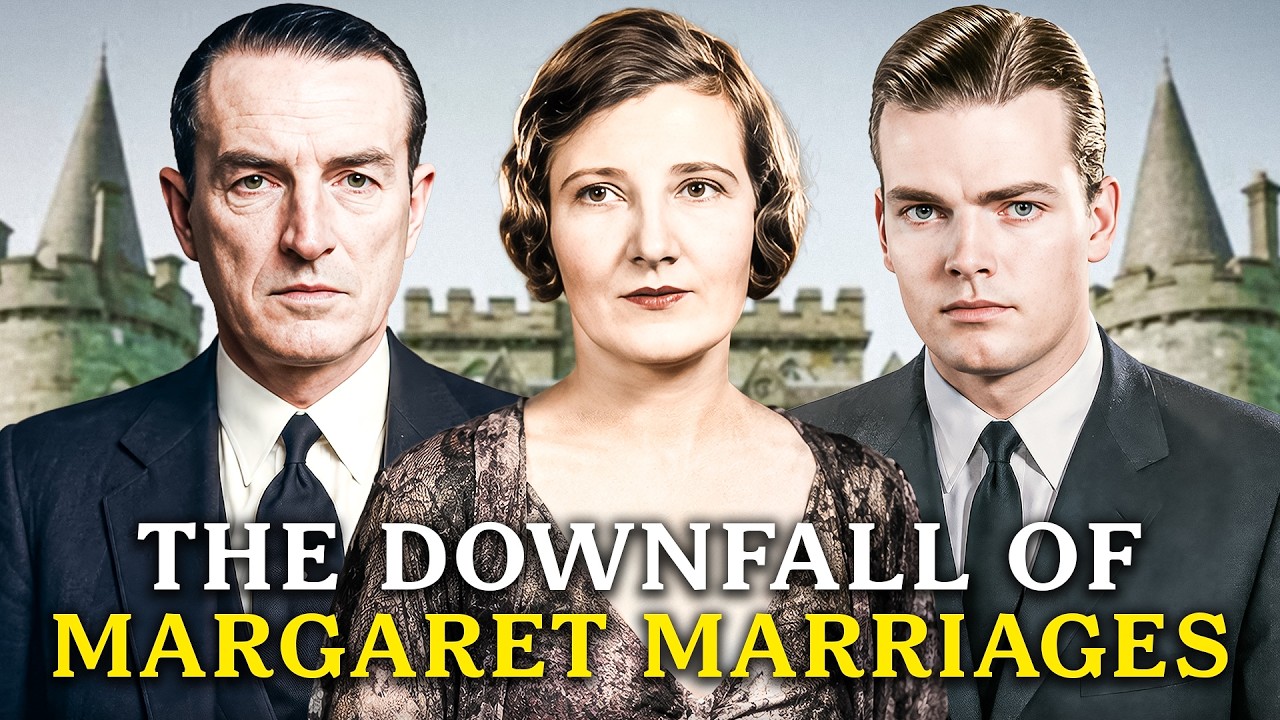
Born Ethel Margaret Whigham on December 1st, 1912 in Newton Mearns, Scotland, she was the only child of George Hay Whigham, a self-made millionaire who built a fortune in the artificial silk business. Her mother, Helen, was obsessed with the girl’s looks and reportedly rationed her reading for fear she would need glasses. Margaret was presented at court at 17, named debutante of the year, and was soon one of the most talked-about young women in London. Cecil Beaton painted her, and a Cole Porter lyric in the British version of “Anything Goes” praised her simply as “Mrs.
Sweeney. ”
In 1928, at 15, she had a secret pregnancy involving the young David Niven, which was ended at a London nursing home. She never spoke of it publicly, though she attended Niven’s memorial service 55 years later. Her first marriage was to American Charles Sweeney, a wealthy golfer, on February 21st, 1933, at the Brompton Oratory.
The publicity around her Norman Hartnell wedding dress was so intense that crowds blocked traffic in Knightsbridge for three hours. The marriage produced two surviving children but deteriorated during the war years. In 1943, Margaret survived a 40-foot fall down a lift shaft in a London clinic. She lost her fingernails clutching the cable, cracked her skull, and permanently lost her sense of taste and smell.
Friends said she returned from the accident a different woman, more openly driven in her relationships with men. The marriage ended in divorce in 1947. In 1951, she married Ian Douglas Campbell, who became the 11th Duke of Argyll. He came with a crumbling castle and overwhelming debts.
She paid for the restoration of Inveraray Castle. She had been warned repeatedly, including by her first husband, who told her the Duke never married for love but for money. She ignored it all. The marriage unraveled quickly.
By the Duke’s account, he had Margaret’s car wiretapped, and by 1959, while she was in New York, he hired a locksmith to force open her locked cabinet. Inside, he found her diaries, letters, and the Polaroid photographs that would soon define her in public memory. The Duke filed for divorce, and the case took four years to reach court. The accusation of infidelity reportedly involved a list of 88 men, including government ministers and three members of the royal family.
The trial landed in the middle of the Profumo affair, giving newspapers an extraordinary confluence of aristocratic scandal and political crisis. Duncan Sandys, then Secretary of State for Commonwealth Relations and Winston Churchill’s son-in-law, told the cabinet he was rumored to be the headless man and offered to resign. The Prime Minister persuaded him not to, unable to absorb another sex scandal in the same summer. Lord Denning, already investigating Profumo, was quietly asked to identify the headless man.
Using the handwritten captions on several photographs, he invited five suspects to the Treasury on a pretext and had them sign the visitors’ register. A handwriting expert reportedly identified Douglas Fairbanks Jr. , the American actor, though he denied it until his death. A later documentary suggested the most notorious photograph had been taken in 1957, when the only Polaroid camera known to be in Britain was on loan to the Ministry of Defense, pointing instead toward Sandys.
The Duchess refused to name anyone. She took the full answer to her grave. The judge, Lord Wheatley, delivered a 50,000-word judgment that took four and a half hours to read. He described Margaret as having a debased sexual appetite and called her a completely promiscuous woman.
The divorce was granted in the Duke’s favor. Her counter-petition accusing him of adultery with her own stepmother was dropped for lack of a witness, and she was later ordered to pay that stepmother 25,000 pounds for libel, slander, and conspiracy. The Duke remarried within the year and died of a stroke in 1973. Margaret retained her title and her composure, but little else.
Her fortune had been eroded by his debts, the castle restoration, legal fees, the libel judgment, and a lifestyle that never included economy. In 1978, she was forced out of the Upper Grosvenor Street house and moved to a hotel suite. In 1990, she was evicted from the hotel. Her first husband, Charles Sweeney, helped her find a temporary apartment.
He died four months before her. Her children eventually placed her in St. George’s Nursing Home in Pimlico. A photographer from Tatler, the magazine that had once documented her at the height of her glamour, published an image of her sitting on the edge of a small, bleak bed in a single room.
She refused to eat lunch when it was served at noon, telling staff only servants ate at that hour. She waited until 1:00. She died on July 25th, 1993, at age 80, following a fall. She was buried beside Charles Sweeney at Brookwood Cemetery.
Within weeks of her death, the press reported the headless man’s identity as Douglas Fairbanks Jr. , based on the handwriting analysis from 30 years earlier. Everyone who held the full answer was already gone. The mystery closed without resolution.
She left behind a memoir that was poorly received, a house sold to pay debts, and a question that outlasted her. The language used to condemn her in court was not applied to her husband, who by multiple accounts was an alcoholic, a drug user, a forger, and a man who married repeatedly for money. The photographs had been stolen from her by him, yet he faced no consequence for taking them. In 2021, the BBC dramatized the story in “A Very British Scandal” with Claire Foy, and audiences found in it a surprisingly current story about how institutions decide who deserves protection and who can be thrown to the press.
Margaret was not a simple heroine. She was vain and capable of dishonesty. But she had been celebrated for everything she was, then condemned for the same qualities when it became convenient.
Even at the end, in that single room, waiting until 1:00 to eat because servants ate at noon, she remained unmistakably, exactly herself.