Abraham Lincoln’s bid for a second term in 1864 unfolded while the nation was torn apart by civil war, making it the only presidential election ever held during active national conflict. With roughly 4 million voters heading to the polls, the choice before the Northern electorate was stark: stay the course and finish the war, or admit failure and push for peace. Lincoln’s path to reelection was anything but certain. By 1863, a wave of war weariness had swept across the North, and his administration faced fierce criticism from all sides.
Copperheads, Northerners sympathetic to the South, openly attacked his policies, while some Democrats claimed the war was being fought to free enslaved people at the expense of white Americans. One Ohio representative declared that New England’s “Constitution-breaking, law-defying, Negro-loving Phariseeism” had driven the South to secession. The president’s evolution on key issues added to the controversy. Between his inauguration and his reelection campaign, Lincoln’s approach to the war had shifted dramatically.
Limited war had become total war. The compensated, gradual emancipation he once envisioned had become immediate and uncompensated. Black men, initially barred from the military, were now actively recruited into Union ranks. And the goal had expanded from restoring the Union to fundamentally reconstructing it.
Northern citizens watched with alarm as the federal government expanded its wartime powers. Habeas corpus was suspended, the press faced suppression, and at least 15,000 Northerners were arrested by federal authorities, many without the civil liberties guaranteed by the Constitution. Combined with inflation, new taxes, and the grim toll of battlefield losses, public morale sank dangerously low. Within Lincoln’s own party, divisions deepened.
Radical Republicans pushed for harsher measures, including the seizure of Confederate property and the immediate emancipation of enslaved people. In December 1862, a secret caucus of 32 radical Republicans targeted Secretary of State William Seward, demanding a cabinet shakeup. Lincoln defused the threat by turning the tables on Treasury Secretary Salmon Chase, a Seward rival, forcing him to admit he could not condemn Seward. When Chase offered his resignation, Lincoln accepted it into his pocket, effectively neutralizing both men and keeping his cabinet intact.
Challenges to Lincoln’s authority continued into 1864. A February circular from Kansas Senator Samuel C. Pomeroy suggested Chase as the Republican nominee, but the effort backfired when Chase lamely apologized and withdrew his name. Then, on May 31, retired Major General John C.
Fremont was nominated by a faction of radical Republicans in Cleveland, a splinter group that called itself Radical Democrats. Lincoln secured the National Union Party’s nomination on June 8, 1864, in Baltimore, with Missouri’s 22 votes for Ulysses S. Grant the only negative mark before the state changed its vote to make Lincoln’s nomination unanimous. Andrew Johnson, a Tennessee Unionist and military governor of Union-held territory, was chosen as his running mate.
The party platform called for unconditional Southern surrender and a constitutional amendment to end slavery. Notably, the platform contained no plank addressing reconstruction. Militarily, the summer of 1864 looked bleak for the Union. Grant was locked in a prolonged siege at Petersburg, Virginia, while Sherman struggled in Georgia.
Jubal Early’s Confederate forces threatened the outskirts of Washington. The dollar had plunged to 39 cents, and Lincoln called for 500,000 more volunteers. One Copperhead editor gloated, “Lincoln is deader than dead. ”
Trouble also brewed within the cabinet.
Lincoln feared that Chase’s influence over a Treasury appointment in New York would alienate moderates there. Confronted, Chase offered his resignation again. This time, on June 30, Lincoln accepted it. “You and I have reached a point of mutual embarrassment in our official relation, which it seems cannot be overcome,” he told Chase.
The removal enraged radical Republicans. On July 4, 1864, Ohio Senator Benjamin Wade and Maryland Congressman Henry Winter Davis sponsored the Wade-Davis Bill, which demanded that 50 percent of a Southern state’s 1860 voters take a loyalty oath before reconstruction could proceed. Lincoln pocket-vetoed the measure, further inflaming tensions with his own party’s radicals. Even the era’s popular music reflected the nation’s exhaustion.
Songs like “When This Cruel War Is Over” and “Tenting on the Old Camp Ground” captured the longing for peace, with lyrics such as “Many are the hearts that are weary tonight, wishing for the war to cease. ”
So dim was Lincoln’s outlook that on August 23, 1864, he asked his cabinet to sign a blind memorandum pledging to cooperate with the incoming administration after the November election. He reportedly told an officer, “I am going to be beaten, and unless some great change takes place, badly beaten. ”
The Democrats gathered in Chicago hoping to capitalize on that discontent.
After internal struggle between War Democrats and Peace Democrats, a compromise emerged: the platform would call for an armistice, and the nomination would go to a military hero. That hero was Major General George B. McClellan, a general without a command. His running mate was George Pendleton of Ohio, an ally of the exiled Copperhead Clement Vallandigham.
McClellan’s discomfort with the platform was immediate. One plank declared that after “4 years of failure to restore the Union by the experiment of war,” immediate efforts should be made to cease hostilities. In effect, the platform demanded peace first and Union second. The Confederacy took hope from the Democratic ticket.
Robert Barnwell Rhett Jr. of the Charleston Mercury predicted that McClellan’s election “must lead to peace and our independence, provided that for the next 2 months we hold our own and prevent military success by our foes. ”
But two days after McClellan’s nomination, Atlanta fell to Sherman’s army, following Admiral David Farragut’s victory at Mobile Bay the previous month. Seward retorted that “Sherman and Farragut have knocked the bottom out of the Democrats’ Chicago platform,” and McClellan publicly broke with the peace platform.
As election day approached, Democrats played on racial fears, calling the Emancipation Proclamation the “Miscegenation Proclamation” and labeling Lincoln “Abraham Africanus the First” and “Abe the Widow Maker. ” Sensing momentum, Lincoln drew Fremont out of the race on September 17. On October 11, early statewide elections offered a preview of the national result. Lincoln knew he had to carry Ohio, Indiana, and Pennsylvania, and Secretary of War Edwin Stanton granted furloughs to soldiers from those states so they could vote.
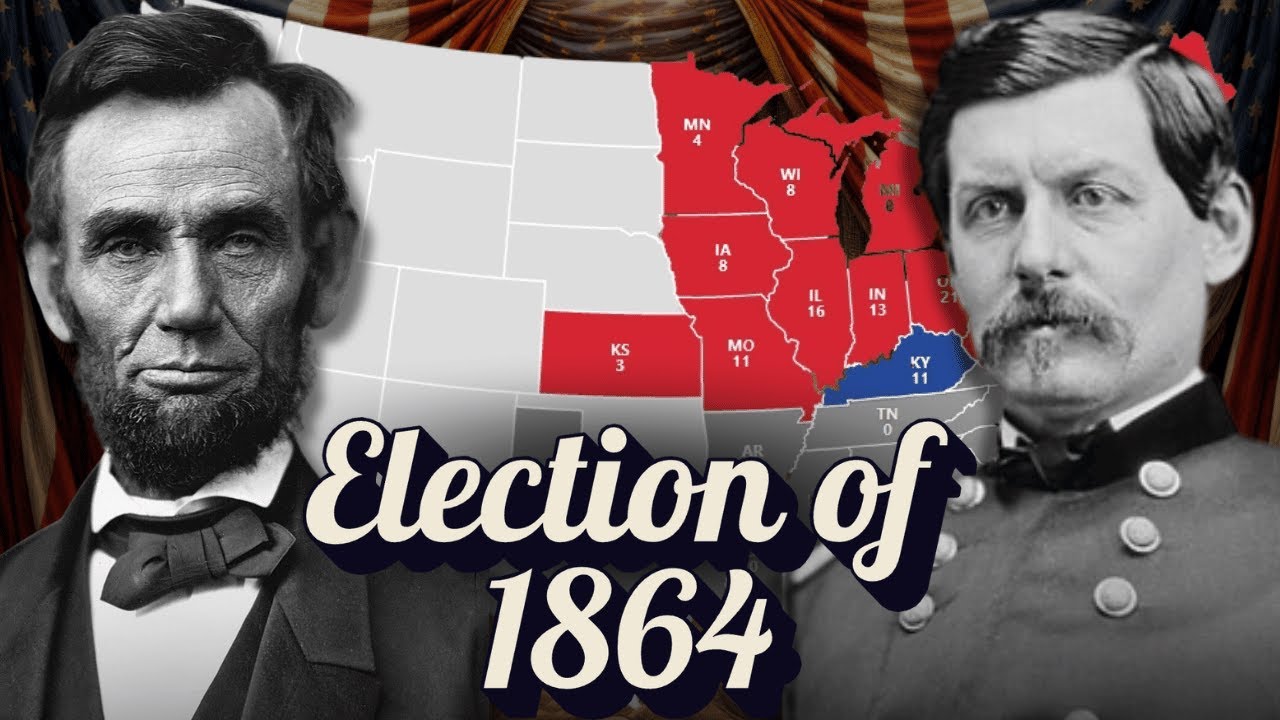
For the first time in the nation’s history, soldiers voted while in the field, with 19 states allowing absentee voting. On Tuesday, November 8, 25 states cast ballots, with none of the 11 Confederate states participating. Soldiers voted roughly four to one for the incumbent. Lincoln won 55 percent of the popular vote, though that figure masked a plurality of only about 400,000 of 4 million votes cast.
Lincoln carried every state except Kentucky, New Jersey, and Delaware, winning the electoral vote 212 to 21. But the margins were narrow in critical places. He won New York by a razor-thin 0. 92 percent, Connecticut by 2.
76 percent, and Pennsylvania by 3. 51 percent. Those three states alone supplied 65 of his 212 electoral votes. The election gave Lincoln’s party a three-fourths congressional majority and gubernatorial victories across the North.
Though the margin was far closer than the electoral tally suggested, Lincoln interpreted his victory as a mandate to fight the war to its conclusion. For all practical purposes, slavery was dead, and freedmen were on the path toward citizenship and suffrage. Lincoln delivered his second inaugural address on March 4, 1865, with only 42 days left to live. The final paragraph remains among the most quoted words in American history: “With malice toward none, with charity for all, with firmness in the right as God gives us to see the right, let us strive on to finish the work we are in, to bind up the nation’s wounds, to care for him who shall have borne the battle and for his widow and his orphan, to do all which may achieve and cherish a just and lasting peace among ourselves and with all nations.
”
In the South, Lincoln’s reelection dashed the last hopes for independence. Jefferson Davis, however, refused to despair. Throughout the Northern campaign, he had never believed McClellan could win, and after Lincoln’s victory he told the Confederate Congress that “nothing has changed in the purpose of this government and the indomitable valor of its troops or in the unquenchable spirit of its people. ”
Southern diarist Mary Boykin Chestnut captured the opposite sentiment, writing, “Since Atlanta I have felt as if all were dead within me forever.
We are going to be wiped off the earth. ”
With a fresh popular mandate behind Lincoln, Generals Sherman and Sheridan moved aggressively in the fall of 1864 to break the Confederacy’s back. The election of 1864 had settled the question of whether the war would end in peace or in victory, and the answer, determined at the ballot box, was to see the conflict through to its end.