In the spring of 1829, a social war broke out in Washington that would tear the federal government apart. It was not fought with armies or legislation, but with turned backs, snubbed invitations, and withheld calling cards. The target was Margaret “Peggy” O’Neal Eaton, the new wife of Secretary of War John Henry Eaton, and the woman at the center of a scandal that forced President Andrew Jackson to dissolve nearly his entire cabinet. Peggy was born on December 3, 1799, in a Washington tavern.
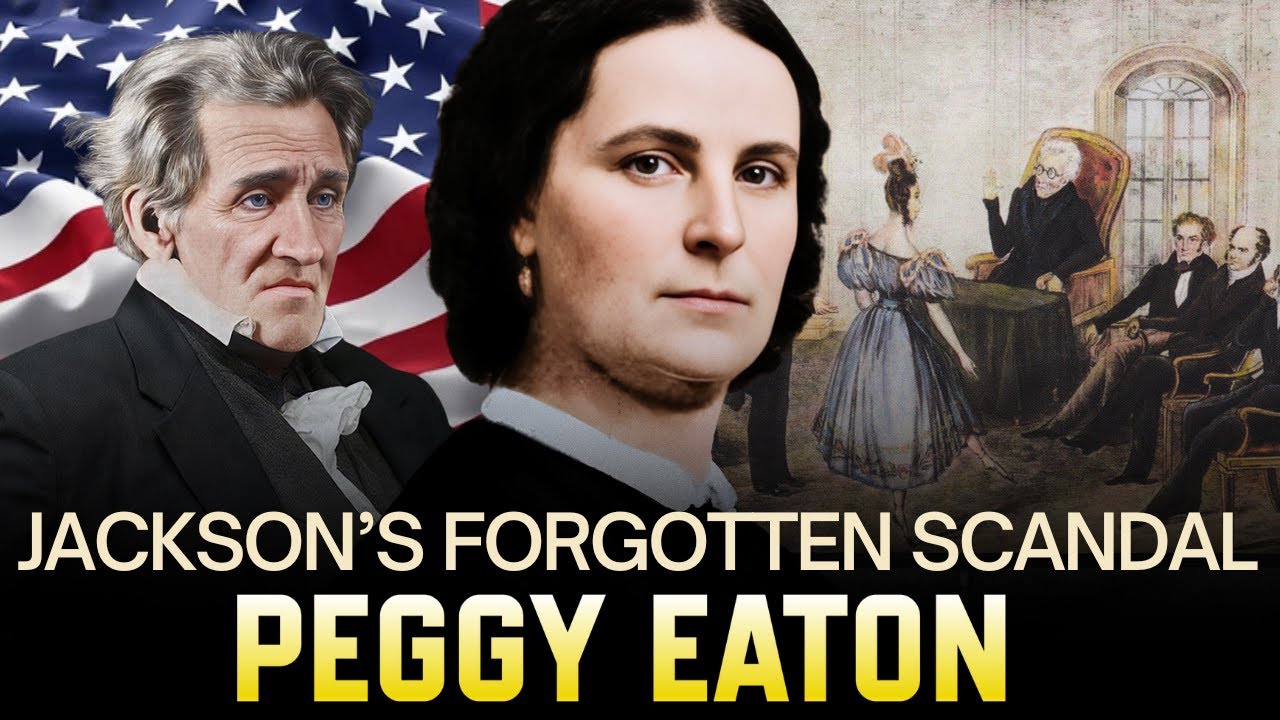
Her father, William O’Neal, ran the Franklin House on I Street, an inn that effectively served as an unofficial dormitory for members of Congress, who often lived there for months while their families remained in their home states. As a child, Peggy passed plates to Henry Clay and poured wine for Daniel Webster. She grew up in the thick of political conversation, learning French, studying history, and mastering the piano under tutors her father hired. But her true education came in the dining room, where she absorbed the rhythms of political speech and learned that power was often exercised through whispers and favors rather than laws.
Her upbringing made her ill-suited for the era. In the 1820s, respectable women were expected to be demure, pious, and submissive. Peggy was outspoken, intelligent, and openly flirtatious. To the congressmen who boarded at her father’s inn, she was a delight.
To their wives, she was a threat to the social order, a serving girl who refused to know her place. Her romantic troubles began early. At 14, she attempted to elope with an army officer but was intercepted, reportedly after knocking over a flower pot. In 1816, at age 17, she married John B.
Timberlake, a U. S. Navy purser. Though he looked respectable on paper, Timberlake was financially reckless, prone to heavy drinking, and frequently away at sea for months at a time.
Peggy bore three children, losing one in infancy, and often had to return to her father’s tavern to support herself and her daughters while her husband traveled and sank deeper into debt. In 1818, a wealthy new boarder arrived at the Franklin House: Senator John Henry Eaton of Tennessee, the close confidant and biographer of Andrew Jackson. Eaton befriended Timberlake and began financially rescuing the struggling family. He bought the Franklin House when William O’Neal faced foreclosure, paid off Timberlake’s creditors, and used his influence to secure better naval postings for the purser.
Washington gossip concluded that there was only one explanation: Eaton was paying Timberlake to look the other way. When Timberlake was sent to the Mediterranean aboard the USS Constitution, a deployment Eaton had helped arrange, the whispers grew louder. Peggy and Eaton were seen together constantly, riding in open carriages and attending the theater. Peggy refused to hide, seeing no reason for shame.
Washington saw every reason, and the rumors fed on every appearance. The crisis broke in April 1828, when Timberlake died aboard the Constitution. The official naval report attributed his death to pulmonary disease. But Washington preferred a darker story, and within days the rumor spread that Timberlake had cut his own throat after discovering proof of his wife’s affair.
There was no evidence for this claim, and Timberlake had a documented history of poor health, but the suicide theory transformed Peggy into a femme fatale who had driven her husband to the grave. Her fate became entangled with Andrew Jackson’s in the final months of the 1828 presidential campaign. During that brutal contest, Jackson’s enemies exposed an irregularity in his marriage to his beloved wife, Rachel: she had married Jackson believing her first husband had divorced her, which he had not, meaning she had technically been a bigamist for a time. The press attacked Rachel viciously.
In December 1828, weeks before Jackson’s inauguration, she collapsed and died. Jackson arrived in Washington as a grieving, furious widower, convinced that the capital’s elite had murdered his wife with lies. When John Eaton asked Jackson whether he should marry Peggy, Jackson did not hesitate. He reportedly said: “If you love the woman, marry her and damn the gossips.
” On January 1, 1829, only nine months after Timberlake’s death, Peggy married John Eaton. The breach of mourning protocol was shocking enough. What truly stunned Washington was Jackson’s next move: he appointed Eaton secretary of war, making the former tavern girl a cabinet wife. Under the strict social protocol of the era, Peggy now outranked nearly every woman in Washington, required to be called upon and treated as an equal by the ladies of the aristocratic elite.
They chose instead to form a silent pact of rejection. The boycott was led by Floride Calhoun, wife of Vice President John C. Calhoun. She refused to receive the Eatons, and other cabinet wives fell in line.
At social events, women turned their backs when Peggy approached. Conversation stopped when she entered a room. She stood next to President Jackson and endured suffocating public silence. Jackson’s fury was explosive.
He saw in Peggy’s persecution a replay of what had destroyed Rachel, and he took the battle personally. He began investigating the rumors himself, dispatching agents to hotels to check registries and doctors to debunk claims about a miscarriage. In one of the most bizarre cabinet meetings in American history, Jackson presented his dossier to his secretaries and declared, “She is as chaste as a virgin. ” The men refused to discipline their wives.
One secretary reportedly said he could control his department but not his wife. The meeting ended in failure. The scandal paralyzed the government. Cabinet meetings broke down into icy silence.
Jackson’s own niece, Emily Donelson, who served as White House hostess, sided with the social boycott, and the president banished her to Tennessee. The affair split the administration into two camps: the Eatonites and the anti-Eatonites, and national business ground to a halt. Into the chaos stepped Secretary of State Martin Van Buren, a widower who saw political opportunity. He courted Peggy openly, seating her at his side at dinners and praising her intellect.
Jackson, grateful for the loyalty, elevated Van Buren as his closest confidant. The affair destroyed the alliance between Jackson and Vice President Calhoun, who retreated to the Senate, his presidential ambitions withering. Historians have argued that this rupture helped push Calhoun toward the doctrine of nullification, a precursor to the Civil War. In April 1831, Van Buren executed a daring plan.
He resigned, and Eaton followed. With the cabinet dissolved, Jackson requested the resignations of the remaining secretaries, framing the purge as routine restructuring rather than a social vendetta. Never before had a president fired his entire cabinet. Calhoun was frozen out, and Van Buren was elevated to vice president in 1832, becoming Jackson’s chosen successor.
With Washington still toxic, Jackson appointed Eaton governor of the Florida territory. The Eatens moved to Tallahassee, then returned briefly to Washington, and in 1836 Jackson made Eaton U. S. minister to Spain.
In Madrid, Peggy finally escaped her reputation. The Spanish court knew nothing of Washington gossip. She became a sensation, befriending Queen Mother Maria Christina, hosting grand balls, and proving herself a more effective diplomat than many who had scorned her. Her daughters married into European nobility.
For four years, Peggy lived the life she had been denied in America. The Eatens returned to the United States in 1840, settling into a life of quiet comfort. They lived on the periphery of power, wealthy and increasingly respected. John Eaton died in 1856, leaving Peggy a rich widow in her mid-fifties.
She owned prime real estate, held bonds, and kept a jewelry box filled with gems from Madrid. It should have been a satisfying ending. It was not. In 1859, Peggy met Antonio Gabriel Buchignani, an Italian immigrant who taught dance to her grandchildren.
He was 19 years old. She was 59. She was infatuated, and to her family’s horror, they married in June 1859. The newspapers mocked the union.
Peggy lavished money on him, paid his debts, secured him a position at the Library of Congress, and transferred assets into his name. She believed she was loved. She was not. In 1866, Antonio and Peggy’s own granddaughter, Emily Randolph, then 17, disappeared together, fleeing to Europe with as much of Peggy’s fortune as they could liquidate.
The betrayal broke her completely. She filed for divorce, which was granted in 1869. The theft and the scandal left her nearly destitute. She sold her jewelry piece by piece, moved into a modest boarding home for destitute women, and spent her final years in poverty.
In 1873, Peggy began writing her autobiography, a fiery defense of her life. She insisted on her innocence in the Eaton affair and lashed out at the Washington society that had tried to destroy her. “I was not the cause of the trouble,” she wrote. “I was the occasion for it.
” She could not find a publisher, and the manuscript sat in a drawer for decades before being published in 1932. Peggy Eaton died on November 8, 1879, weeks shy of her 80th birthday. There were no state funerals. She was buried next to John Henry Eaton in Oak Hill Cemetery in Georgetown.
Historians have long noted that her survival depended on the protection of powerful men, but her story exposed the hypocrisy of a system that demanded women be silent ornaments while still wielding enormous, unacknowledged political power. The Petticoat Affair was a reminder that politics is often deeply personal, and that a whisper could scream louder than a cannon.