In January 1971, the Joseph Schlitz Brewing Company sold more beer than any other company in the United States, shipping 24 million barrels in a single year. One in every five beers consumed by an American adult carried the Schlitz name, and the company had just knocked Anheuser-Busch out of the top spot for the first time in 15 years. Just 11 years later, Schlitz no longer existed as an independent company. The brand that had defined American beer for more than a century sold for $75 million in 1982, a price so low that industry analysts struggled to put it into words.
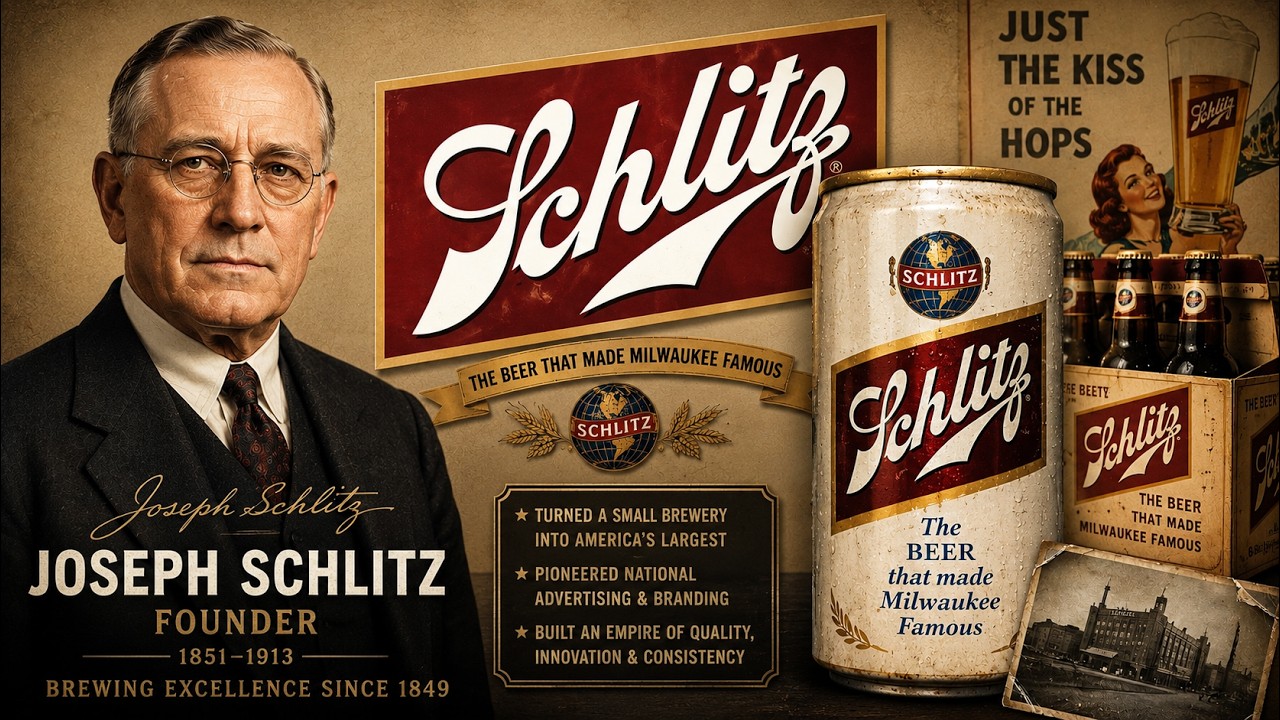
In 1974, Schlitz had generated $650 million in annual revenue. By 1982, what remained of the company was worth less than 12 cents on every dollar it had earned eight years earlier. The story of Schlitz is not a story of a changing market or a recession that dried up consumer spending. Those things happen to every brewery in America.
Schlitz faced something different, something the beer industry had never quite seen before and has never quite forgotten since: the collapse of a company that stopped believing in the one thing that made it great and quietly, without announcement, decided to change it. The story begins in Milwaukee, Wisconsin, in 1849. August Krug was not a businessman but a craftsman, born in Bavaria in 1815. He came to America in the late 1840s as part of the largest wave of German immigration the United States had ever seen, and he settled in Milwaukee, where the land was flat and cold, and the rivers were clean and cold, fed by glacial aquifers just beneath the surface of the earth.
For a man who knew how to brew lager in the German tradition, that cold, mineral-rich water was everything. Krug opened his brewery on West Chestnut Street in 1849, producing roughly 150 barrels in his first year, enough to supply a handful of taverns within walking distance. He borrowed approximately $1,000 to build his first fermentation vessels, and he did his own malting, his own brewing, and his own deliveries. In the winter, he packed river ice into the lagering cellars to keep the fermentation temperature stable.
Joseph Schlitz arrived in Milwaukee in 1850 at age 19, born in Mainz, Germany in 1831. He came alone, with no family, no connections, and no capital. He found work almost immediately as a bookkeeper for August Krug. He was not a brewer and did not claim to be.
He understood what things cost, what things were worth, and how the distance between those two numbers determined whether a business survived. When Krug died suddenly in 1856, Joseph Schlitz was 35 years old and had been keeping Krug’s books for six years. In 1858, Schlitz married Anna Maria Krug, the founder’s widow, and assumed full legal control of the brewery. In 1874, he renamed it the Joseph Schlitz Brewing Company.
The market Schlitz inherited was fragmented and local. There was no national beer brand and no refrigerated rail transport capable of moving fresh lager across state lines. Schlitz saw the gap differently. He recognized that lager was lighter, cleaner, more refreshing, and easier to drink in quantity than English ale.
The market for it was not the German community. The market was everyone else. The answer came on the night of October 8, 1871, when the Great Chicago Fire destroyed 18,000 buildings and left 100,000 people homeless, including most of Chicago’s food and beverage supply. Within days, Schlitz loaded wagons with as much beer as he could move and sent them south to Chicago.
He did not sell it. He gave it away to tavern owners, relief workers, and anyone who needed it. The Chicago newspapers covered the gesture for weeks. When Chicago rebuilt, the tavern owners who had received Schlitz’s beer during the crisis remembered where it had come from.
They ordered it, and they kept ordering it. From that moment forward, Schlitz was no longer Milwaukee’s brewery. It was, as the slogan would say for the next 100 years, the beer that made Milwaukee famous. The Schlitz formula was built on the German lager tradition that August Krug had carried across the Atlantic.
Lager ferments slowly at cold temperatures and conditions for an extended period before reaching the drinker. Where ale ferments in days at room temperature, lager ferments over weeks in cellars kept just above freezing. The result is a beer with fewer harsh byproducts and a cleaner finish. The specific character of Milwaukee lager came from the water.
Combined with malted barley and hops sourced from the Yakima Valley, the Schlitz recipe created a beer that was lighter than a Munich lager and crisper than a Vienna style amber. The consistency was not an accident. Where other Milwaukee breweries were pushing beer out of the lagering cellars in three weeks, Schlitz held to a longer cycle, in some periods as long as 40 days from grain to glass. Packaging was the second front.
In 1891, Schlitz became one of the first major American breweries to adopt brown glass bottles at scale, which protected the beer from light damage that caused a skunky off-flavor. The Schlitz label, dark brown and deep red, was deliberately designed to be recognizable from 20 feet across a tavern room. Distribution followed the railroads. Schlitz invested early in refrigerated rail cars that allowed beer to travel hundreds of miles without spoiling.
By the first decade of the 20th century, Schlitz had established reliable cold chain distribution from Milwaukee to Chicago, St. Louis, Cincinnati, and Detroit. No competitor could match the freshness at that distance. In 1902, for the first time, Joseph Schlitz Brewing Company became the largest beer producer in the United States.
A German immigrant bookkeeper had turned a dead man’s brewery into the most powerful beer company in America in less than 50 years. In the 1950s and early 1960s, Schlitz was omnipresent in American working-class life. Television spots showed construction workers and factory hands without dialogue, just a man finishing a shift and the uncomplicated pleasure of a cold beer earned through labor. The slogan that ran for nearly a century, “the beer that made Milwaukee famous,” was both literally true and emotionally resonant.
In 1956, Schlitz held 17% of the American beer market. One in every six beers sold in the United States was a Schlitz. The brewery on West Galena Street employed more than 3,000 workers at peak production. Distribution reached all 48 contiguous states.
During World War II, the War Production Board mandated that 15% of all beer produced in the United States be set aside for the armed forces. For Schlitz, that meant millions of cans shipped to military bases and combat theaters. The steel can, lighter than bottles and requiring no return deposit, had been introduced commercially in the mid-1930s, but military logistics drove mass adoption. Schlitz produced cans specifically labeled for military distribution.
By 1943, a significant portion of Schlitz’s male workforce had been drafted, and women entered the brewery in numbers that would have been unimaginable five years earlier, operating bottling lines and managing quality checks. When the men came home in 1945 and 1946, they returned to a country that was prosperous and thirsty. Schlitz was waiting for them, the same brand they had drunk in training camps and European staging areas. For a generation of American men, the beer they had drunk in uniform carried a weight that no advertising campaign could manufacture.
In 1971, Schlitz shipped 24 million barrels of beer, number one in the United States, again. It had taken 15 years to reclaim the top position from Anheuser-Busch. What none of the workers or distributors understood was that the decision had already been made. The formula was about to change.
The man who changed the formula was not a brewer. Robert Uihlein Jr. had grown up inside the Schlitz empire, the fourth generation of the family that had controlled the company since Joseph Schlitz himself had handed it to his nephews in the 1880s. He became CEO in 1961.
He was intelligent, serious, and genuinely committed to Schlitz’s continued success. He was also, by training and temperament, a numbers man in an industry that ran on something numbers could not fully capture. What Uihlein saw when he looked at Schlitz’s financial position in the early 1970s was not a company at the peak of its power. He saw a company under pressure.
Anheuser-Busch was building new breweries, and Miller Brewing, acquired by Philip Morris in 1969 and backed by the marketing budget of the largest tobacco company in the world, was preparing an assault on the premium beer market. The 1973 oil embargo sent energy costs across the American economy into territory that no post-war business model had anticipated. For a brewery that ran refrigerated production lines 24 hours a day and maintained multiple large facilities in the energy-intensive upper Midwest, the cost shock was immediate and severe. Barley costs rose, hop prices rose, and the aluminum and steel required for cans rose.
The answer that Uihlein and his team arrived at in 1974 was precise, calculated, and in the logic of the spreadsheet, entirely defensible. They would accelerate the fermentation process, compressing the traditional lagering cycle of up to 40 days to approximately 15 days through a technique called accelerated batch fermentation. They would substitute a portion of the malted barley with corn syrup, replace whole hop pellets with hop extract, and add silica gel to the lagering process to help clarify the beer faster. Each of these changes had a rational justification.
Each had been tested and approved by the company’s internal quality team. The projected savings ran to several million dollars per year. There was no announcement, no press release, no change to the label, no communication to distributors or bar owners. The bottle looked the same.
The can looked the same. The price was the same. Only the beer was different. The people who drank it knew immediately.
In taverns across Milwaukee, Chicago, Cleveland, and Detroit, the comments began within months of the formula change. Not complaints exactly, but questions: “Did they change something? This doesn’t taste the same. ” Bartenders relayed what they were hearing to distributors, who passed it up the chain.
The reports reached headquarters and were received initially as the kind of noise that any large consumer brand generates. Sales in Schlitz’s core markets began declining in late 1974 and into 1975. Slowly at first, in the range of 3 to 5%. Anheuser-Busch was spending heavily on Budweiser, and Miller was about to launch Miller Lite.
There were explanations available that did not require examining what had happened to the formula. Uihlein’s team reached for those explanations. They were wrong. In 1976, the market told them so in a way that could not be explained away.
The silica gel, used incorrectly or used as a shortcut to compensate for a fermentation process compressed too aggressively, produced a fine white sediment in the beer. Particles suspended in the liquid, visible when the light hit the can at the right angle. Not harmful. The FDA investigated and confirmed the substance posed no health risk.
But a man who opens a can of beer and finds something floating in it does not reach for a toxicology report. The press named it immediately: Schlitz flake. Some called it Schlitz snot. The nicknames traveled faster than any correction Schlitz could issue.
In an era before social media, word of mouth moved with a speed and thoroughness that a marketing department could not counter. The physical evidence was more persuasive than any advertisement Schlitz had ever run. In 1976, the company initiated a recall of approximately 10 million cans of beer, one of the largest product recalls in the history of the American beverage industry at that point. Pulling 10 million cans from retail shelves and distributor stock across the country required a coordination effort that consumed resources and goodwill that Schlitz did not have to spare.
Robert Uihlein Jr. did not live to see the full consequences of what the recall set in motion. He died in November 1976 of leukemia at the age of 60. He had run Schlitz for 15 years, presiding over its greatest triumph and over the decision that undid everything that triumph represented.
Schlitz attempted recovery. In 1977, the company moved to reformulate the beer closer to its pre-1974 character with longer fermentation times and reduced reliance on corn syrup adjuncts. The changes were real, but measurably closer is not the same as identical, and identical would not have been enough. The drinkers who had left had learned that Schlitz could change, that the consistency they had trusted for decades was not a guarantee.
Once a drinker learns that lesson, the brand becomes a question rather than an assumption. The advertising response was equally insufficient. A campaign built around the tagline “Schlitz, the one beer to have when you’re having more than one” attempted to reclaim the working man identity. The spots were competent and reached the right demographic, but they did not work because the product behind them had broken the promise that the identity required.
You cannot advertise authenticity to people who have evidence that the authenticity was false. By 1978, Schlitz had fallen to third place behind Budweiser and Miller Lite. By 1980, it had fallen to fourth. The brand that had been number one in 1971 had lost more than half its market share in less than a decade.
The plant closures followed. The Memphis brewery closed in 1980, laying off 500 workers. The Brooklyn facility followed in 1981, laying off 700 workers. A second recall in 1981 erased whatever confidence the recovery effort had managed to rebuild.
In 1982, the Joseph Schlitz Brewing Company, the largest beer producer in the United States as recently as 11 years earlier, was sold to the Stroh Brewery Company of Detroit for $75 million. The Milwaukee brewery was sold at auction. Workers collected their final checks. The sign came down on a Tuesday.
No ceremony. No announcement. 133 years, done. The name survived, but the beer did not.
Stroh Brewing kept the Schlitz brand in production through the 1980s, brewing it in Detroit as a value tier product. A decade after the sale, the brand passed to Pabst Brewing Company, which contracted production to other companies’ facilities, managing labels and distribution without owning a single brewery. The Schlitz that appeared on shelves under Pabst ownership was brewed in facilities with no connection to Milwaukee or the glacial aquifer water that had defined the flavor for a century. In 2008, Pabst announced a restoration of the Schlitz formula to its pre-1974 character.
The company’s archivists had located brewing records from the early 1960s, including hop bills, fermentation schedules, water chemistry targets, and grain ratios. Pabst hired brewmasters to work from those records. The people who remembered the original tried it. Their verdict was consistent and measured: closer.
Not the same, but closer. The water chemistry could be approximated but not replicated. The hop varieties had been largely replaced by newer cultivars. The fermentation equipment was different.
The intention was genuine. The beer was not the same. The brand still finds drinkers in certain markets. There are people who buy it because their father drank it, or because they drank it themselves once and want to test the memory against the present.
Vintage Schlitz cans from the 1960s and early 1970s sell on eBay for $15 to $200. Original Schlitz neon bar signs command between $400 and $900. They move within hours of listing. The original brewery complex on West Galena Street still stands largely intact in Milwaukee, redeveloped as Schlitz Park, a commercial office campus housing technology companies and professional services firms.
The Brown Bottle, the tavern that Schlitz operated for its workers and visitors, survived and operated as a restaurant for years after the brewery closed. The smokestack that served the original brewhouse still rises above the complex, though it has not produced smoke since 1981. Robert Uihlein Jr. , the CEO who authorized the 1974 formula change, kept a photograph on the wall of his office at the brewery.
It was a portrait of August Krug, the Bavarian craftsman who had opened the first brewery on West Chestnut Street in 1849. Whether Uihlein looked at that photograph when he signed the papers authorizing the accelerated fermentation process is not recorded. He was dead within two years of the decision. Schlitz did not die because America stopped drinking beer.
Americans drank more beer in 1982 than they had in 1971. Schlitz did not die because the competition was insurmountable. Budweiser and Miller faced the same cost pressures, the same oil embargo, the same margin squeeze. They found different answers.
Schlitz died because the people running it in 1974 made a calculation that placed the short-term savings of a cheaper process above the long-term value of a promise they had been keeping for 125 years. The promise was that the beer in the bottle was worth the time it took to make it right. They broke that promise on a spreadsheet, and 40 million Americans noticed.