On May 31, 1944, in the Admiralty Sea northwest of New Guinea, three American escort destroyers had hunted a single Japanese submarine for 25 hours. Twenty attacks had been launched, and twenty had failed. Aboard one of the ships, Commander Hamilton Haines activated his radio and sent a message still preserved in U. S.
Navy archives. It consisted of four words: “Dammit, go in England. ”
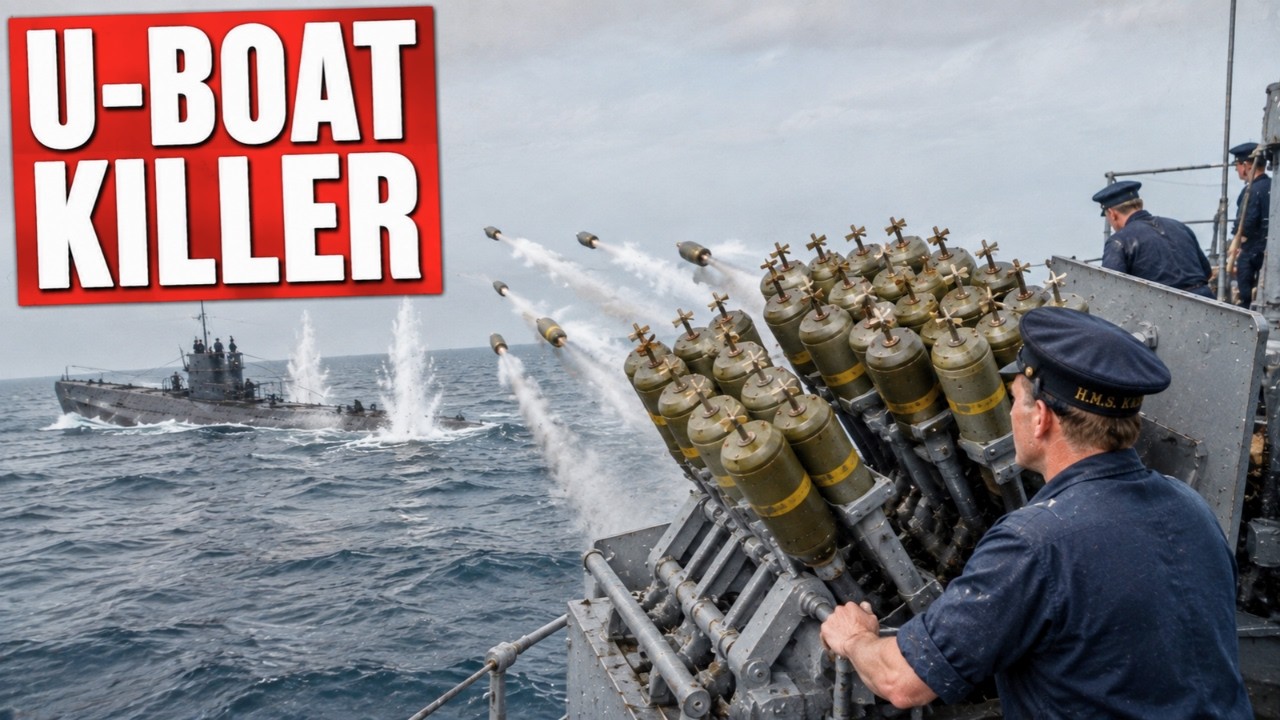
Thirty-six minutes after 7:00 that morning, the USS England entered its attack run and fired a single salvo from a weapon that looked, to anyone seeing it for the first time, like a garden frame bristling with steel spikes bolted to its forward deck. Between six and ten explosions followed beneath the surface.
Within five minutes, 60 Japanese sailors were dead. It was the sixth submarine the England had destroyed in 12 days. No other warship in any navy has ever matched that record. The weapon was British.
The Germans considered it useless. Even British sailors refused to use it for nearly a year. It was called Hedgehog, a set of 24 spiked projectiles designed by about 60 amateurs working in a converted London office, and it would prove roughly ten times more effective at killing submarines than the depth charge that the fleet preferred. To understand how that happened, you must go back four years to a dark night in the North Atlantic and the moment every escort captain in the Royal Navy learned to fear.
Asdic, the British name for sonar, worked by sending a cone of sound downward and forward from the hull of a warship. When the sound struck a solid object, it returned as an echo the operator heard as a clear metallic ring. But the cone had a peculiar geometry. It pointed forward and tilted downward at a shallow angle, and it could not see directly beneath the ship carrying it.
As a destroyer approached a submerged submarine, the target slipped under the beam. At around 200 yards, sometimes less, the echo simply stopped. The submarine had not moved. The Asdic had not failed.
The laws of physics had run out. That was the moment when depth charges had to be launched. But depth charges were rolled from the stern or thrown from the sides, heavy steel drums packed with explosive. To use them, an escort had to sail directly over a target it could no longer hear, guessing the range, the depth, and the course the submarine had already begun to change.
Then the drums were dropped, and the ship had to keep moving, blinded by the shockwave of its own weapons. The German captains had studied this and trained for it. At the moment a British destroyer’s propeller noise passed overhead, a U-boat captain would turn hard to starboard and hold the turn. It took less than a minute.
The depth charges took about the same time to reach their set depth. By the time they exploded, the submarine was outside the kill zone. Worse, the depth charges themselves blinded the ship that had dropped them. For a long time after an attack, the escort stood deaf in the water, and the U-boat was free.
Through the entire war, the Royal Navy recorded more than 5,000 depth-charge attacks. They confirmed the destruction of about 85 U-boats. One hit for every 60 attacks. During the winter of 1940, at the Admiralty in Westminster, men in dark suits looked at those numbers and understood in silence that they were losing.
One submarine on a single successful patrol could sink more merchant ships than an entire escort group could sink in a year. Someone had to build a weapon that could be fired before the submarine disappeared. A weapon that flew forward ahead of the ship while sonar still held contact. The idea was not new.
It had been proposed to the British Ordnance Board in 1910 by a retired officer. The board rejected it. In 1930, a retired Royal Artillery officer named Lieutenant Colonel Latham Valentine Stewart Blacker revived the idea. He was a decorated soldier, pilot, and inventor fascinated with a type of mortar called a spigot, where the bomb sat over a steel rod and the propellant charge was inside the bomb’s tail.
He was 50 years old. The board rejected it. In 1939, with war weeks away, an officer in the Royal Engineers named Millis Jefferis brought the concept back a third time. Jefferis had studied Blacker’s drawings and improved them.
He worked inside a small experimental cell later nicknamed “Churchill’s Toyshop. ” The board rejected it a third time. According to an account later preserved by novelist Nevil Shute Norway, a senior member of the board, when pressed on why the concept could not be reconsidered, reportedly said: “If Almighty God Himself sponsored the spigot mortar, it would still be rejected by the Ordnance Board. ”
Three rejections.
Thirty years. The weapon that would eventually change the course of the Battle of the Atlantic sat in a London filing cabinet. By the summer of 1940, the men who could save it were not on the Ordnance Board. They were in a converted office wing in the Admiralty at Whitehall, working under the loose authority of Admiral Sir James Somerville.
Somerville had been removed from active command due to a tuberculosis diagnosis that later proved wrong. Given a small research office instead of a discharge, he was officially running the Inspection of Anti-Aircraft Weapons and Devices, or IAAWD. Within weeks, the initials had been quietly translated across the fleet into a new nickname: “Incendiary and Aberrant Anti-Aircraft Weapons Department. ” Schemes, amateur tinkering.
The name stuck. In 1941 the department was reorganized as the Directorate of Miscellaneous Weapons Development, DMWD. There were fewer than 60 people, and they were, by the standards of the professional naval weapons establishment, a collection of oddities. Among them was Charles Frederick Goodeve, a 36-year-old Canadian-born physical chemist from University College London.
A retired car-racing photographer. A handful of academics who had never worn a uniform before 1939. And a tall, quiet reservist named Nevil Shute Norway, 42, an aeronautical engineer who had designed the R100 airship and spent weekends writing novels under the pen name Nevil Shute. Goodeve was the driving force.
He asked questions. He entered offices without appointments. He wrote memos that assumed the reader would say yes. He began quietly inquiring about anti-submarine warfare.
In late December 1940, a memorandum arrived. It came from the Director of Anti-Submarine Warfare and referred to a meeting to discuss the use of “spigot weapons” against submarines. Attached was a small drawing in the careful hand of Major Millis Jefferis, together with a description of how it might work at sea. Norway, or perhaps his secretary, wrote a single word in the margin: Norway.
Britain was losing the Battle of the Atlantic. They had less than 60 people, a drawing on a wall, and a nickname meant as an insult. It would have to be enough. The drawing was not left on the wall long.
By early 1941, Norway took the idea to a small experimental station at Weston-super-Mare in Somerset, on a Victorian pleasure pier called Birnbeck. The Royal Navy had leased the pier and named it HMS Birnbeck. On that pier, in huts and canvas hangars, the “Wheezers and Dodgers” began to build a weapon that at first did not work at all. The concept itself was sound.
Twenty-four bombs, each about four feet long, mounted vertically on steel rods arranged in four rows of six on the forward deck of a warship. A propellant charge inside the tail of each bomb. A staggered firing sequence sent pairs into the air fractions of a second apart, so they all landed together in an oval 140 feet by 120 feet, about 200 yards ahead of the ship. At the head of each bomb, instead of a hydrostatic fuse set for a depth, there would be a contact fuse.
The bomb would not explode when it reached a chosen depth. It would explode only when it struck something solid. A hull. If the projectiles missed, they would sink harmlessly to the bottom.
The sea would not boil. The Asdic would not lose contact. The ship could reload in about three minutes and attack again and again until the submarine was sunk or dived too deep to continue. On paper, it was elegant.
In the workshops at Birnbeck, it was a nightmare. The contact fuse was the first problem. It had to survive a 60-foot launch into the air, hit the sea at great speed, dive through cold dark water for six or seven seconds, then detonate the full explosive charge the instant it touched a submarine’s hull. If it exploded early, it would destroy the ship that fired it.
If it failed, it would drift uselessly to the bottom. The shape of the projectile was the second problem. The head had to hit the water in a way that continued directly downward. If the head was round, the bombs skidded sideways on impact and scattered in 24 different directions.
Testing eventually proved the head must be flat, not streamlined. A flat head hit the water without skidding. The charge was the third problem. Twenty pounds of explosive was not reliably enough to penetrate a VIIC U-boat’s hull.
The eventual solution was 35 pounds of Torpex per bomb. The finished projectile weighed about 65 pounds, and a single direct hit was enough to destroy a submarine. A curious detail surrounded who made the first bombs. The Admiralty lacked industrial capacity, so the contract for the first batch of Hedgehog bombs was given to a company called Boosey & Hawkes, which made musical instruments: clarinets, trumpets, bassoons.
The men casting the bombs that would sink German submarines had before the war cast the brass bells of orchestral horns. The name “Hedgehog” itself was born the same casual way. Someone at Birnbeck looked at the launcher, at the rows of empty spikes standing after the bombs were removed, looking like the quills of a startled animal, and suggested the word. A small internal competition was held.
The winner received a single bottle of sherry. By the spring of 1941, they had something they could mount on a ship. The vessel chosen was HMS Westcott, a 23-year-old Admiralty W-class destroyer, a survivor of the last war, worn but reliable. Her forward 4-inch gun was removed.
In its place, in August 1941, they installed the first operational Hedgehog launcher in the world. The men of Westcott did not know what to make of it. During loading trials, one sailor handling a bomb was seriously injured in his hand. On another occasion, at least one salvo exploded on contact with the water, not the target, when fired in early tests.
In May 1941, off Liverpool Bay, they tested the weapon against a known wreck on the seabed. This time it worked. Goodeve allowed himself a small, careful smile. Then he did the thing that saved the entire program.
He arranged a demonstration for the Prime Minister. Winston Churchill was 66 in the spring of 1941. He had said, and would say again in his memoirs, that the only thing that truly terrified him during the war was the U-boat peril. Goodeve knew this.
According to an internal history written a decade after the war, Goodeve arranged for Churchill to witness a live Hedgehog firing. Churchill came in his black coat and hat, stood on a windswept deck, and watched 24 bombs climb into the grey English sky and fall into the sea in a precise, tight oval. Then, according to the account passed down through the departments, he did something unusual. He did not applaud.
He did not speak. He simply asked for another salvo. The second salvo went. A third was requested.
Churchill nodded once, turned, and went back to his car. The next morning, the First Sea Lord summoned Goodeve. The Admiralty would give Hedgehog full backing. It would go into production.
It would go to sea. By early 1942, launchers were being mounted on escort after escort. By the end of that year, more than 100 Royal Navy ships carried Hedgehog. In about 12 months of service, none of them had destroyed a submarine with it.
An old story claimed that HMS Westcott achieved the first Hedgehog kill on February 2, 1942, sinking U-581 southwest of the Azores. The claim appears in some older history books and on memorial plaques. But a careful reading of the accounts shows they do not match. The son of a Westcott signalman firmly said his father told him U-581 was sunk by deliberate ramming.
A book about the ship by a crew member said the same. A newspaper clipping from 1942 preserved in a family album described the ramming and the rescue of survivors. German operational reports, cross-checked against Westcott’s movements that evening, confirmed a collision. Whatever Hedgehog did that day, the submarine was not killed by mortar bombs.
The first confirmed Hedgehog destruction came in November 1942, ten months after the weapon entered service, when more than a hundred ships carried it. Captains in operations rooms in Liverpool, London, Derry, and Halifax began to speak of the weapon with contempt. The reason was simple. They were not using it.
A depth-charge attack was something you could feel. When the barrels exploded, the sea rose in a white column up to 50 feet. The deck shook. The men in the engine room felt it through the hull plates.
Whether the submarine was destroyed or not, the ship had done something. Something loud. Something visible. A Hedgehog attack was frustratingly quiet.
If the bombs missed, and most did, they sank silently to the ocean floor and exploded harmlessly. There was no water column, no vibration, no evidence anything had happened at all. A captain who fired Hedgehog and saw nothing had no way to know if he had missed by ten feet or a hundred yards. On ship after ship, the launcher became something men walked past without touching.
When a target appeared on Asdic, they turned to depth charges. By early 1943, the Admiralty knew. Reports came into Whitehall. One contact after another, one attack after another, always depth charges, always the same one-in-sixty success rate, and the new weapon bolted to the deck like furniture.
The Royal Navy issued a written directive. Any captain of a ship fitted with Hedgehog who did not use it when a submerged target was detected would be required to explain in writing. No other order like it exists in the British naval war archives. Yet in the early months of 1943, no kills were achieved.
Goodeve made a decision. He sent one of his officers to investigate. The man went to Londonderry in Northern Ireland, at the mouth of the River Foyle. In 1943, Londonderry was the main base for the North Atlantic convoy escorts.
The officer boarded ship after ship. He spoke to captains, first lieutenants, and the ratings who loaded the launchers and operated the Asdic. He discovered two things. The first was technical.
North Atlantic winter spray froze on the rails and seeped repeatedly into the Hedgehog firing circuits. Electrical contacts corroded. When a captain finally pressed the firing button, sometimes nothing happened. In other cases, only a few projectiles fired, producing a partial, broken salvo.
In a small number of cases, corrosion caused sympathetic explosions on deck. The solution was maintenance: new procedures for weekly disassembly, cleaning, and refitting. Protective covers. New training for ammunition crews.
The second problem was harder. It was psychological. The escort crews did not doubt the accuracy of Hedgehog. They understood, when it was explained, that the contact fuse allowed multiple attacks, and that keeping Asdic contact was better than a satisfying explosion.
They nodded and agreed, then went to sea and fired depth charges because depth charges felt like action. Hedgehog gave them nothing to feel. What the officer finally did was tell stories. He gathered entire ships’ companies in mess halls.
He told them in detail about the Hedgehog attacks that had succeeded. The pattern that fell exactly right. The small dark spot on the sonar screen that suddenly became two hits, then three, then an oil slick spreading on the surface. He gave them the numbers.
By late 1944, Royal Navy operational research established that Hedgehog attacks, properly executed, killed a submarine ten times more often per attack than the depth charges the crews preferred. That number, ten to one, when stated clearly before a room full of exhausted destroyer officers, changed their minds. The kill rate began to rise. By the end of 1944, on ships that trained seriously in the new procedures, more than one in three Hedgehog attacks achieved confirmed destruction.
Before hearing that good news, in September 1943, there was a moment the program nearly collapsed entirely. It happened aboard HMS Escapade, a British E-class destroyer, on the night of September 20, 1943. Escorting convoy ONS 18 in the North Atlantic, approaching a target, Hedgehog was fired in what should have been a routine attack. The projectiles never left the ship.
A fault in the firing circuit caused one bomb to explode while still on its spigot. The blast set off the bombs around it. The forward part of the ship, in less than a second, became a mass of fire and flying metal. The bridge was demolished.
Men on the forward deck and in exposed positions were killed instantly. Others were burned, blinded, or blown overboard. The captain, Edward Norman Vernon Currey, survived, but many of his men did not. The exact death toll varies between accounts, but in every version it runs to dozens of dead and wounded on a single ship in a single moment, by the weapon designed to save them.
The investigation produced clear answers quickly. The cause was identified. The solution was applied. Every crew carrying Hedgehog was retrained on new safety procedures.
The training program begun in Londonderry continued, ship by ship, until the North Atlantic escort force believed in the weapon on their bows in a way they had never believed in anything else the Admiralty had given them. By the end of that autumn, Hedgehog was no longer the weapon nobody wanted to use. By the end of that winter, it was the weapon many preferred. One man understood Hedgehog better than anyone who ever fired it.
His name was Frederick John Walker. The fleet called him Johnny. He was a Royal Navy captain, 47 in the spring of 1943. For most of the previous 15 years, his career had been considered over.
He had been passed over for promotion and sent to shore posts the more prominent officers avoided. The war saved him. By 1943 he commanded the Second Support Group from Liverpool, six Black Swan-class sloops, and from the bridge of his flagship HMS Starling he devised a way of using Hedgehog no one had thought of before. He called it the creeping attack.
The old method was to rush in at attack speed with Asdic pointed, hoping the submarine would not turn in time. Walker did not rush. He crept. He kept two ships in the fight at all times.
One hung back within long sonar range, tracking the submarine with a beam it could not easily hear. The other approached from the bearing the first ship provided, slow, half-idle engines, coming in on a course the submarine could not detect, guided minute by minute by radio. When the creeping ship reached position, it fired Hedgehog at a spot it had never seen and did not need to see, because the other ship had been watching the target the whole time. It worked spectacularly.
Between January 31 and February 19, 1944, Walker’s Second Support Group sank six U-boats on a single patrol. It was, at the time, the greatest anti-submarine performance in the history of the Royal Navy. The record did not last more than four months. Walker himself did not live to see the end of the war.
He collapsed on the dockside at Liverpool in July 1944, exhausted beyond recovery, and died in a naval hospital nine days later, aged 48. His funeral filled the cathedral. The First Sea Lord attended. So did the crews of the ships he had led, standing in silence in the aisles.
Escort crews initially judged Hedgehog by its sound. It was silent. They believed for nearly a year that silence meant nothing. But they were about to discover that silence meant the sonar was still working.
Silence meant attack after attack, until the submarine perished. The Germans learned to fear it more than any explosion in the world. Silence, when it belonged to Hedgehog, was the sound of a submarine that did not yet know it was already lost. The turning point had a name and a date.
The name was ONS 5. The date was the last week of April and the first week of May 1943. Convoy ONS 5 was a slow westbound convoy of 42 merchant ships from Britain to North America, guarded by a handful of destroyers and corvettes under Commander Peter Gretton. It sailed on April 22 in weather no man on any bridge would forget.
Storms, fog, ice. The convoy scattered and reformed and scattered again. South of Greenland, Karl Dönitz gathered his submarines around it. He had more than 40 U-boats at sea against the five escorts.
It was the greatest concentration of U-boats against a single convoy in the entire war. For a week, the wolves and the escorts fought in weather that made normal combat impossible. Thirteen merchant ships were sunk. By May 6, the German captains began making mistakes.
When U-boats make mistakes, they die. When the fighting stopped on May 6, the wolves had lost the battle. Six U-boats were destroyed. Another six were so badly damaged they had to return home.
Convoy ONS 5, battered and reduced, survived. In the three weeks that followed ONS 5, Dönitz lost 41 U-boats, and with them nearly 2,000 German sailors, most of them young men who never returned home. The German naval command called the month Schwarzer Mai, Black May. On May 24, 1943, Karl Dönitz did what he had never thought he would have to do.
He withdrew his U-boats from the North Atlantic convoy routes. He sent a signal to his commanders to withdraw, disperse, and head south. For survival. On the other side of the world, in a warm sea far from the North Atlantic, the same weapon that had helped break the back of the U-boats was about to be delivered to a young escort destroyer named USS England for use in a way neither side had ever seen.
The Pacific war in the spring of 1944 was moving quickly. In Tokyo, a 59-year-old admiral named Soemu Toyoda had just been promoted to command the Combined Fleet. He decided to use his submarines to find out where the Americans would strike next. He established a reconnaissance line, a fence of Imperial Japanese Navy submarines stretching across the sea from Truk in the Caroline Islands westward toward the Admiralty Islands north of New Guinea.
He assigned seven submarines: I-16, RO-104, RO-105, RO-106, RO-108, RO-116, and RO-117. On May 13, 1944, I-16 sent a routine radio message confirming its schedule. An American intercept station picked it up. The message went to the codebreakers of the U.
S. Pacific Fleet. It was decrypted within hours. The precise route, timing, and intent of Toyoda’s reconnaissance operation were no longer Japanese secrets.
Division 39 of the escorts was at Purvis Bay in the Solomon Islands. Three brand-new Buckley-class destroyer escorts, small ships of about 1,500 tons, with crews that had seen almost no combat: USS George (DE-697), USS Raby (DE-698), and USS England (DE-635), named for a young lieutenant killed aboard the battleship Oklahoma at Pearl Harbor on December 7, 1941. Her captain was Commander Walter Pendleton. Her executive officer was a 29-year-old lieutenant named John Williamson who had studied anti-submarine tactics at every school the Navy sent him to.
Each of the three ships carried, mounted on her bow where the Royal Navy had first put it three years before, the British-designed Hedgehog. On May 18, the three ships received their orders: intercept submarine I-16. They sailed. They found her.
On the afternoon of May 19, in bright sunlight and calm water, USS England detected a submerged target at 13:35. At 13:41, she fired her first Hedgehog salvo. It missed. She turned, reacquired, and fired again.
One hit at 130 feet. She fired a third time. Then a fourth. I-16 evaded them all.
At 14:33, England fired her fifth salvo. Four to six explosions followed from the depths. Seconds later, a much larger explosion came from under the sea. The submarine’s own torpedo warheads, or perhaps her own depth charges, had detonated sympathetically.
The blast lifted England’s stern completely out of the water and knocked men down on the afterdeck. Debris began reaching the surface after 20 minutes. By the next morning, a patch of diesel fuel three miles wide and six miles long drifted across the calm Pacific where I-16 had been. Commander Takeuchi and his entire crew were gone.
The next day, May 20, another intercepted Japanese message reached American commanders. It described in detail the exact positions of the picket line Toyoda was setting up north of the Admiralties. Every station, every submarine, every schedule. The Americans knew the entire trap before it was set.
For 12 days, from May 19 to 31, USS England and her sister ships did something unprecedented in the history of anti-submarine warfare and never repeated since. They hunted the picket line until they annihilated it. On May 22, before dawn, USS George detected RO-106 on radar. England fired and missed, then turned and fired again at 5:05 a.
m. The Hedgehog bombs hit. There was an underwater explosion. RO-106 vanished.
On May 23, they found RO-104. Raby and George attacked with eight depth-charge salvos over two hours. Every one missed. England took over and finished it with her second attack at 8:44 a.
m. On May 24, they found RO-116. England destroyed her before dawn with a Hedgehog salvo that hit from the first attempt. On May 26, they found RO-108.
Raby attacked and missed. England attacked at 23:23 and scored four to six hits. RO-108 sank with all hands, all 53 men. They kept the crews of England awake by rotating sonar operators every few hours, reloading launchers in darkness with hands wet for days, and the captain living on the bridge on cigarettes, coffee, and the sound of the sonar set below.
Then, on May 30, they found the last one, RO-105, commanded by Lieutenant Junichi Inoue, carrying Captain Ryunosuke Kato, commander of Japanese Submarine Division 51. RO-105 did not die easily. The American escorts hunted her for 25 hours. Four ships, four Hedgehog systems working in rotation.
They attacked with depth charges. They attacked with Hedgehog salvo after salvo. Twenty attacks, one witness said later. More than twenty, said another.
Nothing worked. RO-105 maneuvered, dived deeper, moved silently, and dived again. By the morning of May 31, the commander of the escort group, Commander Hamilton Haines, aboard one of the other ships, had run out of patience. He had deliberately held England back, hoping to give the other captains a chance to share in the record.
Now, at 7:00 a. m. on May 31, 1944, he pressed his radio key. The message sent to the United States said that England had been held back for the others, and it consisted of only four words: “Dammit, go in England.
”
At 7:36, 36 minutes after seven, England began her attack. She fired her Hedgehog bombs once. Between six and ten explosions followed one after another in the seconds that followed. One larger explosion came at 7:41, and RO-105 was gone.
Captain Kato was gone. Lieutenant Inoue was gone. The last submarine in Admiral Toyoda’s defensive line was gone. Bubbles rose to the surface.
A large patch of diesel spread across the sea. Some wood, some scraps of clothing, and a small collection of unsecured personal baggage floated to the surface because nothing else could be done with them. An hour later, silence returned to the Pacific, which resumed its flat, sparkling blue. Six Japanese submarines.
Twelve days. One destroyer. No warship in any navy has ever repeated that achievement. USS England received the Presidential Unit Citation.
Commander Pendleton received the Navy Cross. Admiral Ernest King, Chief of Naval Operations, is reported to have said when reading the after-action report: “There will always be an England in the United States Navy. ”
On the other side of the world, with the same weapon, in the same year, the North Atlantic produced another significant moment. On May 29, 1944, in the eastern Atlantic west of Madeira, the American escort carrier USS Block Island was hit by three torpedoes from the German U-549.
The carrier sank with the loss of six of her crew. Her escorting ships pursued the submarine. USS Eugene E. Elmore, a Buckley-class destroyer escort, found U-549 on Asdic.
Her first Hedgehog salvo missed, but because Hedgehog was a silent weapon, it did not blind her sonar. She held contact through the mist. She reloaded. She fired again.
U-549 was destroyed on the second salvo, taking with her Captain Krankenhagen and all of his crew. One American officer later wrote that a depth-charge attack at the same position would have raised a column of water, blinded Asdic for 15 minutes, and allowed the submarine to escape. By the end of World War II, the arithmetic was settled. 268 Hedgehog attacks, 47 confirmed U-boat kills.
A kill rate of about one submarine per every 5. 7 attacks. Depth charges during the same period killed at a rate of about one per 60 attacks. Hedgehog represented only a small fraction of all Allied surface-ship attacks on submarines, but it was responsible for about one-third of all submarines destroyed by those surface ships.
The next weapon, Squid, designed by the same men in DMWD and rushed into service in 1943, achieved a kill rate of one in every 2. 9 attacks. The Wheezers and Dodgers, within four years, had gone from a nickname the fleet used as an insult to a department whose weapons dictated how the Royal Navy would fight submarines for the rest of the twentieth century. The German naval command, watching the events of Black May in the summer of 1943, had already accelerated the program that would produce the acoustic homing torpedo Zaunkönig T5, designed to allow a U-boat to kill an escort from a range outside any forward-thrown weapon.
They did not mock Hedgehog. They tried seriously to build something that would let them kill the ships carrying it before those ships could get close enough to fire. Karl Dönitz, of whom 785 of his 1,162 U-boats never returned home, and of whom nearly 28,000 of his approximately 40,000 submariners were killed, wrote his memoirs after the war and struggled honestly to explain what ultimately defeated his fleet. He wrote about radar.
He wrote about aircraft. He wrote about the loss of the Enigma advantage. He did not write at length about a row of spikes on a destroyer’s forward deck. Perhaps he did not know that it was the silence that made Hedgehog so deadly.
The submarines destroyed by Hedgehog attacks in 1943 and 1944 died mostly without knowing what had hit them, and their command in France mostly did not learn of it either. The German staff kept sending men to sea against tactics they could not properly analyze because the weapon that killed them left no story behind. That silence made Hedgehog useless to the men who first carried it. In the end, it was the same silence that made it lethal.
The men who built it mostly went home after the war and returned to peacetime work. Charles Goodeve was knighted in 1946 and spent the rest of his career in industrial research. Stuart Blacker died in 1964, having lived long enough to see the spigot mortar he proposed in 1930 recognized as the ancestor of a whole generation of anti-submarine weapons. Nevil Shute Norway moved to Australia, wrote on the beach, and became one of the best-selling novelists of the mid-twentieth century under his shorter pen name.
They were 60 people. They were given an insulting nickname and a small office in Whitehall and told to try things no one else would try. They built the weapon that closed the blind spot. And in a war where the numbers still refuse to feel entirely real 80 years later, they made silence lethal.
The men who once refused even to fire the thing bolted to their bows learned, in the end, to trust it with their lives.