In the autumn of 1944, German intelligence officers monitoring Allied radio traffic in eastern France noticed something unusual. The Third Army, commanded by General George S. Patton, had gone silent. For months, German operators had read American transmissions like a morning paper, and spikes in chatter usually signaled an attack. But Patton’s network simply disappeared for nearly three days.
When his armor finally rolled out of the morning fog, it came in a sector nobody was watching. Months later, a captured German officer admitted to his interrogator that any American army could be pinned down in a few hours. Any army except that one.
The story of German officers writing Patton off has grown into a popular legend. It features nameless German officers, clean-shaven Americans in neckties, and a general who handed out weather prayers like ammunition. But the tale, as often told, rests on shaky ground. The eight German officers quoted in the viral version have no names, no unit numbers, and no archive files. The quotes are vivid, but they are built to be believed, not verified.
The real German record tells a colder story. For most of the war, the Germans barely noticed Patton at all. The historian Harry Yeide went through German intelligence files and found the first mention of Patton in May 1943, a note that he had taken command of the U.S. II Corps in Tunisia. By the time the note was written, Patton had already left.
German reports described him as an energetic and responsibility-loving command personality. Professional, polite, and forgettable. His trips to Corsica, Malta, and Cairo drew no notice in German records. In February 1944, a Luftwaffe academy paper circulated short profiles of senior Allied generals. Patton was the only senior Allied general in Britain or the Mediterranean who didn’t get one.
The Allies had built the first version of the Patton legend themselves. In October 1943, Army Chief of Staff George Marshall put the idea in writing. Patton’s movements, he believed, were of great importance to German reactions. So Patton, sidelined after slapping two soldiers in Sicily, became bait. He was sent to Corsica, to Malta, to Cairo, hoping German agents would spot him and wonder what he was planning.
In 1944, the Allies invented a whole army group in England, the First U.S. Army Group, and put Patton’s name on top of it. The logic was simple. If Patton was waiting in southeast England, the invasion must be coming at the Pas de Calais. The German 15th Army stayed at Calais, guarding the wrong beach, while the real landing went in at Normandy.
The deception worked, but not for the reason the legend gives. The Germans reached the Pas de Calais conclusion on their own. Patton’s name was added at the end.
After D-Day, Patton got a real army. The Third Army became operational on August 1, 1944. Within days, it was racing across France. On August 14, Patton put the legend into his own words. His army, he claimed, had advanced further and faster than any army in history.
The Germans noticed him only when he swung around their flank in Normandy. Major General Rudolf-Christoph von Gersdorff, chief of staff of the German 7th Army, later wrote that once Patton’s armored spearheads reached open country, there was nothing left to do but let them roll.
But in September, something strange happened. The army that had just torn across France slowed to a crawl. The German side of the Moselle was a wreck. The German 19th Army, falling back from southern France, had lost 1,316 of its 1,481 artillery pieces.
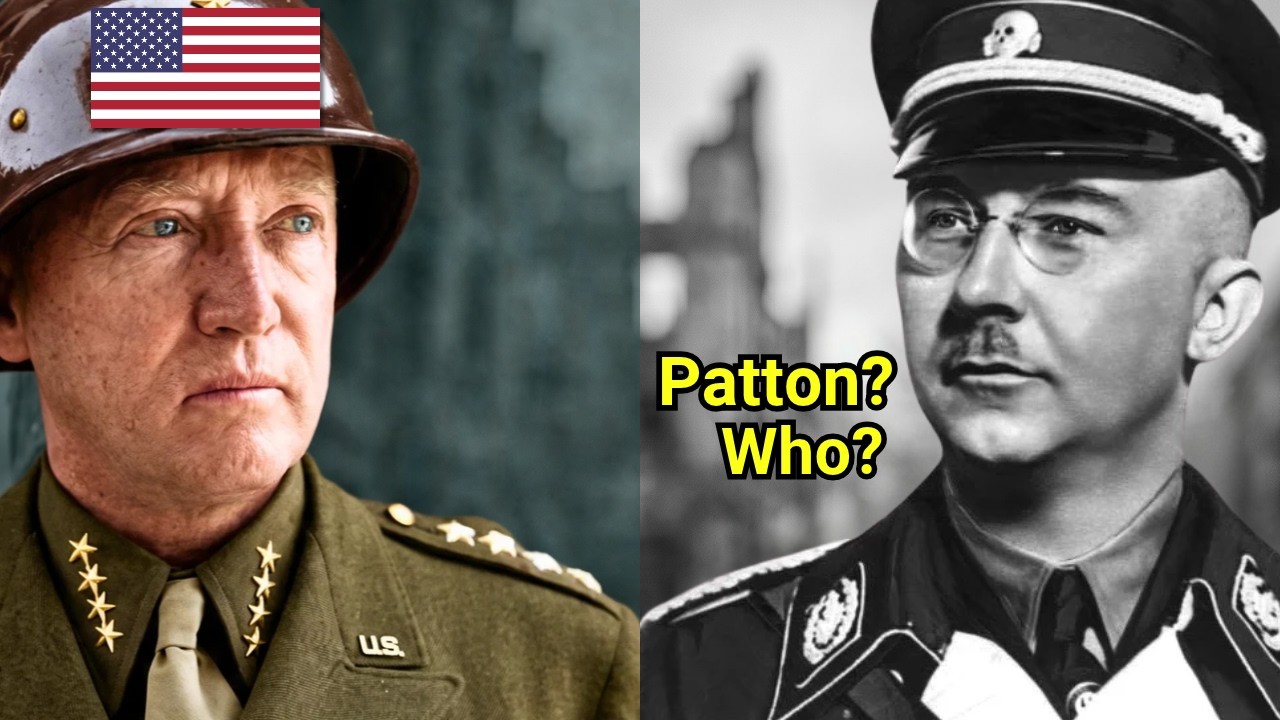
On September 21, a new commander took over Army Group G. General Hermann Balck, a hard veteran of the Eastern Front, was expected to fear Patton. Instead, he gave him none of it. On October 10, 1944, Balck wrote to Field Marshal Gerd von Rundstedt. The German recovery in Lorraine, he said, could only be attributed to the bad and hesitating command of the Americans.
Max Simon, an SS general facing the Third Army in the Saar, said the Americans attacked like men pulling down a wall, one brick at a time. Fight like that on the Eastern Front, he said, and every one of your tanks would have been destroyed.
The Germans had a new theory about Patton’s army. It was timid. They were wrong. The Americans hadn’t lost their nerve. They had run out of gas.
On August 31, the Third Army stopped short of Metz. Not because of German resistance, but because the fuel was gone. Real supply didn’t start flowing again until September 4, and even then it was thin. In mid-September, supply lines delivered an average of 3,500 tons a day to the Third Army. Bradley’s 12th Army Group estimated a single division needed at least 600 tons for a single day of attacking.
Nancy was 461 miles by rail from the port of Cherbourg. The port of Antwerp was only 250 miles away, but not yet open to ships. The Germans knew none of this. They gave the credit to themselves, to their own counterattacks. What looked like hesitation from their side of the map was an empty fuel tank on the American side.
The popular version of the Patton legend comes mostly from Hollywood. In 1970, 20th Century Fox released Patton with George C. Scott in the title role. The film won seven Academy Awards, including Best Picture. It also gave the Germans a character they never had. Captain Oskar, a German staff officer whose job was to study Patton’s history, habits, and mind.
Oskar was a screenwriter’s invention. The same film has Patton watching his tanks beat Rommel’s at El Guettar and shouting that he read Rommel’s book. Rommel never finished that book. He wasn’t even in Africa for that battle.
The viral story took the last step. It gave Captain Oskar a handful of nameless cousins and sat them down in American interrogation rooms. It also misplaced a few facts. One nameless German describes the Third Army’s aggression near Saint-Lô. Saint-Lô fell in July 1944, and the Third Army didn’t become operational until August 1.
Another favorite, the mass surrender of General Boto Stösser’s column at the Brest Peninsula, gets handed to Patton. By then, the 83rd Infantry Division that accepted it had been moved to the 9th Army.
But there was one night when the Germans really did meet the Patton from the movie. March 1945, the Rhine. On the east bank, General of Infantry Hans Gustav Felber commanded what was left of the German 7th Army. He was responsible for more than 50 miles of the river from Worms down to Mannheim with one regular corps. His only reserve had two weak infantry regiments and two light artillery batteries.
Felber knew how river crossings worked. A river this size meant days of preparation. Boats, bridging equipment, and a massive artillery barrage before anyone got wet. He could hope the Americans would stop and build up.

But the U.S. Army’s official history adds a dry note. Every previous dealing with Patton pointed the other way. Early on March 21, Major General S. Leroy Irwin of the 5th Infantry Division was called to corps headquarters. His division had already crossed 22 rivers in this war. The next one was the Rhine.
Mid-morning on March 22, the corps commander, Major General Manton Eddy, told Irwin that Patton wanted the crossing that night. Irwin said a well-planned crossing was impossible on that schedule, but he could get some sort of bridgehead.
Late that morning at Nierstein, Colonel Paul J. Black of the 11th Infantry got his order. Cross at 10:00 p.m. Behind him, 13 battalions of artillery were in position with orders not to fire. No preparation, no barrage. Surprise was the whole plan.
Just before 10, the 3rd Battalion crept down to the water at Nierstein. The moon was uncomfortably bright. Around 10:30, half an hour behind schedule, the first boats of Company K pushed off. Nothing. No flares, no machine guns. Nobody on the far bank seemed to know.
The first boat across carried First Lieutenant Irvin Jacobs and eight men. What happened next is in the official history. Seven surprised Germans promptly surrendered and obligingly paddled themselves across the river without escort.
A little downstream at Oppenheim, it was harder. Companies A and B took machine gun fire in the middle of the river, and the fight at the bank ran on for half an hour. By midnight, the entire 11th Infantry was across. Only then did the German artillery wake up, about 50 rounds on Oppenheim before daylight.
At dawn on March 23, 12 German planes came in to strafe the crossing. They did almost no damage. The whole 11th Infantry took 20 casualties. By late afternoon, a treadway bridge was open, and the 4th Armored Division was ordered across the next morning.
That night, a regiment of German officer candidates counterattacked while Field Marshal Albert Kesselring watched from a command post nearby. By daylight, they had been thrown back.
Omar Bradley announced the crossing on March 23, timed to land right on top of Montgomery’s big set-piece operation further north. The Third Army, he said, had gone over without even so much as an artillery preparation.
Felber had his own word for it in a report he later wrote for the U.S. Army. The enemy, he said, was now willing to take bigger chances than before. The Germans had met a particularly determined and daring opponent.
Five months earlier, Balck had called this army bad and hesitating. Now it had crossed the Rhine without firing a single shell to clear the way.

One detail from the fake story turns out to be true, just in the wrong place. The prayer. The viral version puts it in the Battle of the Bulge, Patton turning his army north toward Bastogne and issuing a weather prayer along with his battle orders.
Here’s what actually happened. On December 8, 1944, eight days before the German offensive even began, Patton was at his headquarters in Nancy watching the Lorraine rain. He told his wife Beatrice in a letter that there was about four inches of liquid mud over everything.
He phoned his chief chaplain, James H. O’Neill, and asked him for a good prayer for weather. O’Neill couldn’t find one, so he wrote one. Patton liked it and ordered 250,000 copies, one for every man in the Third Army. The last cards went out on December 14. Two days later, the Germans attacked in the Ardennes.
The prayer asks God to hold back the immoderate rains. Rain, not Ardennes snow. It was written for the Lorraine mud that had been holding him since September. The skies over the Bulge finally cleared on December 23.
Patton’s own memoir, War as I Knew It, published after his death, offers a confession. Looking back over the whole campaign, he wrote, I know of no error I made, except one. He should have sent a full combat command to Hammelburg instead of the small task force he sent to free a prison camp that held his own son-in-law. That raid was a disaster.
Read his sentence again. One error in the entire campaign. Now put it next to what the men across the line were writing. An army group commander called his autumn bad and hesitating. An SS general said he took walls apart one brick at a time.
Some of that was unfair. The Germans didn’t know about the fuel. But Patton did. And when he sat down to list his mistakes, Lorraine didn’t make it onto the page. The man the Germans found so hard to read had real trouble reading himself.
That line from August, that the Third Army had advanced further and faster than any army in history, wasn’t true. From the breakout at Avranches to Verdun was a 300-mile drive. In the invasion of the Soviet Union, German panzer groups had covered as much as 500 miles in the same amount of time on far worse roads.
One German panzer general had done better still. He pushed his troops 800 miles in six weeks, an advance he himself called unique in Prussian-German military history. His name was Otto von Knobelsdorff. That fall, he was the man holding Patton in the Lorraine mud.
The famous quote, that Field Marshal Gerd von Rundstedt called Patton the best Allied general, follows a trail that runs to a Patton biography published in 2006 and stops. No newspaper, no date, no interviewer, 61 years after the war. If there’s an earlier source, nobody has produced it.
What the Germans really thought when it was over is stranger. Their highest praise came after the shooting stopped, from men in American hands writing for American historians. Günther Blumentritt called Patton the most aggressive panzer general of the Allies. He said Patton came closer than any Allied commander to the German idea of a classical general and that he had even improved on Napoleon’s rule. Activity, speed, and more speed.
Hasso von Manteuffel, questioned in 1945, said Patton acted as I would have done had I been in his place.
What makes this unusual is not that the Germans found Patton strange. It’s that on his best days, they found him familiar. The boy from San Gabriel who grew up reading about Napoleon ended the war with a German general telling American historians he had improved on Napoleon. After all the myths, the strangest thing about George Patton to the men who actually fought him was that he fought like one of them.