On March 19, 1962, a man died alone in a one-bedroom apartment in Kazan, Russia. He was 40 years old, had four children, four marriages, a chest full of military medals, and a name that had once made generals flinch. His name was Vasily Stalin, son of the most powerful dictator the Soviet Union ever produced. At the moment of his death, no one came—no state funeral, no honor guard, no telegram from Moscow.
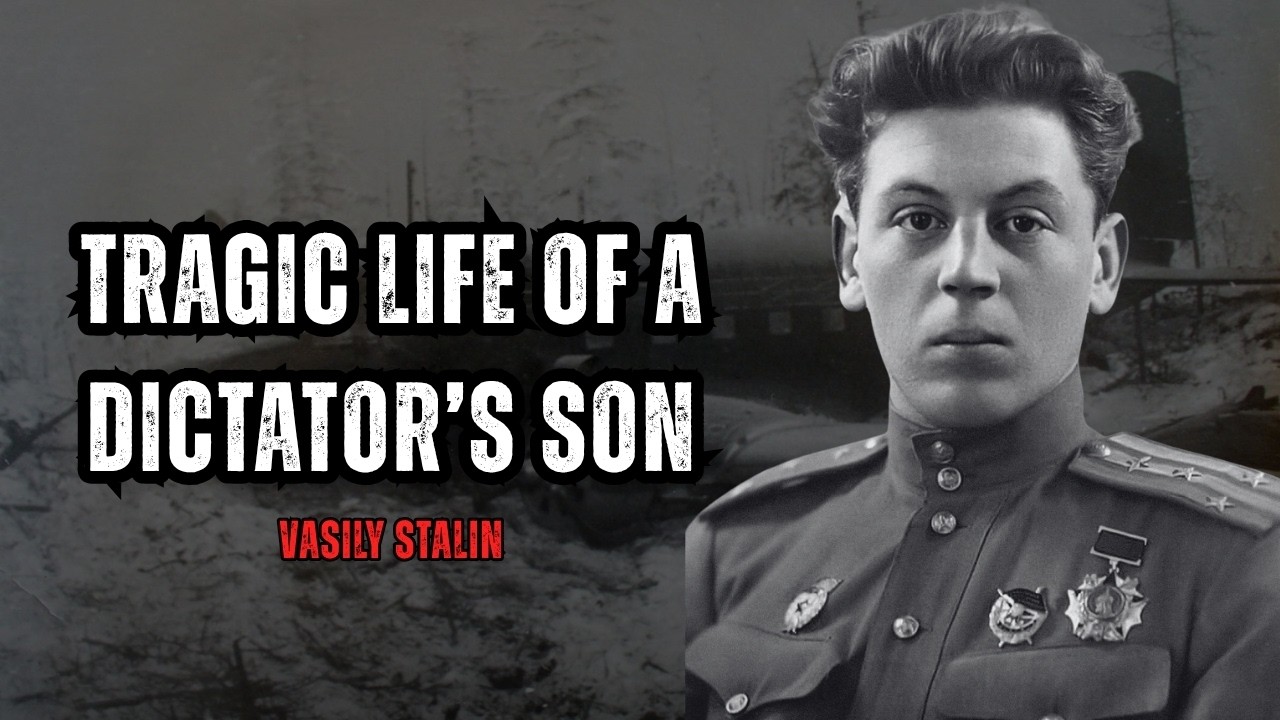
His sister, Svetlana, later summed up his entire life in five words: “His life was tragic in a way. ” The story of Vasily Stalin is not simply about a man who wasted what he was given. It is about what the Soviet state built around him, how it used him, and what it did with him when he was no longer useful. Vasily Iosifovich Stalin was born on March 21, 1921, in Moscow.
His father was Joseph Stalin, already one of the most dangerous men in the Soviet Union. His mother was Nadezhda Alliluyeva, Stalin’s second wife, who was only 17 or 18 when she married the 40-year-old widower. Vasily had an older half-brother, Yakov, from Stalin’s first marriage, a young man his father treated with unconcealed contempt. Five years after Vasily’s birth, his sister Svetlana arrived.
She would become the only one of Stalin’s children to live past 45, and by her own account, the only one her father genuinely loved. When Vasily was born, Stalin was reportedly disappointed; he had wanted a daughter. According to historical accounts, he did not speak to Nadezhda for an entire month after the birth. When Svetlana arrived in 1926, whatever attention Stalin reserved for family shifted almost entirely toward her.
Vasily, from the start, was the child who didn’t register. Nadezhda had professional ambitions and little interest in motherhood. A nanny was hired to raise the children, and Stalin was almost always absent. Vasily’s daily companions were household staff and NKVD security guards.
He would later reflect that his entire life had been spent among adults and guards, and that it left a deep mark on his private life and character. One guard in particular filled the absent parental role: Karl Pauker, an NKVD officer who traveled frequently and brought gifts back for the boy. In August 1937, during the Great Purge, Pauker was shot. Vasily was 16.
He wrote letters to his father about his days and his studies. Stalin never replied. Without supervision and without consequences, Vasily’s behavior deteriorated. He was enrolled in Moscow Model School No.
25. His sister recalled that teachers frequently had to bring his conduct to Stalin’s attention, which put them in an impossible position—disciplining Stalin’s son was not something anyone was eager to do. Nobody did, and Vasily understood very early what that meant. Then came November 9, 1932.
Nadezhda Alliluyeva was found dead in her room that night at age 30. She had argued bitterly with Stalin earlier that evening at a banquet and had left early. The government announced she had died of peritonitis. The children were told the same.
They would not learn the truth for another 10 years. Stalin, by multiple accounts, was devastated. He reportedly said, “The children will have forgotten her within a few days, but me, she has maimed forever. ” After her death, Stalin doted on Svetlana and virtually stopped acknowledging Vasily.
Vasily began drinking at 13. His sister documented that in drunken episodes, he would curse her and become violent. He was increasingly disruptive at the family dacha with no adult authority willing or able to check him. Had he been anyone else’s son, someone might have stepped in, but the name sealed him off from ordinary intervention.
At 17, with poor grades and a record of misconduct, Vasily was sent to the Kachin Military Aviation School. His father issued explicit instructions: “Grant him no special treatment, no privileges, no accommodation because of his name. ” The school complied with none of it. A 1939 progress report noted he studied poorly, was frequently unshaven, and responded badly to problems in flight.
He graduated in March 1940 with final marks recorded as excellent. On December 31, 1940, at age 19, Vasily married Galina Burdonskaya. Six months later, Nazi Germany invaded the Soviet Union, and Vasily went to war. Transferred to the front in August 1941 under the cover surname Ivanov, he flew 29 combat missions and is credited with shooting down two enemy aircraft.
By December 1941 he was a major, and a colonel within months after that—two ranks in a single year of wartime for a man whose graduation marks had been fabricated. His colleagues largely didn’t trust him; many believed he was his father’s informant. The suspicion kept him isolated from the men he served alongside. In April 1943, bored and stationed near the Moskva River, Vasily organized an improvised fishing expedition using aircraft missiles with delayed ignition to net dead fish.
On the fourth attempt, the device detonated in the hands of the regimental flight engineer, killing him. Vasily was injured by shrapnel. Joseph Stalin issued a formal military decree: “Colonel Stalin is relieved from his post of regimental commander due to alcoholism and debauchery and the fact that he spoils and destroys the regiment. ” His father signed that order.
Vasily was demoted and confined to quarters for eight months, then reinstated and promoted again. By the end of the war, at 24, he was the youngest major general in the Red Army. His sister wrote plainly about how this happened: “He was pushed higher and higher. Those responsible couldn’t have cared less about his strengths and weaknesses.
Their one thought was to curry favor with my father. ” Every officer who promoted Vasily was purchasing goodwill with Stalin; Vasily’s rank was a currency, and he himself was incidental. After the war, Vasily’s advancement continued—major general in 1946, lieutenant general in 1947, and by 1948, commander of the air forces of the Moscow military district at age 27. He was also building something on the side.
VVS Moscow, the Soviet Air Force’s sports club, became his personal operation. He used his military authority and his father’s name to pull athletes from other clubs across the country. He brought in Anatoly Tarasov as player-coach for the hockey team’s first season in 1946. Tarasov, who would later become one of the principal architects of Soviet hockey’s international dominance, disagreed with Vasily over player selection and left after one year.
On January 7, 1950, a twin-engine transport aircraft carrying the VVS Moscow hockey team crashed near Sverdlovsk en route to a match in Chelyabinsk. All 19 people on board were killed—11 players, a team doctor, a masseur, and the flight crew. Two men survived because they weren’t on the plane: star forward Vsevolod Bobrov had overslept and taken the train, and Viktor Shuvalov was sidelined by injury. Vasily did not report the crash through official channels.
He held no formal acknowledgement of the dead. Instead, he assembled a replacement team within a single day. He was afraid of his father’s response—that was the entirety of his reasoning. The crash was suppressed, and it would be decades before the story became publicly known.
The rebuilt team went on to win the Soviet championship three consecutive times. On May 1, 1952, Vasily was responsible for the aviation component of the May Day parade in Moscow. The weather was severe; any competent commander would have canceled the flypast. Vasily authorized it.
Two bombers went down. He was relieved of his command and assigned to the General Staff Academy. Around this period, Stalin made a recorded remark about his son with detachment: “His health is so frail. His stomach is sick.
He can’t even eat. ”
Less than a year later, on March 5, 1953, Joseph Stalin was dead. Vasily arrived at his father’s deathbed drunk and told anyone who would listen that Stalin had been poisoned. In the weeks that followed, every person who had promoted him, financed his lifestyle, and tolerated his conduct was gone.
His sister described him in this period with one word: terrified. The new Soviet leadership offered Vasily a military command post anywhere in the country, on the condition that it not be Moscow. Vasily refused. He would accept nothing outside the capital.
On April 28, 1953, 54 days after his father’s death, he was arrested. The charges were anti-Soviet activity, embezzlement, beating of subordinates, criminal negligence, and actions that had resulted in the deaths of others. Historical accounts confirm that a significant portion of those charges were backed by documented evidence. He was tried in a closed hearing, sentenced to 8 years, and held at the Vladimir Special Penitentiary under the name Vasily Pavlovich Vasiliev—a precaution, even in imprisonment, against what his real name might set in motion.
From prison, he wrote repeatedly to Khrushchev, promising changed behavior and asking for clemency. At his trial, not one person had spoken in his defense. Every individual he had threatened and damaged provided testimony against him. The officers he had elevated with patronage simply stood aside.
When the name stopped protecting people, they stopped protecting the name. On January 11, 1960, Vasily was released on health grounds. He returned to Moscow, where the state provided a pension, a three-room apartment, and permission to wear his general’s uniform and decorations. His request to be reinstated in the military was denied.
He was 38 years old, and the Soviet state had no further use for him. On April 15, 1960, Vasily walked to the Chinese consulate in Moscow and requested a medical visa. The precise nature of his intentions remains unclear—some accounts suggest he was seeking medical treatment abroad, others that he intended to speak with foreign officials about his father’s death and the Soviet leadership. He was arrested the following day.
He was exiled to Kazan, 800 km east of Moscow, under house arrest. By government order, his surname was officially changed back to Dzhugashvili, his father’s original family name. The name Stalin, which had defined and destroyed him in equal measure, was formally stripped away. On January 9, 1962, two months before his death, Vasily married for the fourth time.
His wife was a nurse named Maria Nusberg. By then, decades of chronic alcoholism had done cumulative damage that no interval of sobriety could undo. On March 19, 1962, two days before his 41st birthday, Vasily Stalin died in Kazan. He was buried at Arskoye Cemetery with no state ceremony and no official recognition.
In 1999, 37 years after his death, the military collegium of the Supreme Court partially rehabilitated him, removing the anti-Soviet propaganda charges that dated from his 1953 prosecution. In 2002, his remains were transferred to Troyekurovskoye Cemetery in Moscow, where he was reburied beside his fourth wife. Vasily Stalin’s record is not in dispute. He drank through his command responsibilities.
He abused his authority. He covered up the deaths of 19 people to avoid a difficult conversation with his father. He used his name to coerce and threaten those around him. What is equally documented and less frequently examined is the architecture of his life before any of that happened: a mother who died when he was 11, whose real cause of death was hidden from him for a decade; a father who stopped visiting; a childhood spent in the company of guards; a military school that ignored direct orders to treat him like any other cadet; a chain of commanding officers who promoted him to buy favor with the most powerful man in the country; a system that handed him rank, resources, and impunity—and then, the moment Joseph Stalin died, presented the bill for all of it.
His sister Svetlana defected to the United States in 1967 and changed her name to Lana Peters. She died in 2011. She wrote of her own experience: “Wherever I go, I’ll always be a political prisoner of my father’s name. ” Vasily never escaped that sentence.
He lived it out in a one-bedroom apartment in Kazan, two days short of his 41st birthday.