On May 23, 1934, six lawmen ambushed Bonnie Parker and Clyde Barrow on a rural Louisiana highway near Gibsland. More than 130 rounds were fired in about 16 seconds. Both outlaws died instantly in their stolen Ford V8 sedan.
The photographs taken hours later became among the most famous crime scene images in American history. They show Bonnie slumped against Clyde’s right shoulder, his head tilted back against the seat. The scene looks almost gentle, almost romantic.
For 90 years, those images have shaped how generations understand the end of the Bonnie and Clyde saga. But a growing body of evidence suggests the photographs were carefully staged by law enforcement before the cameras arrived.
The official story held for decades. The ambush team included Frank Hamer, the legendary former Texas Ranger, and Ted Hinton, a young deputy sheriff from Dallas County who had known Bonnie before she turned outlaw. Four other officers represented multiple agencies. All had reputations on the line.
The scene was chaotic. Thousands of souvenir hunters descended on the ambush site. Local law enforcement worked to manage the crowd. Newspaper photographers raced to capture what they knew would be the scoop of the decade.
Everyone involved needed the operation to look clean and professional. Hamer’s reputation as an infallible lawman depended on it. Multiple agencies that had been embarrassed by Bonnie and Clyde for over two years needed a decisive, justified end to the manhunt.
According to the official version, the outlaws never had a chance to surrender. The car rolled to a stop after absorbing over 100 rounds. Both occupants were clearly dead. Within hours, photographers documented the bullet holes, the weapons, the blood, and the bodies positioned almost intimately in the front seat.
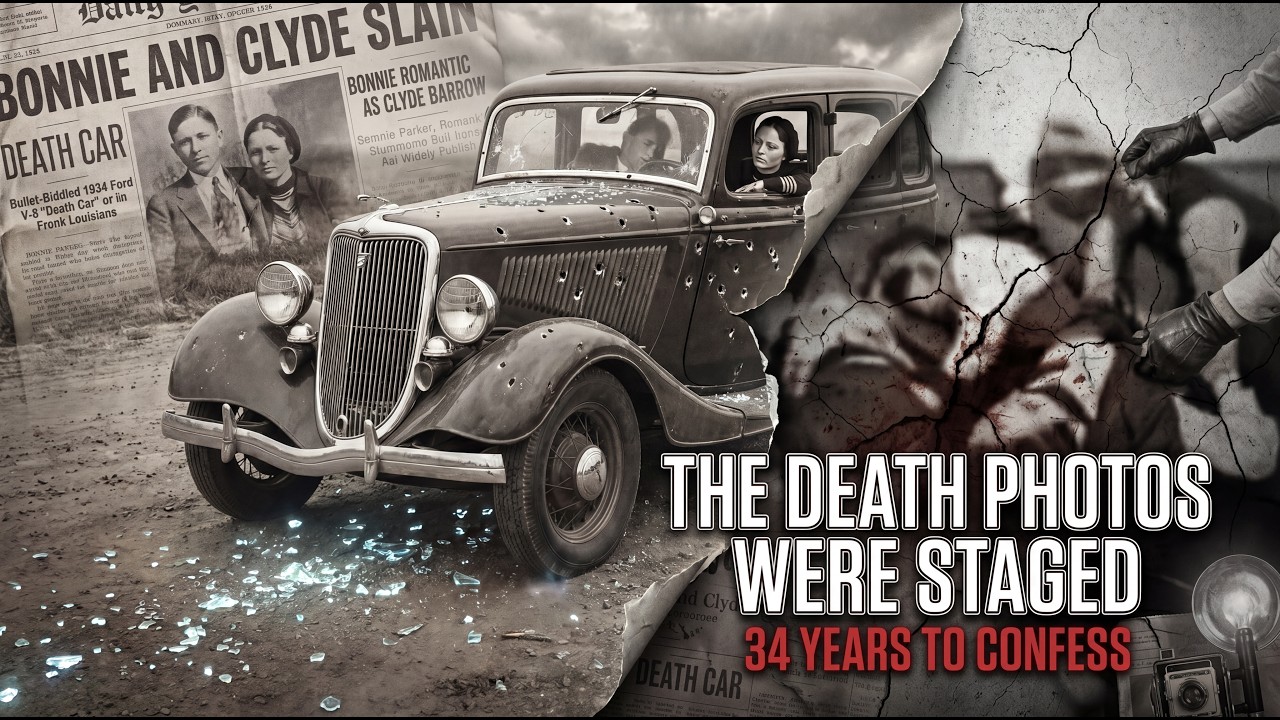
Those photographs became evidence, history, and legend simultaneously. The case was closed in the public imagination. Justice had been served. Frank Hamer became a national hero.
For 34 years, no one from the six-man team contradicted the official account. Then in 1968, Ted Hinton published his memoir titled *Ambush*. Buried in its pages was a shocking admission.
Hinton wrote, “I rearranged them for a better picture.” He moved Bonnie’s body. He positioned her against Clyde for the photographers.
The admission raised immediate questions. Why did Hinton wait 34 years to reveal this? Why had none of his fellow officers ever mentioned it? And what did the scene actually look like before his intervention?
In the 1980s, crime scene analysts began examining the death car with more sophisticated techniques. They found glass fragments scattered on the bodies in patterns that did not match the documented bullet trajectories. The glass appeared to be on top of blood that should have flowed after the shooting stopped.
This indicated the bodies were moved after the initial blood loss but before the glass settled. Someone had disturbed the scene.
In 1979, aging mortician Boots Bailey broke decades of silence. Bailey, who handled the bodies in Arcadia, insisted he received specific instructions about how to prepare Bonnie and Clyde for transport and viewing. He claimed law enforcement told him to position the bodies in particular ways.

Bailey’s statement suggested coordination between the ambush team and local officials to control how the bodies would be presented. The stakes were clear. Any suggestion of evidence tampering or scene staging could destroy multiple reputations and careers.
The American public in 1934 needed heroes and villains, not questions about police procedures. The photographs served that purpose perfectly.
Modern forensic blood spatter analysis in the 1990s revealed a dramatically different story. Bonnie’s blood showed she was initially positioned forward over the dashboard, not leaning gracefully against Clyde’s shoulder. The spatter patterns indicated she died face down, likely with severe facial trauma that would have made her unrecognizable.
Clyde’s position appeared more consistent with the photographs, but even his final pose showed signs of post-mortem adjustment. Enhanced analysis of multiple photographs taken that day revealed the truth. Early crime scene photos taken before media photographers arrived showed the bodies in markedly different positions. Later photos, the ones that became famous, showed the repositioned bodies.
Someone absolutely staged the scene. The question was no longer whether it happened, but who ordered it and why.
Ted Hinton’s private papers, discovered decades later, contained a fuller confession than his memoir hinted at. Hinton was explicitly ordered to reposition Bonnie’s body because the actual death scene was too gruesome and undignified for public consumption.
Bonnie had been shot multiple times in the face and was slumped forward in what Hinton described as an unglamorous position that didn’t fit the story they needed to tell. The brutal reality of 130 bullet wounds and destroyed faces wouldn’t serve law enforcement’s narrative needs.

The coverup wasn’t about hiding police misconduct or an unjustified shooting. It was about controlling public perception and historical narrative. Law enforcement wanted photographs that depicted two outlaws who died together almost romantically, rather than the savage reality of what happens to human bodies when hit with that volume of gunfire.
Frank Hamer and the other senior officers made a calculated decision that the American public needed a palatable version of violent justice. Ted Hinton, as a junior member of the team, was assigned to create that version.
What we know now, based on 90 years of investigation, is that the most famous crime scene photographs in American history were carefully staged. Not to conceal a wrongful shooting, but to construct a more acceptable version of brutal justice for mass media consumption.
Ted Hinton carried the psychological weight of that deception for 34 years before finally admitting his role in creating false historical evidence. The staged photographs became the accepted truth that three generations of Americans believed without question.
The real scene was apparently too graphic, too honest about what violence actually looks like for the mythology being constructed around Bonnie and Clyde’s death. The repositioned bodies created a narrative of romantic outlaws meeting their fate together, rather than two people destroyed by overwhelming firepower.
Several questions remain disputed among investigators and historians. Did all six lawmen participate in the staging, or was it primarily Hinton’s responsibility? Were there other crime scene manipulations beyond repositioning the bodies? How many other historical photographs from this era were similarly arranged for public consumption?
The truth doesn’t change what Bonnie and Clyde did during their crime spree. But it reveals how authorities were already manipulating crime scene evidence for media consumption in 1934, establishing practices that would become standard procedure for decades.
It also demonstrates how easily false narratives become accepted history when they serve everyone’s interests. Law enforcement got their heroic story. The media got compelling photographs. The public got closure.
Only the historical record suffered.