Children carried out of the caves on Okinawa in the summer of 1945 did not even have the strength to cry. An American correspondent described them as caked in mud and shivering in the heat, making a sound quieter than crying. The private holding one of them had no instructions for what to do next, because the answer belonged to a different organization and it had arrived on paper. Between March 25 and mid-April, carrier aircraft scattered about 5 million leaflets across the island.
One leaflet written for civilians gave instructions in five numbered points. The first told anyone hiding in a cave or shelter to come out at once. The second told them to come out together and bring what they could carry. The fourth told them to walk in daylight and never alongside Japanese soldiers, because a group moving at night would be taken for troops and fired on.
Leaflets kept falling until organized fighting stopped, about 8 million in total, along with six issues of an American-printed Japanese-language newspaper for the island. People obeyed in enormous numbers. Within a week of the landings, 10,000 civilians had walked into American custody. By the end of April, that count had multiplied by 12.
By June 1, 144,000 people were under American care, something near half of everyone still alive on the island. A strange proportion of those survivors were children with nobody attached. Many of their mothers were alive, sitting in a camp 30 or 40 miles from the cave where they had been registered by a tired man with one interpreter for every thousand arrivals. The 32nd Army had conscripted most of the men, so the shortage of fathers explained itself.
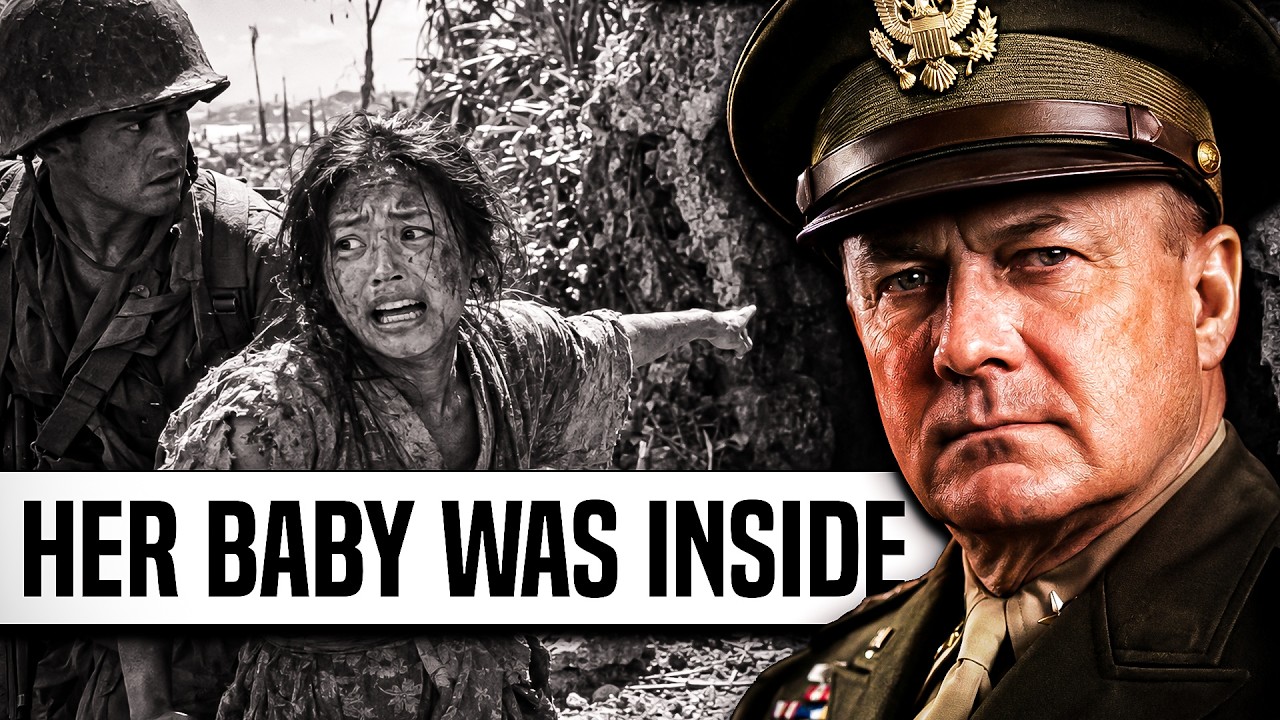
The mothers did not. Collection centers kept filling with infants and small children who had no way of finding the woman who had carried them into the hills. Part of the answer sits in a report written by Navy doctor Henry Stanley Bennett, who had been born and raised in Japan, spoke the language, and came ashore with the Marines. In the first confused days, he wrote, American patrols found women hiding in the hills and brought them out to safety.
The women argued and gestured back toward the caves. Not one man on those patrols understood a word of it, so the women were walked away, and the infants stayed where they were. Bennett put that in his report without softening it. He noted that many families were later put back together and that officers were working on the rest, then wrote that complete success seemed improbable.
The army did have men who could have understood those women. Nisei linguists from the Military Intelligence Service went ashore with every division. Part of their job was what units called flushing caves, walking up to a hole in the rock and talking the people inside into coming out. Ted Higa, born in Hawaii and schooled for 14 years in Okinawa, worked the caves for the 96th Division and at one point found himself questioning his own former teacher.
The army lent another Hawaii man, Terry Shibota, to the Marines, and he climbed down inside the caves himself, which his orders forbade. Nearly 200 more went straight from Hawaii into civil affairs and medical work without seeing the language school. None of that came near covering 400,000 people, and an ordinary rifle patrol had nobody at all. The machinery that collected the survivors was thinner than anyone plans for.
Military government team B-10 came ashore on April 9 with the 27th Division and set up a civilian collection center at Chibana that amounted to a ring of barbed wire and a latrine pit. By June, working near Yaka, that same unit was processing better than 900 people a day. Team C-1 landed near Sotoyama on April 4, and about a thousand residents came out of hiding and gave themselves up the first day. C-1 had one interpreter.
He spent the following week trying to write down names for a flood of new arrivals, and by the fourth week his team held 3,378 people. The first detachment big enough to administer a whole district did not land until April 27. Everyone who came in was dusted with a 5% solution of DDT and kerosene, bodies and bundles both, by the first American they met. Three-quarters of the surviving population had fleas or lice from months underground.
About a third had tuberculosis. Before the campaign ended, military government hospitals had admitted more than 30,000 civilian patients. Then came the sorting, and the sorting is where the children began to accumulate. Women, small children, and old people went into damaged villages at Sobe and Koza, and later at Ishikawa and Yara.
Able-bodied men went behind wire as a security matter. A family that arrived intact did not always stay that way, and a family that arrived in pieces stayed in pieces. What kept them alive was a table of figures written in Washington. On May 18, the Chief of Naval Operations sent out a letter on basic diets for civilians in the Japanese outlying islands.
Someone in that office had computed ration scales by category. A working adult got 2,000 calories or better. Nursing mothers had a line of their own. Very small children got a ration starting at 782 calories and never topping 921, with evaporated milk folded in for the calcium.
The same letter admitted that every one of those rations lacked vitamin C and ran short on riboflavin. By July, the teams were feeding something like a third of a million people a day, more than half of it shipped in. In late September, the whole civilian ration was cut in half. The orphanage went up in the American Army building area at Koza, in a place called Sumiyoshi.
By the time a correspondent got a look at it, there were 350 children in it, from 9 months old to 14 years old. Army doctors ran the medical side. Okinawan women were hired to do the work of raising them. The officer in charge was an Army captain named W.
W. Mallister from Iowa City. What he told a reporter from Stars and Stripes on May 22 was that the local people took an interest in their own babies and nobody else’s, so something had to be done for the children whose parents were dead or missing. There was no formula on the island and no bottles.
The men cut nipples out of surgical gloves and fed the infants canned milk through them. A 2-year-old girl the Americans called Sally was found by a private first class named John Strokes, who supervised her bath, dusted her with anti-vermin powder, and then went into the diaper business with a set of Marine fatigues, a jungle knife, and a couple of pins. Further south, a Navy corpsman named Hugh Bell walked into a cave with a Marine reconnaissance unit and found an entire colony of starving people inside, 35 of them children, needing treatment that hour. He was the only medical man in the cave.
He worked on them for a full day and gave them canned milk while his own unit drank its coffee black. The headman of the cave told the Marines afterward that the people in there had taken to calling Bell mother. Almost nothing on Okinawa was built for the job it ended up doing. A surgical glove became a bottle nipple.
Fatigue trousers became a diaper. An abandoned Seabee camp became five training schools. The children who were not orphans were a different problem, and the file on that one has a certain charm. Loose children in the camps were a nuisance and in places a hazard, wandering onto military roads.
On May 1, the commanding officer of a military government team at Ishikawa decided the fix was a playground. He put 150 Americans and Okinawans to work building it. It opened three days later, and more than a thousand children between 4 and 8 years old turned out for it. A memo about it filed on May 9 carries the title “Ishikawa Playground (Wonder Park) Establishment of.
”
A fortnight after that, headquarters issued Circular Number 16, a preliminary welfare program covering district education and recreation, ordering district commanders to organize activities for every child of elementary school age and to teach reading, writing, and arithmetic. The same organization was also killing people by accident. Tens of thousands of civilians in the south had spent the last weeks of the battle being evicted from their own cave shelters by Japanese soldiers who wanted the space. When they crossed into American lines in late June, about a quarter of them needed medical treatment, and many had injuries that had gone untended for days.
There were no civilian medical facilities in southern Okinawa, so the teams loaded them into trucks, injured and all, and sent them north over broken roads, some of them 40 miles. Small injured children dehydrated fastest. On June 22, a convoy carried 881 evacuees north to Katsuren, and one of its trucks arrived with three of the people aboard already dead: two children and an elderly woman. Drivers arriving at overloaded camps were sometimes turned away and sent on to the next one.
That is why General William Crist, the deputy commander for military government, had to give a direct order in the middle of May that no civilian be turned away at any military government location for any reason. It did not work. Some drivers began unloading people at night without announcing themselves and driving off. On one of those nights, several hundred stretcher cases were left that way at the Naval hospital at Koza.
Crist had already told his staff on May 12 to stop calling the camps “concentration centers,” and Army censors were instructed that descriptions of conditions inside them would be cut out of letters home. Then the orphanage went into the war. The Office of War Information printed a leaflet numbered 1055 showing an American soldier walking with three small Okinawan children. The line on the front said that little loved ones cared for by Americans were waiting for their father to come home.
The text on the back was aimed at Japanese soldiers, and it reprinted the correspondent’s report on Koza almost in full: the 350 children, the ages from 9 months to 14 years, the Army doctors, the Okinawan women, the mud, the sobbing, the children clinging to the walls whenever the guns sounded in the distance. Then it turned the knife. “Only a parent can care for a child who has lost everyone else. Picture the face of a child catching sight of his father from inside the orphanage.
” That leaflet was dropped on men who were still underground, weighing whether to walk out or hold a grenade against their chests. Psychological warfare on Okinawa was the most successful campaign of its kind in the Pacific War. Nearly 11,500 prisoners were taken. During the first 70 days of the battle, the 10th Army averaged fewer than four prisoners a day.
Between June 12 and June 18, it averaged better than 50. On June 20, 977 men gave up in a single afternoon. The nursery at Koza was one of the arguments that produced those figures, and the office that built the argument knew exactly what it had. What the Army did with the children after that was mostly school.
Island Command stood up a military government education section in August 1945 to set policy, find shelter for classes, and provide materials. Camp section leaders picked out Okinawan teachers who were then cleared by counterintelligence. By October 1, there were 72 schools running part-time, first grade through sixth, with 1,300 teachers and 40,000 pupils. In November, the 137th Naval Construction Battalion handed over its camp, and civil affairs officers cut it up into a teachers college, an English language academy, a police course, a mechanical trade shop, and one for cooks and bakers.
On January 2, 1946, the first Okinawan administrative department the Americans created was the Department of Education, under a pre-war educator named Atsushi Yamashiro. The honest problem is that the file on the orphanages themselves is thin to the point of embarrassment. Okinawan historians put the number established across the internment areas at 14. Almost no American photographs of them from 1945 have surfaced, and the handful held in the prefectural archives can be counted on two hands.
No thorough count of the island’s war orphans was ever made by anyone, and the full extent of it is still unknown. Whether the American administrative files on those 14 institutions are sitting unopened in a box somewhere or were thrown out is not a question anybody can answer today. The numbers that do survive are these. In 1940, the Ryukyu Islands held a shade under half a million people, the great majority of them on Okinawa itself.
On July 12, 1945, about a quarter of a million civilians were in American custody. Of the people in the camps that month, children under 12 and adults over 45 made up the greater part of the total, and adult women outnumbered adult men by better than two to one. Perhaps a quarter of the pre-war population, 75,000 people at the lowest reckoning, was never accounted for at all. The ration line for the smallest children never moved off the figure Washington had set in May.
And within a year, the school system had passed its pre-war size, with better than 85,000 pupils in the primary grades alone.