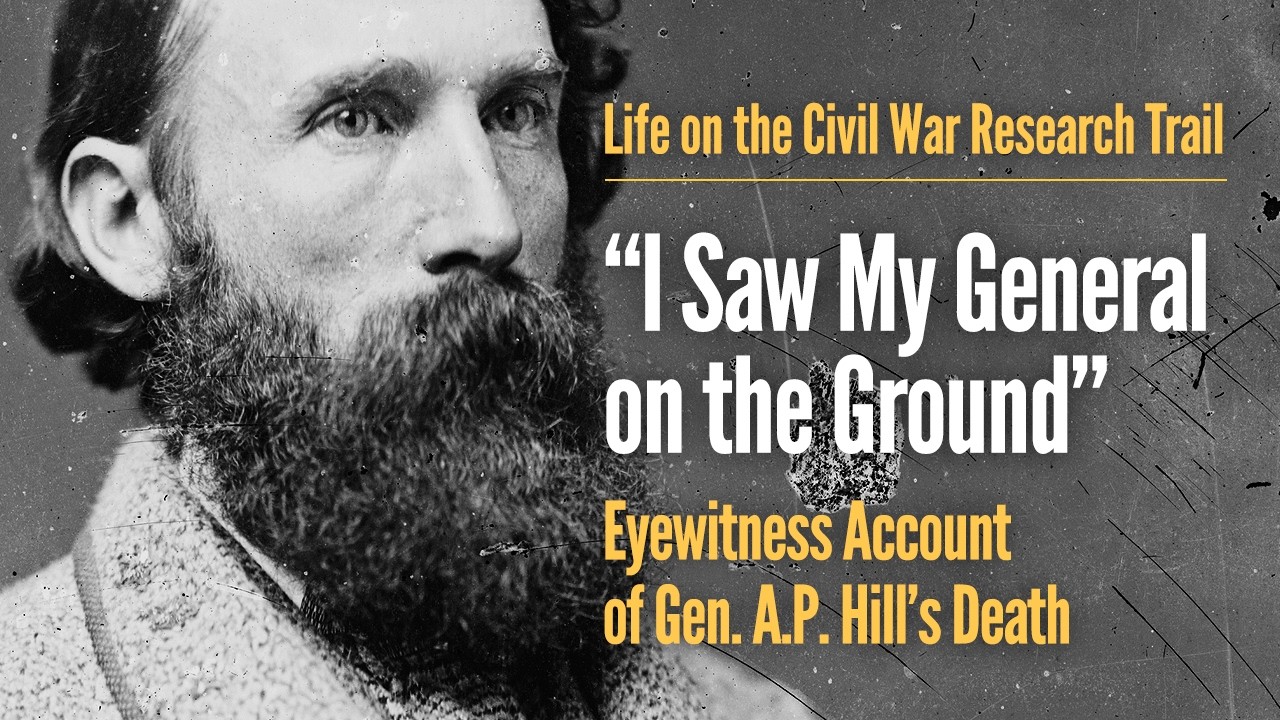
An eyewitness account of the final moments of Confederate Lieutenant General Ambrose Powell Hill has been brought to light in a detailed narrative written by the man who rode beside him when he was killed. The account comes from Sergeant George Washington Tucker Jr. , a courier and trusted aide who was at Hill’s side on April 2, 1865, during the fall of Petersburg and the Confederate retreat that led to the evacuation of Richmond. Tucker, who served in the 12th Virginia Infantry before joining Hill’s staff, had already survived capture at Chancellorsville and a wound at the Wilderness.
He was with the general when Union troops fatally shot Hill during the chaotic final days of the Army of Northern Virginia. According to Tucker’s narrative, he and Hill crossed a road and rode south toward Confederate lines. The general paused to use his field glasses, which struck Tucker as unusual given the circumstances. Shortly afterward, they encountered two armed Union infantrymen.
Tucker and another aide, Jenkins, apprehended them. Hill ordered Jenkins to take the prisoners to General Robert E. Lee, and then he and Tucker continued alone. As they moved forward, Tucker spotted figures in and around old winter quarters that had belonged to General Mahone’s division.
Knowing those huts had been empty since mid-March, Tucker asked the general whose troops they were. Hill answered, “The enemy’s troops. ”
Tucker grew increasingly concerned as they advanced. He asked the general where he was going.
Hill replied that he needed to move to the right as quickly as possible, pointing southwest and explaining that they would follow the side of a branch to the woods, which would cover them until they reached the field behind General Heath’s headquarters. During the ride through the woods, Hill told Tucker that if anything happened to him, Tucker was to return to General Lee and report it. Emerging into a field near Heath’s headquarters, Tucker saw that the woods were full of troops. Hill raised his field glasses and said, “They are there,” indicating the enemy.
Hill pointed toward the tree line parallel to the Boydton Plank Road and said they must keep moving right. Tucker rode forward, then slowed as he studied the edge of the woods. He saw what appeared to be six or eight Federal soldiers. Two of them moved ahead of the rest, took cover behind a large tree, and aimed their rifles.
Hill said, “We must capture them,” and for the first time that day drew his Colt revolver. Tucker urged the general to stay back, saying he would handle the capture. As they closed to about 20 yards, Tucker shouted that the men should surrender or be shot. Hill came up beside Tucker and also demanded their surrender.
When they were within 10 yards, the two soldiers were aiming directly at them—one at Hill, one at Tucker. The lower soldier briefly lowered his rifle but raised it again after his companion spoke. Both fired. Tucker reached out, grabbed the reins of Hill’s horse, and turned it left.
When he looked back, the general lay on the ground, motionless with his limbs outstretched. Tucker immediately turned back, leading Hill’s horse into the woods. Mindful of the general’s last order to report to Lee, Tucker mounted Hill’s horse and rode as fast as the terrain allowed. Confederate soldiers later recovered Hill’s body.
Tucker did reach General Lee and reported what had happened, and he surrendered with the army at Appomattox. He died in 1905, leaving behind this detailed account of the general’s death.