For more than two centuries, a weapon carried by Indigenous warriors across a vast stretch of North America has been misunderstood. It was a wooden club carved to look like the stock of a musket, and it was deadly in close combat — not because it fired a bullet, but because it crushed bone and cut flesh in a single swing. The weapon, known as a gunstock war club, was used from the Great Lakes to the southern plains. It was not a crude imitation made by craftsmen who admired European firearms.
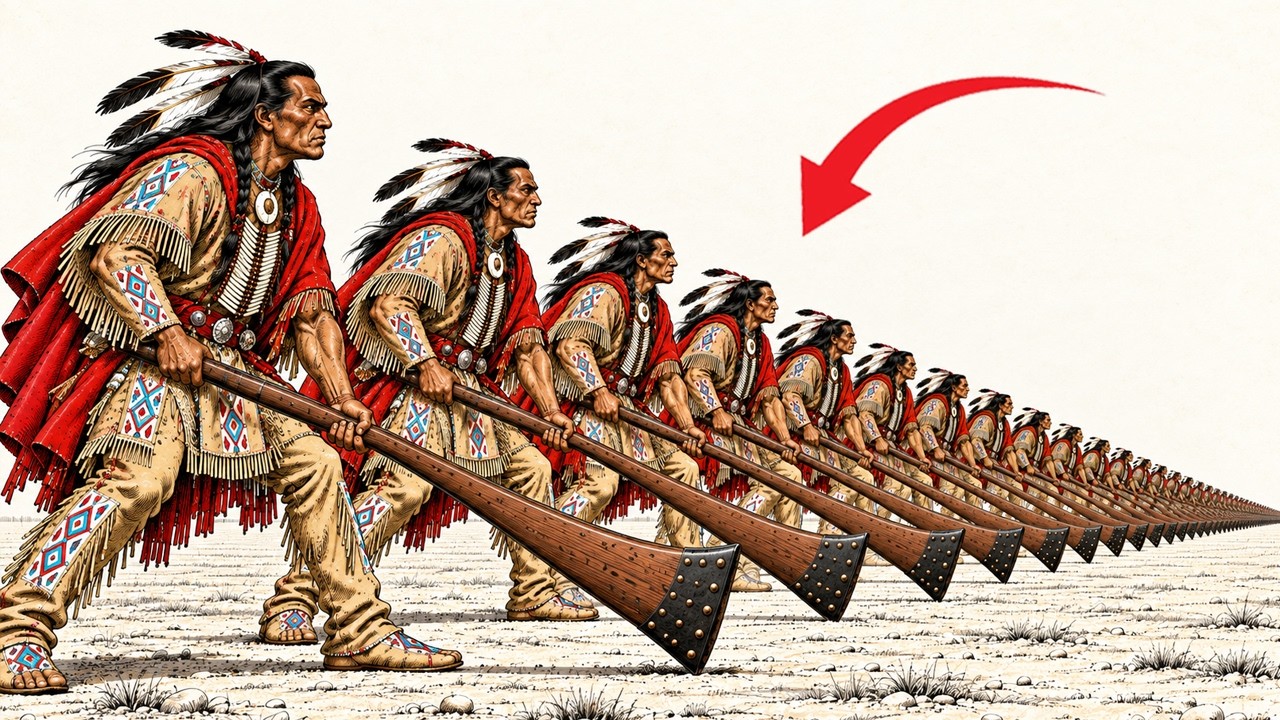
It was a deliberate and effective response to them. The club was typically made from a single piece of hard wood — maple, elm, or walnut — measuring between 60 and 75 centimeters long. One end was shaped as a handle. The middle featured a narrow angled curve.
The other end was broad, flat, and angular, closely resembling the stock of a musket. In the corner of the head, where a real gun’s lock and hammer would sit, makers inserted a blade. Early versions used chipped flint, the same stone used for arrowheads. Later versions used polished horn.
By the peak of its combat use, the blade was made of iron, sharpened and set into the wood at an angle that suited a swinging arm. The weapon was designed to do two things at once. The wood crushed. The blade cut.
One blow was meant to shatter bone and open an artery — not two strikes, but one. The design was not accidental. In the instant of close-quarters combat, a club shaped like a gun registered to a terrified enemy as a firearm. That hesitation gave the warrior the fraction of a second needed to swing.
It was not just imitation; it was armed deception. The weapon emerged during the 17th century in the forests east of the Mississippi River. European traders were pushing inland along the waterways, and firearms were appearing in the hands of some nations but not others. That imbalance was deadly, as alliances shifted with the seasons and villages once considered safe were burned by spring.
One craftsman, faced with the terrifying new weapon of the invaders, made a choice. Rather than copy the gun literally, he carved its silhouette into the traditional club of his people. The gunstock club was not a copy — it was a reply. By the mid-18th century, the weapon had spread across an area larger than most European nations.
Eastern woodland tribes carried it. Great Lakes nations, including the Anishinaabe, Menominee, and Ho-Chunk, developed it. It appeared in the hands of southern plains warriors and in eastern prairie villages. By the 1820s, the Osage of the Missouri River region carried versions that would later end up in European museums, catalogued by men who had never seen their homeland.
Warriors carried the club alongside their firearms. It was a dual tool, not a relic of an older age. A warrior would fire his gun, then drop or sling it and reach for the club before the smoke cleared. The transition took less than a second.
Fire, drop, draw, swing — about two seconds in trained hands. In that time, a soldier with a single-shot musket was still searching for his ramrod. The weapon did not announce itself. A musket shot did.
A gunstock club moved through the air with a low whistle, then fell — and the sound of its fall was the sound of a life ending. The gunstock war club was effective precisely because firearms of the era were specialized tools. They were deadly at range but nearly useless in a wrestling match. They were slow to load, loud, and unreliable.
Powder got wet, flints cracked, mechanisms failed. On a good dry day, a musket might work as intended about 80 percent of the time. On a rainy day, it was useless. The club had none of those weaknesses.
It did not jam, run out of ammunition, or reveal a warrior’s position. It was silent until the last half-second of its swing, and in that half-second it delivered damage a bullet could not match at close range. A bullet made a single hole; the blade of a gunstock club made a tearing cut backed by a crushing handle. Historians have debated exactly how the weapon was used.
Some argue the wooden surface delivered the primary blow, with the blade as a secondary threat. Others contend the blade was the main killing edge, with the wood serving as leverage and reach. The surviving artifacts suggest the truth depended on the target, the distance, and the moment. Against a helmeted skull, the wood did the work.
Against a bare neck, the blade did. Against a raised defensive arm, both hit. The warrior decided during the strike, not before it — a skill that took years to master. Documented examples confirm the weapon’s wide reach.
In 1823, a European traveler named Giuseppe Acerbi obtained a gunstock club on the upper Mississippi River near the Red River region. He was a collector, not a soldier, and he shipped the club back to Europe, where it eventually ended up in a collection linked to the explorer Beltrami. Today it serves as crucial evidence that the weapon was in active use in that region at that time. An Osage example, believed to date to the 1820s, rests in the Pitt Rivers Museum in Oxford, England.
The museum describes the object as being named for its resemblance to the body of a gun. The name was not exaggeration; it described exactly what a warrior wanted his enemy to see in that fatal instant. In 1860, in an area called Garden River in what is now Ontario, an Anishinaabe craftsman made a war club associated with Chief Shingwauk. Records call it a “council war club.
” The Royal Ontario Museum holds it today. The weapon had shifted from a tool of battle to a symbol of authority, carried to councils, political meetings, negotiations, and ceremonies. The Gilcrease Museum in Tulsa records that tribes in these regions used the weapon in warfare until about 1850, and continued using it in ceremonies for many years afterward. The gunstock club was never the invention of a single tribe.
It was not an Iroquois club, an Osage club, or an Anishinaabe club, despite what many online articles claim. It was a shared technology, developed and adapted across dozens of nations spread over a continental span. That collective innovation is not a detail; it is the essence of the story. Popular history has spent two centuries trying to attribute the weapon to one people.
The archaeological and museum records show it was used by many. The gunstock club was a continental idea, not a tribal one. It was not a secret local weapon. It was widely known, feared, and respected across half a continent.
What was not understood was just how effective it was. The weapon’s importance lies not only in its lethality, though it was lethal. It lies in what it represents. The gunstock war club is one of the clearest surviving examples of a truth that popular history often obscures: Indigenous peoples of North America were not simply overwhelmed by superior technology.
They adapted their own technologies skillfully and continuously to counter every weapon the outside world placed before them. The gunstock war club is not a relic of a losing side. It is a record of adaptation and invention.