In the winter of 1910, a mail carrier named Virgil Combs was riding his mule along a frozen creek in the hills of southern Missouri. He was carrying a canvas bag of letters and a small package of medicine for the Tipton general store. He never reached the store.
His mule was found three days later, still saddled, standing in a clearing about four miles off the path. The canvas bag was gone. Virgil’s coat was found folded neatly on a flat rock near the water. There was no blood, no signs of a struggle, and no body.
The county sheriff at the time, a man named Harold Pettit, launched an investigation. He followed the creek north into a dense thicket locals called "The Gorge." When he returned two days later, he told the Tipton postmaster that Combs had likely fallen into the creek and drowned. The current, he said, had carried the body downstream into the White River basin. That was the end of the story.
But Virgil Combs was the fourth person to vanish within 10 miles of that same hollow in less than two years. Each one had disappeared along the same stretch of hills bordering land owned by a single family: the Bonners.
For nearly 30 years, the Bonner family controlled a remote section of the Ozark hills straddling the line between Taney and Stone counties. They held no deed to the land. They paid no taxes. They sent no children to school. According to the few neighbors who lived a day’s ride away, anyone who wandered onto Bonner land without permission never came back the same. Some never came back at all.
What happened inside that hollow between 1882 and 1912 has never been fully told. County records from the period are incomplete. Census entries are contradictory. The few witnesses who tried to speak about it were either discredited or silenced before their accounts could be documented.
This is the story of the Bonner family cult, and the doctrine of bloodline purity they built in the remote hills of the Ozarks.
To understand how the Bonner compound came to be, you have to understand what the Ozark hills looked like in the decades after the Civil War. This was not the America of railroads, telegraph wires, and expanding cities. It was a different world entirely.
The Ozark Plateau stretches across southern Missouri, northern Arkansas, and parts of Oklahoma and Kansas. The hills along the southern Missouri border are among the roughest, most inaccessible terrain east of the Rocky Mountains. Deep valleys cut between limestone ridges covered in dense oak and walnut forest so thick that sunlight barely reaches the forest floor in summer. Streams carve through rock in unpredictable channels. The soil is thin. The winters are harsh.
In the 1880s, the nearest railroad was a two-day ride away. Families that settled in these valleys were self-sufficient by necessity. They grew what they could in rocky clearings. They hunted deer and turkey and trapped fur along the streams. They distilled corn into whiskey because whiskey was easier to transport than grain and held its value better than currency in a barter economy. They lived by codes of conduct that had more to do with clan loyalty and blood ties than anything written in law books.
This isolation was not accidental. Many families that pushed deep into the Ozarks after the war were deliberately fleeing something. Confederate sympathizers fearing federal prosecution, deserters from both armies, men who had committed acts during border conflicts that would have led to hanging in any town with a working courthouse, and families whose religious beliefs put them in conflict with the organized churches of the valley settlements.
The Bonner family fell into that last category.
The first mention of the Bonner name in Missouri records appears in an 1867 land dispute case in Springfield. A man identified as Josiah Bonner, listed as a farmer around 40 years old, challenged the boundaries of a survey near the James River. The case was dismissed because Bonner could not produce a deed or any written proof of ownership. A note in the margin of the document, added in different handwriting, reads simply: "Squatter, no standing."
Josiah Bonner does not appear in the 1860 census for Greene County or any neighboring county. There is no marriage record, no birth record, no military service record. He appeared in the documentary record with that single land dispute and then vanished entirely from Springfield files.
The next time the Bonner name appears is in the 1880 census for Taney County. By then, the family had moved roughly 60 miles south into the deep hills. The census taker, a man named George Allbright, recorded the Bonner family as 11 people. Josiah was listed as head of household at about 53 years old. His wife Mary was listed with no age given. There were seven children ranging in estimated age from 4 to 22. There were also two additional adults with the Bonner surname, with no relation specified. A man named Ezekiel, about 22 years old, and a woman named Ruth, about 19.
Allbright’s notes on the family, still preserved in the county historical society collection, contain a detail that would prove significant later. Allbright conducted the entire census interview from the saddle of his horse at the edge of the property while armed men watched from the tree line.
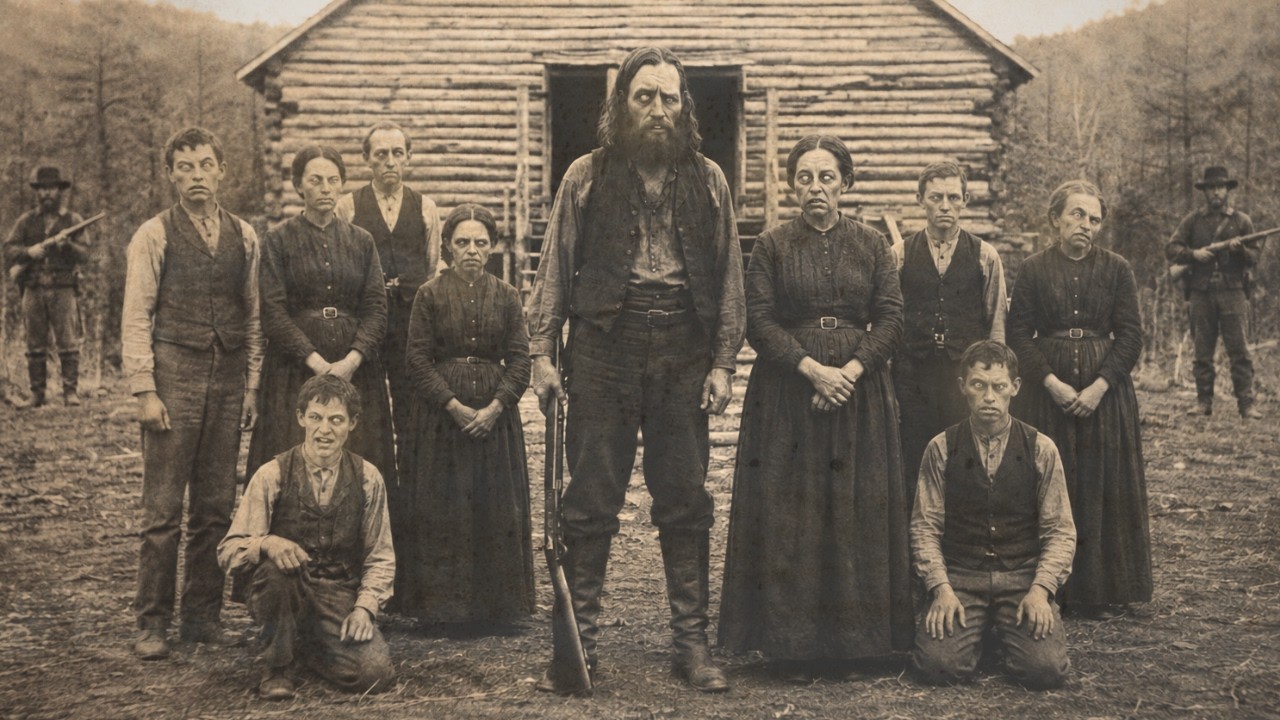
Josiah Bonner, according to surviving accounts, was a man of imposing physical presence and absolute authority within his household. He stood over 6 feet tall at a time when the average American man was 5 feet 7 inches. He wore his hair long and his beard unshaven. He carried a rifle wherever he went. And he gave sermons.
Those sermons are the key to everything that followed.
Josiah Bonner belonged to no recognized religious denomination. He did not attend church in Forsyth or Branson or any of the small settlements scattered through the White River valley. He conducted his own rituals on his own land. The doctrine he taught was something he either developed himself or drew from a tradition that left no written record.
The core of Josiah’s belief system, as reconstructed from surviving fragments, centered on a concept he called the Blood Covenant. The idea was deceptively simple. Josiah taught that God had not made a covenant with all of humanity, but with specific family bloodlines. Chosen bloodlines. And that the purity of those bloodlines was the most important obligation any believer could maintain.
Mixing blood with outsiders was not merely a sin. It was an act of cosmic rebellion against the divine order, carrying a punishment Josiah described in terms borrowed from the Old Testament but twisted into something far more extreme. According to Josiah’s doctrine, a bloodline contaminated through outside marriage or reproduction could only be purified through sacrifice. Not a symbolic sacrifice, not prayer or fasting or repentance, but physical blood sacrifice. The contaminated member had to be removed from the family, and all family members had to witness the removal so that everyone understood the price of breaking the covenant.
It is important to note that no direct writings of Josiah Bonner survive. No sermons, no journals, no letters. Everything known about his theology comes from secondhand accounts recorded decades after his death. Some of those accounts may be exaggerated. Some may have been distorted by time and the tendency of oral tradition to make details more dramatic than the original reality.
But the physical evidence that emerged in the years following Josiah’s death tells its own story, and it is unambiguous.
Josiah Bonner died in either 1894 or 1895. The exact date is unknown because no death certificate was ever filed. No grave marker was ever identified, although a cluster of unmarked stone slabs on the former Bonner property suggests a family burial ground. The cause of death is unrecorded. What was recorded, in a brief mention in the Forsyth newspaper in March 1895, is that the elder Bonner of the Stone County hills had passed, and that his son Ezekiel had taken over leadership of the family settlement. The article is only three sentences long. It appears on the last page beneath an advertisement for a patent medicine. It is the only contemporary acknowledgment of Josiah’s death in any surviving publication.
Ezekiel Bonner was about 37 years old when he took control of the compound. Everything about the family changed under his leadership except the doctrine. The doctrine remained the same. The Blood Covenant, the prohibition against outside contact, the belief in chosen family bloodlines, and the divine mandate to preserve their purity. All of it remained exactly as Josiah had established it.
What changed was the enforcement.
Under Josiah, the Bonners had been reclusive and hostile toward outsiders. But there are no surviving accounts of organized violence during his lifetime. The family stayed in their valley. They avoided settlements. They snarled at census takers and ran off surveyors. But the disappearances that would later define the Bonner story began only after Ezekiel took charge.
Ezekiel was not just an extension of his father. He was an escalation. Surviving physical descriptions of Ezekiel are strikingly consistent across different sources, which lends them some credibility. He was shorter than his father, about 5 feet 10 inches, but heavier and broader. He had a scar running from his left ear to the corner of his mouth, the source of which no one outside the family knew. He spoke in a low, measured voice that one neighbor later described as sounding like a man reading a court judgment. And he possessed a quality that many described using the same word: certainty.
Ezekiel Bonner never hesitated. He never softened his statements. He never appeared to wrestle with doubt. When he spoke, he did so with the quiet finality of a man who believed he was conveying direct instructions from a source that could not be wrong. For roughly 30 people living under his authority in the Bonner compound by the late 1890s, that certainty was the air they breathed.
The compound itself had grown significantly since the 1880 census. By the time Ezekiel took control, it included about 300 acres of hillside forest, two bottomland fields for crops, a cluster of six or seven log buildings arranged around a central meeting house, and a series of outbuildings for livestock and storage. The meeting house, which served as the site of Ezekiel’s sermons, was the largest building on the property. Built of hand-hewn oak logs, it could seat about 40 people on rough benches arranged in rows facing a raised platform at the front.
Services were held every night. Not weekly, nightly. Ezekiel preached after the evening meal, and attendance was mandatory for every member of the family. These sessions lasted from one to three hours. The content of the sermons, reconstructed from later accounts, focused obsessively on the themes Josiah had established: bloodline purity, the covenant, and the consequences of contamination. But Ezekiel added layers of specificity that his father apparently had not.
Where Josiah spoke in general terms about divine selection of family bloodlines, Ezekiel named specific families in the surrounding region whom he claimed carried corrupted blood. He identified individuals by name and declared them threats to the covenant. He described in precise detail what would happen, spiritually and physically, to any Bonner family member who allowed themselves to be influenced by or connected to these contaminated outsiders.
And he introduced a practice that had no precedent in Josiah’s teachings. He called it the Blood Trial.
The Blood Trial, as described by the few who eventually spoke about it, was a ritual test conducted on family members suspected of contact with outsiders. The accused would be brought before the full assembly in the meeting house. Ezekiel would interrogate them for hours, sometimes. The questions were specific and invasive. Where did you go? Who did you speak to? Did you touch them? Did they touch you? Did you eat their food? Did you drink their water?
If Ezekiel determined the contact was superficial, the accused would undergo a period of isolation. They would be confined in a small structure at the edge of the compound, described by one source as a root cellar with a locked door, for 3 to 7 days. During this time, they received only water, no food. Ezekiel described this as purification.
If Ezekiel determined the contamination was serious, or that there had been physical intimacy, or that the accused had formed an emotional bond with an outsider, the punishment was far harsher. Some accounts describe beatings, prolonged ritual beatings administered by Ezekiel himself while the assembled family watched. Other accounts describe something worse. A ritual in which the contaminated individual was cut with a hunting knife and forced to bleed into a basin. The blood was then poured onto the ground outside the compound boundaries as a symbolic rejection.
A few accounts, the most difficult to verify but also the most difficult to ignore, describe family members who underwent the Blood Trial and were never seen again.
The first outsider to raise formal concerns about the Bonner compound was a circuit-riding preacher named Thomas Yarnell. Yarnell traveled through the Ozark hills in the late 1890s and early 1900s, visiting remote farmsteads and holding services for families living too far from town to attend church regularly.
In the spring of 1901, Yarnell wrote a letter to the senior pastor of the Methodist Episcopal Church South, describing an encounter with a young woman he met on the road near the Bonner property. The letter, which remained in the church’s regional archive until a fire in 1943 destroyed most of the collection, was partially copied by a local historian in 1938. According to the copied text, Yarnell wrote that the young woman was barefoot, emaciated, and had visible bruises on her arms and neck. She told Yarnell her name was Sarah and that she had left the Bonner property on foot during the night while the family slept. She begged Yarnell to take her to Forsyth. She said that if Ezekiel’s men found her, they would kill her.
Yarnell’s letter continues with an account of how he put the woman on his horse and began riding south toward the county seat. Before they reached the main road, two men on horseback intercepted them. The men identified themselves as members of the Bonner family and told Yarnell that Sarah was sick and disturbed, and that they had come to take her home for treatment. Yarnell wrote that Sarah began trembling uncontrollably when she saw the men and whispered to him: "Don’t let them take me back."
The men took Sarah. Yarnell’s letter states that he did not resist because the men were armed and because he was unsure of his legal standing to intervene in what the men described as a family matter. He wrote that he felt enormous guilt about that encounter and had been praying about it ever since. The senior pastor’s response to Yarnell’s letter, if one was ever sent, did not survive.
Sarah Bonner, or whatever that young woman’s name was, never appeared in any later record. No mention of the name Sarah appears in the 1900 census record for the Bonner household, though the census data for that year in Taney County is notably incomplete. Several pages are missing from the original enumeration forms in the National Archives collection, and the pages that survived for the Bonner area show signs of water damage that made portions illegible.
Thomas Yarnell continued his circuit for several more years. In 1903, he wrote a second letter, this time to the Taney County sheriff, reporting that he had heard from settlers in the area that screaming could sometimes be heard coming from the Bonner valley at night. The sheriff at that time was a man named Franklin Rhodes. There is no record indicating Rhodes responded to the letter or took any investigative action.
The disappearances began in earnest around 1904.
The first documented case involved a man named William Spears, a timber buyer from Springfield who traveled through the Ozark backcountry purchasing standing timber rights from landowners. Spears was last seen at a general store in Walnut Shred in August 1904, where he told the store owner he intended to head north into the hills to survey timber on several properties, including land adjacent to the Bonner claim. Spears never returned to Springfield. His wife filed a missing person report with the Greene County sheriff in October 1904.
A search was organized in November. A group of six men headed into the hills north of Walnut Shred and spent three days combing trails and creek beds. They found Spears’ horse tied to a tree about two miles south of the Bonner property boundary, still saddled with empty saddlebags. The leather bag was never found. Neither was William Spears. The search party did not enter the Bonner property. When asked later why they stopped at the boundary, the party leader, a Taney County deputy named Clyde Massey, was quoted as saying: "We were looking for a missing man, not starting a war."
The second disappearance occurred in February 1905. A woman named Ada Ketchum, a midwife who served farms throughout the southern Ozark hills, failed to reach a cabin near Blue Eye where she was expected to assist with a birth. Ada was 61 years old and had been making the same rounds of farmsteads for over 20 years. She knew the trails better than most men in the county. Her route that week would have taken her along the north fork of Bear Creek, which passes within a mile of the Bonner property.
Her horse was found four days later, standing in an open area near the creek with her midwife bag still tied to the saddle. The bag contained clean linens, scissors, and several bottles of medicinal tinctures. Ada’s personal belongings, her coat, her money, and her small Bible, were not with the horse. Ada Ketchum was never found. Her family petitioned the county court for a death certificate, which was granted in 1908.
The third disappearance is the one that should have triggered an investigation. In September 1907, a family of four named Harkey, a father, mother, and two children under ten, vanished while traveling from their farm near Kirbyville to the town of Hollister. The Harkeys had sold their property and were relocating to Hollister, where the father, Delbert Harkey, had secured a job at a lumber mill. They loaded their belongings onto a wagon and left Kirbyville on a Tuesday morning. The road they were supposed to take passes within 3 miles of the Bonner compound. They never reached Hollister.
The wagon was found a week later, overturned in a ravine about 5 miles east of the Bonner property. The family’s belongings were scattered through the brush. The draft horse was dead, lying at the bottom of the ravine with a broken leg. There was no trace of the Harkey family. No bodies, no blood, no indication of what caused the wagon to leave the road and go over the hill.
The county sheriff at the time, Harold Pettit, the same man who would later investigate the disappearance of mail carrier Virgil Combs, ruled that the family had likely died in an accident and that their bodies had been carried off by animals. Four people, a father, mother, and two children, carried off by animals. All four, without leaving a trace. No one challenged the ruling.
This is where we need to talk about Harold Pettit.
Pettit served as Taney County sheriff from 1902 to 1914. He was elected three times, and each time he ran unopposed. He was well-liked in Forsyth, where he lived with his wife and three children in a painted frame house near the courthouse square. He attended the Baptist church. He served on the school board. By all outward measures, he was a respected member of the community.
But Harold Pettit had a connection to the Bonner family that he never publicly disclosed. His mother, born Lucinda Bonner, was the younger sister of Josiah Bonner. Harold Pettit was the first cousin of Ezekiel Bonner.
This fact does not appear in any contemporary record from Pettit’s tenure in office. It was not mentioned during his campaigns. It was not disclosed in any of the disappearance investigations he oversaw. The fact only emerged in 1936 when a WPA interviewer conducting oral history recordings in Taney County spoke with an elderly woman named Cora Shelton, who had been a neighbor of the Pettit family in the 1890s.
Shelton told the interviewer: "Everyone knew Harold was kin to the Bonners. His mother was a Bonner before she married a Pettit boy. But you didn’t talk about it. Harold didn’t like it talked about, and the Bonners didn’t like it either. It was just something everybody knew and nobody said."
The implications were staggering. The man responsible for investigating every disappearance in the Bonner vicinity for 12 years was a blood relative of the family most likely responsible for those disappearances, and the community knew it. They knew and they said nothing.
Why? Fear is the obvious answer, and probably the correct one. But there was something else at work as well. There was something specific about the culture and economy of the Ozark hill region in that era that made silence not just the safe choice but the logical choice.
Taney County government in the early 1900s operated effectively as a family business. The sheriff, county clerk, circuit judge, and three county commissioners were all chosen from a small group of interconnected families. The Pettits, Rhodes, Maddox, and Tabor families. These families intermarried, traded land, shared business interests, and protected each other’s interests. Challenging one of them meant challenging all of them.
For the scattered settlers living in the hills, challenging the county power structure meant risking the loss of whatever fragile stability they had managed to build. If you reported a disappearance and the sheriff ruled it an accident, it was an accident. If you objected, you might find your property taxes suddenly doubled, or your livestock seized for unpaid fees, or your well poisoned. This was not hypothetical. There are documented cases from that era of Ozark county officials using their positions to punish opponents and settle personal grudges.
The silence around the Bonner compound was not passive. It was enforced, and the enforcer wore an official badge.
Between 1907 and 1910, three more people disappeared in the vicinity of the Bonner property. A traveling salesman named Horace Grady vanished in the spring of 1908. A young man named Peter Kinley, who had been hired for seasonal timber work in the area, failed to return to his family in Arkansas in the fall of 1909. Then Virgil Combs, the mail carrier, in January of 1910.
Each disappearance followed the same pattern. The person was last seen on or near a road passing by the Bonner compound. The person’s horse or mule was later found, often still saddled, a few miles from the property. Personal belongings were either missing or arranged in a way that suggested deliberate placement rather than natural abandonment. And the sheriff’s investigation, such as it was, concluded quickly with a ruling of accidental death or unknown causes.
No one on the Bonner property was ever questioned. No search warrant was ever issued. No Bonner family member was ever interviewed as a witness, let alone as a suspect.
But the disappearances were not the only thing happening inside the compound. Something was happening to the family itself.
The 1910 census provides our clearest picture of the Bonner household. And the numbers tell a disturbing story. The census taker for that year, a man named Raymond Oaks, recorded 32 people living on the property. But here is the detail that jumps off the page. Of those 32 people, 26 bore the surname Bonner.
The ages of the children and young adults reveal a pattern of reproduction entirely consistent with what we know about the Blood Covenant doctrine. Every marriage in the family was between individuals who already bore the Bonner surname. Cousins married cousins in at least two cases, and the age gaps between spouses suggest that uncles married their nieces. The children born from these unions showed the consequences.
Oaks’ notes, more detailed than Allbright’s from 30 years earlier, indicate that many of the younger children suffered from what he called "obvious deformities." He did not specify the nature of these deformities, but he noted that at least three children could not walk, and that one, a boy of about seven, appeared to be deaf and mute.
The biological reality of sustained inbreeding within a small population is well documented. The concentration of recessive genetic mutations leads to increased rates of physical deformities, intellectual disability, weakened immune function, and shortened lifespan. In a small population like the Bonner compound, where roughly 30 people were reproducing exclusively within the same gene pool generation after generation, these effects would have become apparent quickly and worsened with each successive generation.
Ezekiel’s doctrine made this inevitable. The Blood Covenant required the family to reproduce only among themselves. Mixing blood with outsiders was the cardinal sin, so the family obeyed. They married their cousins. They bore children who paid the genetic cost of that obedience. And when those children were born damaged, Ezekiel had a theological explanation ready.
The deformities were not the result of inbreeding. They were the result of hidden contamination. Somewhere in the bloodline, someone had broken the covenant without being detected. The deformed child was proof of that sin, and the only solution was to identify the contaminated bloodline and purge it.
This was the engine driving the violence inside the compound. The doctrine created the conditions for genetic damage. The genetic damage was then interpreted as evidence of covenant violation. The perceived violation demanded punishment, which further concentrated the remaining gene pool, which produced more damage, which demanded more punishment. It was a death spiral built on theology and biology. Ezekiel stood at the center of it, interpreting every birth, every illness, every deformity as confirmation of his authority and the righteousness of his system.
The question of what happened to children born with severe disabilities is one the surviving sources only address obliquely. Cora Shelton, in her 1936 WPA interview, said that Bonner women sometimes gave birth to children who were "set aside." When the interviewer asked what she meant by "set aside," Shelton was silent for a long time, according to the interviewer’s notes, then said: "They weren’t raised." That was all she would say on the matter.
Another source, a letter written in 1924 by a retired physician named Calvin Hughes who had practiced medicine in the Ozark hills for 40 years, contains a passage relating to the Bonner family. Hughes wrote: "I was once called to attend a birth at a place in the hills I will not name. The child was born alive but with defects that were immediately apparent. The head of the household, a man of great presence and absolute authority over his people, examined the infant and declared that ‘the covenant had been broken.’ I was asked to leave. I never learned what became of that child. I did not ask because I already knew the answer, and I was afraid of what might happen to me if I acknowledged it."
Hughes does not name the Bonner family in his letter, but the description of the household head, the phrase "the covenant was broken," and the geographical references in the surrounding paragraphs make the identification nearly certain.
By 1910, the Bonner compound was a closed system consuming itself. The population had grown through internal reproduction only. The genetic consequences were compounding. Ezekiel’s grip on the family was absolute. And the surrounding community had learned, through a combination of fear, complicity, and deliberate ignorance, to pretend that the valley where the Bonners lived was simply empty space on the map.
But something happened in the spring of 1911 that broke this equilibrium. A woman came out.
Her name, or at least the name she gave, was Leah. She appeared at the general store in Walnut Shred on a Saturday morning in April 1911, wearing a homespun dress and barefoot. She asked the store owner for a drink of water. The store owner, a man named Cyrus Talbot, gave her water and a piece of bread, and immediately noticed that something was wrong.

Leah’s hands were covered in scars. Her teeth were in very poor condition. She was thin in a way that suggested not just hunger but chronic malnutrition. And she had a fresh wound on her left forearm, partially covered by a piece of cloth, that looked like a knife wound.
Talbot asked Leah where she had come from. She told him she had walked out of the hills. He asked where in the hills. She said the Bonner farm. According to Talbot’s account, which he related to a journalist 20 years later, the moment Leah said the name Bonner, everyone in the store went completely silent.
Leah told Talbot she was Ezekiel’s daughter. She said she was 23 years old, though Talbot thought she looked closer to 40. She said she had been married to her cousin Isaac at age 14. She said she had borne four children, two of whom had been taken away because Ezekiel declared they had broken the covenant. She said her husband Isaac had undergone the Blood Trial six months earlier and had not been seen since. And she said she had fled because Ezekiel had told her her turn was coming.
Talbot sent word to the county seat. A deputy sheriff named Wells came to Walnut Shred and spoke with Leah. Wells took notes on the interview, but those notes were never found. What we know of that conversation comes from Talbot’s later account and from a brief reference in a letter written by county judge Terrence Maddox.
According to Talbot, Leah described the compound in detail. She described the meeting house, the nightly sermons, the Blood Trial, and the punishments. She said Ezekiel kept weapons stored in a cellar beneath the meeting house, and that every adult male on the property carried a rifle or shotgun at all times. She said guards were posted on the ridgeline at night, and that anyone approaching the property without permission would be shot. She described an open area on the north side of the compound where she had seen freshly turned soil on multiple occasions, and where she believed bodies were buried.
Deputy Wells returned to Forsyth, and according to Talbot, discussed Leah’s account with Sheriff Pettit. What happened next is disputed because the two surviving accounts contradict each other.
According to Talbot, Pettit dismissed Leah’s claims as the delusions of a disturbed woman. He told Wells that the Bonners were eccentric but harmless, that family disputes were not the business of the sheriff’s office, and that Leah should be directed to the county poor farm if she needed assistance.
According to Judge Maddox’s letter, written in 1918 and addressed to the state attorney general’s office in Jefferson City, the situation was handled differently. Maddox wrote that Pettit did visit the Bonner property after Leah’s escape, but went alone. When he returned, he told Maddox that he had spoken with Ezekiel and that Leah’s claims were unfounded. Maddox wrote that Pettit appeared visibly agitated after the visit but refused to elaborate on what he had seen or discussed.
Whether Maddox’s account or Talbot’s account is more accurate, the outcome was the same. No formal investigation was opened. No warrant was issued. No charges were filed. And Leah herself disappeared from the record within weeks of arriving in Walnut Shred.
Talbot said two men came to the store one evening and took her, telling her that Ezekiel had forgiven her and wanted her to come home. Talbot said Leah went with them. He said she did not appear willing, but she went. Talbot told the journalist that Leah just looked at the ground and walked out the door. She didn’t say goodbye, and she didn’t look back. Leah was never heard from again.
The failure to act on Leah’s testimony in 1911 is one of the most damning aspects of this story. There was an eyewitness, a family member, making detailed claims of murder, abuse, and unlawful imprisonment. And the county law enforcement apparatus, led by a man who was secretly a blood relative of the accused, simply chose not to pursue it.
But Leah’s brief emergence from the compound had consequences that neither she nor Ezekiel anticipated. Because Cyrus Talbot talked. He told other store owners. He told travelers. He told anyone who would listen about the scarred woman from Bonner Hollow and the things she had described. And the word spread. Slowly, the way information travels in rural Ozark regions, but steadily. By the summer of 1911, the Bonner compound was no longer a secret known only to immediate neighbors. It was a growing rumor spreading through the wider region.
And that rumor eventually reached someone who could not be intimidated by the Taney County power structure.
His name was James Reed, a United States Marshal based in the Western District of Arkansas, which shared jurisdiction with federal courts covering parts of southern Missouri. Reed had spent 20 years chasing fugitives through Indian Territory and the Ozark borderlands. He was 56 years old, built like a blacksmith, and known to be methodical, fearless, and unbribable.
Reed first heard about the Bonner compound in the fall of 1911 from a timber agent who mentioned the disappearances casually during a conversation about unrelated matters. Reed was curious. He made inquiries. He wrote to the Taney County sheriff’s office requesting files on missing persons cases connected to the area. The response he received, if one was ever sent, was not preserved.
Over the following months, Reed compiled his own file on the Bonner situation. He tracked down relatives of the missing people. He spoke with settlers in the surrounding hills. He found Yarnell, the circuit preacher, and obtained a copy of his 1901 letter. He began to form a picture of the compound, one that was largely consistent with Leah’s account but went further in one crucial respect. Reed became convinced that the Bonner compound was not merely an abusive religious community. He believed it was the site of multiple murders, and he was determined to prove it.
In the spring of 1912, Reed petitioned the federal court in Fort Smith, Arkansas, for authority to investigate the Bonner property on the grounds that several of the missing persons had been carrying U.S. mail or engaged in interstate commerce at the time of their disappearances, providing a basis for federal jurisdiction. The petition was granted in April 1912, and Reed was authorized to form a posse and enter the property.
Reed chose four men for the operation. They were all experienced lawmen he had worked with before. They armed themselves with Winchester rifles and Colt revolvers, packed rations for a week, and headed north from the Arkansas border in the first week of May 1912.
What happened over the next 72 hours has been pieced together from Reed’s official report, filed with the federal court in Fort Smith, which survives in the National Archives, though portions are water-damaged and partially illegible.
Reed and his men reached the southern boundary of the Bonner property on the morning of May 8, 1912. They encountered the guards Leah had described, two armed men positioned on a ridgeline. Reed identified himself and asked to speak with Ezekiel Bonner. One of the guards disappeared into the woods while the other remained watching them with a rifle resting on his arm.
After about two hours, Ezekiel appeared. He was accompanied by six men, all armed. Reed described the confrontation in his report. "The elder presented himself with quiet authority and inquired as to our purpose. I explained that I held federal authority to investigate matters concerning missing persons believed to have been last seen in the vicinity of his property. He listened without expression and then stated that his family lived according to God’s covenant, and that no outside authority, federal or otherwise, had standing on his land."
Reed told Ezekiel he would enter the property regardless. Ezekiel replied, according to Reed: "Then you will answer to God for what happens next."
Reed and his men entered the compound at midday on May 8. What they found shocked even a man who had spent two decades in some of the most lawless territory in America.
The compound consisted of nine buildings, not six or seven as earlier estimates had suggested. The buildings were arranged in a rough semicircle around the central meeting house. The inhabitants, about 35 men, women, and children, were gathered inside and around the meeting house when Reed arrived. They did not speak to the lawmen. They did not move. They simply watched in a silence Reed described as "profound."
Reed’s men searched the buildings systematically. In the cellar beneath the meeting house, they found a weapons cache. Fourteen rifles, eight shotguns, hundreds of rounds of ammunition, and a collection of knives and axes. They also found chains and shackles for legs and arms, hand-forged from blacksmith iron and bolted into the stone wall of the cellar.
In a small building at the edge of the compound, the one that matched Leah’s description of the isolation cell, they found a wooden door with an iron lock. Inside was an earthen-floored space about 6 by 8 feet with no windows and no ventilation except a gap between the log walls. The floor was stained with dark patches. Reed noted that the smell was unbearable.
Then they went to the open area on the north side. Reed’s report describes what his men found in the clearing in matter-of-fact language that leaves no room for doubt. "Upon digging into the disturbed earth at the location indicated by the informant, we discovered human remains at a depth of approximately 3 feet. The remains were in varying states of decomposition, indicating burial at different times over a period of years. An initial count identified partial remains of at least nine individuals, including two who were small in stature consistent with children."
Nine bodies. At least two of them children.
Reed arrested Ezekiel Bonner and four other adult men on the property. He placed the women and children under the care of two of his men, and sent a rider to Forsyth to notify county authorities and request additional support for transporting the prisoners.
But here the story takes an infuriating turn. The rider reached Forsyth and delivered Reed’s message to Sheriff Pettit. Pettit’s response, as described in Reed’s subsequent report to the U.S. Attorney for the Western District of Arkansas, was extraordinary.
Pettit went to the Bonner compound and confronted Reed. He did not bring deputies. He did not bring a wagon to transport prisoners. He brought a lawyer. The lawyer, a man named Charles Hembree of Forsyth, argued that Reed had exceeded his federal authority, that the property fell within the jurisdiction of the state of Missouri, and that the arrests were illegal. Pettit endorsed this argument. He told Reed he would not recognize the federal warrants, and that if Reed attempted to transport the prisoners through Taney County, Pettit would arrest Reed’s men for kidnapping.
Reed was a federal officer. Pettit was a county sheriff. Theoretically, federal authority supersedes county authority. But practically, in the Ozark hills in 1912, whoever had local support and weapons had the upper hand. And Pettit had both.
Reed backed down. Not entirely, not permanently, but in that confrontation he withdrew from the compound with his men and returned to Arkansas to regroup. He left the prisoners in Pettit’s custody. That decision doomed any chance of justice.
Because once Reed was gone, Pettit released the Bonner men, all of them, within 24 hours. Pettit claimed the charges were unfounded. In a brief report filed with the county clerk’s office, Pettit stated that the remains found in the clearing were "ancient Indian graves" disturbed by Reed’s unauthorized digging.
Ancient Indian graves. Nine bodies, including children, buried in a clearing on property owned by a family that multiple eyewitnesses had accused of murder and abuse over 30 years, and the county sheriff dismissed them as ancient Indian graves.
Reed was furious. His report to the U.S. Attorney presented the facts with barely contained rage, describing Pettit’s actions as "obstruction of federal justice motivated by family loyalty and complicity in the concealment of criminal acts." Reed requested that the U.S. Attorney petition the federal court for new warrants and grant him authority to arrest Pettit himself for obstruction.
The U.S. Attorney’s response, dated July 1912, survives in fragmentary form. The relevant portion reads: "While this office appreciates the seriousness of the allegations and the diligence of Marshal Reed in investigating, the jurisdictional questions raised by the Taney County Sheriff’s office present complications requiring careful study. Moreover, the current political climate in the state of Missouri makes federal intervention in county affairs a matter of great sensitivity. We recommend referring this matter to the Missouri Attorney General for independent evaluation."
The Missouri Attorney General’s office took no action on the referral. There is no record indicating they even acknowledged receipt.
James Reed retired from the Marshal Service in 1914. In a letter to a colleague written just before his retirement, Reed described the Bonner case as "the one I carry with me, the one I could not close, the one that tells me more about the nature of justice in this country than any other case I ever worked." Reed died in 1921 in Fort Smith, Arkansas, at age 65. He never spoke publicly about the Bonner case. His family said he kept the file in his desk drawer until the day he died.

After Reed’s intervention and withdrawal, the Bonner compound entered a period the surrounding community later referred to as "the quiet years." From roughly 1912 until 1918, no disappearances were recorded in the area. No new complaints were filed. No outsiders attempted to enter the property. The Bonners simply retreated into their valley and closed their doors.
Settlers in the surrounding areas noticed the change immediately. Hunters who had previously avoided Bonner Hill reported seeing fewer guards on the heights. The smoke rising from the compound’s chimneys, which had been visible for miles on cold mornings, became intermittent. A farmer named Orin Buckley, who grazed cattle south of the Bonner boundary, told neighbors that the cornfields the Bonners had cleared were beginning to wither, and that the trees along the southern ridge showed no recent cutting. Buckley said the compound was quieting the way a sick animal quiets. He meant it was dying, and he did not mean it as a metaphor.
But the compound was indeed dying. The genetic consequences of generations of inbreeding were accelerating. The infant mortality rate within the family appears to have been catastrophic during this period, based on the number of small unmarked graves later found on the property. The children who survived were increasingly afflicted with physical and mental disabilities. The adult population was shrinking as the elderly died and the younger generation was too incapacitated to perform the labor required to maintain the farm.
Even Ezekiel himself was deteriorating. By the mid-1910s, he was in his fifties, an advanced age by Ozark hill standards. Multiple sources indicate he suffered from episodes of what modern medicine would classify as paranoid delusions. During these episodes, he would preach for hours about imminent attacks from outside forces and order the family to prepare for a siege. He became increasingly violent, conducting Blood Trials with greater frequency and severity.
And his theological pronouncements became more extreme in what may be the most disturbing aspect of his later doctrine. Ezekiel began teaching that the covenant required not just purity of blood but purity of form. Children born with visible deformities were not merely covenant breakers. They were, in Ezekiel’s terms, "vessels of the adversary." The presence of a "vessel of the adversary" within the household contaminated every family member. The solution Ezekiel prescribed for this contamination was the same solution he had always prescribed. Removal.
How many children were removed during the quiet years is unknown. The small graves on the property cannot be dated with precision, but the number is not insignificant. An estimate offered by a forensic researcher who examined photographs of the burial site in the 1960s places the number of child-sized graves at between 12 and 20.
Twelve to twenty children born into a closed community that revered genetic purity, inside a family controlled by a man who believed their deformities were evidence of divine punishment, killed and buried in an open clearing in the hills while the county sheriff protected the family from investigation and the state government looked the other way.
This is the hardest part of telling the Bonner family story. Not because the facts are uncertain, though some of them are, but because the scale of failure was absolute. Every institution that could have intervened failed to do so. Local law enforcement was complicit. State government was indifferent. The federal government was procedurally hesitant. And the surrounding community lived in fear. The Bonner children, born with bodies that carried the cost of their family’s doctrine, had no one to stand for them.
The end of the Bonner compound was not the result of justice. It was the result of collapse.
In the winter of 1918, the influenza pandemic reached the Ozark hills. The virus swept through isolated communities with devastating efficiency, and the Bonner compound was not spared. The combination of malnutrition, weakened immune systems from inbreeding, and a complete absence of medical care made the family catastrophically vulnerable.
By the spring of 1919, the compound was nearly empty. An estimated 15 to 20 family members died during the pandemic, though no death certificates were ever filed. The survivors, perhaps 10 or 12 people, were in such poor condition that they could no longer care for the farm. The fields were left unplanted. The livestock was slaughtered or died from neglect. The buildings began to deteriorate.
Ezekiel Bonner is believed to have died during the influenza outbreak, though there is no record of his death. Some accounts place his death in late 1918. Others say he survived the flu but died shortly afterward, alone and weakened in the meeting house where he had preached his bloody doctrine for 25 years.
The last Bonner family member to leave the property was a woman identified in later accounts only as Martha. She appeared in Branson in the summer of 1919, malnourished and disoriented, and was taken in by a family named Clemens who ran a boarding house. Martha reportedly did not speak for several days after her arrival. When she finally did speak, she told the Clemens family that everyone was dead. She said it simply and without emotion, as if describing the weather.
Martha lived with the Clemens family for about two years. She never spoke in detail about the compound or about Ezekiel. She never used the word cult or covenant. She worked in the boarding house kitchen and attended Sunday services at the Branson Methodist Church. The Clemens daughter, interviewed decades later, remembered that Martha would sometimes stand at the kitchen window after dark and stare north toward the hills without moving for 10 or 15 minutes at a time. If anyone spoke to her during those moments, she would start violently, as if brought back from somewhere very far away. The daughter said Martha never smiled, not once, in two full years.
Then one morning in 1921, Martha disappeared. Her bed was made. She left behind her few possessions. A pair of shoes the Clemens family had bought for her sat by the door, untouched. She left barefoot, just as she had arrived. No one looked for her.
The Bonner property remained abandoned through the 1920s and 1930s. The buildings rotted. The forest reclaimed the open spaces. The trails leading into the valley filled with brush and weeds. By the time anyone from the outside returned to the property, which appears to have happened in the early 1940s when a U.S. Forest Service survey crew mapped the area for potential timber sales, the place was barely recognizable as having been inhabited by humans. The surveyors noted the collapsed buildings, the abandoned fields, and the stone-ringed graves in the north clearing. They did no digging. They did not report the graves to any law enforcement agency. They marked the area on their survey map and moved on.
The deliberate erasure of the Bonner family story from historical records is not speculation. It is documented.
In 1936, the Works Progress Administration sent interviewers into the Ozark region as part of the Federal Writers’ Project, which aimed to compile oral histories and regional folklore from across the United States. Several of the interviews conducted in Taney and Stone counties contain references to the Bonner family. The Cora Shelton interview, mentioned earlier, is the most detailed. But there are others.
A man named Edgar Sims, interviewed in 1937, told the interviewer that his father had known Josiah Bonner, and that the Bonners were "the darkest thing in these hills." He said his father had warned him as a child to stay away from the Bonner valley, and that the warning was not paternal caution but a survival instruction. "If you went up there, you didn’t come back," Sims said. "That wasn’t just a saying. That was a fact."
Another interview with a woman named Pearl Osborne contains a reference to the disappearances. Osborne said her uncle had been part of the search party for William Spears in 1904, and that her uncle had told the family they found Spears’ horse but the sheriff would not let them continue searching. She said her uncle believed Spears was dead, and that the Bonner boys had killed him for what he was carrying.
These WPA interviews were collected and preserved in the state archive in Jefferson City. But here is the critical detail. The original interview transcripts for Taney and Stone counties were partially redacted before the records were archived. Specific passages were struck through with heavy black ink. Names were removed. In several cases, references to the Bonner family were deleted entirely from the texts.
Who authorized these redactions? The archive records do not say. The redactions bear no initials of the responsible officials. There is no memo explaining the reasons behind them. But the pattern is clear. Every significant reference to the Bonner family, every mention of the disappearances, every detail about the compound was specifically targeted for removal.
This was not accidental damage. It was not careless editing. It was a deliberate effort to erase the Bonner story from the public record. And it happened inside the state archive, meaning whoever did it was someone with access to government files and the authority, or at least the opportunity, to alter them without oversight.
The timing of the redactions is also suspicious. The WPA interviews were conducted between 1936 and 1938. The redactions appear to have been made before the materials were catalogued and stored, placing them in the late 1930s or early 1940s. Harold Pettit died in 1933, but his son, Harold Pettit Jr., served as Taney County clerk from 1930 to 1948. Draw your own conclusions.
The rediscovery of the Bonner story began in the 1960s when a University of Missouri graduate student named David Easterlin was researching Ozark folk religion for his doctoral dissertation. Easterlin stumbled upon the partially redacted WPA interviews and noticed the censorship patterns. He began tracing the threads.
Over the next three years, Easterlin tracked down relatives of the surviving WPA interviewees. He found descendants of Cyrus Talbot, the Walnut Shred store owner. He located copies of Thomas Yarnell’s letters. He obtained portions of James Reed’s report from the National Archives. And he made several trips to the former Bonner property, where he photographed the ruins of the compound and the unmarked graves in the north clearing.
Easterlin’s dissertation, completed in 1967, included a 40-page chapter on the Bonner family. It was the first comprehensive account of the compound ever assembled. But when Easterlin tried to publish his dissertation as a book, he encountered resistance. Two university presses declined to publish it, citing concerns about the verifiability of oral history sources. A commercial publisher expressed interest but wanted Easterlin to rewrite the Bonner chapter to present the story as folklore rather than documented history. Easterlin refused.
He self-published a limited edition of 200 copies in 1971. Most were distributed to academic libraries and folklore collections. The book received no reviews and attracted no attention outside a small circle of Ozark historians. Easterlin died in 1989. His research notes, including interview transcripts, photographs, and correspondence, were donated to the Western Historical Manuscript Collection at the University of Missouri, where they remain today. They have been cited in only three published works since his death.
The physical evidence of the Bonner compound has almost entirely disappeared. The site is now part of the Mark Twain National Forest. The foundations of the buildings are buried under decades of leaf litter and forest growth. The graves in the north clearing have never been professionally excavated.
In 2003, a group of amateur historians from the Ozarks Regional Historical Society attempted to organize a formal archaeological survey of the Bonner site. They submitted a proposal to the Forest Service requesting permission to excavate the graves and building foundations. The proposal was denied. The Forest Service cited concerns about disturbing potential Native American burial sites, which would trigger compliance requirements under the Native American Graves Protection and Repatriation Act.
The Forest Service’s response echoed, perhaps unknowingly, the same justification Sheriff Pettit had offered 90 years earlier. Ancient Indian graves. Different century, same excuse.
The Ozarks Regional Historical Society appealed the denial. The appeal was rejected in 2005. No explanation was given beyond a reference to ongoing land management priorities.
A local journalist named Karen Whitfield wrote a three-part series about the Bonner compound for the Branson Tri-Lakes News in 2007, drawing on Easterlin’s research and her own interviews with descendants of families who lived near the property. The series lasted one week. On day eight, Whitfield received a phone call from a lawyer representing an unnamed party who claimed the articles contained defamatory statements about a family with living descendants. Whitfield asked which statements were defamatory. The lawyer declined to specify. The newspaper’s editor removed the series from the online archive the following Monday. Whitfield left the newspaper six months later. She told a colleague that the editor had advised her to stop pursuing the story, and that the advice had not been phrased as a suggestion.
To this day, the Bonner graves remain unexcavated. The identities of the people buried there remain unknown. The full scope of what happened inside the compound between 1882 and 1918 remains undocumented. And the cover-up that protected the Bonner family during their active years has been succeeded by a cover-up of a different kind. Not an active conspiracy of silence, but a passive one. A bureaucratic unwillingness to open a door that has been closed for a century.
The Bonner story is not an anomaly. It is an extreme example of a pattern that repeated throughout the Ozark hills during the late 19th and early 20th centuries. Isolated communities ruled by charismatic patriarchs. Theologies weaponized to justify control and violence. Local power structures that protected abusers because they were kin. And a broader society that found it easier to look away than to intervene.
What makes the Bonner case exceptional is not the existence of the cult itself. Cults form in every era and every place. What makes it exceptional is the completeness of the erasure. The deliberate redaction of public records. The destruction of evidence. The legal maneuvering that prevented federal investigators from doing their jobs. And the century of silence that followed.
The people who disappeared near the Bonner compound, William Spears, Ada Ketchum, the Harkey family, Virgil Combs, and others whose names we may never know, deserve to be remembered. Not as marginal notes in a folklore collection. Not as local legends. But as victims. As human beings who had names and families and lives that were taken from them by a belief system that valued blood purity over human life, and by a power structure that valued family loyalty over justice.
And the children, those born inside the compound, who carried in their bodies the genetic price of Ezekiel’s covenant, who were declared vessels of the adversary and buried in an open clearing in the hills, those children deserve something they never received and that the system still refuses to give them. They deserve to be found. They deserve to be counted. They deserve to have their names remembered.
Until someone with the authority and the will excavates those graves, the Bonner cover-up is not a historical event. It is an ongoing one. The valley is still there. The graves are still there. The bones of the children are still in the ground, unmarked and uncounted, in a national forest in the Ozark hills of southern Missouri. And no one is digging.