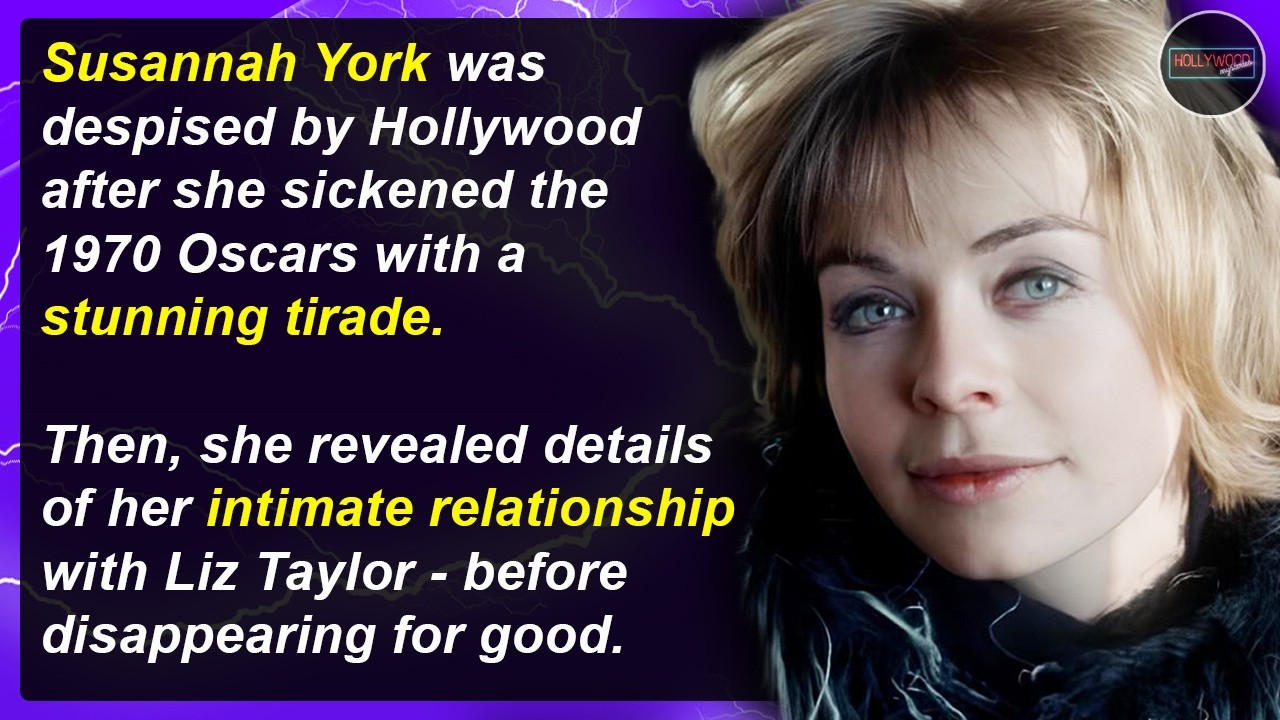
When Susanna York learned she had been nominated for an Academy Award without being consulted, her reaction was not gratitude but outrage. The British actress publicly rebuked the Academy in 1970, saying she was “offended to be nominated without being asked,” a stunning display of defiance from someone on the cusp of Hollywood stardom. She attended the ceremony anyway, applauding politely as Goldie Hawn took home the Oscar for Best Supporting Actress. But the incident cemented her reputation as a woman who refused to play by the industry’s rules.
Born Susanna Yolande Fletcher in Chelsea, London, on January 9, 1939, York grew up in a well-to-do but fractured family. Her father was a steel magnate and her mother the daughter of a diplomat; the couple split when Susanna was young, and she and her mother moved to a remote Scottish village. There, among windswept hills, her imagination flourished, and by the age of nine she had discovered acting after delighting in playing an ugly stepsister in a school production of Cinderella. At 13, York was expelled from her boarding school for going skinny dipping in the school pool under moonlight, a mischievous streak that foreshadowed her later defiance of convention.
Undeterred, she won a place at the Royal Academy of Dramatic Art, where her classmates included Peter O’Toole and Albert Finney, and she graduated in 1958 carrying the Ronson Award for the school’s most promising student. She married fellow acting student Michael Wells in 1959, a move that surprised friends given her fiercely independent nature. The following year she made her film debut opposite Alec Guinness in the military drama “Tunes of Glory,” swiftly followed by roles that showcased both her beauty and her range. Critics began to note an “impish wildness” lurking behind her delicate, blue-eyed features.
Her breakthrough came in 1961 with “The Greengage Summer,” released in the US as “Loss of Innocence. ” At 21, York delivered a sensual performance as a teenage girl discovering her seductive power, making her a sought-after leading lady. But she bristled at being typecast as a demure English rose. “I was terrified people would think I was dull,” she later admitted.
“The truth was I was a bit of a rebel. ”
In 1962, John Huston cast her opposite Montgomery Clift in “Freud: The Secret Passion,” a demanding role that showed her dramatic depth. She remained wary of the movie-star machinery, later confessing she had treated cinema with a certain arrogance, thinking films were “for pretty people” and that she was destined for something more serious. The role that turned her into an international name came in 1963 with “Tom Jones.
” Director Tony Richardson pursued her for the part of Sophie Western, but York turned it down three times before succumbing to guilt. As she told it, she invited Richardson to lunch, served him a disastrously inedible meal, and felt so guilty that she finally accepted. The film won the Oscar for Best Picture, and York became a household name on both sides of the Atlantic. Fame did not sit comfortably.
“I did not want to have an image,” she said. “Being a star seemed to lock you into an image, and I was always frightened of that because I knew I would disappoint people. ” She deliberately chose roles that stretched her, appearing in the 1966 film “Kaleidoscope” opposite Warren Beatty, whose relentless flirting she recalled having to fend off with words like “Come on, cool it, Warren. ” That same year she delivered a poignant performance in the Oscar-winning historical drama “A Man for All Seasons” as Margaret More.
Through the late 1960s she worked steadily across genres alongside leading men including William Holden, Dirk Bogarde, and Christopher Plummer. But her most controversial role came in 1968 with “The Killing of Sister George,” one of the first mainstream films to openly depict a lesbian relationship. Directed by Robert Aldrich, the film earned an X rating and was heavily cut by censors in Britain and the US. York played Alice, the fragile and emotionally volatile young lover of an older woman, a role she acknowledged taxed her deeply.
“I could accept the idea of lesbianism philosophically,” she reflected, “but playing intensely emotional scenes with another woman taxed all my resources as an actress. ”
The production was complicated by a feud between her co-stars Beryl Reid and Coral Browne. “Beryl and Coral were chalk and cheese,” York recalled. “But they liked me, so I was kind of the jam in the sandwich.
I got on well with each individually, but they loathed each other. ” The role cemented her reputation as a fearless performer willing to smash social conventions. By the end of the decade, Hollywood had taken notice. Executives called her the most important star to come out of England since Elizabeth Taylor.
Her American breakthrough came in a dark drama that would bring her both an Oscar nomination and a very public clash with the industry. The film was Sydney Pollack’s “They Shoot Horses, Don’t They,” starring Jane Fonda and Michael Sarrazin, about a grueling Depression-era dance marathon. York played Alice, a down-on-her-luck would-be starlet whose dreams collapse in a harrowing mental breakdown. Her performance earned her a BAFTA and an Oscar nomination for Best Supporting Actress.
But when she learned of the nomination, she reacted with fury rather than joy. In an interview with the London Evening News, she called the nomination presumptuous and unwelcome. The press had a field day, and Hollywood columnists branded her ungrateful. She had no interest in being anyone’s packaged ingenue.
After the Oscars, she made clear her disdain for her own nominated work. “I don’t think much of the film or of myself in it,” she said. She also gave frank interviews criticizing America’s obsession with age, its brashness, and the commercialism of the US film industry, comments that hardly endeared her to studio bosses. She simply shrugged and returned to London.
Back in Britain, she took on a dark family drama called “Country Dance” (also known as “Brotherly Love”) about an uneasy quasi-incestuous relationship with her unstable brother, played by her friend Peter O’Toole. Her marriage to Michael Wells was beginning to unravel by the early 1970s; they divorced in 1976 but remained amicable, raising their two children, daughter Sasha and son Orlando. In 1971 she starred opposite Elizabeth Taylor and Michael Caine in “X, Y and Zee” (released in the US as “Zee and Co. ”), a melodrama in which York’s character becomes the lover of Caine’s character, only to be targeted by Taylor’s vengeful wife.
The film gave York the chance to tell journalists she had an “erotic relationship” with Taylor, adding fuel to the promotional fire even though it was strictly on-screen. Her greatest artistic triumph of the decade came in 1972 with Robert Altman’s haunting film “Images,” a cerebral psychological drama in which she played a children’s author losing her grip on reality. The film leaned heavily on her performance, and she won the Best Actress prize at the Cannes Film Festival. The role drew on a whimsical unicorn story she had written herself, foreshadowing a later career as a published children’s author.
She continued to take unusual roles, appearing in “The Maids” (1974) with Elizabeth Taylor and Glenda Jackson, in which the actresses played murderous, possibly insane servants caught in erotic roleplay. She worked in Australia and Canada through the late 1970s, and in 1978 she accepted a small part in Richard Donner’s blockbuster “Superman” as Lara, the biological mother of Superman, sharing the screen with Marlon Brando in the film’s prologue. She reprised the role in “Superman II” and later voiced the character in “Superman IV. ” York was pragmatic about these commercial gigs, acknowledging they paid the bills.
After her divorce, she briefly dated the psychologist Dr. Nicholas Humphrey in the late 1970s, a relationship far outside the show business world. But her primary focus was her children and her craft. As her son Orlando later remembered, “She loved nothing more than cooking a Sunday roast and sitting around the fire of a winter’s evening.
”
By 1980, York had pivoted decisively toward the stage. In 1978 she appeared in “The Singular Life of Albert Nobbs,” playing a woman in 19th-century Ireland who lives as a man in order to survive. The role astonished audiences and critics, and she went on to perform Jean Cocteau’s one-woman monologue “The Human Voice” on global tours, and even learned her lines in French to perform in Paris. In 1984 she played Mrs.
Cratchit in a starry adaptation of “A Christmas Carol,” with both of her children cast as Tiny Tim’s siblings. In 2001 she created her own labor of love, a solo show called “The Loves of Shakespeare’s Women,” in which she performed monologues from Juliet to Lady Macbeth. By her sixties, she had become a theatrical missionary, bringing high art to fringe festivals and regional stages. Her political convictions ran deep.
Raised with a Scots Presbyterian sense of social duty, she was a committed left-leaning activist who campaigned for nuclear disarmament. In 1984 she organized a star-studded peace benefit years before such events became common. Her most dramatic political act came in 2007 on a stage in Tel Aviv, where she dedicated her performance to Mordechai Vanunu, the Israeli whistleblower who exposed Israel’s secret nuclear program. The dedication drew loud boos and shouts from the audience, though a few cheered her courage.
She stood her ground amid the cacophony. Through it all, York remained strikingly grounded. She lived in a comfortable home near Clapham Common in London, avoided the celebrity spotlight, and wrote two children’s fantasy novels. In a 1991 interview, she described herself as a “hardworking character actress who longs to play drunks and nasties.
Can also do comedy, she’s been told. ” The self-deprecating wit captured her refusal to treat herself as a star. In August 2010, at the age of 71, York stepped onto the stage of the Oxford Playhouse to perform in a production of “Quartet. ” It was her final performance.
She had been diagnosed with multiple myeloma only months earlier, and she kept the news private, even declining chemotherapy so she could honor her contract and not miss the show. Her son Orlando later said she was incredibly brave in those final months. After the production ended, York began treatment, but the disease progressed quickly. On January 15, 2011, she died peacefully at the Royal Marsden Hospital in London, surrounded by her children.
She was 72. The Guardian remembered her as one of the most memorable faces of the 1960s British film industry who never stopped pushing her limits. The Telegraph recalled the “blue-eyed English rose” who surprised everyone with her extraordinary emotional range. She left behind her two children and a grandson and granddaughter to whom she was devoted in her final years.
Susanna York’s life was one of contradiction: a woman who scaled the heights of stardom yet was never comfortable in its spotlight, who took on daring, taboo-breaking roles long before it was fashionable, and who had the audacity to scold the industry itself at the pinnacle of her fame. In her own words, she was at heart a frustrated wild child. Beneath a refined exterior lurked a free soul, full of mischief, daring, and a hunger for authentic expression.