James Longstreet, the senior Confederate general who served as Robert E. Lee’s most trusted commander, found himself the target of a campaign of destruction after his death. But the campaign was not waged on a battlefield — it was waged in history books, memoirs, and the pages of the Southern press. Longstreet was virtually the only high-ranking Confederate officer who understood that the age of the heroic frontal assault was dead.
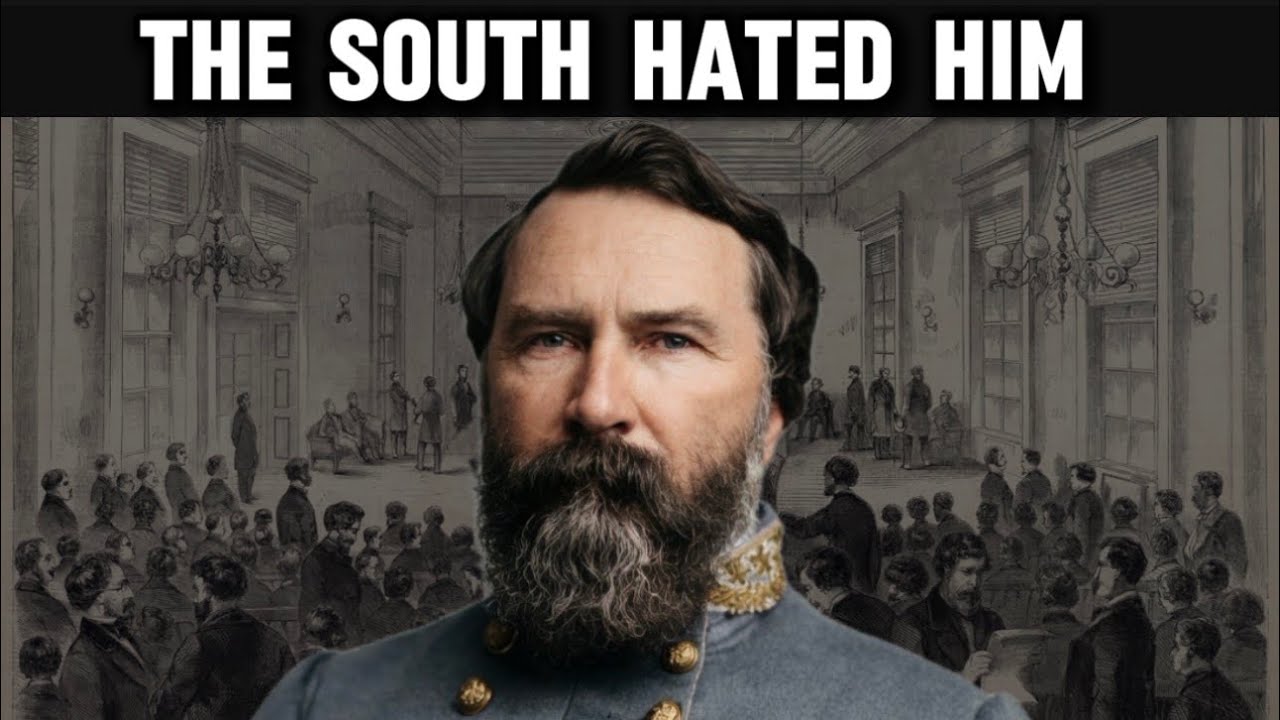
He recognized that the rifled musket and the new Minié ball had extended the killing range of infantry from 50 yards to over 300 yards, making defensive positions nearly impregnable. While his peers saw glorious opportunity in open-field charges, he saw a slaughterhouse. At the Battle of Fredericksburg in December 1862, Longstreet’s defensive philosophy proved devastating. His troops, positioned behind a stone wall at Marye’s Heights, cut down wave after wave of Union infantry.
His artillery chief predicted that a chicken could not live on the field once the guns opened up — the prediction proved horrifyingly accurate. The battle produced the highest casualty imbalance of the entire war. Robert E. Lee called Longstreet his “old warhorse.
” The nickname acknowledged both his dependability and his total lack of vanity. While officers like J. E. B.
Stuart rode into battle wearing peacock feathers and silk sashes, Longstreet dressed in a battered wool coat and moved through camp without fanfare. The divide between Lee’s romanticism and Longstreet’s pragmatism reached a breaking point at Gettysburg in July 1863. Longstreet had agreed to the northern campaign only on the understanding that the army would maneuver into a strong defensive position and force the Union to attack. When the armies collided at Gettysburg, Lee found the enemy on the high ground of Cemetery Ridge and insisted on attacking.
Longstreet pleaded with Lee to swing the army around the Union flank and cut supply lines. Lee refused, pointing toward the Union center and declaring that was where he intended to strike. On July 3rd, Longstreet was assigned to oversee the grand frontal assault that would forever bear George Pickett’s name. He was so overcome with dread that he could not speak the words to authorize the charge.
Pickett asked if he should advance; Longstreet bowed his head in silent agony. Some 15,000 Confederate soldiers stepped into open fields and marched toward Cemetery Ridge. Modern artillery and rifled muskets tore massive gaps in their lines. The charge was a catastrophic failure and shattered the myth of Confederate invincibility.
A personal tragedy had hardened Longstreet’s cold realism. In January 1862, a scarlet fever outbreak swept through Richmond and took the lives of three of his young children — Mary, James, and Augustus. The shattered father returned to command a changed man, withdrawing into a quiet, icy demeanor. He developed an absolute intolerance for wasteful death on the battlefield.
Longstreet was also one of the few Confederate officers who understood what was coming when Ulysses S. Grant took command of all Union armies in 1864. Longstreet had known Grant before the war and had served as best man at his wedding. When fellow officers expressed confidence they would drive Grant back as they had done with previous Union commanders, Longstreet corrected them.
Grant, he warned, would fight every day and night until his objective was secured. At the Battle of the Wilderness in May 1864, Longstreet executed another brilliant flank attack along an unfinished railroad bed. But as he rode forward to direct the final push, Confederate soldiers from a nearby brigade mistook him for Union cavalry in the thick smoke. He was struck in the neck and shoulder by his own men’s fire, wounded so severely that he was knocked out of action for six months and permanently lost the use of his right arm.
When Longstreet returned, the war had descended into the siege of Petersburg — miles of trenches that previewed the Western Front of World War I. It was exactly the type of war he had predicted. But the Confederacy lacked the manpower and industrial capacity to survive a battle of attrition. At Appomattox in April 1865, with the Union Army surrounding Lee’s exhausted remnants, several officers proposed scattering into the woods to carry on a guerrilla war.
Lee asked Longstreet’s opinion. Longstreet forcefully rejected the idea, recognizing that a guerrilla campaign would turn the South into a lawless wasteland without changing the outcome. When a soldier has lost the ability to win on the battlefield, he argued, his duty shifts to saving his men from meaningless slaughter. Longstreet then made a radical choice that set him apart from almost every other southern leader.
He publicly stated that since the South had submitted the questions of slavery and secession to the sword, and the sword had decided against them, it was the moral obligation of every southern citizen to accept that judgment without reserve. In 1868, he joined the Republican Party — the party of Abraham Lincoln — and endorsed Grant for president. To the political elite of the defeated South, this was an unforgivable act of treason. He was labeled a scalawag and a traitor to his race.
Old battle companions refused to shake his hand. Newspapers that had once praised him began a systematic campaign to destroy his character. In September 1874, Longstreet’s commitment to the new reality was paid for in blood. Serving as commander of the Louisiana State Militia and the city’s integrated police force under the Reconstruction government, he faced an armed white supremacist organization known as the White League.
Some 8,000 men had assembled to overthrow the elected governor and forcibly disarm the black population. Longstreet strapped on his sword, mounted his horse, and personally led a force of black policemen and state militia into the streets to hold the line for federal authority. At the Battle of Liberty Place, he rode into the direct fire of men who had once served under his command in the Army of Northern Virginia. He was struck in the leg by a spent bullet and knocked from his horse.
His integrated force was temporarily overrun, and he was dragged from the field by his troops and held as a political prisoner until federal troops arrived. The response from former Confederate leaders was a campaign of historical assassination that lasted over a century. Led by former General Jubal Early and supported by the Southern Historical Society, ex-Confederate writers manufactured the myth of the Lost Cause — portraying the southern war effort as a flawless crusade of marble heroes defeated only by overwhelming northern numbers. To make the myth work, they needed a scapegoat to explain Lee’s loss at Gettysburg.
They targeted Longstreet, fabricating a timeline claiming he had deliberately disobeyed Lee’s orders out of jealousy. Memoirs were altered, wartime dispatches were selectively edited, and false testimonies were recorded. Robert E. Lee, who died in 1870, became untouchable — any failure had to be assigned to someone else.
Longstreet, with his Republican politics and his command of black troops, was the perfect target. For decades, statues of Lee, Stonewall Jackson, and Stuart were erected across the South. Longstreet’s name was deliberately left off monuments, removed from textbooks, and spoken with contempt. He spent his final decades writing articles and a massive memoir, “From Manassas to Appomattox,” using official war records and maps to defend his reputation.
But the public did not want the truth about the war; they wanted a beautiful, tragic myth. When Longstreet died in January 1904 at age 82, he was the last surviving member of the Confederacy’s high command. His passing was treated with cool indifference by the people he had spent four years defending. He was buried in Gainesville, Georgia, with a modest ceremony largely ignored by the southern political establishment.
His grave remained without a proper state monument for nearly a century. In 1998, more than 90 years after his death, a small statue of Longstreet was finally placed at Gettysburg — hidden in the woods of Fitzsimmons’s Woods rather than standing on the main boulevard alongside the grand monuments of his peers.