On December 21, 1866, 81 US soldiers, scouts, and officers marched into a carefully orchestrated Native American trap in the Wyoming Territory and were annihilated in less than an hour. Their mutilated bodies were later found scattered across the frozen ground near Fort Phil Kearny, miles from the safety they had left behind. The clash became known as the Fetterman Fight, the U. S.
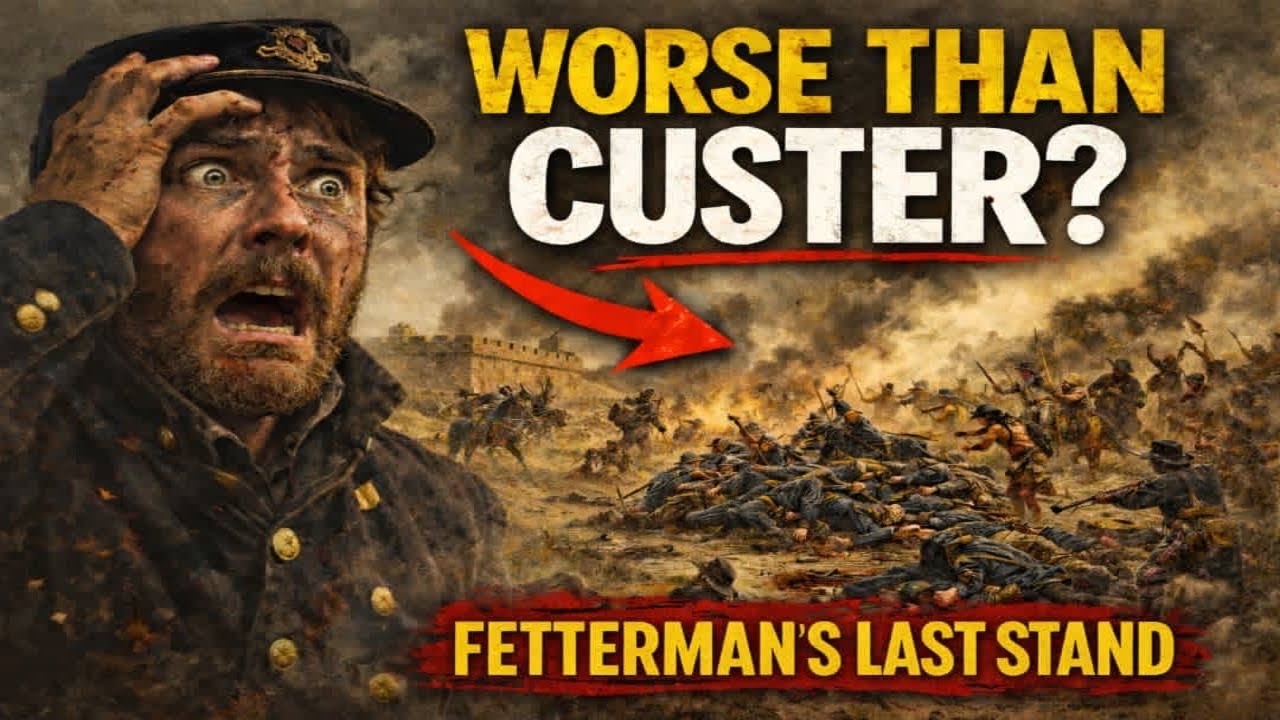
Army’s worst defeat on the Plains until Custer’s Last Stand at Little Bighorn a decade later. It was not a chaotic skirmish but a surgical ambush driven by months of planning, spiritual prophecy, and deep grievances over broken treaties. The Powder River country, spanning parts of today’s northern Wyoming and southern Montana, had been guaranteed to the Lakota under the 1851 Fort Laramie Treaty. For years, the region remained largely untouched, rich with bison herds and sacred to the Lakota way of life.
That arrangement began to unravel in 1863, when John Bozeman carved a trail through prime hunting grounds, funneling miners and settlers into tribal lands without consent. By 1866, the U. S. military had entrenched the intrusion by building forts, including Fort Phil Kearny, along the route.
Lakota leader Red Cloud, a principal chief of the Oglala band, attended treaty renewal talks that same year only to find troops already occupying the disputed territory. He called the negotiations a sham, walked out, and launched what became one of the most effective Indigenous resistance campaigns against U. S. expansion on the Plains.
Commanding Fort Phil Kearny was Colonel Henry Carrington, a Civil War organizer with a cautious, defensive style. He focused on fortifications and supply lines while war-hardened junior officers, fresh from battles like Shiloh and Gettysburg, dismissed his restraint as weakness. The garrison was under constant harassment. Warriors picked off woodcutters, stampeded herds, and shadowed every patrol, choking the fort’s resources and morale.
Captain William Fetterman arrived in November with a reputation for aggressive tactics and made no secret of his contempt for Carrington’s caution. He reportedly boasted that with 80 men he could ride through the entire Sioux nation. His confidence set the stage for a confrontation with the colonel just weeks later. Tensions peaked after a failed skirmish on December 6, when Carrington’s flanking attempt fizzled in a blizzard and the warriors escaped untouched.
Fetterman grew more vocal in his criticism, while Carrington recognized the discipline and cunning of the forces surrounding his post. On the morning of December 21, alarms sounded as warriors attacked the wood train about three miles from the fort. Carrington dispatched reinforcements under Lieutenant James Powell but deliberately limited the relief force to 80 men. He ordered them not to pursue beyond Lodge Trail Ridge, beyond cannon support and sight lines from the fort.
Fetterman assumed command upon arrival, joined by Lieutenant George Grummond’s 27 cavalrymen, 49 infantry soldiers, two civilian scouts armed with rapid-fire Henry repeaters, and volunteer Captain Frederick Brown, who reportedly sought a final fight before his transfer. In total, exactly 81 men set out. Waiting for them were between 1,000 and 2,500 Lakota, Cheyenne, and Arapaho warriors, a coalition driven by months of raids and unified by shared grievances. The Cheyenne, in particular, were still haunted by the 1864 Sand Creek massacre of their people.
Days before the battle, an Oglala medicine man named Crazy Mule had conducted a ritual widely believed to grant spiritual power and prophesied that 100 white men would be killed. The warriors embraced the vision as a promise of victory, and the fight that followed would come to be known as the Battle of the Hundred in the Hands. As Fetterman’s column secured the wood train, decoys appeared on the distant slopes. The bait was led by a 24-year-old warrior in his breakout battle, Crazy Horse, who would later become one of the most legendary Lakota leaders.
His riders taunted the soldiers with flapping robes and feigned stumbles, staying just beyond rifle range and drawing the command northward over Lodge Trail Ridge. Fetterman could have turned back after his objective was complete. Instead, he pushed forward, his aggressive instincts overriding the warning Carrington had hammered home. The infantry lagged behind the cavalry, stretching the column dangerously thin across frost-covered ground.
When the soldiers crested the ridge, they were blind to the fort and fully exposed. They descended into a basin where the warriors lay concealed in gullies, behind boulders, and flattened in the dead grass. As the decoys wheeled away, the trap slammed shut. War cries erupted from all directions.
The eastern contingent blocked the rear, the western force pinned the core, and the northern wave drove between the cavalry and infantry, splitting the command into fragments. At the fort, soldiers heard two faint volleys, then silence. Carrington ordered a relief force under Captain Ten Eyck, which arrived to find only desecrated bodies scattered across the slope. The infantry hunkered down on the south side in a ragged formation, their single-shot Springfield rifles no match for waves of arrows and close-quarter attacks.
Slow reloads spelled doom in the open. The cavalry lunged for boulder clusters but were swarmed by warriors who rode close enough to strike coups, a practice considered the highest form of bravery. Fetterman and Brown fought back to back until Oglala warrior American Horse slashed deep gashes across the captain’s chest and throat. Brown, seeing no way out, turned his revolver under his chin and took his own life.
The scouts, Wheatley and Fisher, anchored themselves at a lone tree with their Henry repeaters, firing over 100 rounds in a desperate stand until they were overrun. Their bodies were later found surrounded by brass casings, a testament to their last fight. Most of the 81 dead showed wounds from clubs, lances, and blades, not bullets. Only six had gunshot wounds.
Their bodies were stripped and ritually marked, a practice meant to prevent the dead from troubling the living. The warrior casualties were far lighter, with estimates ranging from 13 to 60. Ten Eyck’s men halted at the ridge’s edge, fearing another trap, and found the scene that has come to symbolize the battle: 49 infantry piled on the slope, cavalry pierced among the boulders, and the scouts’ tree surrounded by spent shell casings. Many of the rescuers were sickened by what they saw.
Wagons carried the dead back to the fort, where morale cratered under isolation and fear. Red Cloud’s coalition had delivered a crushing statement. The fight shattered the U. S.
Army’s confidence in the region and marked the beginning of a broader campaign that would eventually force the abandonment of the Bozeman Trail forts. Crazy Mule’s prophesied figure of 100 off by just 19 became a point of spiritual triumph for the Lakota and their allies. The Fetterman Fight was a stark demonstration of hubris colliding with preparation, and it remains one of the most studied and sobering engagements in the history of the American Plains.