In 1584, Ivan the Terrible died, leaving behind a dynasty in ruins. Of his eight children, only one would ever sit on the throne, and within fourteen years of his death, the Rurikid bloodline that had ruled Russia for over seven centuries was extinct. The story of that extinction began with tragedy. Ivan’s first child, Anna, born in 1549 to his beloved first wife Anastasia Romanova, died in infancy.
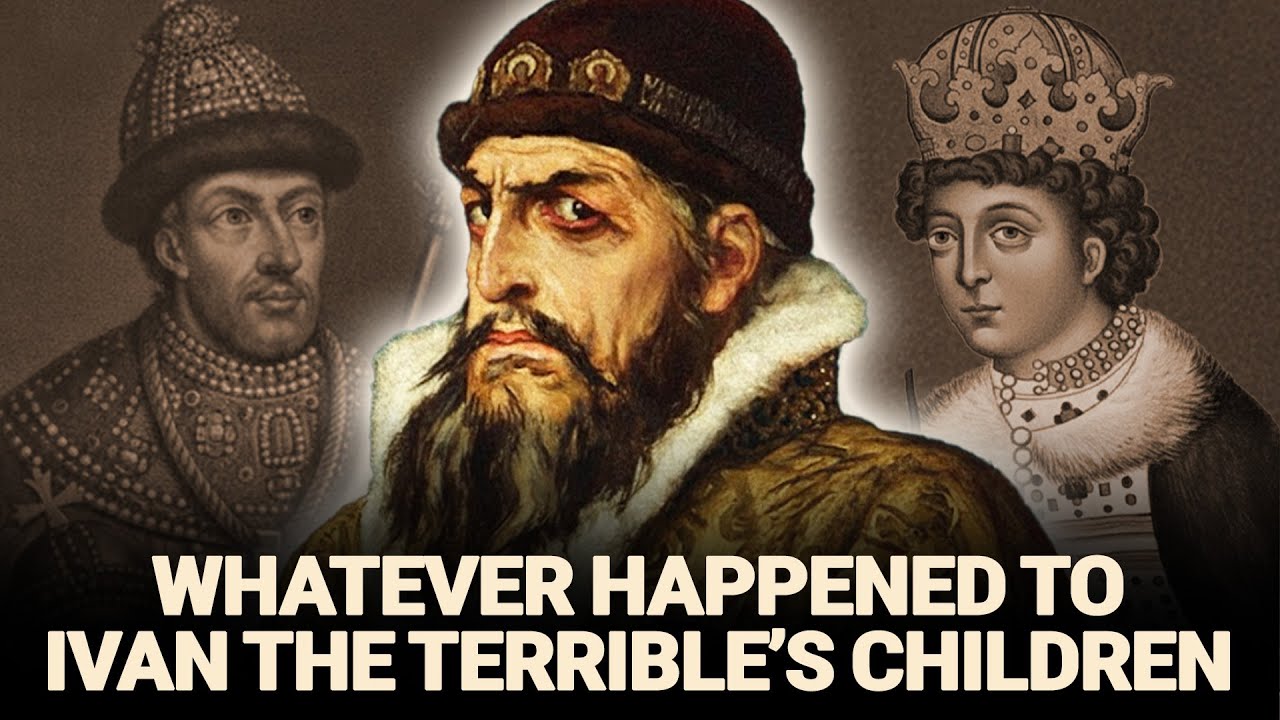
A second daughter, Maria, followed the same fate around 1552. Both were buried in the Cathedral of the Archangel, their graves now unmarked. In 1552, the birth of a son, Dmitri, seemed providential, arriving in the same year Ivan conquered Kazan. But the infant died in May 1553 during a pilgrimage to the Trinity Monastery, less than eight months old.
The loss devastated Ivan and deepened his growing distrust of the boyar nobility. A second son, Ivan Ivanovich, was born in 1554 and survived into adulthood. He received an extensive education, proved himself in military campaigns, and became the most capable of Ivan’s heirs. By his late teens he was taking on real governance, moderating his father’s worst excesses and managing diplomacy with European powers.
His life ended violently in November 1581. During an argument with his father over military strategy, Ivan the Terrible struck his son with his iron-tipped staff. The blow proved fatal. Ivan Ivanovich died three days later at age 27.
His father reportedly tore his hair and called for his own death in remorse, but the capable heir was gone. Another son, Vasili, was born in 1563 to Ivan’s second wife, the Circassian princess Maria Temryukovna. He died in infancy the same year. A daughter, Udoxia, born in 1556, also died young in 1558, during the final illness of her mother Anastasia.
Anastasia’s last child, Theodore, was born in 1557. Gentle, deeply pious, and apparently limited in intellect, he was unsuited to rule. After his brother’s death, he became the sole heir. In 1580 he married Irina Godunova, sister of Boris Godunov, who would soon dominate the government.
Theodore became tsar in 1584. Effective power lay with Boris Godunov, who managed the administration, military, and diplomacy while Theodore focused on religious affairs. The most notable achievement of his reign was the establishment of the Moscow patriarchate in 1589, a matter in which Theodore showed genuine personal competence. His marriage produced no surviving children.
As his health declined in the 1590s, the succession question became acute. Theodore died on January 7, 1598, the last legitimate Rurikid tsar. His widow briefly claimed power but soon retired to a convent. Boris Godunov was elected tsar shortly afterward.
Ivan’s final child, Dmitri, was born in October 1582 to his controversial seventh wife, Maria Nagaya. His legitimacy was questioned under Orthodox canon law, and after Ivan’s death, the infant and his mother were sent to Uglich, effectively in exile. In May 1591, at age eight, Dmitri died under suspicious circumstances. The official investigation ruled his death an accident during an epileptic seizure, but few believed it.
Riots broke out in Uglich, and his mother was forced into a convent. Dmitri’s death triggered decades of turmoil. Within a decade, pretenders claiming to be the resurrected prince appeared, fueling the Time of Troubles, a period of foreign invasion and near-total collapse that lasted until the election of Michael Romanov as tsar in 1613. The new dynasty maintained a blood connection to Ivan through his first wife, Anastasia Romanova.
Three of Ivan’s children were eventually canonized by the Russian Orthodox Church: Theodore, Dmitri of Uglich, and later Ivan Ivanovich. Their tombs in the Cathedral of the Archangel remain a monument to a dynasty that survived Mongol invasion and foreign war but could not survive the simple failure to produce heirs.