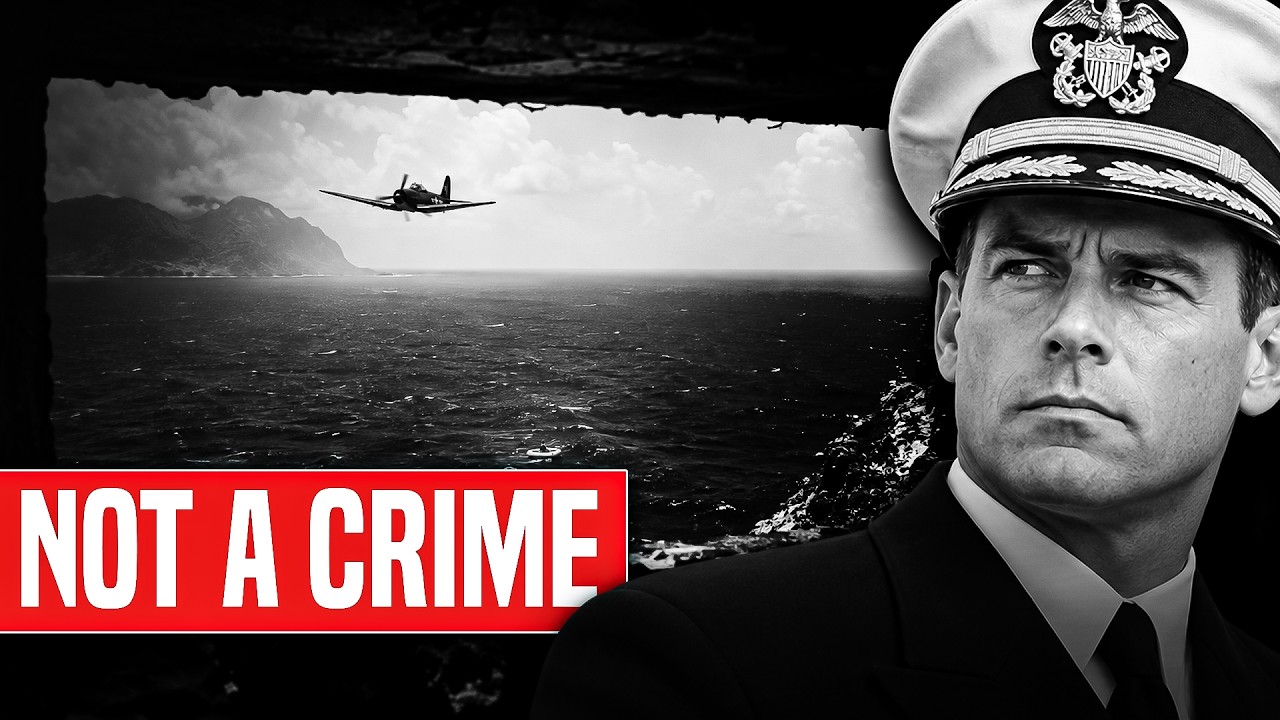
On September 2, 1944, a 20-year-old Navy pilot named George Bush was shot down over the Japanese island of Chichijima. He survived, was rescued by a submarine, and went on to become the 41st president of the United States. But the eight other American airmen who went down near the same island were not so lucky. Most were captured by the Japanese garrison.
Several were executed, and according to testimony at a postwar war crimes trial, some of their remains were consumed by Japanese officers. The case became one of the most disturbing episodes of the Pacific War, and it ended with five Japanese officers hanged by the U. S. Navy on Guam.
Bush launched from the light carrier San Jacinto on the morning of September 2, 1944, as part of a strike against a Japanese radio station on Chichijima, a volcanic island about 150 miles north of Iwo Jima. He was flying with two crewmen: his regular radioman, John Delaney, and a substitute gunner, Lieutenant Junior Grade William White, who had asked to join the mission. Their Avenger torpedo bomber was hit by anti-aircraft fire before reaching the target. Bush held his dive long enough to drop his bombs on the radio station, then turned out to sea with the plane on fire.
He ordered his crew to jump. When no one answered, he went over the side himself, striking his head on the tail of the aircraft as he fell. Pilots behind him saw a second parachute deploy but never open. Neither Delaney nor White was ever found.
Bush landed in a yellow raft and began paddling with his hands because the breeze was pushing him toward shore. A Japanese boat came out to capture him, but another American pilot strafed it and stopped it. More than two hours later, the submarine USS Finback surfaced about seven miles from the island and pulled him aboard. The next day, Bush wrote to his parents.
His mother kept the letter. “My heart aches for the families of those two boys with me,” he wrote. Over the following months, American carriers and bombers returned to Chichijima repeatedly, and more American planes went down in the area. Some of the airmen who survived crashes were picked up by the Japanese garrison.
By the count used in the U. S. Navy’s later charges, eight airmen were killed on the island. The first documented step in the American investigation came with Japan’s surrender.
On September 3, 1945, a year and a day after Bush went into the water, Japanese Lieutenant General Yoshio Tachibana signed away the Bonin Islands aboard the destroyer USS Dunlap. The garrison of Chichijima and nearby Hahajima numbered more than 20,000 soldiers and sailors. That October, U. S.
Marines landed to arrange the repatriation of the garrison to Japan. The officer in charge, Marine Colonel Presley Rixey, was nominally there to handle logistics. But he met daily with a Japanese commission assigned to assist him, and he asked what had happened to the American flyers who had been captured on the island. The commission produced a story built to hide what had been done, including a hurriedly assembled false burial site.
Rixey did not believe it, but he had no witnesses to prove otherwise. The first solid clue came from a man named Frederick Savory, a great-grandson of Nathaniel Savory, an American who had settled the Bonins in 1830. Savory, a Japanese citizen, had been in exile in Japan and returned to Chichijima after the war. According to Time magazine’s report on the case, Savory brought investigators their first reports of executions on the island.
It took about five months of statements before the full picture emerged. The captured airmen had not been held in one camp. They had been parceled out, one to a unit, and several spent weeks with their captors. As the fighting on Iwo Jima continued through February and March 1945, the prisoners were killed one after another.
Tachibana had given the order that captured flyers were to be executed. One young officer, a student called up from school named Koken Suchiya, was initially told to carry out an execution himself, but another student with a higher rank volunteered and took the sword instead. Suchiya, as officer of the watch, walked the American to the place of execution. In the battalion of Major Sueo Matoba, Navy pilot Floyd Hall was executed on the afternoon of March 9, 1945.
That morning, Matoba had called two officers in and told them face to face what would be done with Hall’s body afterward. After the war, he wrote out that order from memory for investigators in three numbered paragraphs, with his name and the hour at the bottom. It went into the evidence. The Navy held its war crimes trials on Guam, at a large Quonset hut on Nimitz Hill.
Prosecutors filed charges in February 1946 against Tachibana, Vice Admiral Kunizo Mori, Matoba, Captain Shizuo Yoshii, and more than 20 others across several proceedings. Rear Admiral Arthur Robinson presided over the commission, and the historian Timothy Maga writes that Robinson wanted evidence, not horror stories. The accused had American counsel and Japanese counsel, including civilian lawyers from Japan who worked without pay. In September 1946, the prosecution put Matoba’s own confession before the commission.
Time reported that the only explanation offered for what was done was, in two words, “war madness. ” A Captain Kasuga testified that he had seen American prisoners tied to stakes near Tachibana’s headquarters, though his credibility was questioned. A key witness was Fumio Tamamuro, a Japanese American who had been born in America, was visiting relatives in Japan when the war started, and was drafted into the Japanese army and sent to the island. He described the execution of an American radioman he had befriended, down to the leather jacket and scarf the man was wearing.
The prosecution had already found a jacket and scarf like that beside a road on the island, near remains too far gone to identify. The prosecutors faced a legal problem they could not get around: the officers’ meals. Murder was a crime, and the commission could try it. But testimony said that livers taken from executed prisoners had been served at officers’ messes, and that act was not listed as a crime anywhere in international law.
Time noted that the practice was so far outside what anyone had imagined that no rule had been written against it. So the Navy charged murder, and beside it a second charge that did exist: prevention of honorable burial. The Geneva Convention of 1929 required that prisoners who died in captivity be honorably buried. The evidence of the meals went in under that heading.
The proceedings ran in stages from May to September 1946. Tachibana heard his death sentence that October. The commission condemned five of the accused to death: Tachibana, Matoba, Yoshii, and two others. Five drew life sentences, including Admiral Mori.
Fifteen more received prison terms. The count of the dead stayed where the charge sheets put it, at eight. A review of historian Chester Hearn’s book on the case summarizes his findings as more than 100 American airmen lost over and around the island, only three of them rescued by submarines, and 20 or more taken alive. Of those, three were shipped to Japan, and the rest were killed on Chichijima.
Maga writes that accusations against Tachibana ran into the hundreds, but little physical proof remained. The garrison had built a cover story and a false burial site. Several of the dead were never identified, and the men who could have given a full list were the men on trial for their lives. Admiral Mori never went home.
The Dutch wanted him for the killing of prisoners in the East Indies in the first months of the war, when he had commanded there, and a Dutch court sentenced him to death. He was executed in April 1949. Some popular accounts say the Navy hanged him on Guam, but in fact the Navy gave him life, and the Dutch executed him. Koken Suchiya, the young officer who walked Warren Vaughn to his death, became a lawyer and later president of the Japan Federation of Bar Associations.
He said the case was where his legal work began. The student officer who took the sword from him was sought by war crimes investigators after the surrender and took his own life in his home district. On one point, the sources disagree. At a talk in 2008, Suchiya insisted that no one ate Vaughn’s body and said he had turned back two starving soldiers who tried to dig it up that night.
A magazine investigation by writer Kumiko Kakihashi, published in Japan the year before, says the opposite. Nothing in the reachable files decides between them. Bush himself flew again after his rescue. He spent a month aboard the Finback, hitched rides back to the San Jacinto instead of going home, and finished the war with 58 attack missions.
During the 1988 presidential campaign, a crewman from another Avenger on the raid told reporters that Bush had been the only man to jump from his plane. The squadron commander’s report said otherwise, and so did a Japanese document found later on Chichijima, which noted that a second man had jumped from the aircraft and his parachute had failed. The families of the other airmen were told little. Floyd Hall’s brother James went through his life believing Floyd had died on impact when his plane hit the water, until author James Bradley telephoned him while writing a book about the eight.
Bradley has said the government kept the trial secret, but the documents tell a slightly different story. Time printed Matoba’s confession in 1946, and newspapers carried the grim details at length after the trials. What stayed out of the papers was the names of the victims. On September 24, 1947, the Navy hanged Tachibana, Matoba, Yoshii, Lieutenant Colonel Kikuji Ito, and one more officer from the island on Guam.
Navy News reported that the hangings took place quietly somewhere in the interior. The Navy buried the five there in unmarked graves on American military land.