A frontier surgeon could handle a bullet. Lead balls pushed tissue aside, leaving a wound channel he could understand, and the body could sometimes wall one off with scar tissue, allowing a man to carry the lead inside him for years. An arrowhead offered no such negotiation. In 1862, U.
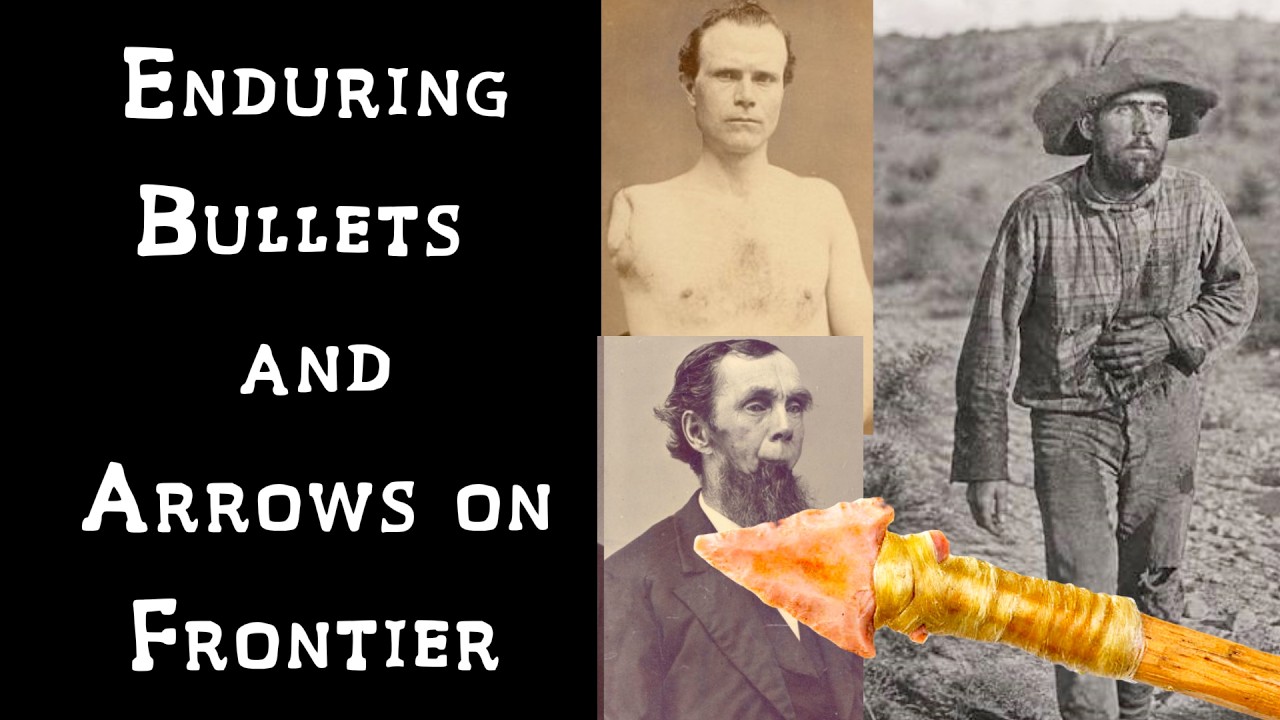
S. Army surgeon J. H. Bill published his findings from Fort Defiance, New Mexico, a 22-page study based on treating living patients and examining the dead.
His conclusion required no elaboration: arrows caused more deadly wounds than any other weapon, especially when surgical help was unavailable. This was the history the frontier actually made—not legend, not myth, but a plain record of what men did, what it cost them, and what it cost the people who stood in their way. The arrow’s design was the source of everything that followed. Native arrowheads were made of flint, obsidian, bone, or traded metal, with edges sharp as a razor—unlike any bullet.
The head was fixed into a split in the wooden shaft and bound with dried animal sinew, wrapped wet and shrinking tight as it dried. Hide glue and pine pitch sealed the binding. The dry climate was the decisive factor. Once an arrow penetrated the body, it entered an environment of blood and tissue fluid.
The sinew began to dissolve within minutes, then the hide glue. Army surgeon Captain H. S. Kilbourne documented this outcome in 1881.
Body fluids loosened the binding, and if the head was not removed at once, it came loose and separated when extraction was attempted. The shaft came out. The head stayed behind—disengaged, sharp-edged as stone, moving with every breath the patient took. A bullet, the body could resist.
An arrowhead, it could not. The rough, barbed edges of a flint head could not be encapsulated by scar tissue. With every movement the patient made, those edges cut into new tissue. With every breath.
With every attempt to sit up. The body’s inflammatory response, its effort to expel the foreign object, formed an abscess that the arrowhead’s constant motion prevented from closing. Infection was not a threat—it was an arrival. The only question was whether it would arrive faster than the surgeon could.
Dr. Bill left no doubt about the need for surgical intervention. It was better to cut open the patient’s limb and find the arrowhead. Finding it was the first problem.
The wound channel had closed behind the arrow’s path, compressed by surrounding tissue down to the diameter of the shaft, leaving the surgeon nothing to follow but fingers working blindly through living flesh. No imaging. No probe sensitive enough to navigate accurately. A man on a table, awake, having drunk whatever whiskey remained in camp, while the surgeon cut a narrow path by touch alone.
That was the straightforward case. When an arrowhead struck bone—and it did so repeatedly, piercing a rib, the shoulder blade, the skull, or the bones of the long limbs—dense tissue clung to the rough stone, preventing any pull the surgeon could apply safely without damaging surrounding tissue. Dr. Bill’s solution was a forceps with jaws curved at a right angle, which did not pull, but grasped the arrowhead laterally, catching its widest dimension perpendicular to the wound channel, rotating it free rather than dragging it through the tissue that held it.
An instrument designed specifically for this problem, in this country, for these wounds. When bone itself had to be penetrated, when the skull itself had seized the arrowhead, the tool was a cylindrical bone trephine. The surgeon passed a thread through the skull around the embedded head, making an opening larger than the wound, and extracted the head through the hole he had created. Army records documented soldiers who survived arrows to the skull.
They survived because a surgeon reached them in time to cut through the bone that held the arrowhead in place. The field kit available to that surgeon contained whiskey, cotton, and whatever carbolic acid reached the wound. Which was not much in the 1860s and most of the 1870s. Joseph Lister’s antiseptic methods were not standard army practice.
Even years after the worst frontier wars, surgeons packed the wound, waited, and watched for the rising fever that signaled infection had passed the point of excision. Infection on the frontier was not a risk—it was expected. The only factor the surgeon could rely on was whether he had removed the cause before infection arrived. Arrow wounds to the chest or abdomen carried mortality rates that no available treatment could significantly change.
An arrowhead that separated from its shaft inside the chest cavity, came to rest against a rib, moved with every breath, and drove its edges into lung tissue with every inhale, created a wound the surgeon could not safely reach and the body could not locate. Dr. Bill examined these men. He wrote his conclusions in language as simple and precise as a man documenting something he could not yet repair.
The men who survived arrow wounds owed their survival more to physical strength than to treatment. Years of hard outdoor labor had given them a margin the wound had to consume before reaching the threshold of death. If the sinew had not fully degraded, if the shaft came out with the head attached, and if the surgeon recognized his luck before it was too late, a man had a reasonable chance. If the head had already separated by the time he reached the operating table, the odds shrank dramatically.
Not many survived. An arrow in the hands of a trained warrior at close range was accurate, silent, and fast—six to eight shots in the time it took a soldier with a Springfield rifle to reload once. And it left behind a wound a skilled surgeon might spend a full hour on without certainty he had healed it completely. The army surgeons who worked at frontier posts understood the warriors who carried those weapons.
They studied them, treated the wounds they caused, and documented the results with remarkable precision, as men whose records were filled with cases they had lost. What kept them awake at night was not the warrior himself, but the wound he left inside a man on the operating table—still moving, still cutting, long after the fighting had ended.