Jennifer Fitzgerald spent decades at the right hand of George H. W. Bush before becoming one of Washington’s most talked-about but least documented figures. In August 1992, during Bush’s re-election campaign, she was thrust into the national spotlight when allegations of a decades-long affair appeared in print, threatening to unravel his presidency.
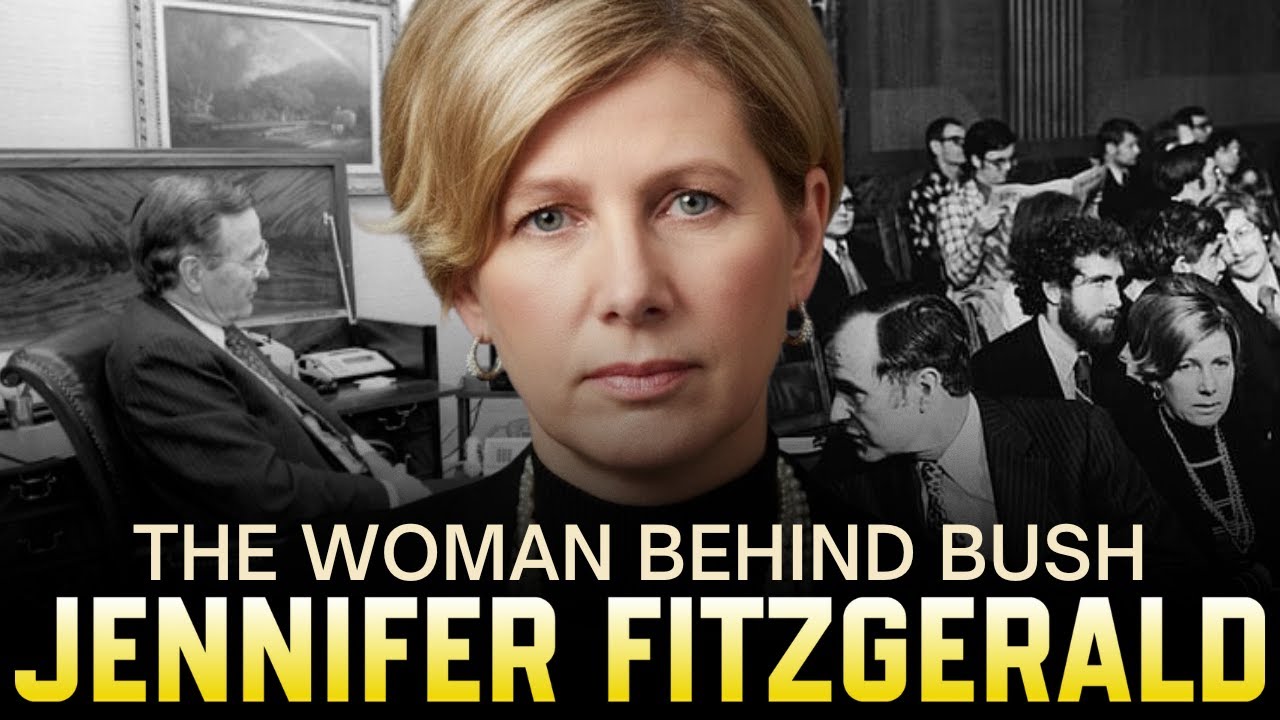
Born Jennifer Anne Isabel Patterson Knight in the United Kingdom in 1932, she was the daughter of a British Army officer. She immigrated to the United States as a child and was later naturalized as an American citizen, but she retained a clipped, formal accent throughout her life. Her early attempt at marriage, to a man named Fitzgerald, ended in divorce within a year and produced no children. She never remarried.
Her political career began when she met Bush in 1973. He had just been appointed chairman of the Republican National Committee, a politically toxic assignment during the Watergate crisis. Bush was overwhelmed by the pressure, and friends suggested Fitzgerald as a secretary who could impose order on his chaotic operation. The professional chemistry was immediate.
Staffers at the RNC soon noticed changes in how Bush operated. His desk was organized, his schedule became disciplined, and access to him was strictly controlled. Fitzgerald was efficient, unsentimental, and unafraid to say no on his behalf. She quickly became more than an assistant: she became his confidante, his strategist, and his emotional anchor during a period that was devastating his party.
When Bush was appointed chief of the US liaison office in Beijing in 1974, he requested that Fitzgerald accompany him. Her presence was highly irregular, since career State Department staff normally filled such posts. Inside the isolated, pressure-cooker environment of the liaison office, the bond between them deepened. They were often seen together: playing tennis, sharing meals, and attending diplomatic functions as a pair.
It was during the Beijing years that one of the most famous anecdotes about their relationship emerged. According to accounts that circulated among diplomats, Bush’s family cocker spaniel once trotted into a room carrying a pair of beige pantyhose while his wife Barbara was out of the country. The implications were widely understood, and the story became a staple of Washington gossip. Bush returned to Washington in 1975 to lead the CIA, and Fitzgerald followed him to Langley.
When he became vice president in 1981 under Ronald Reagan, she was appointed his executive assistant. She became the gatekeeper outside his office, controlling access, returning memos with red ink, and intercepting calls. Staffers gave her the nickname “the Dragon Lady,” and her conflicts with senior advisers such as Chief of Staff Craig Fuller and Admiral Daniel Murphy became legendary. James Baker, Bush’s close friend and campaign manager, considered Fitzgerald a serious political liability.
During the 1980 campaign, she was reportedly kept off the campaign plane and assigned to a desk job in New York to keep her away from the press. But once the election was won, Bush brought her back. He was unwilling to operate without her. The most damaging allegations surfaced from a 1984 trip to Geneva, where Bush led a nuclear disarmament delegation.
Decades later, Ambassador Louis Fields went on the record describing unusual accommodations: Bush and Fitzgerald were reportedly given connecting rooms with an internal door, bypassing standard security and protocol arrangements. Fields said his staff was horrified but the arrangement was kept. By the 1988 presidential campaign, the rumors had become a serious strategic vulnerability. Campaign manager Lee Atwater believed that if the story broke, Bush’s “family values” brand would be destroyed.
The task of confronting the vice president fell to his son, George W. Bush. According to insiders, the younger Bush delivered a blunt ultimatum: keep Jennifer or win the presidency, but not both. Bush agreed only to a partial solution: Fitzgerald would be removed from the inner circle during the campaign.
Rumors still surfaced. In October 1988, the stock market briefly dipped on speculation that the Washington Post was about to publish an expose. When asked by a Newsweek reporter about rumors of infidelity, George W. Bush denied it sharply, saying, “The answer to the big A question is no.
” The “A” was understood to stand for adultery. Later that month, Donna Brazile, a field director for the Dukakis campaign, told reporters that the American people had a right to know “if Barbara Bush will share that bed with him in the White House. ” The backlash against Brazile was immediate. The Dukakis campaign fired her, and mainstream media declined to pursue the story.
Bush won the election in a landslide. When Bush was inaugurated president in January 1989, Fitzgerald was not given a position in the White House. She was appointed deputy chief of protocol at the State Department, a respectable role that kept her physically and politically distant from the Oval Office. She accepted the demotion quietly and remained out of the spotlight for three years.
The story finally broke in August 1992, when journalist Susan Trento published a book that included Ambassador Fields’ account of the Geneva arrangement. The New York Post ran a cover story with the headline “The Bush Affair” alongside photos of Bush and Fitzgerald. Spy magazine followed with a feature that included the Beijing pantyhose story and other details. Even Hillary Clinton appeared to allude to the affair.
In a Vanity Fair interview about her own marriage, she said, “We’re not like some people who are in a rote marriage and just keeping up appearances. ” The comment was widely interpreted as a swipe at the Bushes. The pressure culminated in a moment of genuine crisis for the president. At a press conference in Kennebunkport, Maine, CNN reporter Mary Tillotson asked Bush directly about the allegations.
He responded with visible anger. “I’m not going to take any sleazy questions,” he said. “You’re not going to get down in the gutter with me. ” He called the question filth and accused the media of lowering the discourse.
Barbara Bush stood by her husband publicly. She maintained a stoic public posture throughout the scandal. But the affair allegations contributed to the perception that Bush was hiding something and belonged to an older political era. He lost the 1992 election to Bill Clinton.
In the final weeks of the administration, Fitzgerald was fined $648 after customs officials found that she had failed to declare a silver fox coat and had understated the value of a fur-lined raincoat on a return trip from Argentina. The incident made news, framed as a minor scandal involving a diplomat who had been in the shadows for two decades. Various accounts later suggested that Linda Tripp, who worked in the Bush White House and was a known gatherer of secrets, may have been a source for some of the media coverage of Fitzgerald. Tripp later became a central figure in the Monica Lewinsky scandal during the Clinton presidency.
After Bush left office in January 1993, Fitzgerald retreated from public life almost completely. Though she was still alive in her nineties, she gave no interviews and published no memoir. Researchers at the George H. W.
Bush Presidential Library have noted the absence of personal correspondence related to her, and many records from the period were reportedly sanitized or destroyed. When George H. W. Bush died in late 2018, Fitzgerald was not included in the official narrative.
Her absence from the coverage was noted by those who knew the history. She made no public statement. She had, by all accounts, chosen to remain invisible. The story remains one of Washington’s great unresolved narratives, preserved only in the memories of those who were present and in a handful of published accounts.
Fitzgerald lived to be the last surviving witness to one of the most consequential relationships of the Bush presidency, but she never told her side of it.