In the spring of 1886, the residents of Turner’s Lane in Ashton-under-Lyne, England, were haunted by a series of sudden deaths. Within just two months, three people from the same close circle had died, each suffering from eerily similar symptoms. When authorities discovered lethal amounts of poison in one victim’s body, the quiet industrial town was confronted with a startling reality: a murderer had been living among them. Mary Ann Britland was born in 1847 in Bolton, Lancashire.
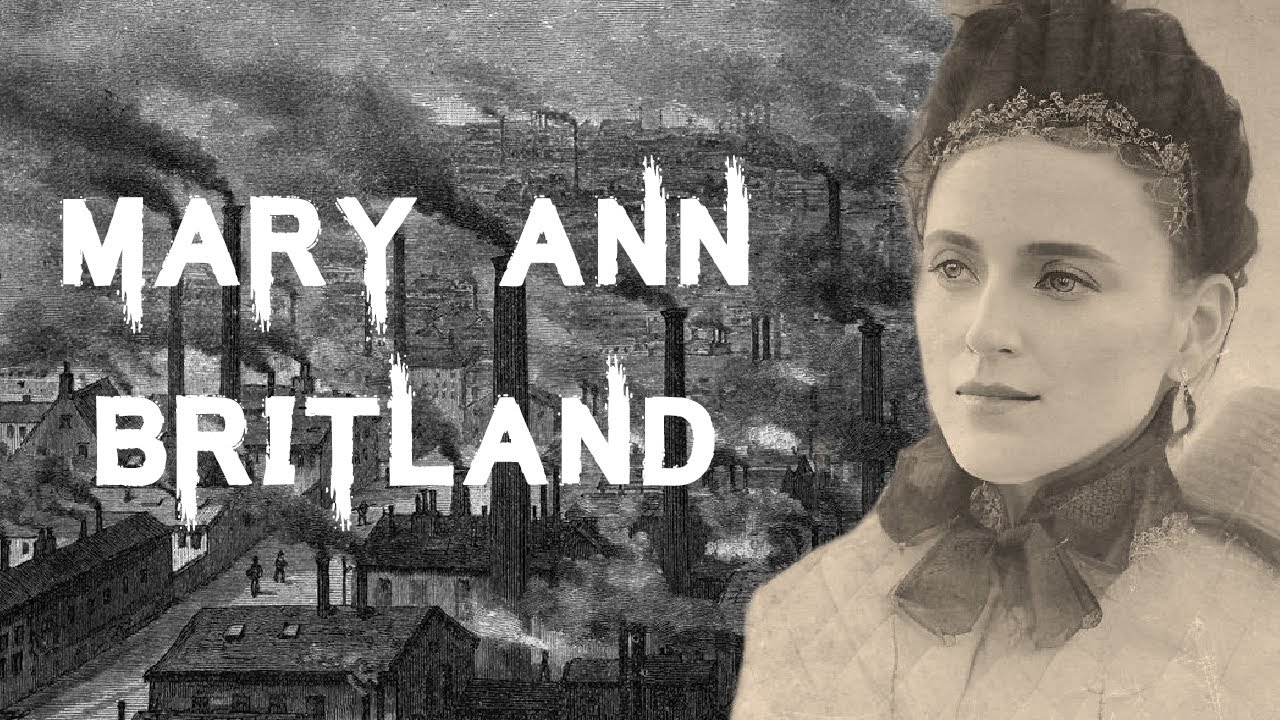
She was the second oldest daughter of Joseph and Hannah Haigh. When she was a child, her family moved to Ashton-under-Lyne, a town at the heart of the Industrial Revolution. Its textile mills and coal mines drew workers in large numbers, and Mary Ann later found employment as a cotton reeler in a factory. In 1866, at age 19, Mary Ann married Thomas Britland, a hardworking man five years her senior.
The couple welcomed two daughters, Elizabeth in 1867 and Susanna in 1868. By the mid-1880s, the family had established their home at 92 Turner’s Lane, a charming property known for a persistent mouse infestation. To support the household, Mary Ann worked at Fishers Mill by day and as a barmaid by night. Like many Victorian families, the Britlands had taken out small life insurance policies with the Prudential Insurance Company.
These modest policies were commonly used to cover funeral expenses or provide economic security in the event of an unexpected death. In February 1886, neighborhood gossip began circulating about a close friendship between Mary Ann and Thomas Dixon, a married man who lived nearby at 128 Turner’s Lane. The rumors soon reached Mary Ann’s eldest daughter, Elizabeth, who became suspicious that her mother might be involved in an improper relationship. On March 7, just days after learning of the rumors, Elizabeth fell ill.
Despite her mother’s care, her condition did not improve, and she died the following evening. No formal inquest was held. Instead, the family doctor, Dr. Thompson, issued a death certificate attributing her passing to vomiting, convulsions, and heart spasms.
Mary Ann received a £10 insurance payout after her daughter’s death. During the preparation of Elizabeth’s body, a local woman named Sarah Lloyd made a curious observation: Elizabeth’s hands were tightly clenched. Notably, this detail had been overlooked by the doctor. On April 30, Mary Ann made an unusual purchase at Kilbingtons, one of the town’s trusted chemists.
She bought Hunter’s Infallible Vermin and Insect Destroyer, a purchase that appeared to be a simple attempt to address the long-standing mouse problem at her home. That same evening, her husband Thomas began displaying symptoms remarkably similar to those that had affected their daughter. His condition deteriorated rapidly, and he died three days later. Dr.
Tucker, who was summoned after Thomas’s death, made an unexpected diagnosis: he stated that the previously healthy man had died of epilepsy. The assessment was met with skepticism in the community. Following her husband’s death, Mary Ann received an insurance payout of nearly £20. In the wake of Thomas’s passing, Mary Dixon, the wife of Thomas Dixon, offered Mary Ann warm support.
She had assisted in nursing Thomas Britland in his final days and continued to open her home to Mary Ann. However, on Thursday, May 13, Mary Dixon fell seriously ill with symptoms strikingly similar to those of Elizabeth and Thomas Britland. Dr. Thompson was sent for, but Mrs.
Dixon died in the early hours of May 14. He attributed the death to abdominal spasms. Sarah Lloyd, who again prepared the body for burial, became suspicious. She noticed that Mrs.
Dixon’s body bore an eerie resemblance to those of Elizabeth and Thomas Britland: all had died with clenched hands. Thomas Dixon, now a widower, sought assistance from a local cafe owner named John Law to arrange catering for his wife’s funeral. On May 15, Law arrived at the Dixon residence, but was greeted not by Mr. Dixon, but by Mary Ann Britland.
During their conversation, Mary Ann brought up the topic of poisoning, which caught Law off guard. She revealed that she had purchased rodent killer, a fact she had concealed from her late husband. Thomas Dixon, who was also present, reacted with astonishment and became deeply perturbed. He began to wonder whether his wife’s death might have had a sinister cause.
These suspicions were soon reported anonymously to the police. Authorities ordered a postmortem examination, which was conducted within the Dixon residence. The pathologist’s findings shocked the community: Mrs. Dixon’s body contained lethal levels of both arsenic and strychnine, the very same toxic components found in Harrison’s vermin killer.
Mary Ann Britland and Thomas Dixon were both arrested. Police investigated Mary Ann’s purchase of Harrison’s vermin killer and discovered she had also procured Hunter’s Infallible Vermin and Insect Destroyer, which contained other poisons. She insisted she had bought the products exclusively to deal with the mice infestation, but the purchases had been recorded in the chemists’ poison register. Authorities also ordered the exhumation and autopsy of the bodies of Elizabeth and Thomas Britland.
After hours of questioning at Ashton-under-Lyne police station, Mary Ann offered a full confession. She admitted to poisoning her daughter Elizabeth, who had grown suspicious of her relationship with Thomas Dixon. Fearing that Elizabeth might expose the truth to her husband, Mary Ann resorted to murder. She also confessed to poisoning her husband Thomas and to the calculated murder of her friend, Mary Dixon, fueled by the hope that eliminating Mary would allow Thomas Dixon to someday become hers.
Thomas Dixon told police a different version of events. He claimed that on the night his wife fell ill, he had gone out around 8 p. m. and returned two hours later, only to find his wife and Mary Ann sharing supper.
He noted that the two women had earlier gone to Mary Ann’s property and that he didn’t know whether his wife had eaten anything there. He added that Mary Ann had been a familiar presence in their lives for three years and had spent much time at his house since the deaths of her daughter and husband. Dixon also revealed that his wife had been insured with two companies, from which he received payouts totaling over £29, but he insisted he loved his wife and had nothing to do with her death. Thomas Dixon was released, and Mary Ann Britland was charged with murder.
Her trial took place in Manchester on July 22, 1886, lasting two days and presided over by Justice Cave. The courtroom was filled to capacity, with journalists and spectators eager to observe the proceedings. Mary Ann had retracted her confession and pleaded not guilty. Dr.
Harris, a crucial witness, revealed findings from his examinations of the bodies of Thomas and Elizabeth Britland. Although the strychnine had been fully absorbed by the time the autopsies took place, a sinister trace of arsenic was discovered. Mary Ann’s defense lawyer argued that she lacked a clear motive, but the judge clarified to the jury that motive, while often important, was not an absolute requirement for conviction. The jury’s duty was to ascertain the certainty of guilt.
The jury initially failed to reach a unanimous decision and returned to the courtroom without a verdict. Justice Cave asked them to discuss the evidence further. Shortly after 10 p. m.
, they returned with a guilty verdict. When the judge asked if she had anything to say, Mary Ann proclaimed, “I am quite innocent. I am not guilty at all. ” Nevertheless, the judge sentenced her to death.
It is alleged that Mary Ann finally confessed to all three murders in the presence of her mother and surviving daughter. On the morning of August 9, 1886, Mary Ann Britland was executed at Strangeways Prison in Manchester. She was in a state of collapse and required the support of two female wardens during the walk to the gallows.
She was the first woman to be executed at Strangeways Prison.