On April 18, 1861, Francis Preston Blair, a 67-year-old former congressman, sat down in his Washington townhouse across from a 54-year-old colonel and asked a question that would reshape American history. Blair was speaking with the direct knowledge and blessing of President Abraham Lincoln. The offer he carried was almost unprecedented in the early days of that crisis: field command of the United States Army. Lincoln wanted Robert E.
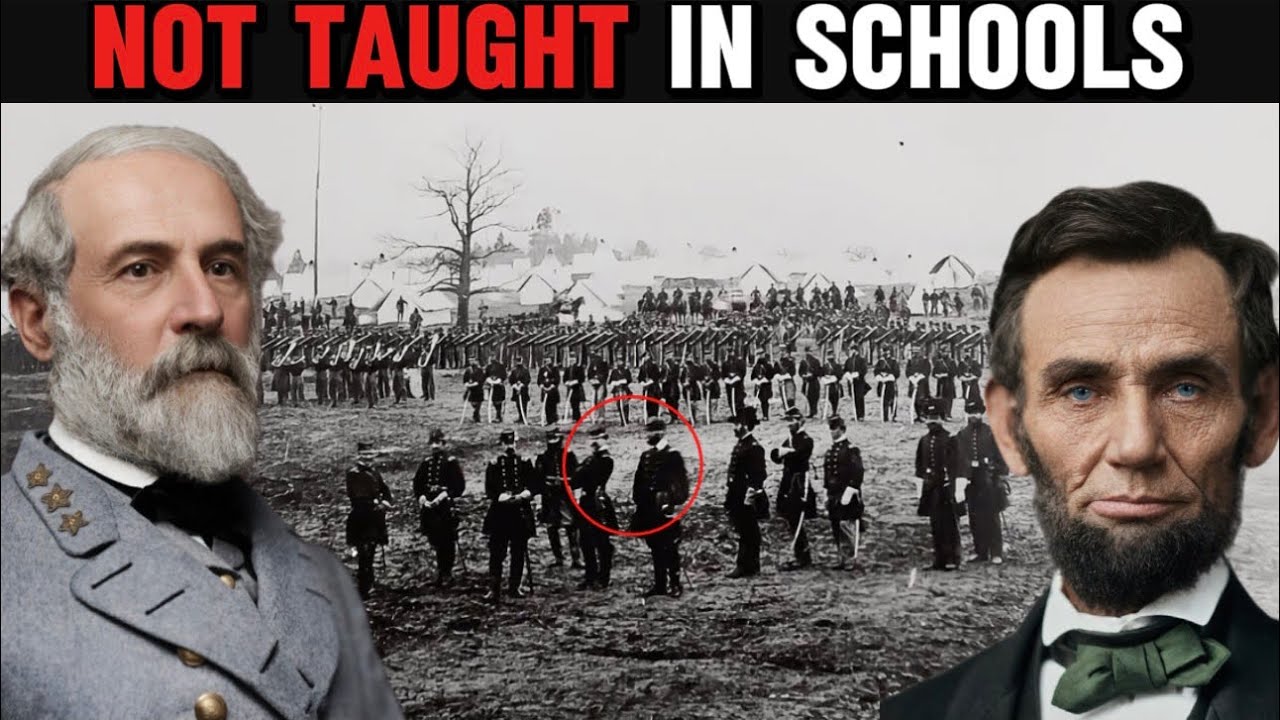
Lee. Lee did not say yes, and he did not say no. He asked for time to consider the matter and left Blair’s house that afternoon, walking directly to the office of General Winfield Scott. The aging commanding general had known Lee since Lee was a young officer under him in Mexico.
Scott, who wanted Lee for the position as badly as Lincoln did, told him plainly there was no way to remain neutral in what was coming. Lee went home to Arlington that night and did not sleep. His wife Mary later wrote that she heard him pacing the floor for hours. Two days later, on April 20, Lee wrote his letter of resignation from the United States Army.
He had served for 32 years. Four days after that, he accepted command of the military forces of Virginia. The man Lincoln wanted to lead the Union to victory instead led the resistance that came within a hair’s breadth of destroying the Union altogether. The story of what happened in that room and in the four days that followed involves a man so admired by both sides that the president tried to hand him an army.
Lee turned it down for reasons that had almost nothing to do with slavery as an institution and almost everything to do with a single word: home. Lee’s path to that April afternoon began at Arlington itself. He came from a family whose name carried weight but whose finances did not. His father, Henry Lee, known as “Light-Horse Harry” for his cavalry exploits under Washington during the Revolution, had been a genuine war hero and a genuine financial catastrophe.
He cycled through debtor’s prison and speculative schemes that left the family name distinguished and the family accounts empty. Robert was six years old when his father left for the Caribbean to escape creditors and never returned. Henry died on the trip home when Robert was 11. The boy grew up in Alexandria under his mother, Anne Carter Lee, whose family connections to the Virginia planter aristocracy gave him social standing his father’s failures could not erase, but whose actual resources were modest.
West Point, free and prestigious, was less an ambition than a practical necessity. Anne Carter Lee was chronically ill for most of Robert’s childhood. By his teenage years, he had become her caretaker, managing household accounts and nursing duties that would have fallen to servants in a family of greater means. Biographers have long pointed to those years as the origin of the severe self-discipline that defined Lee as an adult, a boy who learned early that the family’s dignity depended on his own restraint.
He excelled at West Point in a way that has become part of his mythology but is nonetheless documented fact. He graduated second in his class in 1829 without a single demerit in four years, a record no cadet before him had matched. It reflected a temperament controlled, disciplined, and almost unnervingly self-possessed, one that would define his military career and make him by 1861 the most respected officer in the United States Army under Scott himself. The marriage that gave Lee Arlington came in 1831, when he married Mary Anna Randolph Custis.
She was the great-granddaughter of Martha Washington and the daughter of George Washington Parke Custis, who had built Arlington House as a monument to his adoptive grandfather. Lee married into the closest thing early America had to a royal inheritance: the Washington name, Washington relics displayed throughout the house, and an estate perched on a hill overlooking the capital with the Potomac River and the unfinished Capitol dome visible from its front portico. When Custis died in 1857, Lee inherited responsibility for Arlington and for the roughly 200 enslaved people on the estate, along with a will that stipulated they were to be freed within five years. Lee spent those years administering the clause with a rigor that some historians read as reluctant compliance and others read as active delay.
The record supports both readings depending on which correspondence is given the most weight. By the time the secession crisis reached its breaking point in the winter of 1860 and spring of 1861, Lee held a reputation that placed him at the very top of the United States officer corps. He had distinguished himself in the Mexican-American War under Scott’s direct observation, performing reconnaissance work at Cerro Gordo and Chapultepec that Scott himself credited as decisive to American victories. At Cerro Gordo in April 1847, Lee scouted a path through terrain the Mexican army had judged impassable, guiding an American flanking column along a route that avoided a fortified position and forced a Mexican withdrawal.
Scott later called it the finest piece of reconnaissance he had witnessed in his career. At Chapultepec, Lee was wounded slightly and rode for two straight days without rest coordinating artillery placement. He emerged from the campaign with three brevet promotions for gallantry, an extraordinary rate of advancement that marked him in the eyes of senior officers as the most capable engineer in the army. Lee had served as superintendent of West Point from 1852 to 1855, modernizing the curriculum and personally supervising cadets who would within a decade be shooting at each other across battlefields neither side could yet imagine.
He had commanded the detachment of Marines that captured John Brown at Harpers Ferry in October 1859. Lee happened to be in Washington on leave from his post in Texas when word reached the War Department that an armed group had seized the federal arsenal there. He was given command of the response simply because he was the most senior officer available on short notice. The operation took less than three minutes once Lee gave the order.
Brown was captured alive, tried, and hanged within two months. The episode hardened sectional feeling on both sides in ways historians now recognize as one of the direct accelerants of the secession crisis that followed within 18 months. Lee wrote a report on the incident that was notably restrained, describing Brown’s actions as those of a fanatic. When the crisis arrived, when South Carolina seceded in December 1860, when six more states followed by February, when Fort Sumter fell in mid-April, Lee was not an obscure colonel being elevated beyond his qualifications.
He was the obvious choice, the man both Scott and Lincoln independently identified as the single best available officer to lead what everyone expected would be a brief, limited military action to restore federal authority in the South. The reasoning Lee gave for declining was neither complicated nor evasive, though it has been interpreted in wildly different ways ever since. He wrote to his sister Anne Marshall, who lived in Baltimore and whose own son would go on to fight for the Union, that he looked upon secession as anarchy, that he had no sympathy for dissolving the Union, and that if he owned every enslaved person in the South, he would give them all up to save the Union. That letter is genuine and is often cited by people arguing that Lee’s decision had nothing to do with enthusiasm for the Confederate cause.
It is equally genuine that in the same letter, Lee wrote that he could not raise his hand against his relatives, his children, his home. Virginia had not yet seceded when Blair made the offer on April 18. It seceded on April 17, the day before, though news had not yet reached Washington through official channels when Lee sat down with Blair. By the time Lee made his decision on April 20, Virginia’s secession was confirmed.
For Lee, that single fact reorganized every other consideration. Lee was not defending slavery as an institution in any ideological sense that his own letters support. His correspondence is, in fact, more critical of slavery in the abstract than that of many Union officers of the period, even as he continued to hold people in bondage at Arlington and managed that inheritance with documented harshness toward enslaved people who attempted escape. He was also not a man who believed secession was constitutionally justified.
He said so explicitly and repeatedly. What he was, by his own repeated explanation and by the consistent judgment of nearly every biographer who has examined the record since, was a man for whom loyalty to Virginia, as opposed to loyalty to the United States generally or to the Confederacy as a political project, was the value that outranked every other consideration in his moral architecture. Lee’s reasoning was not that Virginia’s cause was righteous. It was that Virginia was, in the framework of allegiance he had inherited from a generation raised to think of the United States as a voluntary compact of sovereign states rather than a single indivisible nation, his primary political community.
That framework strikes most people today as strange, even indefensible, precisely because the Civil War itself permanently settled the argument in the other direction. Virginia was not an abstraction to Lee. It was Arlington. It was the graves of his parents.
It was the entire social and family world that had made him who he was. Winfield Scott, when Lee came to deliver his resignation on April 20, reportedly told him he had made the greatest mistake of his life. Scott, himself a Virginian by birth who had remained loyal to the Union, understood exactly what Lee was choosing and what it would cost. Scott had spent three decades grooming Lee as his likely successor.
He watched that investment walk out the door in the space of a single conversation. By every account from people who were present or who spoke to Scott afterward, it affected him for the rest of his life. Scott’s position in this story deserves attention because he was proof that a senior Virginia-born officer could choose the Union without hesitation. Scott had been born in Dinwiddie County, Virginia in 1786, three decades before Lee.
When Virginia seceded, Scott did not waver for a single day. He remained loyal to the government he had served since the War of 1812, which makes the contrast with Lee’s agonized four days all the more striking. Lee’s decision was, for Scott, both a professional loss and something closer to a personal betrayal, though Scott never spoke of it with anger. He spoke of it with grief.
The consequences of Lee’s decision are the rest of the story of the Civil War. Lee did not simply decline a job. He took the military judgment that Scott and Lincoln both regarded as unmatched anywhere in the federal officer corps and delivered it directly to the opposing side. For the next four years, that skill set produced Confederate victories at Second Bull Run, Fredericksburg, and Chancellorsville.
At Chancellorsville in May 1863, Lee split his already outnumbered army in the face of a Union force nearly twice its size and won one of the most tactically audacious victories in American warfare. Union general after Union general, McClellan, Pope, Burnside, Hooker, arrived in command of the Army of the Potomac believing they could match Lee. Each one left having discovered they could not, until Grant finally arrived in 1864 with a strategy built not around outmaneuvering Lee but around outlasting him through attrition. Most historians agree that without Lee commanding the Army of Northern Virginia, the war would have looked substantially different and quite possibly shorter.
Lee’s decision was not made by an institution or an ideology. It was made by a single exhausted man pacing a floor above his wife’s bedroom, weighing an oath to a government he respected against an identity built from birth around a piece of land, a family name, and a state that had just ceased to be part of the country he had sworn to serve. Lee’s biographer Douglas Southall Freeman described those four days as the most difficult of Lee’s entire life. Nothing in Lee’s surviving correspondence contradicts that judgment in any meaningful way.
There is a coda to the Arlington story that adds a final layer of irony. When Lee left Arlington in April 1861, he never returned to live there again. Union forces occupied the estate within weeks, and by 1864, the federal government had begun burying Union war dead on the grounds. A decision made, according to the quartermaster general who oversaw it, specifically so that the Lee family could never again treat the property as a private home.
Arlington National Cemetery exists today on the ground where Robert E. Lee once stood and looked out over the same Potomac River and the same unfinished Capitol dome that had been visible from that spot since his marriage in 1831. The home he chose over Lincoln’s offer became the resting place of thousands of the men who died fighting the army he led. Today, more than four million visitors walk those same grounds every year.
Lee surrendered at Appomattox Courthouse on April 9, 1865, almost exactly four years after Blair’s offer and Scott’s warning and the sleepless night at Arlington. Grant’s terms were generous by the standards of the era. Confederate officers and soldiers were permitted to return home without prosecution for treason, and Lee never faced legal consequences for a rebellion that under a strict reading of federal law could have cost him his life. He spent his remaining five years as president of Washington College in Lexington, Virginia, approaching the position with the same discipline and reserve that had defined his career.
He declined to profit from his fame, generally avoided public commentary on the war, and quietly discouraged the erection of Confederate monuments during his lifetime. He applied for but never received a formal pardon restoring his United States citizenship, an oversight not corrected until 1975, more than a century after his death in October 1870. The debate over what Lee chose in April 1861 and why has not stopped since. The offer Lincoln extended through Blair was not a footnote to Lee’s career.
It was the fork in the road that determined everything that followed. A colonel in Washington chose the uniform he had worn for three decades over the house on the hill where he had built his life. He chose the house.
The country spent the next four brutal years finding out exactly what that single choice would cost.