The Soviet state needed heroes. Clean ones, the kind you name streets after and put on posters. The problem was that the civil war that built the state had largely been fought by men who were anything but clean. One of those men was Grigory Ivanovich Kotovsky, a shaved-headed, left-handed, stuttering bank robber from Bessarabia who spent most of his adult life either robbing people at gunpoint or escaping from prison.
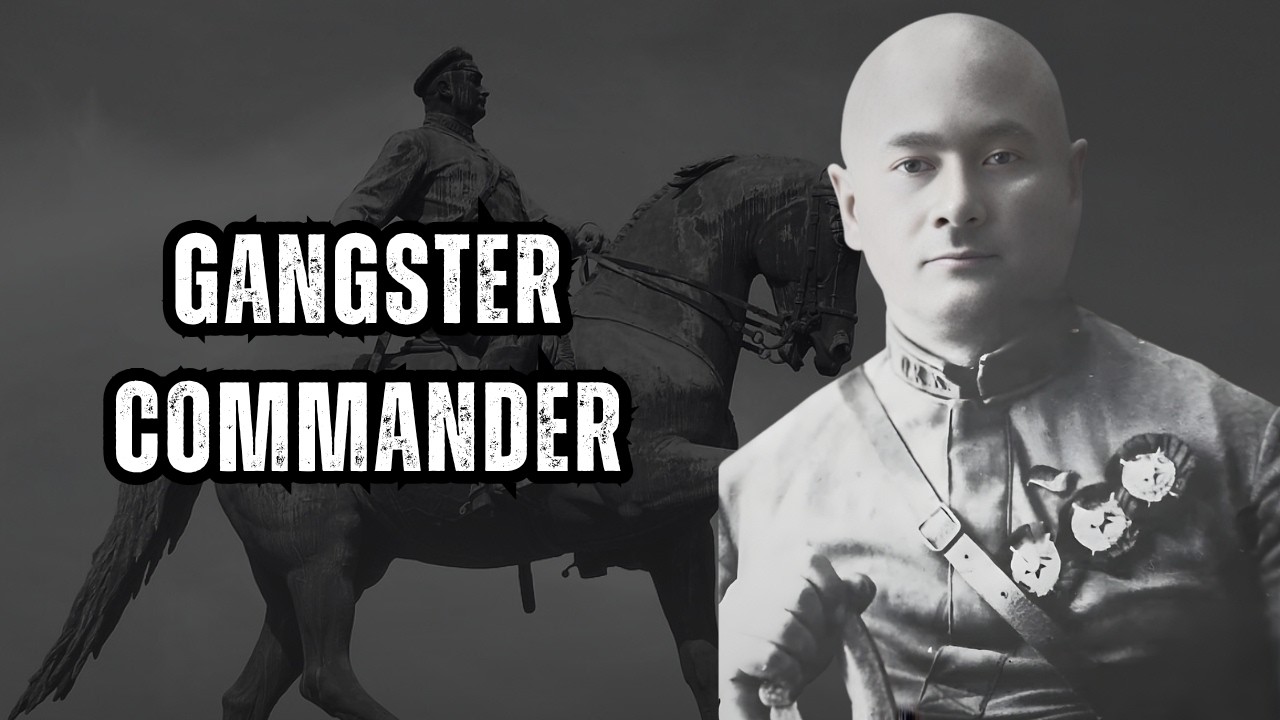
By the time the Soviet state was finished with him, Kotovsky had been awarded three Orders of the Red Banner, given a mausoleum, and had cities renamed in his honor. His story is not one of redemption. It is the story of a system that needed to manufacture a hero, and what happens to the truth when a state decides it is more useful as propaganda. Kotovsky was born on June 24, 1881, in Hîncești, in the Bessarabia Governorate, now Moldova.
He was one of six children. His father, a mechanic of Polish descent, had aristocratic blood on his side, minor Polish nobility that was ruined after his grandfather participated in uprisings against Russian rule. His mother was ethnic Russian. She died when Kotovsky was two.
His father died of tuberculosis when he was fourteen. Orphaned and placed under the care of a godfather, a landowner named Manuk Bey, Kotovsky was enrolled in the Cucuruzeni Agricultural College. A childhood fall from a roof had left him with a stutter that stayed with him for life. He was also left-handed in an era when that was treated as a defect.
After graduating in 1900, he was hired as an assistant estate manager. He was fired almost immediately for theft and conduct his employers found intolerable. A second estate produced the same result. When the Russo-Japanese War broke out in 1904, Kotovsky hid from the draft.
He was caught in 1905 and sent to the 19th Kostroma Infantry Regiment in Zhytomyr. He deserted almost immediately. In the chaos of the 1905 Revolution, he formed a gang. His operation hit estates, banks, apartments, and merchants across several provinces.
The Robin Hood framing came later. Police files tell a different story: proceeds went primarily to women, restaurants, horse racing, and alcohol. Small amounts were occasionally given to the poor, not out of ideology but to build a reputation that made villagers less likely to cooperate with police. He was arrested in January 1906, escaped six months later, and was arrested again in September.
He was sentenced to twelve years of hard labor in Siberia. He cooperated with prison authorities and supervised a railroad construction crew while waiting for his chance. When a Romanov dynasty amnesty in 1913 excluded convicted bandits, he escaped and walked back to Bessarabia. By 1915 and 1916, his gang had conducted more than twenty raids across multiple cities.
After he robbed the Bender State Treasury, a secret police dispatch described him as a man who spoke Russian, Romanian, Yiddish, and some German and French. They called him completely intelligent, smart, and energetic, capable of passing as a landowner, an estate manager, or a military officer. While being hunted across several provinces, he lived openly in Chisinau’s finest hotel under a false name, sitting on café terraces for hours. In March 1916, his gang, dressed in officers’ uniforms, attacked a prison transport car at Bender station, disarmed the guards, and freed sixty prisoners.
Several joined his operation immediately. On June 25, 1916, police caught him after another raid. He was shot in the chest during the arrest. The Odessa Military District Court sentenced him to death by hanging.
On death row, Kotovsky wrote letters of repentance and begged to be sent to the front lines. His sentence was commuted, reportedly with intervention from Southwestern Front Commander General Brusilov. Then, in February 1917, Tsar Nicholas II abdicated. The provisional government declared a sweeping amnesty, and Kotovsky walked out of prison with one condition: he had to go to war.
In May 1917, Kotovsky arrived at the Romanian front with the 6th Russian Army. He was thirty-six years old with no formal military training and a criminal record stretching back fifteen years. What he did have was fifteen years of leading men under conditions where failure meant capture or death. He understood mobility, deception, and the importance of moving before the enemy could consolidate.
In a collapsing imperial army, that was worth more than formal training. By October 1917, he had been awarded the Saint George Cross and promoted to ensign. By November, he had joined the Left Socialist Revolutionaries and been elected to the Soldiers’ Committee of the entire 6th Army. When the Odessa Soviet Republic was proclaimed in January 1918 and Romanian forces advanced into Bessarabia, Kotovsky volunteered to cover the Bolshevik retreat from Chisinau.
He commanded the defense of Bender through several days of fighting, inflicted a reported defeat on Romanian troops at Dubossary, and crossed the Dniester under cover of an armored train. A Romanian intelligence report from February 4, 1918, noted that his forces had crossed from Tiraspol to deliver a formal ultimatum demanding Romanian withdrawal from Bessarabia. His alignment with the Bolsheviks was pragmatic on both sides. They needed men who could fight and organize under unstable conditions.
He had spent fifteen years doing exactly that. Over the next three years, Kotovsky fought the White Army, Symon Petliura’s Ukrainian forces, Nestor Makhno’s anarchist army, and in the Soviet-Polish War. Those who served alongside him described him consistently: dexterity, strength, and an animal instinct combined with great courage. In 1921, his cavalry brigade was deployed to suppress the Tambov Rebellion, one of the largest peasant uprisings in Soviet Russia.
Led by Alexander Antonov, tens of thousands of fighters opposed Soviet grain requisitioning. Red Army directives for the operation mandated the seizure of fifty to one hundred hostages per rebel band, with orders to execute them within hours if surrender demands went unmet. Declassified post-Soviet research documents punitive raids on suspected villages, mass grain seizures, and the deportation of more than 100,000 peasants to forced labor camps by mid-1921. On May 25, 1921, Kotovsky’s forces defeated Antonov’s units near the Tambov forests.
The Soviet biography records a military victory. The archival record documents participation in the systematic terrorization of peasants who were protesting hunger. Both belong to the same man. Propaganda works by keeping those two pictures in separate rooms.
By 1922, Kotovsky commanded the 2nd Cavalry Corps near Uman, Ukraine. He held seats on both the Central Executive Committee of the Soviet Union and the All-Ukrainian Central Executive Committee. He was a principal advocate for the Moldavian Autonomous Soviet Socialist Republic, established in 1924. He had proposed to Defense Minister Mikhail Frunze a plan to lead a handpicked detachment across the Dniester, raise a peasant uprising in Romanian-occupied Bessarabia, and force the creation of a new government that would vote to join the Soviet Union.
He was willing to have it declared a personal initiative so the government could disavow him if it failed. The political leadership rejected the plan. Frunze was working to appoint him as his deputy in the Defense Ministry. That appointment never went through.
On the evening of August 5, 1925, Kotovsky attended a bonfire at a pioneer camp near Shabanky, outside Odessa. He was tired and reportedly reluctant to go. He spoke to the pioneers about the Antonov operation, a subject that, by accounts of those who knew him, always caused him significant strain. He came home around 10:00.
A small farewell gathering formed among neighboring officers. At approximately 11:00, a single revolver bullet struck him in the aorta. Death was instantaneous. The killer did not run.
He appeared at the scene almost immediately, fell to his knees before Kotovsky’s wife, Olga, and kept repeating, “I killed the commander. ”
His name was Meyer Zayder, also known as Mayorchik. Before the revolution, he had owned one of the largest brothels in Odessa. He and Kotovsky had history.
Around 1918, Kotovsky had arrived at Zayder’s door in an artillery officer’s uniform, announced himself, and asked to be hidden. Zayder put him in his attic. Kotovsky left the next morning and told Zayder he was now in his debt. By 1920, the Soviet government had shut down Zayder’s brothel.
Two years of odd jobs followed. In 1922, Zayder found his old debtor commanding a cavalry corps near Uman and asked for help. Kotovsky arranged for him to head security at the Paragonovsky sugar factory near the corps’s base. Then Zayder shot him.
At the investigation, Zayder said jealousy, claiming Kotovsky had been having an affair with his wife. At trial, he changed his account, saying Kotovsky had refused to promote him. He kept changing his testimony. The trial was closed.
The sentence was ten years. He served less than three, released in 1928 for exemplary behavior. In the autumn of 1930, three of Kotovsky’s former cavalrymen informed his widow that Zayder had been sentenced to death. Shortly afterward, Zayder’s body was found near a railway station in Kharkiv, strangled and placed on the tracks to simulate an accident.
The train was delayed. It did not work. The killers were identified as Strigunov, Waldman, and a third man never named. None were charged.
The official Soviet biography eventually concluded that Kotovsky had been killed by the worst enemies of the people: Trotskyist agents of foreign intelligence. Meyer Zayder was not a Trotskyist agent of foreign intelligence. He was someone who could be blamed, sentenced lightly, and silenced. The Soviet propaganda apparatus worked through Kotovsky’s biography with considerable thoroughness.
His criminal record was reframed. Robberies became expropriations. Expropriations became class struggle. The Tambov operations appeared as military victories.
The circumstances of his death were classified. Court records, police files, and testimony from displaced peasants were suppressed or sealed. Cities were renamed. Birzula became Kotovsk in 1935.
His hometown of Hîncești was also renamed. His body was embalmed and placed in a mausoleum, one of only three in the Soviet Union. A 1943 film dramatized his life as a story of revolutionary redemption. Romanian troops destroyed the mausoleum during their occupation of Transnistria and took the three Orders of the Red Banner displayed alongside the body.
After 1991, the archives confirmed what historians had long inferred. The censorship was deliberate and organized. Hîncești reclaimed its name in 1990. The Ukrainian city of Kotovsk was renamed Podilsk in 2016 under legislation removing communist-era place names.
Kotovsky was not what the Soviet state needed him to be. He was a career criminal who found himself inside a revolution that had use for men who could lead fighters and were not troubled by violence. He was also, by the operational record, an effective military commander. The Civil War produced few men with clean hands.
The system did not just use him as a symbol. It needed him as one, as proof that the revolution could transform even its most damaged products. That was what the mausoleum was meant to say. That was what the renamed cities encoded.
The man was murdered at 44 and turned into a poster before he was cold. The files are still classified. That is what they built the cities over.