The relationship between Queen Elizabeth II and her younger sister, Princess Margaret, is one of the most examined and romanticized in modern royal history. The popular narrative is familiar: the dutiful heir and the rebellious spare, bound by love but separated by duty. Yet, a closer examination of the documented record, drawn from the accounts of biographers, courtiers, and household staff, reveals a far more complicated story.
It is a story not simply of sibling rivalry or tragedy, but of a trust that was tested, eroded, and ultimately managed over five decades. While the affection between the two sisters remained genuine until Margaret’s death in 2002, the unguarded confidence of their childhood was replaced by a careful, institutional wariness.
The seeds of this dynamic were planted long before the throne was ever in question. Born in 1926 and 1930 respectively, Elizabeth and Margaret enjoyed a warm and close childhood. Their governess, Marion Crawford, described two sisters who were inseparable, sharing a nursery and a world largely devoid of other playmates. Elizabeth was serious and orderly, while Margaret was quick-witted and restless, a division of temperament that would define their public roles for the rest of their lives.
The abdication of their uncle, King Edward VIII, in 1936, changed everything. Their father became King George VI, and Elizabeth became the heir presumptive. This event also cemented Margaret’s secondary position within the family, a role she had not chosen and could not change. The family’s new moral architecture, built on the sacrifice of personal desire for duty, became the lens through which both girls were raised.
The Second World War offered a brief period of equality. On Victory in Europe Day in 1945, the two sisters slipped out of the palace to celebrate anonymously with the crowds in London. Both would later describe it as one of the purest memories of their lives, a few unrepeatable hours before the machinery of rank fully separated them.
The first major fracture came with the publication of Marion Crawford’s memoir, *The Little Princesses*, in 1950. Although the book was affectionate and tame by modern standards, the family reacted with total banishment. Crawford was cut off completely, and her name became a private byword for betrayal. The lesson learned by the institution, and by Elizabeth in particular, was that any disclosure of private royal life carried an unacceptable cost.
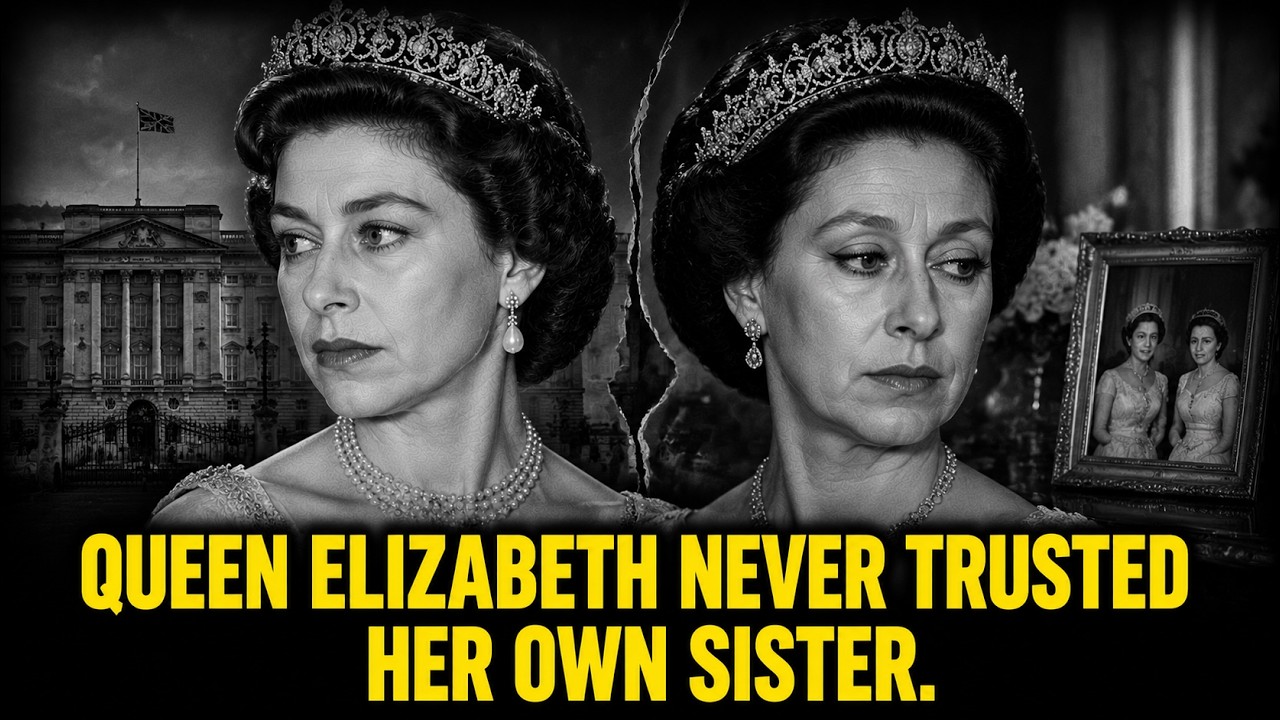
The death of King George VI in February 1952 formalized the hierarchy between the sisters. Elizabeth became queen, and Margaret became, in her own words, the family’s spare part. The informal deference of childhood became a permanent constitutional reality, with courtiers treating the new sovereign with a formality that extended even to private family gatherings.
It was during this period of mourning that Margaret’s relationship with Group Captain Peter Townsend deepened. Townsend, a decorated Battle of Britain hero and a trusted member of the household, was 16 years older than Margaret and in the process of a divorce. Their love affair became public at the 1953 coronation when a photograph captured Margaret brushing a piece of fluff from his uniform.
The ensuing crisis tested the new queen’s reign. Under the Royal Marriages Act of 1772, Margaret required Elizabeth’s consent to marry. The Church of England, of which Elizabeth was supreme governor, did not permit the remarriage of divorced persons. The cabinet, led first by Winston Churchill and then by Anthony Eden, advised against the match, fearing a constitutional crisis so soon after the abdication.
Townsend was reassigned to a diplomatic post in Brussels, a deliberate attempt to separate the couple. For two years, they waited. When Margaret turned 25 in August 1955, she no longer required the sovereign’s consent, but she would need the permission of Parliament to retain her royal rights and income. The government made it clear that a marriage would require her to renounce her succession rights and her royal income.
In October 1955, Margaret issued a public statement announcing she would not marry Townsend. The statement claimed she had reached the decision entirely alone, mindful of the church’s teaching and her duty to the Commonwealth. This final line, that the decision was hers alone, has been treated with deep skepticism by biographers, as it so precisely tracked the outcome the establishment had engineered for two years.
The sacrifice was publicly celebrated, but privately it bred resentment. Margaret had given up the man she loved to protect her sister’s reign, and the thanks she received was continued, tightening supervision. From 1955 onward, Elizabeth learned a cold lesson: Margaret’s private life would be treated as a risk to be managed, not a happiness to be trusted.

Margaret’s subsequent marriage to photographer Antony Armstrong-Jones in 1960 was initially a success. He was created Earl of Snowdon, and the couple became a glamorous symbol of a modernizing monarchy. A highly publicized tour of the United States in 1965 was a high-water mark of Margaret’s public standing, with American press comparing her favorably to Jacqueline Kennedy.
However, the marriage began to curdle in private. Accounts describe a household of open warfare, with Snowdon compiling a written list of his wife’s irritations and both partners conducting affairs. The marriage’s collapse became public in 1976 with a photograph of Margaret on the island of Mustique with Roddy Llewellyn, a gardener 17 years her junior. The timing was disastrous, landing directly in the run-up to the Queen’s Silver Jubilee.
The scandal gave the palace’s critics, particularly Labour MP Willie Hamilton, fresh ammunition in their long-running campaign against the cost of the monarchy. Margaret had been a favorite target for over a decade, criticized for drawing a public income while providing little formal duty in return. The 1976 affair cemented the palace’s view of her as a liability that required careful management.
Margaret and Snowdon divorced in 1978, the first senior royal divorce since Henry VIII. The irony was profound: the woman who had been told she could not marry a divorced man was now herself at the center of a royal divorce. The church’s position had not changed, but the institutional machinery that had been so rigid in the 1950s was now processing the divorce through ordinary legal channels.
The pattern of containment intensified after 1976. Margaret’s public appearances were more carefully vetted, her statements rarer. The palace’s press operation, which had once relied on flat refusal, evolved into a more sophisticated system of managing information. Margaret’s own guardedness with the press left her with fewer sympathetic outlets when the tabloids came for her.
The caution was not without cause. In 1984, Margaret made remarks about Chinese people at a private dinner in Chicago that were reported internationally and drew a formal diplomatic complaint from the Chinese government. The incident reinforced the judgment that she could not be trusted in unscripted settings.

By the 1980s, the relationship between the sisters had settled into a permanent, unspoken arrangement: close in private, carefully managed in public. The affection remained, but the trust had been replaced by a watchful, institutional caution. This was not cruelty, but the rational response of an institution that had been repeatedly burned.
Margaret’s health began to decline in the 1980s. She had part of a lung removed in 1985, a consequence of her lifelong heavy smoking. She suffered a stroke in 1998, and a severe scalding accident at Mustique left her with lasting mobility problems. A further stroke in 2001 left her with vision loss and paralysis.
In her final years, the record shows a shift. Elizabeth’s response to her sister’s decline was one of unambiguous warmth. She visited regularly and involved herself personally in her sister’s care. The institutional caution that had defined their relationship for decades gave way to a simpler, older instinct: an older sister looking after a younger one.
Margaret died on February 9, 2002, four days after a final stroke. Her funeral was held on February 15, exactly 50 years to the day after the funeral of her father, King George VI. The family let the coincidence stand without comment, in keeping with a habit of silence that had governed so much of the sisters’ relationship.
The question of whether Elizabeth secretly distrusted her sister is best answered by the documented record. The distrust was real, but it was not personal in the sense of dislike. It was an institutional discipline, applied to her sister as it was applied to ministers and heads of state. It was a caution born of necessity, a response to decades of scandals that had repeatedly threatened the monarchy.
The love between the two sisters never disappeared. But the trust, eroded case by case, scandal by scandal, never fully recovered. Theirs is a story of two women who loved each other their entire lives, and who also ran out of the one thing a bond like theirs needs to survive at full strength. It is a far more human, and far less tidy, story than the fairy tale.