In the late 1970s, a night nurse named Elvire Gozin worked the overnight shifts at a townhouse at 4 Rue du Champ d’Entraînement in the Bois de Boulogne, Paris. Her patient was a woman who had once made headlines on every continent, a woman who had caused a sitting king of England to give up his throne in 1936 rather than give her up.
When Gozin later described those years to biographer Hugo Vickers, two phrases came out. The Duchess had become a prisoner in her own home. And she had died in a slum.
The person controlling that house wasn’t a rival or a court enemy. It wasn’t a member of the royal family that had kept its distance for 35 years. It was Wallis Simpson’s own lawyer, Maître Suzanne Blum.
Blum was a French attorney who had begun as a trusted professional. Over roughly a decade, she methodically dismantled every protection Wallis had. Her English-speaking staff. Her legal representation. Her finances. Her correspondence. Her companion animals. Eventually, her access to the outside world.
By the time Wallis died on April 24th, 1986, there was almost nothing left.
In September 1943, 43 years before Wallis’s death, Suzanne Blum wrote a sentence in a letter to an American named Carmel Offie. “The best way to keep someone as a prisoner,” she wrote, “is to surround him with love, affection, and friendship.”
She was 44 years old when she wrote that. By 1986, it read differently than it had in 1943.
Wallis Simpson spent the last decade of her life unable to speak, bedridden, and cut off from almost everyone she had ever known. The mechanics of how that happened, the specific documents, the items sold, the people dismissed, and the letters suppressed, form one of the most disturbing legal stories of the 20th century.
On May 18th, 1972, Queen Elizabeth II, Prince Philip, and Prince Charles arrived at the house in the Bois de Boulogne. The Duke of Windsor, the man who had been Edward VIII before his abdication in December 1936, was dying of throat cancer. He was 77.
Ten days later, on May 28th, 1972, the Duke died at home. Wallis was flown to London for the funeral and stayed at Buckingham Palace. Then she returned to Paris.
The door between the Windsor family and the woman they had spent 35 years treating with varying degrees of collective frost swung quietly shut again.
What Wallis had in the summer of 1972 was a house in the Bois de Boulogne that the French government allowed her to occupy rent-free. She had a voluntary pension of 5,000 pounds per year that Queen Elizabeth had privately promised the Duke she would provide if Wallis survived him. And she had a support network that stretched across two countries.
Sir Godfrey Morley of the London firm Allen & Overy managed the Windsors’ English legal affairs. For French matters, there was the firm built by the late Paul Weil, who had served as the Duke’s Paris attorney since the couple settled in France in 1952. Weil had died in 1965.
His widow was Suzanne Blum. She had been inside the Windsor orbit for years. The question, and the answer to it shapes everything that follows, was how far she would go once the Duke was gone and no one was watching.
Suzanne Marguerite Blumel was born on November 24th, 1898 in Niort, in western France, into a Jewish family with roots in Alsace. She studied law at the University of Poitiers, then at the University of Paris, then took a master’s degree in international law at Columbia University in New York.
She was admitted to the Cour d’appel de Paris on January 22nd, 1924, when she was 25 years old and women had held the right to practice law in France for only a handful of years. Her specialty was literary law and private cinematographic law. Entertainment contracts, copyright, the legal infrastructure of the film business.
Her client list was the kind that generated trust across institutions. She represented Warner Brothers in a copyright dispute against the composer Igor Stravinsky. She represented Rita Hayworth in her divorce from Prince Aly Khan. By March 1979, the New York Times was reporting that she had represented Darryl Zanuck, Jack Warner, and Walt Disney.
She also wrote crime novels under the pseudonym L. S. Karen, three of them, which suggests something about the architecture of her mind. In 1975, she published a memoir of her wartime years in New York, where she and Paul Weil had fled during the German occupation of France. Both were Jewish lawyers. Both knew what it meant to lose the protection of a legal system overnight.
She was, by 1972, a commandeur of the Légion d’honneur. She had married twice, to Weil in 1934, then after his death in 1965, to French General Georges Spilmann in 1968. Spilmann died in 1980.
She was respected by the Paris bar, decorated by the French state, cited in the New York Times as the attorney of Hollywood royalty. This is the woman Wallis trusted. This is the woman who was already present, already credentialed, already embedded in the legal apparatus of the Windsor household when the Duke died and left Wallis alone.
Hugo Vickers, whose 2011 book Behind Closed Doors remains the most comprehensive account of Wallis’s final years, characterized Blum as a satanic figure wearing the mantle of good intention to disguise her inner malevolence. That characterization matters, but it arrived in print 17 years after Blum was dead. It arrived because Blum spent her life ensuring that nothing of the kind could be published while she was alive.
According to accounts documented by author Anna Pasternak, the mechanism Blum used in the early years wasn’t legal maneuver, but fear. Blum told Wallis the French government might evict her from the rent-free house unless her estate was arranged in ways the French authorities would find satisfactory, insisting she would have to bequeath everything to the Louis Pasteur Institute.
Those close to the Duke attested that he had stated in his will that after Wallis’s death, everything, money, jewelry, paintings, artifacts, should return to Britain. What Blum was doing wasn’t simply managing the estate. She was redirecting it.
The first formal casualty was Sir Godfrey Morley of Allen and Overy. He had served the Windsors with professional integrity for years. Vickers records that Blum told Wallis that Morley was trying to get her money.
Wallis, widowed and increasingly reliant on the people physically present in her life, believed it. She signed a letter naming Blum as her sole legal representative.
Vickers describes what happened. In a shaky hand, the Duchess signed Sir Godfrey away and delivered herself into the hands of her French lawyer. That was 1973.
After publication, Michael Reynolds of Allen and Overy gave Vickers the firm’s files covering those negotiations. Vickers’ conclusion after reviewing them: it was while the Duchess was in hospital with a broken hip that Maître Blum effected this coup. Not before. During.
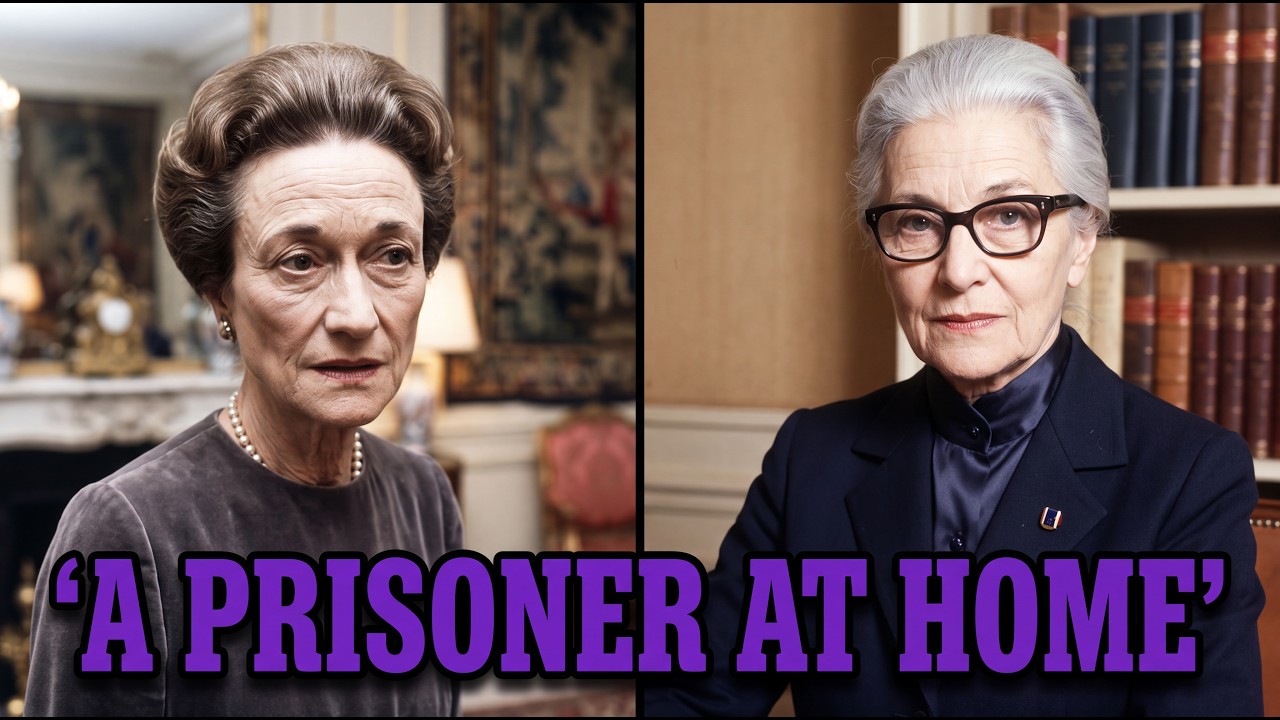
Then the household began to go. The English chef, the concierge, the chauffeur, the hairdresser. Each was dismissed, each replaced with staff of Blum’s choosing.
Blum dismissed the Duchess’s entire English-speaking support world, role by role, and replaced it with people who answered to her. The Foxt Quarterly’s review of Vickers summarized the pattern bluntly. Financial papers were burned, staff were let go, locks were changed.
One account citing Vickers records that the hairdresser, identified in one source only as Goen, twice tried to alert the Queen to Wallis’s situation. Neither attempt succeeded.
The Telegraph’s review of Vickers noted that Blum prevented the Duchess from leaving her room and barred friends from visiting lest it be noticed that the royal treasures were disappearing.
Johanna Schutz, the Windsors’ former private secretary, was eventually pushed out. She said she was offered a new contract in 1978 but refused to sign it. She would work for the Duchess, not for Blum. She left when Wallis, by then emaciated and confused, no longer recognized her.
Christmas 1972 was the inflection point. Wallis fell out of bed at the Paris house. The fracture wasn’t recognized immediately. When doctors confirmed in the new year that she had broken her hip, she was 76 years old and the hospitalization for surgery gave Blum the opening she needed.
Vickers is explicit about the sequence. It was while Wallis was in hospital recovering from that surgery, away from her English lawyers, away from her support staff, unable to consult anyone who might advise against what she was about to do, that Blum had her sign away Sir Godfrey Morley.
The shaky signature on the dismissal letter was made in a hospital room, not in the drawing room of a home where the Duchess still controlled who came and went.
Wallis did recover from the hip surgery. She was able to walk without a stick again. The medical outcome wasn’t catastrophic. The legal outcome was.
Before the fall, Wallis was frail but still capable of independent decision-making, still theoretically connected to a legal world in London. After Blum’s coup, she was someone who had signed that world away. Whether she fully understood what she had signed is a question no one has been able to definitively answer because no one who might have challenged it was left in the room.
The physical deterioration after that was steady. Around 1973, Wallis fell again in a bathroom, striking the bathtub hard enough to break several ribs. Then, in November 1975, a severe intestinal hemorrhage, described in some accounts as a perforated gastric ulcer, sent her to the American Hospital in Paris in critical condition.
Johanna Schutz had been planning that same year to take Wallis to live in New York at the Waldorf Towers, well outside Blum’s jurisdiction and influence. “We were all set to go,” Schutz told Pasternak. “Then the Duchess suffered a perforated ulcer because Blum had worried her so much. That’s when all her troubles started. After that, she was too ill to travel or impose her wishes.”
The 1975 hospitalization produced something that the official record has never fully resolved. According to a Radio Times piece examining the historical background to The Crown’s portrayal of these events, Elvire Gozin, the night nurse who would care for Wallis until her death in 1986, had at some point during this period traveled to London in an attempt to warn the Queen directly about the Duchess’s condition.
What she found, or whether the warning ever reached anyone with authority to act on it, isn’t documented in the accessible primary sources. A 1982 UPI report stated only that a source at Buckingham Palace said the Queen keeps discreetly in touch with the Duchess’s condition.
Whether that discreet awareness ever translated into action, whether anyone at the Palace attempted to verify what was being done to the woman now in Blum’s custody, the record does not say.
What happened inside the house in those years, Gozin could describe from her own experience. She told Vickers that Wallis had died in a slum. She told him Wallis had become a prisoner in her own home.
Gozin took photographs of the bedridden Duchess that were published after Wallis’s death. She was the person who saw the reality up close every night for a decade.
By 1979, doctors had reportedly advised Blum not to excite the Duchess. And friends who had known Wallis for decades were increasingly denied visits. The medical instruction became the policy. The policy became the wall.
By 1978, Wallis was a total invalid, unable to speak or move, spoon-fed by nurses. By 1981, one of her doctors described her as a vegetable.
Throughout all of this, multiple sources note, her medical and nursing care was outstanding. Whatever was being taken from her, physical suffering in the narrowest sense, wasn’t part of the calculation. The cruelty was more deliberate than that.
The legal mechanism that made all of this possible was the power of attorney Blum had secured. The exact date on which the formal document was executed is contested in the sources. Caroline Blackwood’s account of the period points to 1976, while the initial letter displacing Morley had been signed in 1973.
What isn’t contested is the practical effect. By the mid to late 1970s, Blum had the authority to sign contracts, sell property, and conduct legal correspondence in Wallis’s name. She could do, legally, whatever she determined was appropriate. And report the results to a woman who could no longer speak, protest, or seek a second opinion.
The full operational scope of that authority was visible in the paper trail by 1977. On August 30th, 1977, a jonquil diamond ring was sold to the cosmetics magnate Estée Lauder for $150,000. The ring had been photographed on Wallis’s finger just 6 years earlier in a portrait taken in 1971.
Hugo Vickers’s caption to that photograph is precise. The ring was sold without her knowledge, but with the authority of Maître Blum.
Without her knowledge. Blum had the legal authority to sell it. Wallis didn’t know it was gone.
That sentence is the sharpest summary of what had been built between 1973 and 1977. A woman had been maneuvered through a combination of fear, hospitalization, isolation, and document signing into a position where her most personal possessions could be disposed of without her being told. The authority to do so was entirely legal. The knowledge that it was happening was deliberately withheld.
The jewelry sales that have been most extensively documented took place in January and March 1976. Hugo Vickers’s research places the total from those two sales at approximately $470,000. The stated justification was that the Duchess had given instructions about which items to sell.

In February 1976, records show she was asked twice to sign new authorizations for a man named Mr. Amiguet to dispose of objects she might no longer wish to keep. Whether Wallis, recently returned from hospital and by Vickers’s description a virtual wreck, had a meaningful understanding of what she was authorizing isn’t established.
What followed has been documented by Vickers as a distribution of spoils, a period running from September 1976 through December 1977, in which jewelry and precious objects were allocated to a small circle. The Duchess’s doctor, Jean Thin, received items. Mr. Amiguet received items.
Suzanne Blum received a ring set with an oval amethyst surrounded by turquoises and diamonds, an amethyst necklace, and a Louis the 15th gold box. She also received a gold cigarette box.
The inscription on that box read, “David from Wallis, 1935 Christmas.” A gift from Wallis to the man who would abdicate the following year, rather than lose her. Now, in the possession of the woman who would inherit control of her affairs.
The box had been inscribed in the last year of Edward’s reign. It had survived everything. It survived 37 years before ending up in Blum’s hands.
Other items documented in the same period: watches, earrings set with rubies, emeralds, and diamonds, a bracelet with round brilliants on platinum, a gold Cartier watch, a gold tie pin with blue enamel bearing a crowned E.
Personal items, items inscribed, engraved, chosen, the material evidence of a 40-year marriage, moved through a private distribution process with no public record, at prices Vickers describes as preposterously low.
The scale of what was lost becomes visible only when compared to what survived. Sotheby’s Geneva auctioned the Duchess’s remaining jewelry collection on April 2nd and 3rd, 1987, 1 year after her death. 87 pieces. The pre-sale estimate was 7 to 7 and 1/2 million dollars. The sale realized approximately 50.3 million dollars.
The surviving collection included a Cartier onyx and diamond panther bracelet, a flamingo brooch set with rubies, sapphires, and emeralds, and a heart-shaped piece with the initials WE under a crown.
What was gone before Sotheby’s could assess it, the pieces moved through private sales at preposterously low prices throughout the late 1970s, can only be estimated from its absence.
The estate at the time of Wallis’s death was the subject of a May 1986 UPI report. Blum, now identified in press reports as Suzanne Blum Spilmann, confirmed to the Los Angeles Times that the Institut Pasteur in Paris would inherit the residual estate after other donations.
Wallis had no documented connection to the Institut Pasteur. She had shown, in the words of multiple accounts, little interest in charity during her life. The Sotheby’s proceeds, eventually around $50 million, were also directed to the Institut Pasteur for medical research, including AIDS research.
Schutz had seen a copy of Edward’s original will. In her account, it directed that after Wallis’s death, everything, money, jewelry, paintings, artifacts, should return to Britain. The Duke had stated that he never wanted any piece of jewelry he had made for the Duchess to be sold or worn by another woman. They were for her and her alone.
What Edward had wanted and what Blum arranged weren’t the same thing. Nothing about that arrangement required Blum to have broken any law. She simply had the authority to choose differently.
Hugo Vickers argues that Wallis wanted the famous love letters destroyed. According to his account, Blum obtained control of the correspondence. She authorized her chosen researcher, Michael Block, to publish works about the Windsors using the letters, giving what the Independent described as their point of view.
The Duchess, who had explicitly wanted certain correspondence destroyed, had the most intimate records of her life. The letters of a woman who spent 35 years being called the destroyer of a monarchy, published after her death by the lawyer who controlled her estate.
Vickers had documented a broader pattern here that the Telegraph’s review of his book summarized this way. Manuscripts Wallis wanted destroyed, Blum kept for future publication. The correspondence being published wasn’t simply a commercial decision. It was the final disposal of something Wallis had already decided the fate of.
Caroline Blackwood was a British journalist commissioned by The Sunday Times in 1980 to write about the aging Duchess. She encountered Blum’s legal apparatus first hand. Her resulting manuscript described Blum as the most sinister figure she had ever encountered.
Blum threatened legal action. The manuscript, a book that would have been the first serious public account of what was being done to Wallis, sat in a filing cabinet, legally suppressed for 15 years. Blackwood died before the book came out.
The Last of the Duchess was finally published in 1995, one year after Blum’s death. The story of what had been done to Wallis waited, sealed and legally inaccessible until the person who had done it was no longer alive to challenge it in court.
The story of Wallis’s final years was locked away by the same mechanisms that locked Wallis herself away. That parallel isn’t incidental. It’s the clearest demonstration of how Blum’s system worked. Legal threat as a substitute for legal legitimacy, deployed to keep the record closed as long as possible.
Wallis Simpson died on April 24th, 1986 at 4 Rue du Champ d’Entraînement, Paris. Bronchial pneumonia. She was 89 years old. She had been almost entirely incapacitated for the last 8 years of her life.
Five days later on April 29th, she was buried at Frogmore, the royal burial ground at Windsor, beside the Duke, exactly as they had arranged in correspondence with the Queen years earlier. Queen Elizabeth attended the burial service.
Among those who had known Wallis, the prevailing sentiment at her death was described by the Daily Mail as relief. One of her closest friends was reportedly delighted when told the news, wishing only that it had come sooner. Whatever warmth or loyalty those friendships had contained, the last decade had made the death a mercy rather than a loss.
Hugo Vickers recorded a moment at Frogmore that has persisted in the biographical literature. At the burial, the Queen wept.
Whatever history the palace and Wallis had shared, 35 years of cold distance, the long refusal of the HRH title, the institutional verdict that Wallis had been unacceptable, by 1986, the shape of those final years was visible to anyone with knowledge of them.
The woman being buried at Frogmore wasn’t the dangerous seductress of the official mythology. She was someone who had spent 8 years unable to speak in a house described by her nurse as a slum, while the contents of her home were systematically moved to different hands.

The question Diana Mosley raised, recorded in Vickers’s own diary entry from July 11th, 1986, just after the burial, was this. “Do you think we’ll ever know the whole truth?”
At the time, the answer was genuinely uncertain.
There is a persistent belief that Suzanne Blum ended up blind and paralyzed. It was the most liked comment on a video about this story. People wanted it to be the ending. The idea that she received something specific and physical, that her body failed her in the way she had made Wallis’s body fail, was satisfying in the way that documented justice almost never is.
Here is what the record actually confirms.
Suzanne Blum retired from active practice at the Paris Bar on December 31st, 1980, six years before Wallis died. She organized the Sotheby’s Geneva auction in April 1987 and directed its proceeds to the Institut Pasteur, as the will stipulated.
She continued as Wallis’s posthumous legal representative, managing what remained, authorizing publications, maintaining the official narrative she had been constructing since the late 1970s. She was, by every professional and legal indicator, entirely insulated from any consequence.
No court in France, Britain, or the United States ever adjudicated a claim relating to Wallis Simpson’s treatment in her final decade. A French documentary produced in 2023 stated that Blum was never troubled by legal authorities. The phrase was elle n’a jamais été inquiétée.
No formal complaint was filed against her with the Paris Bar. The Musée du Barreau de Paris, which maintains a detailed profile of her career and honors, records no disciplinary measures of any kind. The bar’s own records of her career from her admission in 1924 through her retirement in 1980 contain no sanctions, no complaints, nothing.
She received the Grande Officier of the Ordre National du Mérite in 1989, 3 years after Wallis died. The French state was still decorating her.
Hugo Vickers called her conduct one of the most sinister relationships ever formed between lawyer and client. That characterization appeared in print in 2011. Blum had been dead for 17 years.
She died on January 23rd, 1994 in her apartment in the 7th arrondissement of Paris. She was 95 years old.
The Independent published her obituary 3 days later on January 26, 1994. One passage in it has been circulating in comment sections ever since, occasionally accurately, more often not. The paper wrote that in her late 80s, Blum had been nearly blind and had retreated from the scene while the Duchess was buried beside her Duke in an English grave.
Nearly blind. Not blind and paralyzed.
The paralysis in the comment, it turns out, belongs to a different sentence from a different source. The Evening Standard, in a piece about the Windsor story, had described Wallis herself as having spent her final years paralyzed and kept in isolation by her ruthless lawyer, Maître Suzanne Blum.
Between that sentence and its retelling in comment sections, the paralysis transferred from the victim to the perpetrator.
The comment got one element right. Blum did lose her sight in her final years, partially. The Independent confirms it.
What she didn’t lose while she was alive was her freedom, her legal standing, her professional honors, her Paris apartment, her ability to authorize publications, direct proceeds, and prevent inconvenient books from reaching readers. She retained all of that until January 23rd, 1994.
What she lost in those final years was her sight and eventually time.
The books that would define her legacy in the historical record arrived almost entirely after her death. Blackwood’s in 1995, Vickers’s comprehensive account in 2011. The 15 years The Last of the Duchess sat suppressed isn’t a publishing footnote. It’s the final exhibit in the case against her.
The mechanism she had used to control Wallis’s world, legal threat, legal authority, the power to prevent documentation, she also used to control her own story. She bought herself a clean reputation for the duration of her natural life. The truth about what she did became fully accessible to the public only after she was gone.
Wallis Simpson spent 35 years being described as the most dangerous woman in the world, the one who broke a monarchy, who seduced a king into self-destruction, who put personal ambition above constitutional stability. History had a long time to work with that version of her. It was vivid, it was dramatic, and it made her the villain of a story that was easier to tell that way.
The version that received less attention for decades is the one you now have in full. The same woman spent her last decade unable to speak, cut off from everyone she had ever known, in a house her nurse described as a slum, while a gold cigarette box inscribed “David from Wallis, 1935 Christmas” was quietly distributed to the lawyer who was supposed to protect her.
While her dogs were removed and her correspondence was published against her stated wishes. While the Queen’s own lawyers were turned away at the door. While the nurse who saw what was happening tried to get a warning out and couldn’t reach anyone with the power to act on it.
The honest answer to the question of whether Blum got what she deserved is that she didn’t. Not legally, not formally, not while anyone could do anything about it.
She died at 95, never charged, never investigated, never required to explain herself under oath. Honored by the French state three years after Wallis’s death with one of its highest civil orders.
The paralysis attributed to her belongs to her victim. The blindness is real and documented and came at the end of a long life that had faced no formal reckoning.
The books exposing what she did arrived after she was gone. The full account of Wallis’s final years was legally suppressed for 15 years and published only after the woman who suppressed it had died.
That is the part of this story that has never been told all the way through until now.