When Captain Charles Elliot ordered British merchants in Canton to surrender their opium stock in March 1839, he made them a promise: the British government, and the Queen herself, would reimburse them for every chest they handed over. That promise forced a choice on London that would reshape the map of Asia. Faced with a demand from Chinese authorities to destroy a massive stockpile of smuggled narcotics, the British government could have accepted the loss and respected Chinese law. Instead, within months, it was preparing for war—not to defend trade in the conventional sense, but to force China to pay for drugs that had been smuggled into the country against its own laws.
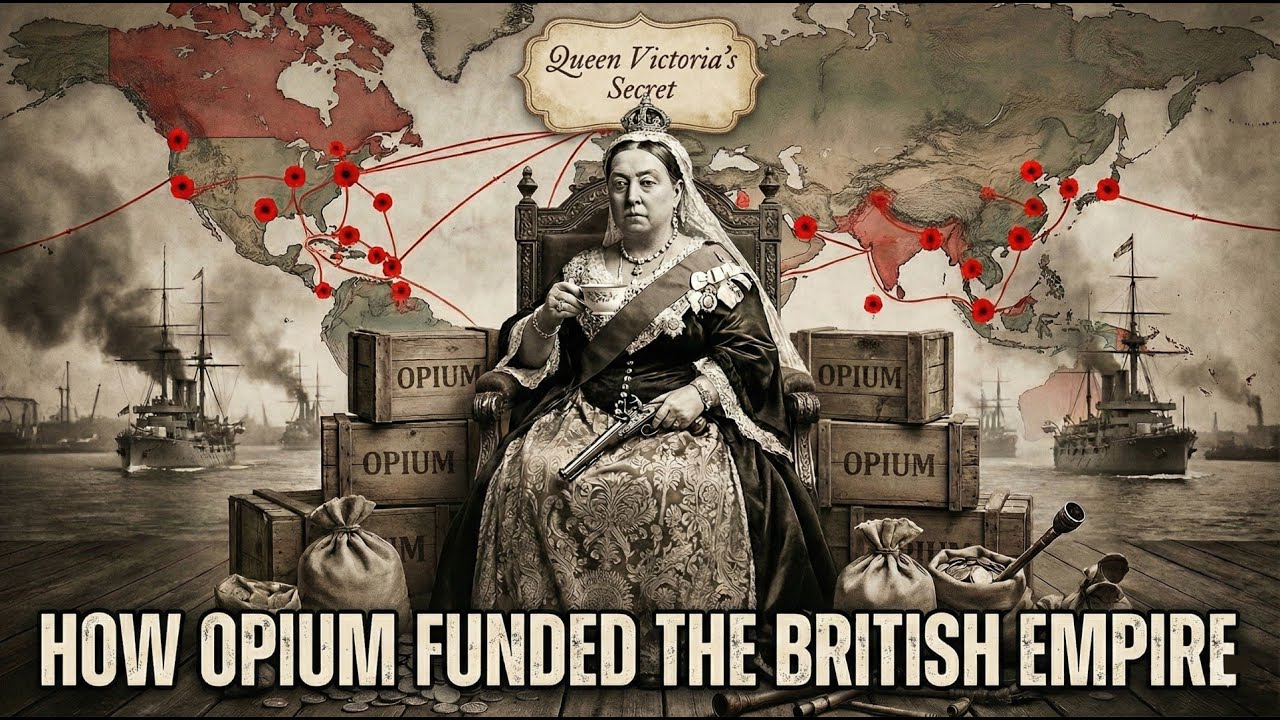
The conflict that followed, known as the First Opium War, is one of the most consequential and least comfortable chapters in British imperial history. It began with an economic crisis and ended with the cession of Hong Kong and the payment of a ruinous indemnity that included compensation for the very opium China had seized and destroyed. To understand how a monarchy that styled itself as the height of civilization came to wage war on behalf of drug traffickers, it is necessary to trace the financial pressures of the early 19th century. Britain had developed a seemingly unquenchable appetite for Chinese tea.
The government depended heavily on tax revenue from tea imports, and the beverage had become central to daily life across the country, fueling the long working hours of the industrial age. But there was a fundamental problem at the heart of this trade. The Qing Empire, which produced the tea, had little interest in British manufactured goods. Chinese officials did not want British wool or mechanical clocks.
The emperor and his merchants demanded payment in silver. For decades, vast quantities of silver bullion flowed from Britain to Canton, draining the country’s reserves and destabilizing its currency. Faced with a hemorrhage of its wealth, the East India Company sought a product that China could not refuse. It found one in opium.
Although the sale of opium was strictly prohibited in China, and the penalty for trafficking was death, the Company decided to organize the trade on an industrial scale. In the Bengal region of India, the colonial administration forced local farmers to grow poppies instead of food crops. Processing factories at places such as Patna and Ghazipur produced standardized cakes of opium, stamped with the Company’s official seal. To maintain a degree of legal distance, the East India Company did not sail the ships to China itself.
Instead, it sold the opium at public auctions in Calcutta to private merchants. These traders, such as the Scottish physician turned merchant William Jardine and his partner James Matheson, then smuggled the drug into China aboard heavily armed clipper ships. They anchored off the coast, established distribution networks with the help of bribed officials and local gangs, and brought silver flooding back into British banks. By 1838, British merchants were smuggling an estimated 40,000 chests of opium a year into China.
The effects on Chinese society were devastating. Reports from Chinese officials described villages where men had stopped working, soldiers selling their weapons to buy the drug, and a bureaucracy paralyzed by addiction. The outflow of silver caused inflation, poverty, and unrest that threatened the stability of the Qing Empire. In a desperate attempt to save his state, the Qing emperor appointed Lin Zexu, a scholar and official known for his integrity, as imperial commissioner with a mandate to eliminate the opium trade.
Lin arrived in Canton in March 1839 and moved quickly. He arrested thousands of Chinese dealers, forced tens of thousands of addicts into rehabilitation programs, and then turned his attention to the foreign merchants who operated in the walled enclave known as the Thirteen Factories. Lin ordered the merchants to surrender every ounce of opium in their possession and to sign bonds promising never to traffic in the drug again. When they hesitated, he surrounded the foreign quarter with troops, cut off food and water, and ordered his men to beat drums and gongs day and night to deny the merchants sleep.
Trapped and fearing for the lives of his countrymen, Captain Charles Elliot, the British superintendent of trade, ordered the merchants to comply and pledged that the British government would compensate them. Lin seized more than 20,000 chests of opium. He did not sell the captured stock. He ordered the drug destroyed.
Workers dug three large trenches on the beach, crushed the opium balls, and mixed them with lime, salt, and water. The chemical reaction produced a boiling, toxic sludge that was washed out to sea at low tide. The destruction took 23 days. During that time, Lin composed a letter to Queen Victoria.
He asked how a nation that strictly forbade opium smoking within its own borders could bear to export the poison to other lands. He appealed to her sense of justice and wrote as a man of conscience to a monarch he hoped shared his values. The letter was never answered and likely was never seen by the Queen. In London, the destruction of the opium was not treated as a legitimate act of law enforcement.
It was described as the theft of British property. William Jardine traveled to London and lobbied government officials, including Foreign Secretary Lord Palmerston. He argued that China had insulted the British flag and violated the principles of free trade. He described the Chinese military as weak and promised that a modern naval force could force the Qing Empire to submit within weeks.
The British government, financially strained and facing a bill for millions of dollars in compensation to its own merchants, chose war. In the summer of 1840, a British fleet sailed from India to China. The expedition included the Nemesis, the first oceangoing iron warship, powered by steam engines and capable of operating in shallow rivers where traditional warships could not go. Facing a Chinese navy of wooden junks armed with outdated cannon, the British forces strangled China’s coastal trade, bombarded forts, occupied key ports, and threatened the capital with starvation.
By the summer of 1842, the British fleet had reached Nanjing. Facing the threat of annihilation, the emperor capitulated. On August 29, 1842, Chinese officials boarded the HMS Cornwallis and signed the Treaty of Nanking, the first of what China later called the unequal treaties. China was forced to pay an indemnity of 21 million silver dollars, six million of which was specifically for the opium Lin Zexu had destroyed.
The treaty also opened five treaty ports to British residence and trade and ceded the island of Hong Kong to Britain in perpetuity. Lord Palmerston initially dismissed Hong Kong as a barren rock with not a house on it. The drug smugglers, however, understood its value. Under British protection, Hong Kong became the operational headquarters of the opium trade, a safe harbor where ships could dock and warehouses could be built without fear of Chinese authorities.
In the decades that followed, the opium trade expanded dramatically. By the 1880s, British merchants were selling over 6,000 tons of opium to China every year. Revenue from the trade supported the British administration in India and funded infrastructure, the civil service, and the navy. The peace and prosperity of the British Empire, its so-called Pax Britannica, was underwritten by the addiction of millions of Chinese people.
The psychological damage to China was profound. A civilization that had long seen itself as the center of the world was brought low by a nation shipping poison into its ports. The resulting trauma fed a period of internal chaos, civil war, and foreign domination that the Chinese came to call the century of humiliation. The men who orchestrated the trade did not face consequences.
William Jardine returned to England and was elected to Parliament. James Matheson became a baronet and one of the largest landowners in Britain. The company they founded, Jardine Matheson and Company, evolved into one of the great trading houses that built modern Hong Kong. Its legacy remains visible in the financial district, where buildings and streets still bear the names of the men who made their fortunes from the drug trade.
By the early 20th century, Britain finally stopped exporting opium to China. The change came after years of moral campaigning by religious groups, but by then the trade was no longer essential to the empire’s finances, which had found other sources of revenue. The damage to China, however, was irreversible, and the memory of the Opium Wars remains a lasting source of distrust between East and West.