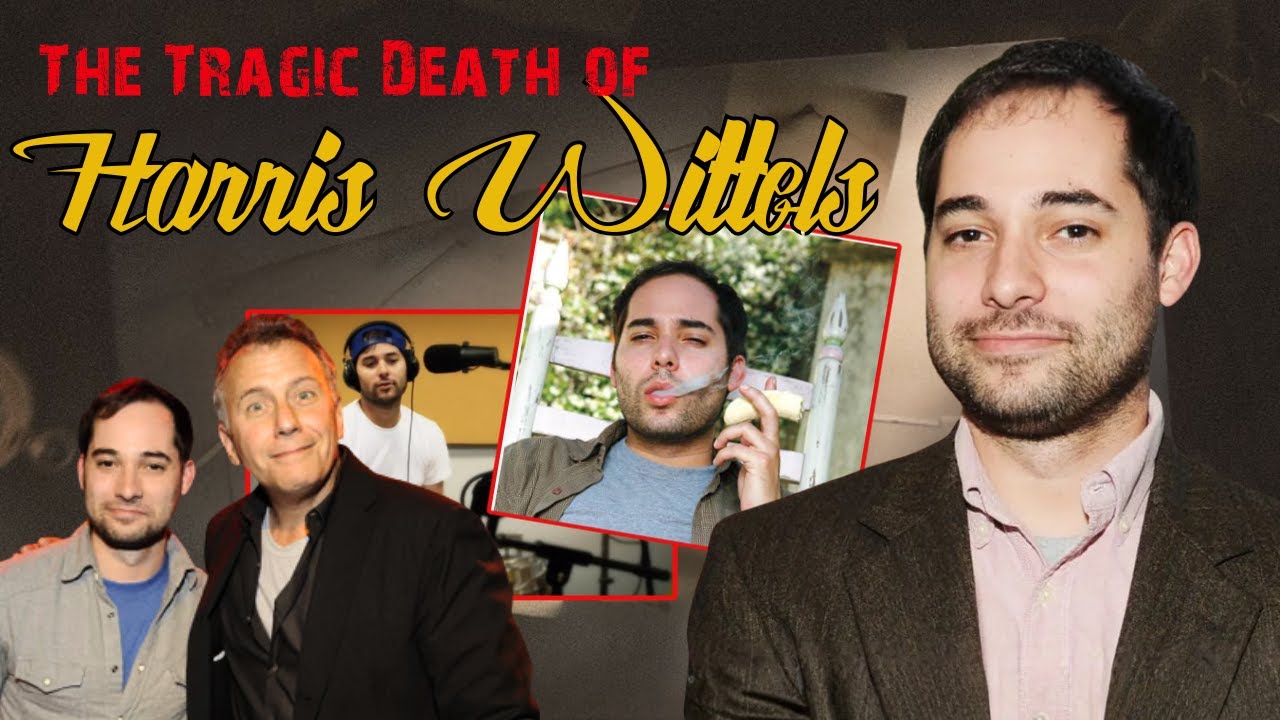
Harris Wittels was the comedian who coined the word “humblebrag,” the term used to describe a boast disguised as a complaint. He taught the world to see and name this social phenomenon, but he could not save himself from an addiction that began long before his career took off. At the age of 30, at the peak of his professional life, he died of an accidental heroin overdose in his Los Angeles home. Wittels was born on April 20, 1984, in Oklahoma City and raised in Houston, Texas.
He grew up in a loving, supportive Jewish family. His father was a respected physician, and his mother was devoted to him and his sister Stephanie. By all accounts, his childhood was warm and full of humor. There was no dramatic or troubled backstory.
Yet he later confessed that his drug use began at the astonishingly young age of 12. He attended Houston’s High School for the Performing and Visual Arts, a rigorous conservatory that trained him in collaboration, workshopping, and creative critique. He went on to Emerson College in Boston, where he studied television and video production. This practical technical training made him more than just a funny person.
He understood the mechanics of television production, editing, and structure. That combination of artistic absurdity and technical skill set him apart. After graduating in 2006, he moved to Los Angeles to begin performing standup. He quickly found his place at the UCB Theatre, the heart of the alternative comedy movement.
His deadpan, low-energy style was unconventional. He often presented jokes using absurd graphs and charts, as if he were a visiting lecturer from a strange parallel universe. He was not performing for the audience so much as inviting them into a bizarre game he had invented. One night, Sarah Silverman was in the audience.
She was preparing “The Sarah Silverman Program” for Comedy Central and was looking for writers who spoke the same strange, high-concept language. She saw Wittels perform and hired him as a staff writer. He was 22 years old and barely out of college, and he had landed one of the most anticipated comedy writing jobs on television. From 2007 to 2010, he wrote for Silverman’s show and other high-profile projects, including the MTV Movie Awards.
He proved himself a versatile craftsman who could pitch a bizarre non sequitur for Silverman or write a clear, concise punchline for a mainstream presenter. In 2009, he joined the writing staff of “Parks and Recreation” for its second season. The show was a struggling mockumentary spin-off of the American version of “The Office. ” It had received mixed reviews in its first season and had not yet found its voice.
The writing room, run by Greg Daniels and Michael Schur, included rising comedic stars like Aziz Ansari, Alan Yang, and Chelsea Peretti. Wittels quickly became their secret weapon. He excelled at the weird. While other writers handled character, story, and emotional warmth, Wittels pitched the most absurd, unexpected, and hilarious jokes.
His influence was immediate. He was promoted from story editor to executive story editor, then to co-producer, and eventually co-executive producer. He co-wrote some of the show’s most beloved episodes, including “Media Blitz,” in which Adam Scott’s character Ben Wyatt has a complete nervous breakdown on live television, and “Road Trip,” a crucial episode in the show’s central Ben-Leslie romance. His most famous uncredited contribution was a gag in the episode “Farmers Market” involving a charred mouse found in a bag of chard at a local vendor stall.
It was a bizarre, simple, unforgettable image that became a perfect example of his humor. His influence was so great that the show’s creators wrote him into the series. He began appearing in recurring cameos as Harris, one of two hopelessly inept animal control workers, alongside Colton Dunn. His character, deadpan and slightly baffled by the world, was draped in an ever-present fish T-shirt.
This reflected his real-life obsession with the band Phish. Wittels was a superfan of Phish, seeing them perform live over 300 times, according to his mother. The band’s intricate, nerdy, and absurd music mirrored his comedic philosophy. It was not for everyone.
It rewarded the committed and the obsessive. In a comedy world defined by cynicism, his love for Phish was an act of pure earnestness. He was also a talented drummer and played in a comedy rock band called Don’t Stop or We’ll Die with his friends Paul Rust and Michael Cassidy. They wrote absurd, catchy songs with titles like “I Got a Perm for My Camping Trip” and “She’s Got Titties in Her Heart.
”
While his television career flourished, a second public-facing persona was taking shape in the world of podcasting. He became a regular on “Comedy Bang Bang,” hosted by Scott Aukerman. He was one of the few guests who was almost always invited to appear as himself. His role was that of the brilliant deadpan instigator who could derail the show in the best possible way.
On that podcast, he launched his most famous segment, Harris’ Phone Corner. He would read jokes, ideas, and observations typed into his phone. The catch was that they were almost universally terrible, half-formed, nonsensical, and misspelled. The genius was not in the jokes but in the performance of the badness.
In an industry obsessed with perfection, Wittels had the courage to present his failures and misfires as the entertainment itself. He was deconstructing the creative process in real time. The true joy of the segment was the sound of his friendship with Aukerman, the two of them laughing until they cried. When he lost his phone, or simply grew tired of the bit, the segment was rebranded Harris’ Foam Corner.
He read the same terrible jokes off a large piece of Styrofoam. The absurdity of the commitment to the bit was the joke. His podcasting peak came with “Analyze Phish,” a show with a near-impossible premise. He tried to convince Scott Aukerman, a vocal Phish hater, to like the band.
On the surface, it was a joke. But underneath, it was one of the most honest and earnest explorations of male friendship ever recorded. It was about the universal human desire to share something you love with someone you love, that vulnerable plea to be understood. He willingly subjected the music that defined him to his friend’s relentless ridicule, all for the chance of a genuine connection.
He did not make Aukerman a fan, but he got him to listen and to understand. He also co-hosted the chaotic “Farts and Procreation” podcast with Adam Scott and Chelsea Peretti. It was a “Parks and Recreation” rewatch show that almost never discussed the show itself. It was the sound of late-night hangouts between friends at the peak of their chemistry.
It was around this time that Wittels turned his cultural eye to social media. In 2010, he noticed the rise of a new, uniquely obnoxious form of posting. It was a brag disguised as a complaint, a boast wrapped in false modesty. He started a Twitter account called @Humblebrag to document what he saw.
Celebrities posted things like, “It’s so annoying when you’re on vacation and you get a text saying your film just got greenlit” and “Just woke up to 5,000 new followers. I just can’t keep up. So blessed. ”
The concept was explosive.
He had named a specific, hilarious, and toxic behavior of the modern age. In 2011, the American Dialect Society named “humblebrag” the most useful new word of the year. A book, “Humblebrag: The Art of False Modesty,” followed in 2012. He had literally changed the English language.
By every external measure, Wittels was a spectacular success. He was a co-executive producer of a hit show. He was a published author. He was a podcast star.
He was a musician. And he was a heroin addict. This was not a fall from grace. This was a man fighting for his life while he was winning.
The addiction was not a late-stage development. It was a co-pilot. He later revealed that he wrote the entire “Humblebrag” book, the project that cemented his status as a cultural critic, while high on oxycodone. He started with prescription pills.
Oxycodone was a common and respectable entry point. It was medicine. But the pressure on him was immense. He was a co-executive producer on a major network sitcom, a management-level job that required sharp focus and relentless creative output.
He was also writing for other shows, performing in his band, and doing standup. He was living two completely irreconcilable lives. He also spoke of a devastating breakup. He had been dating a woman he described as perfect, someone he truly loved.
He then discovered that she and her family were devout Scientologists. For Wittels, with his skeptical, analytical mind, this was a chasm he could not cross. The emotional fallout, combined with the professional pressure, was a catastrophic trigger. As his tolerance built, pills became too expensive and too hard to find.
He made the common and fatal jump to heroin, which was cheaper, more potent, and more dangerously unpredictable. His friends, colleagues, and family saw signs but not the whole picture. They saw exhaustion and a pale complexion, and they attributed it to his punishing schedule. He became a master of deceit, not out of malice, but out of the desperate need to protect his addiction.
He had been to rehab and had relapsed. He had gone to a second facility. His private war was a grueling cycle of recovery and shame-filled relapse. On November 19, 2014, Wittels appeared on the podcast “You Made It Weird” with Pete Holmes.
It was an intimate, deeply personal show where comedians talk for hours about their anxieties, beliefs, and flaws. For over two hours, Wittels laid everything bare. He confirmed his friends’ worst fears. He talked about his escalation from pills to heroin, the lying, the hiding of needles, the constant fear of withdrawal, and the crushing shame.
He told a story of being so desperate that he had to call a drug dealer from the “Parks and Recreation” writers room, terrified that his friend and boss Michael Schur would find out. At the time of the recording, he was one month sober. He sounded hopeful and clear-eyed. He sounded like a man who had been to hell and was grateful to be back.
The episode was a bombshell. In one conversation, Wittels had become the new public face of opiate addiction. A successful, intelligent, beloved, and deeply ill person. The outpouring of love and support was immediate and immense.
In the months that followed, he seemed to be doing well. He was about to start a new, exciting chapter. Aziz Ansari was creating a new show for Netflix, “Master of None,” and Wittels was brought on as a writer and co-executive producer. He was planning to move to New York.
He was sober and supported. He had survived. That was the narrative. On February 11, 2015, Wittels gathered with Adam Scott and Chelsea Peretti to record what would be the final episode of “Farts and Procreation.
” The tape is a perfect time capsule. It is not the sound of a man in crisis. It is the sound of three best friends making each other laugh until they were breathless. It was the sound of Harris, happy and alive.
One week later, on the night of February 18, he did a stand-up set at The Meltdown, a comedy show held in the back of a comic book store in Los Angeles. He talked openly about his sobriety and told the crowd he was in a good place. He finished his set and went home. The next day, February 19, 2015, Harris Wittels was found dead in his home in the Los Feliz neighborhood of Los Angeles.
He was 30 years old. The cause of death was an accidental heroin overdose. The news shattered the comedy world. Tributes poured in from everyone he had ever touched.
Sarah Silverman called him “my baby. ” Aziz Ansari was devastated. Amy Poehler released a statement that read: “I lost a friend. I lost a great comedy mind.
I’m so sad. ”
The shock was deeper than the sadness of a premature death. Wittels was supposed to be the one who made it. He had done all the right things.
He had been to rehab twice. He had been courageous and honest on “You Made It Weird. ” He had a support system most people could only dream of. He had talent, wealth, and access to the best care.
And the disease still won. His death was a brutal lesson that addiction is not a moral failing or a weakness of character. It is a cunning and powerful illness that can take the best and brightest. The timing of his death was almost poetically cruel.
Five days later, on February 24, 2015, the series finale of “Parks and Recreation” was set to air. After the final credits, the screen faded to black, and a simple handwritten message appeared: “We love you, Harris. ”
When “Master of None” premiered later that year, the entire first season was dedicated to his memory. He received a posthumous Emmy nomination for his work on the show.
His friends also had to decide what to do with the digital ghosts he left behind. Scott Aukerman released a small backlog of unreleased Harris’ Foam Corner bits as a tribute. It was a final silly gift, a way for fans to hear that infectious laugh one last time. The final unreleased episode of “Farts and Procreation,” recorded just a week before his death, was a bigger dilemma.
Aukerman hesitated to release it, worrying it would be too dark. It was Chelsea Peretti who insisted. She told him that everything Harris says is funny, and that his fans deserved to hear him laughing one last time. Aukerman listened to the tape and realized it did not make him sad.
It made him laugh. He released the episode. For one last hour, fans around the world got to hear Wittels as he truly was: happy, playful, brilliant, and surrounded by people who adored him. His sister Stephanie Wittels Wachs, a writer and artist, channeled her pain into a purpose.
She wrote a 2018 memoir titled “Everything Is Horrible and Wonderful,” a line that Harris himself had texted to her. The book became one of the most powerful accounts of a family’s struggle with the opioid crisis. It is not a celebrity memoir. It is a raw, honest look at the messy nature of addiction, the circular logic of the rehab industry, the shame, the secrecy, and the unconditional love.
Using Harris’ inheritance, his family did not build a somber statue. They built a stage. In 2017, Stephanie co-founded Rec Room, a nonprofit performance and art space in Houston. It was designed as a community hub for local creators, actors, and comedians to experiment and grow, much like the UCB Theatre where Harris had found his voice.
The family also established the Harris Wittels Scholarship Fund at his alma mater to provide financial support for young high school students pursuing the arts. Harris Wittels’ story matters because it is a perfect, heartbreaking microcosm of a larger ongoing tragedy. He had every advantage. He had a loving family, a community of adoring friends, a dream career, and access to the best medical care.
And the disease still won. But his life was not defined by his death. His legacy is the word “humblebrag,” which changed the English language. It is in every episode of “Parks and Recreation,” in his absurd jokes, and in the hours of podcast recordings he left behind.
His sister captured the paradox of his life in the title of her memoir. The horrible is his loss. The wonderful was him.